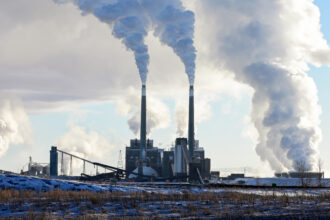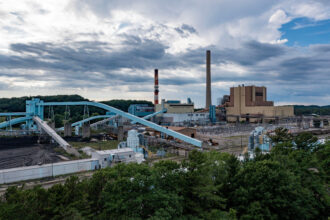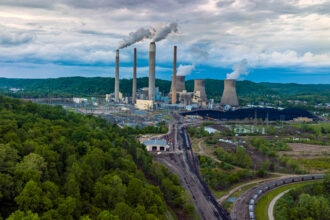


SEATTLE—The last coal-fired power plant in Washington state was set to go cold at the end of the year. It would then switch to natural gas, cutting carbon emissions in half.
The shutdown had been in the works for 15 years and was mandated by state law. It required the Canadian energy company that owns the power plant, TransAlta, to retrain workers and ease the local community’s economic transition.
But the farewell to coal was cancelled this week by the Trump administration. In furtherance of the president’s crusade to keep America’s coal plants burning, the Department of Energy announced Tuesday that an “emergency exists” in the Pacific Northwest “due to a shortage of electricity.” To keep the lights on, Energy Secretary Chris Wright said that the Centralia electric generating facility in southwest Washington must continue to burn coal for at least 90 more days.
“Issuance of this order will meet the emergency and serve the public interest,” said Wright, who issued a similar order last summer that blocked the planned retirement of an aging coal-fired plant in Michigan.
There is, however, no imminent shortage of electricity in Washington state or across the Pacific Northwest, according to state officials and regional energy experts.
“Let’s be clear: there’s no emergency here,” said a joint statement by Washington Gov. Bob Ferguson, along with the state’s attorney general and ecology director. “The Trump administration has conveniently ignored the law and the facts. The TransAlta power plant is days away from completing its shutdown—a milestone the company and the state have been working toward since 2011. The workers have moved on. There’s no coal left to burn.”
The governor’s office and local environmental groups said they were examining the Trump administration order and may fight it in court. TransAlta said in a statement that it is “evaluating” the federal order but remains committed to a coal-to-gas conversion at the Centralia plant.
The year-end emergency that does exist in Washington state has been caused by record-setting rainfall and widespread flooding. (President Donald Trump has declared a federal emergency and authorized disaster assistance.) Thousands of people have been displaced and damage to major highways will take months to repair.
“It is so ironic, when we have a real emergency, that they picked this time to fabricate an energy emergency,” said KC Golden, a member of the Northwest Power and Conservation Council, an interstate agency created by Congress to ensure reliable power while protecting the environment.
While there is no emergency electricity shortfall in the Pacific Northwest, the region, like much of the United States, does have a serious and worsening long-term electricity supply problem.
Washington and Oregon are home to about 100 data centers. Oregon is second only to Virginia in data center capacity, and the centers consume 11 percent of Oregon’s power supply, nearly three times the national average, according to the Sightline Institute, a Seattle think tank.
Energy use is rising along with the region’s booming high-tech economy, its outsized appetite for electric cars (The Seattle Times reported that 26 percent of new cars registered in Washington in October were EVs) and the climate-change-driven growth of home air-conditioning. The Northwest could face a 9 gigawatt shortfall of power by 2030, according to a recent utility-funded report by the energy consulting group E3. Nine gigawatts is roughly the electricity load of Oregon.
“We are facing a real energy supply challenge and we have been slow to take up that challenge,” said Golden, who represents Washington state on the Northwest power council.
The Pacific Northwest gets more of its power from hydroelectric dams than any other part of the country (60 percent in Washington), and the region has long been blessed with cheap electricity rates. But drought and changing weather patterns (less snow, more rain) have hammered the reliability of the system, which draws most of its power from big federal dams on the Columbia River, North America’s largest hydroelectric resource.
Grand Coulee Dam, the largest electricity producer in the United States, last year generated about half as much power as it did in 2012, according to the U.S. Energy Information Administration. Power production in the Northwest and across the West fell to a 22-year low in 2022-23, largely because of a years-long drought.
This story is funded by readers like you.
Our nonprofit newsroom provides award-winning climate coverage free of charge and advertising. We rely on donations from readers like you to keep going. Please donate now to support our work.
Donate NowMaking matters worse, the Bonneville Power Administration, a federal agency that sells electricity from Columbia River dams and operates a high-voltage transmission system, has been exceedingly slow to connect new sources of power—wind and solar—to the grid. An investigation this year by ProPublica and Oregon Public Broadcasting found that of 469 large renewable projects that applied to connect to Bonneville’s system since 2015, one was approved. Bonneville has said it is working to speed up the process. ProPublica also found that Oregon and Washington—while promising to eliminate fossil fuels from the grid—trailed most states in connecting large solar and wind projects.
“It takes too long to build new transmission,” said Lauren McCloy, utility and regulatory director of the NW Energy Coalition, an alliance of environmental groups, local utilities and local government agencies. “But we are all working on it.”
McCloy said that the entire Pacific Northwest is trying “to focus on how we can meet our clean energy goals and keep the lights on.” She added that in all the meetings she has attended in recent years, “I haven’t heard anyone in this region point to the [Centralia] coal plant as a solution to this challenge.”
Washington state codified its intention to move away from fossil fuels in 2019. The law mandates the closure this year of all coal-fired plants. It also requires carbon-neutral power production by 2030 and an electricity supply system that is free of greenhouse gas emissions by 2045. Mushrooming power demands of data centers, combined with halting integration of wind and solar into the grid, have raised questions about the state’s ability to enforce its law.
About This Story
Perhaps you noticed: This story, like all the news we publish, is free to read. That’s because Inside Climate News is a 501c3 nonprofit organization. We do not charge a subscription fee, lock our news behind a paywall, or clutter our website with ads. We make our news on climate and the environment freely available to you and anyone who wants it.
That’s not all. We also share our news for free with scores of other media organizations around the country. Many of them can’t afford to do environmental journalism of their own. We’ve built bureaus from coast to coast to report local stories, collaborate with local newsrooms and co-publish articles so that this vital work is shared as widely as possible.
Two of us launched ICN in 2007. Six years later we earned a Pulitzer Prize for National Reporting, and now we run the oldest and largest dedicated climate newsroom in the nation. We tell the story in all its complexity. We hold polluters accountable. We expose environmental injustice. We debunk misinformation. We scrutinize solutions and inspire action.
Donations from readers like you fund every aspect of what we do. If you don’t already, will you support our ongoing work, our reporting on the biggest crisis facing our planet, and help us reach even more readers in more places?
Please take a moment to make a tax-deductible donation. Every one of them makes a difference.
Thank you,