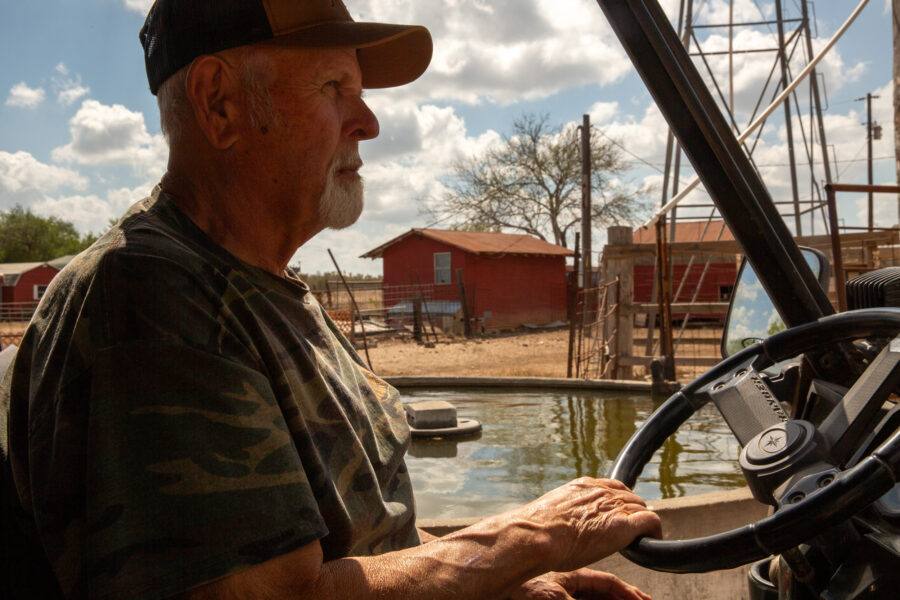


WALNUT COVE, N.C.—Tim and Deborah Mabe gazed off their back deck and into a deep cleft where Town Fork Creek flows through their land and on to the Dan River. The creek where 60 years ago Tim’s younger sister floated in a washtub a quarter-mile downstream before he and his twin brother nabbed her.
Tim grew up here, playing in the woods and fields that have been in the family for generations. He made his living as a dentist, but he can build and fix anything. He saved an historic barn built by enslaved people on the nearby Hairston Plantation, then disassembled and reconstructed it next to the couple’s house.
Tim and Deborah, a retired accountant for US Airways, live in a house built 42 years ago in four days by seven men with 73 logs salvaged from the R.J. Reynolds tobacco warehouse in downtown Winston-Salem.
Now in their 70s, the couple have been married 36 years and seem to spend most of their time laughing. “That’s where Deborah feeds the deer,” Tim said, as they rode in a golf cart through the fields fringed with forest. “They’ve gotten so fat they can’t jump.”
The spring peepers began to sing below the trees.
“It’s so peaceful,” Deborah said. “We come back here every night.”
That peace is in jeopardy. By a 3-2 vote, the Stokes County Commissioners in January overruled the local planning board and approved a request by Engineered Land Solutions to rezone 1,844 acres, which will allow the company to construct a massive data center project. The property abuts or includes farms, homes and the burial grounds of Native American and enslaved people.
Now the Mabes and a dozen more property owners, as well as two environmental groups, 7 Directions of Service and CleanAIRE NC, are suing Stokes County. They allege the commission committed a slew of procedural, factual and legal errors, and are asking a judge to invalidate the rezoning.
“The commissioners thought we’re just a small town,” Tim Mabe said. “They thought they could tell us anything and we’d believe it.”
The commission approved the rezoning based, in part, “on false or materially incomplete premises” about job creation, tax revenue, noise and the protection of culturally sensitive areas,” according to the lawsuit.
When the commissioners voted for the data center rezoning, Engineered Land Solutions, which incorporated in December 2024, had not presented a detailed site plan, named a tenant, nor explained how the project would add 250 to 500 jobs and generate $20 million to $40 million a year in tax revenue for the county.
The commission allegedly failed to notify all of the affected landowners, court documents show. It also voted to allow data centers on a dozen other properties throughout the county. Those projects can now be built “by right,” and provided they adhere to the zoning ordinance, they don’t require public notice or a hearing.
“This lawsuit isn’t suggesting that the county should be anti-tech or anti-development,” said Anne Harvey David, attorney with the Southern Coalition for Social Justice. SCSJ is co-representing the plaintiffs with the Southern Environmental Law Center.
“But it must be done smartly, deliberately, equitably, according to law and with some attempt at foresight, not simply buying into the pie in the sky hype and grandiose speculation to fill the pockets of developers and tech investors, while the community of Walnut Cove, again, pays the cost.”
County Manager Jeff Sanborn told Inside Climate News that “we recognize that land-use decisions can have significant impacts on residents, and the County remains committed to transparency, public participation, and the fair administration of all zoning and planning processes. Stokes County will not comment on specific allegations contained in the complaint at this time, but will provide additional information when appropriate and permitted.”
Central to the data center controversy is David Couch, a wealthy and politically connected real estate mogul who lives in Guilford County. Two years ago he was embroiled in a controversial land use case in Summerfield, a small town in nearby Guilford County, where officials denied his application to build a mixed-use development on 1,000 acres.
Couch asked state lawmakers to de-annex the property, which would place it in an unincorporated area and unfetter him from Summerfield’s strict development standards.
When the House introduced a de-annexation bill—such legislation is common—it didn’t include Summerfield. However, the Senate added Summerfield to the bill a few months after Couch contributed $6,400 to Phil Berger, the Senate President Pro Temp and, at the time, the most powerful legislator in either chamber.
Now one of Couch’s companies, DFC Stokes, owns the three parcels where the data centers would be built. Yet the rezoning request, which Couch signed, listed four parcels, including acreage belonging to John Wayne Fulks.
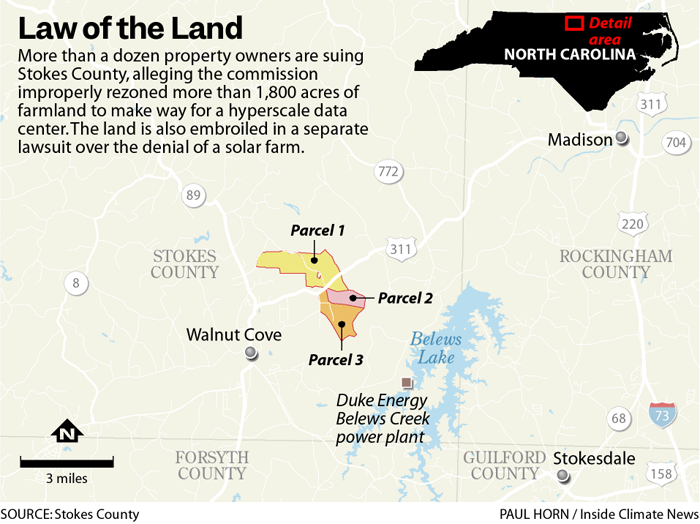
Because the commission didn’t independently verify DFC’s ownership claims, Fulks’ home of 14 years suddenly was zoned heavy industrial—without his permission. The county’s property database still lists Fulks’ property as residential-agricultural, but now his three acres is an island, surrounded by heavy industrial zoning.
Couch did not respond to phone calls seeking clarification on the error.
Through attorneys at the Southern Environmental Law Center, Fulk declined to comment on the case.
“It seemed that the commission was almost unaware of what it was doing” when it rezoned the land from residential-agricultural to heavy industry, Harvey David, the SCSJ attorney, said.
DFC Stokes originally proposed a 633-acre solar farm for the property. After the commissioners denied the project, the company sued Stokes County. The case is still being litigated.
“If we turn down a data center and a solar farm ends up on that property, it would be a tragedy,” said Stokes County Commissioner Rick Morris before the data center decision in January. “It would provide nothing but an ugly eyesore and no revenue. “
A Heated, Chaotic Commission Meeting
Betty’s Outdoors on N.C. Highway 89 in Walnut Cove sells fishing and hunting supplies, like bait buckets and blackpowder, as well as camping supplies. The shop is also the rare full-service gas station. Shortly after the lawsuit was announced in mid-March, a young man wearing camouflage and reflective sunglasses pulled up in his blue pickup truck and chatted with the person pumping his gas about the data center.
They were disgruntled with the commissioners who they felt had disregarded the strenuous opposition of their constituents.
“They passed it anyway,” the man said, shrugging, as he drove away.
Walnut Cove is a town of 1,500 people in southeastern Stokes County. The area has long been targeted by energy industries. Duke Energy has operated a nearby coal-fired power plant in Belews Creek, since 1974. The utility also plans to build at least one small modular nuclear reactor there.
Fracking interests have occasionally eyed this part of the county, which is undergirded by shale formations within the Dan River sub-basin. In 2015, county commissioners, all of them Republican, unanimously approved a three-year moratorium on the process, which uses horizontal drills and a chemical cocktail to fracture the rock and extract natural gas.
But that was 11 years ago, and a new commission is in charge.
At the January 2026 meeting, more than 100 people crammed into the commissioners’ chambers. A room on the third floor held an overflow crowd, and another 100 or so protested outside—so loudly that their chants could be heard over the livestream. One commissioner asked a sheriff’s deputy to quiet the crowd, but the protest continued.
On YouTube, the chat was filled with viewers’ withering criticisms of the commissioners:
“Who’s the tool who said this is a golden opportunity?”
“These people should not represent Stokes.”
“Vote them out.”
Drew Nations, CEO of Engineered Land Solutions, told commissioners the data centers would create 250 to 500 well-paying jobs. The project would not take water from the Dan River for cooling the computers, but rather use water sourced elsewhere and recycle it in a closed loop system, he said.
The noise level would not exceed 70 decibels, about the volume of a dishwasher, Nations said, albeit one that is constantly running. Seventy decibels is also the maximum safe noise level, averaged over a 24-hour period, according to the U.S. Environmental Protection Agency.
This story is funded by readers like you.
Our nonprofit newsroom provides award-winning climate coverage free of charge and advertising. We rely on donations from readers like you to keep going. Please donate now to support our work.
Donate NowUntil it becomes feasible to connect to the Duke Energy grid, the data centers would be powered by onsite generators, likely fueled by natural gas, releasing methane, carbon dioxide and other harmful air pollutants.
After nearly three hours, the commissioners explained how they planned to vote. “I wasn’t crazy about one coming to Stokes,” Keith Wood said. “But while I was praying about this one morning my wife had Fox News on and Charles Payne”—of Fox Business News—”came on and made a comment that ‘any city or county who refuses to commit to a data center is committing economic suicide.’”
“And I said, ‘I’m in.’”
A Forever Home and an Eternal Resting Place
Rachel Dillon and her adult son, Bryce, live on Tuttle Road with three German shepherds and a house full of plants. Rachel bought the 10-acre property a decade ago with the life insurance money left by her older son, Matthew, who died unexpectedly. She grows hay to sell to local cattle farmers.
Rachel likes to sit outside at night and look at the stars. She can hear coyotes in the distance and see raccoons and deer cut through her field. This is Rachel’s forever home, which she plans to leave to Bryce so he can raise his family here.
Rachel and Bryce are plaintiffs in the lawsuit against the county. Their property adjoins that of the data center, separated only by a threadbare tree line.
“We just built a back porch,” Bryce said, “so we can look at a data center.”
The Dillons say neither the developers or the commissioners will have to live with the consequences of their decision. Nations, CEO of Engineered Land Solutions, lives in Charlotte. None of the commissioners live in Walnut Cove.
From the Dillons’ front yard, they can see a solar farm being built across Tuttle Road on property owned by a New Bern company. They’re watching the transformation of land all around them.
“Once farmland is gone it’s gone,” Rachel said. “They’re going to destroy all that for pure greed.”
Nations has promised not to build on the 900 acres of floodplain near the Dan River, where archaeologists have found Native American burial grounds. The data center property also contains parts of Upper Sauratown, a village where Saura Indians lived beginning in the fifteenth century.
In 1972, a teenage boy found a young native woman buried near the Dan River. She became known as Sauratown Woman, and forensic scientists estimated that she was 18 to 21 years old when she died, likely in the early 1700s.
“For my people, this is not simply an archeological discovery,” said Crystal Cavalier-Keck, a member of the Occaneechi-Saponi tribe and the executive director of 7 Directions of Service, a plaintiff in the lawsuit. “This is the place of one of our ancestors. It is a resting place, and there are many burial mounds and graves along the river, but her burial reminds us that these lands along the Dan River Corridor are not empty land waiting for development.”
Sauratown Woman was laid to rest with whelk shells that are often found in the Dan River, bracelets and a brass pendant adorned with hundreds of glass trade beads and brass bells, as well as scissors and a spoon. “These objects tell a story of a people who are still deeply rooted in their traditions, while also encountering new trade networks and new pressures brought by colonization, Cavalier-Keck said, “and that reflected her changing world that her people have been living in.”
About This Story
Perhaps you noticed: This story, like all the news we publish, is free to read. That’s because Inside Climate News is a 501c3 nonprofit organization. We do not charge a subscription fee, lock our news behind a paywall, or clutter our website with ads. We make our news on climate and the environment freely available to you and anyone who wants it.
That’s not all. We also share our news for free with scores of other media organizations around the country. Many of them can’t afford to do environmental journalism of their own. We’ve built bureaus from coast to coast to report local stories, collaborate with local newsrooms and co-publish articles so that this vital work is shared as widely as possible.
Two of us launched ICN in 2007. Six years later we earned a Pulitzer Prize for National Reporting, and now we run the oldest and largest dedicated climate newsroom in the nation. We tell the story in all its complexity. We hold polluters accountable. We expose environmental injustice. We debunk misinformation. We scrutinize solutions and inspire action.
Donations from readers like you fund every aspect of what we do. If you don’t already, will you support our ongoing work, our reporting on the biggest crisis facing our planet, and help us reach even more readers in more places?
Please take a moment to make a tax-deductible donation. Every one of them makes a difference.
Thank you,

Lisa Sorg
Reporter, North Carolina
Lisa Sorg is the North Carolina reporter for Inside Climate News. A journalist for 30 years, Sorg covers energy, climate environment and agriculture, as well as the social justice impacts of pollution and corporate malfeasance.
She has won dozens of awards for her news, public service and investigative reporting. In 2022, she received the Stokes Award from the National Press Foundation for her two-part story about the environmental damage from a former missile plant on a Black and Latinx neighborhood in Burlington. Sorg was previously an environmental investigative reporter at NC Newsline, a nonprofit media outlet based in Raleigh. She has also worked at alt-weeklies, dailies and magazines. Originally from rural Indiana, she lives in Durham, N.C.