

The Texas Commission on Environmental Quality on Friday approved an investigation report on Tesla’s battery-grade lithium compounds manufacturing facility near Robstown in Nueces County, finding no violation of the plant’s wastewater discharge permit.
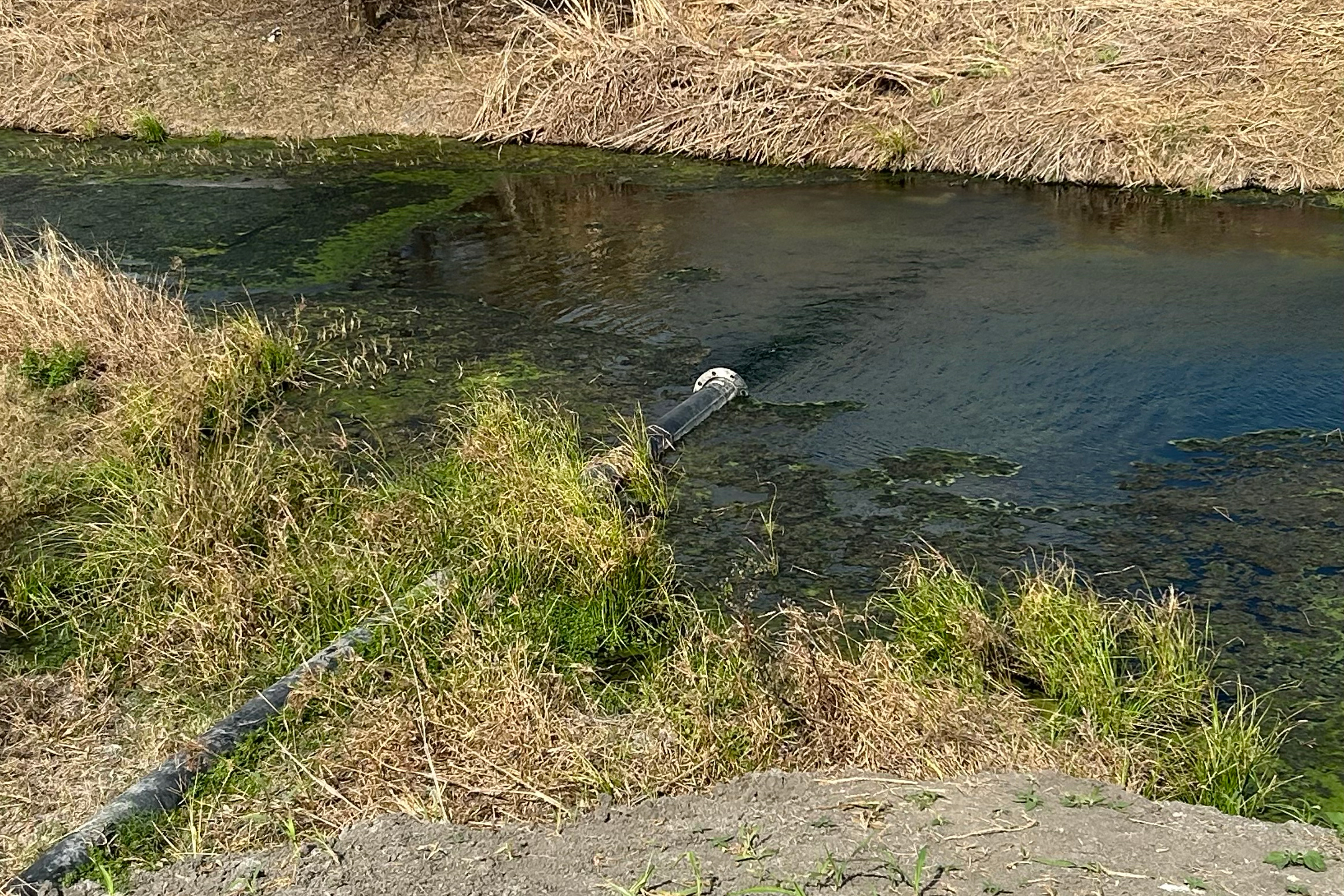
TCEQ began its investigation after workers for Nueces County Drainage District No. 2, which presides over the ditch area, found an unfamiliar pipe stretched across the district’s easement, expelling black liquid into the ditch. The workers filed two complaints with TCEQ on Jan. 20 and Feb. 9 about the quality of the wastewater discharged from the Tesla facility.
On February 12, a state investigator evaluated the ditch running alongside U.S. 77, west of Corpus Christi, and the liquid waste from the discharge pipe. The wastewater appeared clear as it flowed downstream, according to state records. Along the banks and in the ditch, there was a heavy growth of algae and vegetation.
The investigator then went to the Tesla facility and met with a senior environmental engineer and manager and collected samples from near the cooling towers and from the pipe leading to the ditch after the wastewater was treated. The lithium refinery plant is permitted to discharge cooling tower blowdown, water treatment wastes and boiler blowdown. Test results for dissolved solids, oil and grease, chlorides, sulfates, temperature and oxygen were all within the bounds of Tesla’s permit, according to the TCEQ investigation.
Steve Ray, a spokesperson for the drainage district, said the district has met with Tesla management three times concerning this situation.
“We appreciate the cooperation from Tesla, TCEQ and Nueces County and will continue to monitor the discharges as we work to keep drainage ditches in the area operational and safe for our workers and the citizens we serve,” Ray said on Wednesday.
While the electric vehicle company is permitted by TCEQ to dispose of up to 231,000 gallons of treated wastewater per day on average in the ditch, the Nueces County Drainage District wasn’t aware of the permit before its workers found the pipe discharging black liquid into the ditch.
The district workers were performing routine maintenance, clearing overgrown brush and fallen winter branches, when they first reported the black liquid.
“We told them not to do anything until we saw it,” Ray said. The industrial, dark, wastewater pooling in the county’s ditch came from Tesla’s lithium refinery plant across the way, Ray said, as first reported by KRIS 6 News, a local TV station.
The drainage district then set up a meeting with the electric vehicle company about the wastewater, Ray said.
The discharge permit was issued to Tesla in January 2025, according to TCEQ documents. The permit didn’t allow Tesla to use private or public property to transport the wastewater. Under the permit, it was Tesla’s responsibility to acquire whatever property rights were required to use the discharge route, the TCEQ permit states.
When asked if Tesla was authorized to construct a pipe to the unnamed ditch, the TCEQ repeated its permit rules. The wastewater compliance report does not include mention of Tesla’s use of the drainage district’s easement. The pipe is still there, Ray said.
TCEQ doesn’t communicate directly with local drainage districts as part of the permitting process, a spokesperson for the agency said.
For individual water quality permits, the TCEQ requires two public notices. Applicants, like Tesla, must publish them in local newspapers. TCEQ also makes notices available online for treated wastewater discharge applications received prior to June 1, 2024.
The wastewater permit also requires that there isn’t any significant discharge of floating solids or foam and no discharge of visible oil.
Tesla did not respond to questions from Inside Climate News about the wastewater disposal nor the use and construction of the pipe.
The electric vehicle company is run by the richest man in the world, Elon Musk, who resides and has multiple facilities in Texas for his various endeavors, including Tesla, SpaceX, X (formerly Twitter) and The Boring Company. Some of his companies have accrued TCEQ violations.
The nearly $1 billion lithium refinery plant in Robstown, Texas, aims to increase the domestic supply of battery-grade lithium hydroxide, a critical chemical compound for making rechargeable batteries, including those for electric vehicles, according to Tesla. The site, which started construction in May 2023, processes the lithium without using harsh acids, allowing for the refinery’s byproduct to be a mixture of sand and limestone, the company says.
Ray said that in a discussion between the drainage district and the company, Tesla continued to refer to its wastewater as clear. “It’s not clear at all,” Ray said. “It’s black.”
This story is funded by readers like you.
Our nonprofit newsroom provides award-winning climate coverage free of charge and advertising. We rely on donations from readers like you to keep going. Please donate now to support our work.
Donate NowTesla’s wastewater operations were set as an agenda item for the drainage district’s Jan. 27 public meeting. In a letter obtained by KRIS 6 News, a senior manager of the Tesla site said the company could not have a company representative there and wanted to understand any concerns.
Jason Bevan, the senior manager, said in the letter that Tesla is committed to being a good neighbor in the community. The company has partnered with local environmental groups, Bevan wrote, including the Coastal Bend Bays Foundation and The Harte Research Institute at Texas A&M University-Corpus Christi (HRI), the marine research institute working to advance long-term sustainable use and conservation of the Gulf.
The drainage ditch flows to Petronila Creek and ultimately to Baffin Bay. The saltwater bay is often called the “jewel” of the Texas coast and has supported longtime fishing in the area. But over four decades, the ecosystem’s health has deteriorated, according to HRI publications.
The Baffin Bay watershed in South Texas is increasingly vulnerable to flooding caused by intense rain and corresponding stormwater runoff, which carries pollutants that degrade water quality and threaten wildlife populations, stated the research institute.
Ensuring the quality of the area’s waterways and environment is a priority to the drainage district, Ray said. While the district looks to undergo its own water quality testing of the ditch, Ray is concerned about the sensitivity of the bay’s ecosystem. “I do want to have a clean environment for my children and grandchildren and great grandkids,” Ray said.
As Tesla is one of the first industrial clients the drainage district is dealing with in its rural area, there aren’t other examples of how large corporate clients transport its wastewater and notify the district, Ray said. But not seeking out permission to use its easement and build a pipe is not the precedent they’re looking to set. “They went across our easement without letting us know,” Ray said. “We need to be informed about it and we weren’t.”
Revelation of the pipe has put the district in an uncomfortable position. “It’s not that we are anti-industry; we’re very pro-industry,” Ray said. “This is not really directed at Tesla itself, this is directed simply at ensuring that our workers and the citizens that we serve have a clean environment.”
About This Story
Perhaps you noticed: This story, like all the news we publish, is free to read. That’s because Inside Climate News is a 501c3 nonprofit organization. We do not charge a subscription fee, lock our news behind a paywall, or clutter our website with ads. We make our news on climate and the environment freely available to you and anyone who wants it.
That’s not all. We also share our news for free with scores of other media organizations around the country. Many of them can’t afford to do environmental journalism of their own. We’ve built bureaus from coast to coast to report local stories, collaborate with local newsrooms and co-publish articles so that this vital work is shared as widely as possible.
Two of us launched ICN in 2007. Six years later we earned a Pulitzer Prize for National Reporting, and now we run the oldest and largest dedicated climate newsroom in the nation. We tell the story in all its complexity. We hold polluters accountable. We expose environmental injustice. We debunk misinformation. We scrutinize solutions and inspire action.
Donations from readers like you fund every aspect of what we do. If you don’t already, will you support our ongoing work, our reporting on the biggest crisis facing our planet, and help us reach even more readers in more places?
Please take a moment to make a tax-deductible donation. Every one of them makes a difference.
Thank you,

Arcelia Martin
Reporter, Texas Renewables
Arcelia Martin is an award-winning journalist at Inside Climate News. She covers renewable energy in Texas from her base in Dallas. Before joining ICN in 2025, Arcelia was a staff writer at The Dallas Morning News and at The Tennessean. Originally from San Diego, California, she’s a graduate of Gonzaga University and Columbia University Graduate School of Journalism.