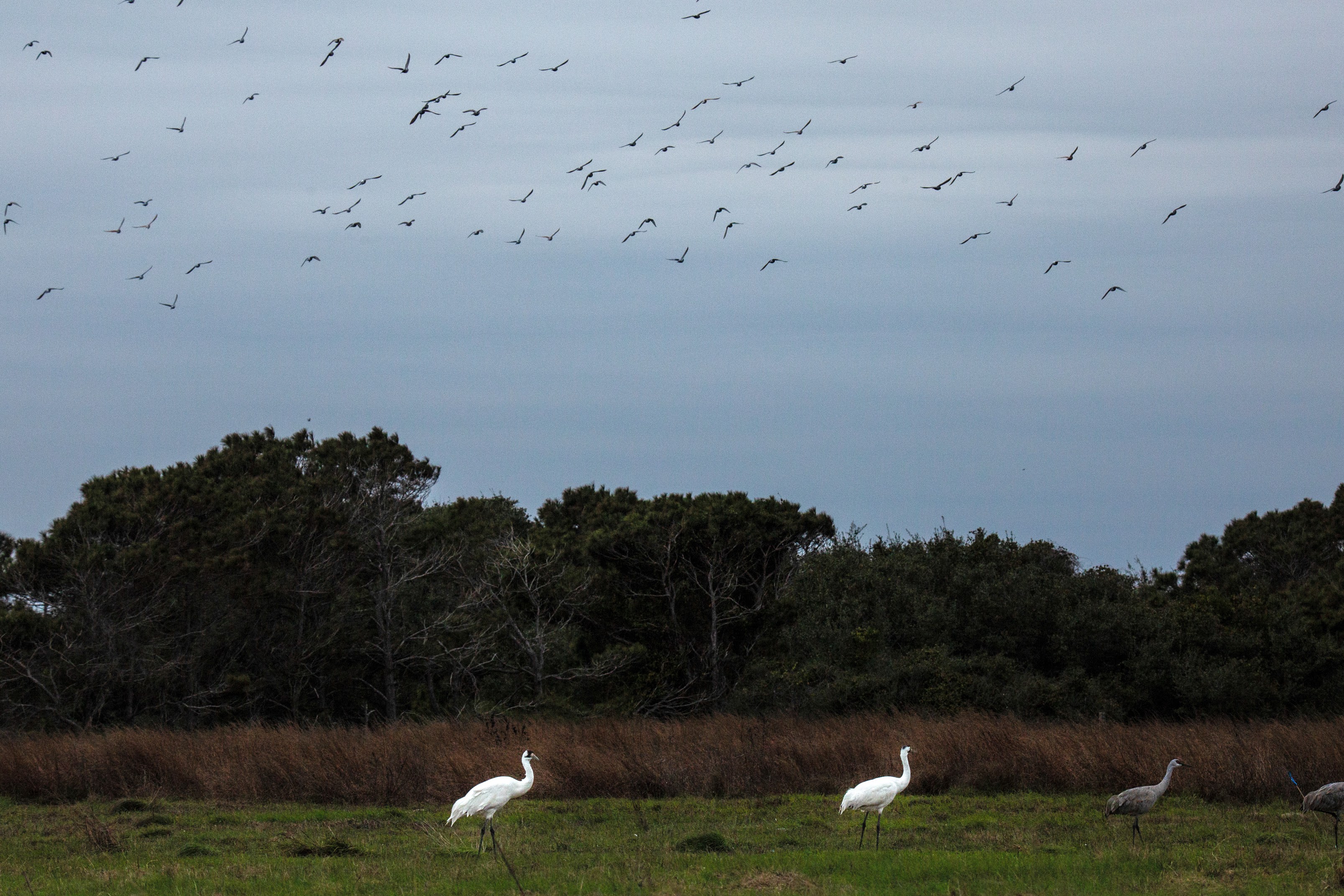


On an isolated stretch of Texas coastline, conservation groups have acquired more than 3,000 acres of nearly pristine prairie to preserve as habitat for endangered whooping cranes, one of the rarest birds in North America.
Groups this month announced the $8 million purchase of two tracts in rural Calhoun County, halfway between Houston and Corpus Christi, among the last substantial pockets of unplowed acreage along the Texas coast and the winter grounds for the world’s last wild flock of whooping cranes.
“Large, intact coastal landscapes are disappearing fast, and protecting this one is a major win,” said Julie Shackelford, Texas state director at The Conservation Fund, which bought the 2,200-acre Costa Grande Ranch. Less than five percent of Texas’ native coastal prairie remains, she said.
The purchase of another, 1,100-acre coastal property by the International Crane Foundation marked that groups’ first such land acquisition since it was founded in 1973 to nurse the dwindling whooping crane population back from the brink of extinction.
Five-feet-tall, monogamous and known for elaborate dances, barely two dozen of these birds remained a century ago. Now almost 600 make up the last wild flock that still makes its ancient, annual migration between the Canadian taiga and the middle Gulf Coast of Texas, where only a smattering of protected areas offer them reliable habitat.
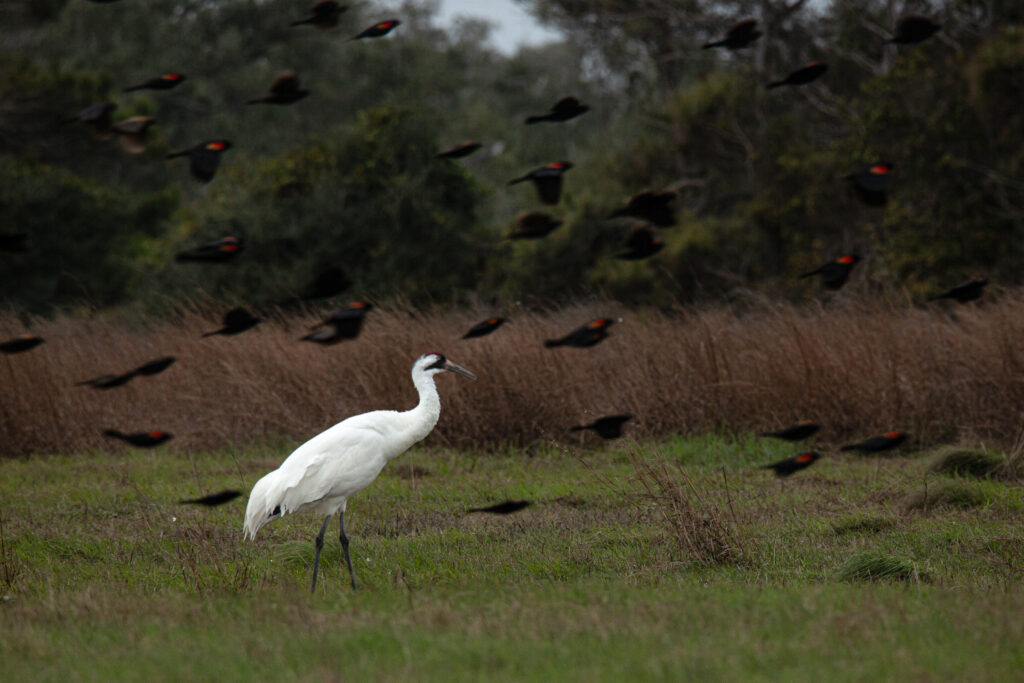
“As the populations have grown, they have expanded more and more off of those protected lands,” said Carter Crouch, director of Gulf Coast programs at the International Crane Foundation. “If we want to have a continually growing and recovering population we need to secure sufficient wintering habitat.”
This stretch of waterfront, far from major population centers, remains relatively unspoiled by the industrial and urban development that has overtaken much of the Texas coastline. Most of the best preserved savannah exist on enormous family ranches, crawling with antelope and alligators, that have been passed down and divided for generations.
Virtually no public access currently exists by land to the landscapes on this part of the coast, except for a federal wildlife refuge, although two major projects are planned here: a 2,300-acre Powderhorn Ranch State Park and a 6,400-acre Green Lake Park.
“There is a lot of focus on all kinds of different aspects of conserving those natural resources now, while we still can,” said James Dodson, founder of the San Antonio Bay Partnership. “There are a lot of proposed new industrial facilities and things.”
He recalls visiting the nearby federal wildlife refuge as a Cub Scout in the 1960s, when it was winter grounds for the last few whooping cranes alive. Birders would come from across the country and the world to see these rare and majestic specimens.
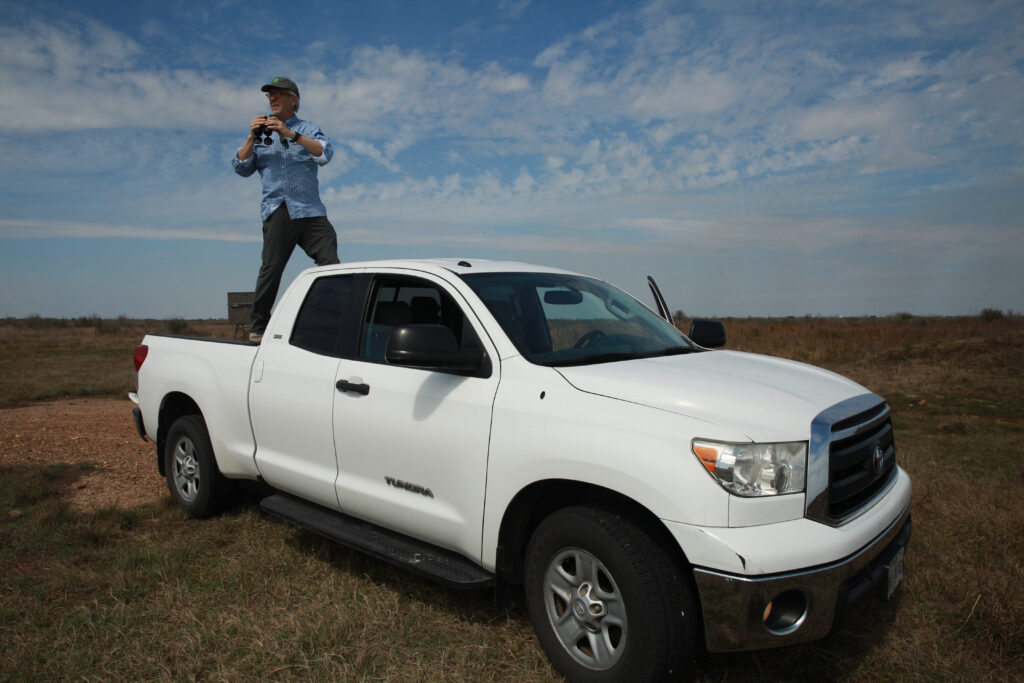
Later in life, Dodson, a former director of Corpus Christi’s water department, began working with the Crane Foundation on a project called Water for Wildlife, drilling wells and making ponds in the bush on private or government lands in the region to re-create the wetland habitats that whooping cranes and other animals here need.
Most of this area was once grazed by cattle, Dodson said. Dredging of a ship channel offshore altered the coastline. Thirsty upstream cities have dried up the rivers that used to spill their regular freshwater floods over all of this region.
But in general, it retains its natural shape and many of its old trees, as it was never cleared and flattened for agriculture.
“It has been relatively unspoiled,” Dodson said.
This story is funded by readers like you.
Our nonprofit newsroom provides award-winning climate coverage free of charge and advertising. We rely on donations from readers like you to keep going. Please donate now to support our work.
Donate NowThe Costa Grande Ranch, purchased by the Conservation Fund, will eventually be transferred to the Coastal Bend Bays and Estuaries Program, a robust regional organization that preserves a collection of ecologically sensitive tracts that may be developed for public access.
While the tall, dancing whooping cranes may capture most attention, these landscapes serve a multitude more species, according to Crouch at the Crane Foundation. Migratory routes connecting Canadian forests with Central American jungles converge along the Gulf Coast of Texas, forming one of the busiest flyways on the continent.
A multitude of fulltime native species here also face the constant pressure of habitat loss due to urban and industrial sprawl. Texas has led the country in population and economic growth during the last 20 years, fueled in large part by the petrochemical industries that continue to expand along its coast.
“The Texas coast is certainly under a lot of development threat,” Crouch said. “This part of the world gets an incredible amount of bird use, it’s incredibly important to these species.”
CORRECTION: This article has been updated after an earlier said the Powderhorn Ranch State Park would be 17,000 acres. The Powderhorn Ranch Wildlife Management area is 17,000 acres but the park will be 2,300 acres. The earlier version also said there is little public access to the coastal landscapes of Calhoun County. There is public access by watercraft.
About This Story
Perhaps you noticed: This story, like all the news we publish, is free to read. That’s because Inside Climate News is a 501c3 nonprofit organization. We do not charge a subscription fee, lock our news behind a paywall, or clutter our website with ads. We make our news on climate and the environment freely available to you and anyone who wants it.
That’s not all. We also share our news for free with scores of other media organizations around the country. Many of them can’t afford to do environmental journalism of their own. We’ve built bureaus from coast to coast to report local stories, collaborate with local newsrooms and co-publish articles so that this vital work is shared as widely as possible.
Two of us launched ICN in 2007. Six years later we earned a Pulitzer Prize for National Reporting, and now we run the oldest and largest dedicated climate newsroom in the nation. We tell the story in all its complexity. We hold polluters accountable. We expose environmental injustice. We debunk misinformation. We scrutinize solutions and inspire action.
Donations from readers like you fund every aspect of what we do. If you don’t already, will you support our ongoing work, our reporting on the biggest crisis facing our planet, and help us reach even more readers in more places?
Please take a moment to make a tax-deductible donation. Every one of them makes a difference.
Thank you,

Dylan Baddour
Reporter, Austin
Dylan Baddour covers the energy sector and environmental justice in Texas. Born in Houston, he’s worked the business desk at the Houston Chronicle, covered the U.S.-Mexico border for international outlets and reported for several years from Colombia for media like The Washington Post, BBC News and The Atlantic. He also spent two years investigating armed groups in Latin America for the global security department at Facebook before returning to Texas journalism. Baddour holds bachelor’s degrees in journalism and Latin American studies from the University of Texas at Austin. He has lived in Argentina, Kazakhstan and Colombia and speaks fluent Spanish.