

The Trump administration last week established a new firefighting agency to combine operations at the Department of the Interior under one entity.
But Congress isn’t cutting any ribbons.
The appropriations bill package approved by the Senate on Thursday doesn’t allocate any funding for the U.S. Wildland Fire Service, denying the administration’s request for $6.5 billion for a new agency. The snub is more targeted at the Trump administration’s broader vision to also fold into the agency fire operations from the U.S. Department of Agriculture’s Forest Service—a merger that has not yet happened and is unlikely without congressional approval, sources say.
“The bill does not endorse the consolidation of federal wildland firefighting into one agency as proposed in President Trump’s budget request,” reads a summary of the measure from Sen. Patty Murray (D-Wash.), the vice chair of the Senate Committee on Appropriations. “Instead, it specifically provides funding to continue wildland firefighting using the longstanding practice of funding both the U.S. Forest Service and the Department of the Interior to allow Congress to consider legislative proposals for such a major change.”
Even without the Forest Service included, the shift under Interior marks one of the most profound transformations in how the country manages wildfire. For months Congress has been signaling to the Trump administration that it should slow down its consolidation push.
But the Interior Department is still charging ahead, and may be able to access funding for the new agency through the $6.4 billion allocated by the new bill to Interior for wildland fire management activities. The bill awaits approval from President Donald Trump.
“Wildfire response depends on coordination, clarity and speed,” Brian Fennessy, the newly appointed chief of the Wildland Fire Service, said in a statement. “This initial planning effort is about bringing programs together, strengthening cooperation across the Department and building a framework that better supports firefighters and the communities they serve.”
Big Changes, Mixed Reviews: If this new agency rollout seems confusing, that’s because it is. In the U.S., wildland fire management is a complex system that stretches across multiple agencies, tribes, states and county fire management offices.
At the federal level, firefighters at Interior have been spread across the National Park Service, the Bureau of Land Management, the Fish and Wildlife Service and the Bureau of Indian Affairs. The bulk of firefighting personnel and funding for suppression, though, falls under the USDA’s Forest Service.
In June, Trump issued an executive order directing the Departments of the Interior and Agriculture to combine their wildland fire programs “to achieve the most efficient and effective use of wildland fire offices.” In September, the administration announced its plan to create the new Wildland Fire Service at Interior, without the Forest Service forces for now.
For a recently published deep dive on this initiative, I spent months talking with firefighters, former federal employees, scientists and other experts about how a consolidated wildland fire force might look and how they felt about it. Some were supportive of the push, which they believe could help firefighters facing increasingly destructive blazes. Others—including Congress—have reservations.
As part of the appropriations bill, Congress directed the agriculture secretary, in consultation with the interior secretary, to contract with an independent research organization to “conduct a comprehensive study on the feasibility” of consolidation between the departments’ fire operations.
Overhauling the country’s wildland fire operations is a behemoth task, and many experts worry these changes are coming at a breakneck pace, with far too little planning or resources. Some members of the firefighting community are concerned that the move could be a guise to cut yet more staff after widespread layoffs last year.
And environmental groups such as the Sierra Club and The Wilderness Society fear that the new service will overemphasize suppression to the detriment of ecological health. A federal mandate in the early 20th century to suppress virtually all fires as quickly as possible caused an overgrowth of forests that are now fueling some of the country’s most destructive blazes.
“The way we got into this crisis to begin with was over a century of wildfire suppression,” Josh Hicks, director of conservation campaigns at The Wilderness Society, told me last week after the launch. “Now it seems they’re setting up an agency to suppress wildfires, when really what we need is a more holistic approach that explores, ‘When do we need to put fires out? When can we get more fire back on the landscape?’”
Hicks and other fire experts have also questioned whether a new service is necessary, given the collaboration already in place between agencies through bodies such as the Idaho-based National Interagency Fire Center, which was established in 1965.
“This new agency is redundant, at the very least,” Hicks said. It’s “a bit of a solution looking for a problem.”
A Black Box: Firefighters have spent decades pressing for reforms to the federal wildland fire management system, which has seen stark levels of staff attrition in recent years due to mental-health challenges and low pay.
Many members of the wildland fire community are open to changes and were particularly encouraged by the appointment of Fennessy to lead the new service.
Fennessy served nearly eight years as the fire chief of the Orange County Fire Authority in California and previously spent more than a decade in the federal fire forces.
“I always thought it was a great concept,” Luke Minton, a wildland division chief in the Weber Fire District of Northern Utah, said of a combined agency. Minton has experience in fire operations with the Forest Service and various agencies in the Interior Department.
“There may be some pretty good opportunities here for local government and state government,” such as streamlining funding and reimbursements and implementing projects in high-risk areas, he said. But like others, Minton still has questions about what priorities the new service will set and how that will benefit the public and partners.
The news site Government Executive reports that an email sent by Fennessy to Interior staff said he would be issuing a “blueprint for our phased unification” in the coming weeks. The secretarial order that launched the agency last week outlined some of the transition plan for the new service, which will include streamlining the chain of command, standardizing pay, improving coordination and upholding the Interior Department’s “treaty and trust responsibilities to Tribes.”
As far as the congressional funding goes, Interior spokesperson Elizabeth Peace told Government Executive the department “is well within its authority to evaluate how its internal programs are organized and to take steps to improve coordination, efficiency, and operational effectiveness.”
She added: “No new funding is being obligated, and no structural changes requiring congressional authorization are being implemented at this stage.”
So far, Interior has posted at least one high-level job opening at the Wildland Fire Service, for a wildland fire officer.
Overall, though, details on how the new service will operate—and how many staff could be moved or laid off in the process—have been sparse. The Interior Department did not respond when Inside Climate News asked whether officials had started shifting fire-related employees to the new service, how it would allocate funding based on the new appropriations bill and whether the reorganization would involve staff cuts.
“This consolidation plan has occurred in a black box,” Tim Ingalsbee, a former federal firefighter, told me last week. He is the executive director of Firefighters United for Safety, Ethics and Ecology. “Everything they’ve done on this has been basically an unfunded mandate [by] Trump.”
More Top Climate News
In a world first, an international agreement to legally protect vast areas of the global ocean beyond countries’ national jurisdictions went into effect last week, Sachi Kitajima Mulkey reports for The New York Times. Known as the High Seas Treaty, it was ratified in September by dozens of countries, including Morocco, Sierra Leone and China. Notably absent from the list: the United States. The Trump administration has pushed for more deep-sea mining exploration, though the activity has not yet taken place in the high seas. If you want to learn more, my colleague Teresa Tomassoni recently spoke about the marine conservation effort with Nichola Clark, a senior officer at the Pew Charitable Trusts, who has spent the past 10 years leading the nonprofit’s advocacy work related to the treaty.
A new study suggests that Antarctic penguins are breeding earlier due to warming temperatures, which could have cascading consequences for certain populations, Seth Borenstein reports for The Associated Press. The research found that by 2022, three species of penguins in the region began their reproductive season two weeks earlier than in 2012. Scientists say these changes in breeding timing and other climate-fueled shifts in the animals’ food chain could trigger overcompetition—both between penguin species and with commercial fisheries.
The Trump administration recently issued new dietary guidelines that would nearly double the amount of protein Americans consume, which could lead to a jump in greenhouse gas emissions from the cattle industry, Oliver Milman reports for The Guardian. The agricultural sector is one of the largest contributors of climate-warming gases, and environmental groups have urged people to consume less meat and dairy to minimize their own carbon footprint. Now, Robert F. Kennedy Jr., the secretary of health and human services, is recommending the opposite, stating that “protein and healthy fats are essential and were wrongly discouraged in prior dietary guidelines.”
Postcard from … Iowa
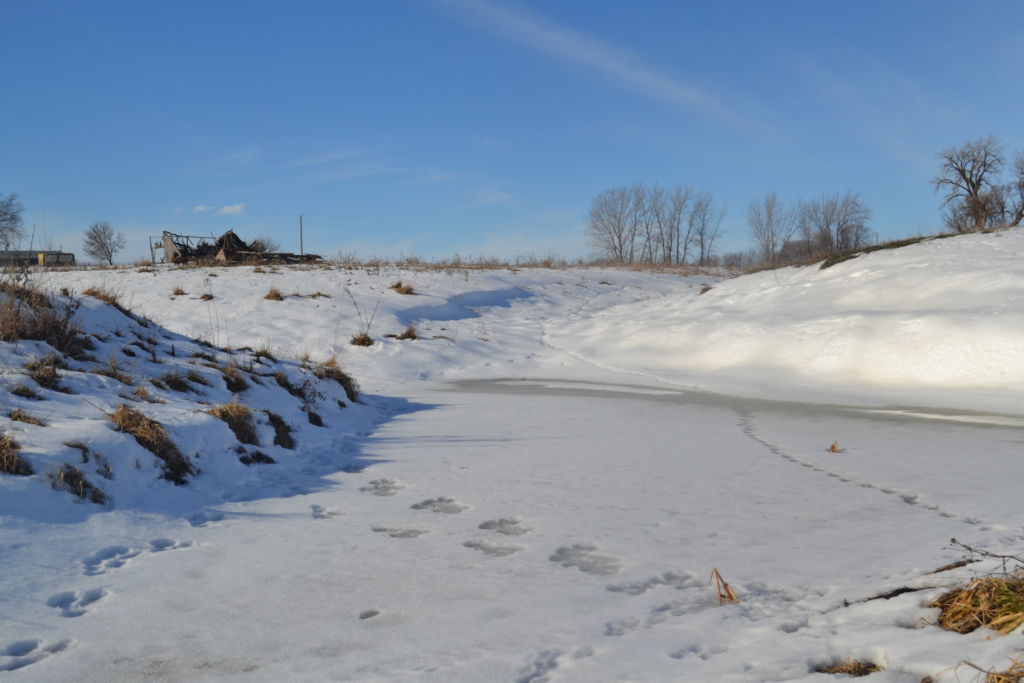
For this installment of “Postcards From,” my colleague Anika Jane Beamer sent a recent photo from a snowy walk in Central Iowa.
“This restored oxbow was once a riverbed, then a damp divot where no crops would grow, and now it’s in the early days of its new life as a wetland,” Anika Jane said. “It seems to be a hit amongst the locals—all sorts of critter tracks converge at this pool of icy slush. The half-collapsed barn in the distance is a nice touch, I think, in this attempt to return a bit of scarred farmland to nature.”
Readers, we want to feature your nature photos in our “Postcards From” series. If you’d like to submit, please send them to [email protected].
About This Story
Perhaps you noticed: This story, like all the news we publish, is free to read. That’s because Inside Climate News is a 501c3 nonprofit organization. We do not charge a subscription fee, lock our news behind a paywall, or clutter our website with ads. We make our news on climate and the environment freely available to you and anyone who wants it.
That’s not all. We also share our news for free with scores of other media organizations around the country. Many of them can’t afford to do environmental journalism of their own. We’ve built bureaus from coast to coast to report local stories, collaborate with local newsrooms and co-publish articles so that this vital work is shared as widely as possible.
Two of us launched ICN in 2007. Six years later we earned a Pulitzer Prize for National Reporting, and now we run the oldest and largest dedicated climate newsroom in the nation. We tell the story in all its complexity. We hold polluters accountable. We expose environmental injustice. We debunk misinformation. We scrutinize solutions and inspire action.
Donations from readers like you fund every aspect of what we do. If you don’t already, will you support our ongoing work, our reporting on the biggest crisis facing our planet, and help us reach even more readers in more places?
Please take a moment to make a tax-deductible donation. Every one of them makes a difference.
Thank you,

Kiley Price
Reporter
Kiley Price is a reporter at Inside Climate News, with a particular interest in wildlife, ocean health, food systems and climate change. She writes ICN’s “Today’s Climate” newsletter, which covers the most pressing environmental news each week.
She earned her master’s degree in science journalism at New York University, and her bachelor’s degree in biology at Wake Forest University. Her work has appeared in National Geographic, Time, Scientific American and more. She is a former Pulitzer Reporting Fellow, during which she spent a month in Thailand covering the intersection between Buddhism and the country’s environmental movement.