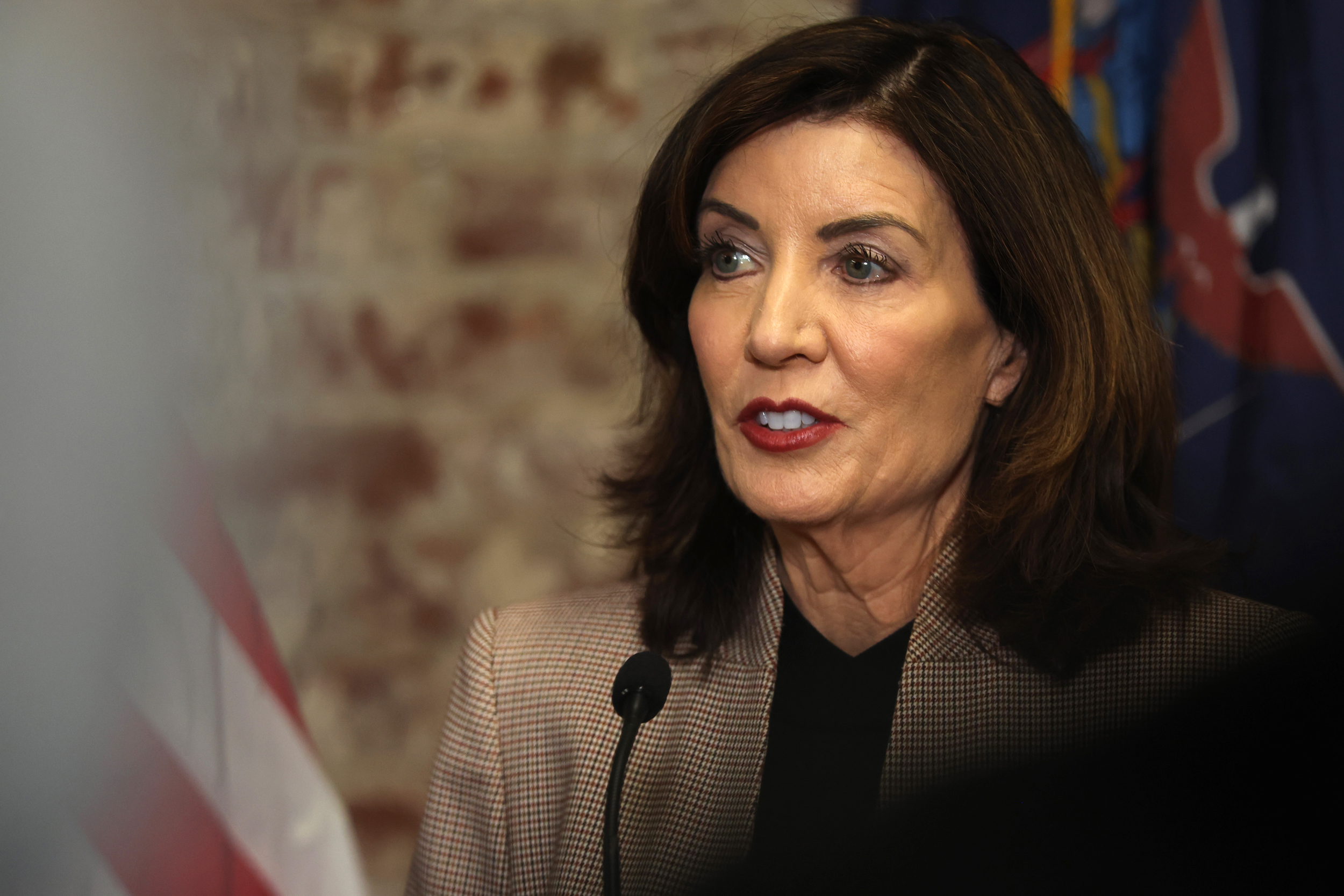


New York Gov. Kathy Hochul announced plans to roll back parts of the state’s Climate Act, which established aggressive targets for reducing greenhouse gas pollution.
Using 1990 as a baseline, the law requires a 40 percent reduction in greenhouse gas emissions by 2030, and an 85 percent decline by 2050. In an op-ed on the news site Empire Report, Hochul proposed eliminating enforcement of the 2030 emissions target and replacing it with a new 2040 target. The 2050 target would remain the same.
Hochul also proposed delaying implementation of regulations mandating greenhouse gas emission reductions until the end of 2030. The Climate Act sets out targets for emission reductions, but it does not specify how the state should meet them. That responsibility falls to the state Department of Environmental Conservation.
Last year, environmental organizations sued Hochul for failing to release the agency’s plan by the January 2024 deadline set by the Climate Act.
The state designed a plan that would force polluters to buy “allowances” for their greenhouse gas emissions. The money from those sales would be used for energy bill rebates and reinvestment in emission-reduction initiatives, such as building electrification—a policy commonly known as cap-and-invest.
But Hochul never made those regulations public, which advocates alleged in their lawsuit violated the Climate Act. She lost, but the judge allowed her to appeal the decision.
“She needs to release these regulations and put forward a strong policy that does protect our pocketbook and deploys renewable energy,” said Ethan Gormley, a climate justice organizer at Citizen Action of New York, one of the plaintiffs in the lawsuit against Hochul.
Responding to questions about the announcement, a spokesman for Hochul pointed back to the op-ed.
Hochul’s announcement comes after months of statements to various media outlets saying she wanted to slow the law’s implementation. In February, the state’s Energy Research and Development Authority also released a memo indicating that utility costs would rise if the state met the greenhouse gas reduction targets.
The announcement effectively introduced these proposals into ongoing budget negotiations with the Legislature. As the governor, she has significant leverage in the process, said state Sen. Kristen Gonzalez, who represents parts of east Manhattan, Queens and north Brooklyn and opposes changes to the Climate Act.
“It’s my constituents who are directly impacted when we rely on fossil fuels as our energy provider, instead of doing what we need to do as a state, which is invest deeply in and build out the maximum amount of renewable energy possible,” Gonzalez said.
Any of the proposed changes would signal a significant departure from the Climate Act in its current form. If the implementation of regulations and the emission targets they are tied to are delayed, there likely won’t be financial incentives for polluters to reduce emissions for at least another four years.
“It looks like the governor is attacking every aspect of the law,” said Anshul Gupta, the policy and research director for New Yorkers for Clean Power. “This is a gift to the fossil fuel industry.”
This story is funded by readers like you.
Our nonprofit newsroom provides award-winning climate coverage free of charge and advertising. We rely on donations from readers like you to keep going. Please donate now to support our work.
Donate NowRobert Howarth, a professor of ecology and environmental biology at Cornell University and a member of the Climate Action Council, which designed the state’s plan to reduce emissions in line with the Climate Act’s targets, said the goals were “entirely achievable” when the council released its plan at the end of 2022.
Though the state has made progress in renewable energy, he said, it has failed to meaningfully address one of its main sources of pollution—buildings.
“We strongly recommended getting fossil fuels out of homes,” Howarth said. “It’s such an obvious thing to do to both reduce greenhouse gas emissions and get affordability, but the state hasn’t done it.”
Some New York buildings use propane and oil for heating, while most use natural gas, all of which release greenhouse gases into the atmosphere. Advocates have long fought for legislation that would require developers to outfit new buildings with heat pumps, appliances that can heat and cool a building using a method similar to that of a window air conditioner.
Hochul’s op-ed also proposes a change to the way the state calculates its emissions.
According to Howarth, the current method acknowledges the near-term damaging impact of methane emissions, while the proposed calculation, used in other states, would place less emphasis on its impact.
Dozens of scientists, including Howarth, signed a letter to the governor this month saying they were alarmed to hear that the state was contemplating such a change: “The short-lived greenhouse gases, particularly methane, are the biggest and most important controls we have to turn down the rate at which our planet warms.”
Over the past few months, as well as in her most recent op-ed, Hochul has cited post-COVID inflation and supply chain problems, as well as a federal government hostile to renewable energy, as reasons the state is unable to meet its emissions targets.
The governor has tied these changes to affordability concerns, though many advocates have taken issue with her numbers. Gormley referred to the energy agency’s memo as a “scare tactic.”
Gonzalez, the state senator, argues that the cost of fossil fuel infrastructure, like gas mains and pipelines, as well as the volatility of oil and gas prices due to events such as the U.S.-Israel war in Iran, have pushed up utility expenses for residents.
“The reason that we’re seeing our utility prices increase is our reliance on fossil fuels,” Gonzalez said. “When I ask for the maximum build-out of renewables … it is because I understand that that is what will eventually drive down costs.”
About This Story
Perhaps you noticed: This story, like all the news we publish, is free to read. That’s because Inside Climate News is a 501c3 nonprofit organization. We do not charge a subscription fee, lock our news behind a paywall, or clutter our website with ads. We make our news on climate and the environment freely available to you and anyone who wants it.
That’s not all. We also share our news for free with scores of other media organizations around the country. Many of them can’t afford to do environmental journalism of their own. We’ve built bureaus from coast to coast to report local stories, collaborate with local newsrooms and co-publish articles so that this vital work is shared as widely as possible.
Two of us launched ICN in 2007. Six years later we earned a Pulitzer Prize for National Reporting, and now we run the oldest and largest dedicated climate newsroom in the nation. We tell the story in all its complexity. We hold polluters accountable. We expose environmental injustice. We debunk misinformation. We scrutinize solutions and inspire action.
Donations from readers like you fund every aspect of what we do. If you don’t already, will you support our ongoing work, our reporting on the biggest crisis facing our planet, and help us reach even more readers in more places?
Please take a moment to make a tax-deductible donation. Every one of them makes a difference.
Thank you,

Lauren Dalban
Reporter, New York City
Lauren Dalban is a New York City-based reporter with a background in local journalism. A former ICN fellow, she now covers environmental issues in all five boroughs. Originally from London, she earned a B.A. in History and English from the University of Virginia, and an M.S. from Columbia Graduate School of Journalism.