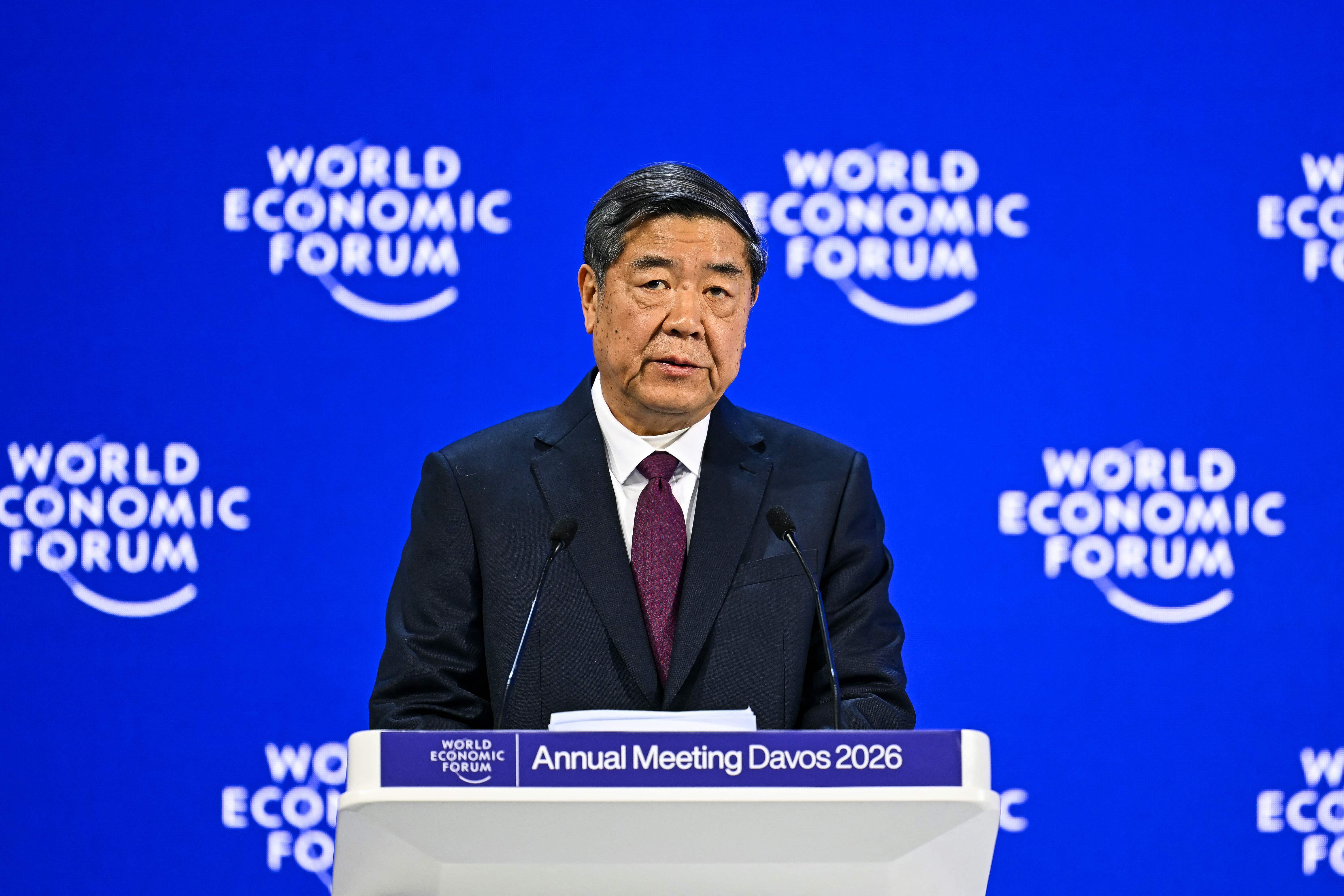


As the United States retreats from climate policy, China signaled its rising intent to lead a transition away from fossil fuels and toward Chinese-made renewable energy technologies in remarks to world leaders on Tuesday.
Speaking at the World Economic Forum in Davos, Switzerland, Chinese Vice Premier He Lifeng cast China as a beacon of stability as he touted the economic potential of wind, solar and battery power.
“China has put in place the world’s largest renewable energy system and the most complete new-energy industrial chain,” He said. “We invite entreprises from all over the world to embrace the opportunities from the green and low-carbon transition, and work closely with China.”
For China, which emits more greenhouse gases, burns more coal and imports more oil than any country in the world, this energy transition isn’t all about climate. A global shift to low-carbon power also poses substantial economic benefits to China, the world’s top manufacturer of batteries, solar panels and electric cars.
As energy appetites grow quickly across developing countries, China hopes to move them onto its new systems of solar, wind and battery power rather than fossil fuel technologies and markets still dominated by the U.S.
“They see oil and gas as far too dependent on foreign powers,” said Steven Lewis, C.V. Starr transnational China fellow at Rice University’s Baker Institute for Public Policy in Houston. “They are building a fleet of electric vehicles and they’ve already made a big dent in their oil imports for that reason alone.”
China’s state-backed overseas investment program has also poured hundreds of billions of dollars into energy projects in developing countries around the world. Its investments in renewable energy sources overtook fossil fuels around 2023 for the first time since the program began in the early 2000s, according to reporting from Inside Climate News.
“China will pursue green development and share with the world the opportunities from green and low-carbon transition,” He said at Davos.
These sorts of economic forces are increasingly shaping the politics of the energy transition, rather than diplomatic discourse at international forums, said Li Shuo, China Climate Hub director at the Asia Society Policy Institute.
“It is becoming less about what governments say and more about which companies are putting EVs on the road and solar panels on rooftops,” he said. “On that front, China’s lead is not only intact, but widening.”
China, home to 1.4 billion people, accounted for about a third of global greenhouse gas emissions in 2024. Its emissions plateaued in 2025, suggesting a possible peak after decades of steep growth. Last September, at a U.N. summit on climate change, Chinese President Xi Jinping announced plans to begin reducing overall emissions by 2030.
These and other steps position China to fill voids in energy transition leadership left by the U.S. and other Western countries.
This story is funded by readers like you.
Our nonprofit newsroom provides award-winning climate coverage free of charge and advertising. We rely on donations from readers like you to keep going. Please donate now to support our work.
Donate NowLast year, U.S. president Donald Trump told the U.N. general assembly, “If you don’t get away from the green energy scam, your country is going to fail.”
Trump has also withdrawn the U.S. from the 2015 Paris Accords and from the U.N. Framework Convention on Climate Change, two global agreements to reduce carbon emissions.
China will work with all parties to “fully and effectively implement” those agreements, He said at Davos.
“They have the ability to use opportunities like the U.S. retreat in these sectors and these diplomatic arenas to their own advantage,” said Jackson Ewing, director of energy and climate policy at Duke University’s Nicholas Institute for Energy, Environment & Sustainability. “They are taking these measures that have real climate importance, even if the drivers of those measures aren’t always primarily climate change.”
About This Story
Perhaps you noticed: This story, like all the news we publish, is free to read. That’s because Inside Climate News is a 501c3 nonprofit organization. We do not charge a subscription fee, lock our news behind a paywall, or clutter our website with ads. We make our news on climate and the environment freely available to you and anyone who wants it.
That’s not all. We also share our news for free with scores of other media organizations around the country. Many of them can’t afford to do environmental journalism of their own. We’ve built bureaus from coast to coast to report local stories, collaborate with local newsrooms and co-publish articles so that this vital work is shared as widely as possible.
Two of us launched ICN in 2007. Six years later we earned a Pulitzer Prize for National Reporting, and now we run the oldest and largest dedicated climate newsroom in the nation. We tell the story in all its complexity. We hold polluters accountable. We expose environmental injustice. We debunk misinformation. We scrutinize solutions and inspire action.
Donations from readers like you fund every aspect of what we do. If you don’t already, will you support our ongoing work, our reporting on the biggest crisis facing our planet, and help us reach even more readers in more places?
Please take a moment to make a tax-deductible donation. Every one of them makes a difference.
Thank you,

Dylan Baddour
Reporter, Austin
Dylan Baddour covers the energy sector and environmental justice in Texas. Born in Houston, he’s worked the business desk at the Houston Chronicle, covered the U.S.-Mexico border for international outlets and reported for several years from Colombia for media like The Washington Post, BBC News and The Atlantic. He also spent two years investigating armed groups in Latin America for the global security department at Facebook before returning to Texas journalism. Baddour holds bachelor’s degrees in journalism and Latin American studies from the University of Texas at Austin. He has lived in Argentina, Kazakhstan and Colombia and speaks fluent Spanish.