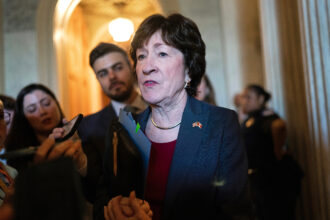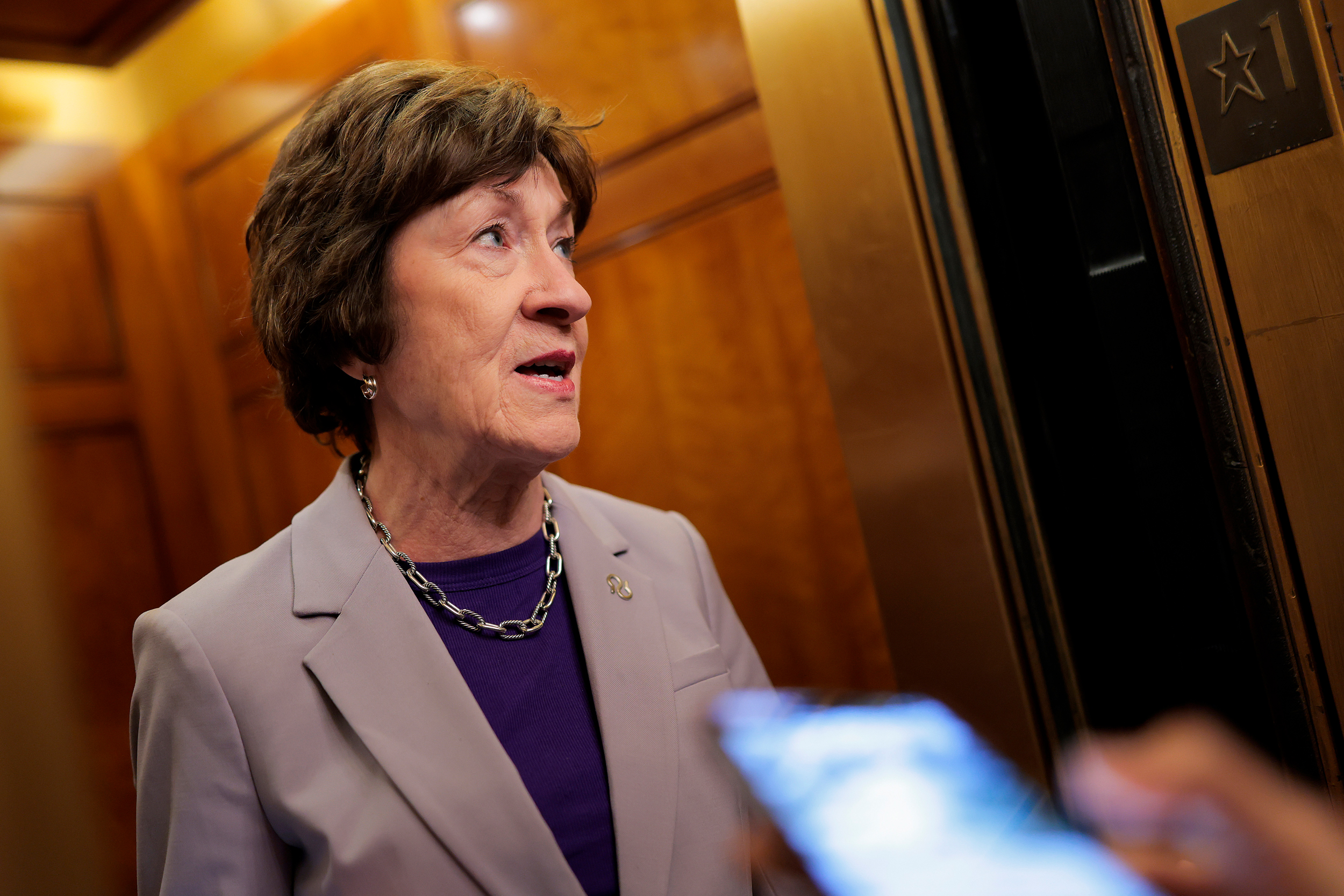


Last August, when reports emerged that the Environmental Protection Agency (EPA) planned to cancel $7 billion in grants for solar panels for low-income households, including an estimated 20,000 households in Maine, Sen. Susan Collins seemed to defend the move.
“It is no surprise, now that control of the White House has changed, that the new administration would consider terminating this IRA program,” she was quoted as saying, referring to the Biden administration’s 2022 Inflation Reduction Act.
While Collins did call the termination “abrupt” and “unfortunate,” her primary concern seemed to be rehashing the IRA’s partisan passage. “Not one Republican voted for the Inflation Reduction Act that included this grant program,” Collins said, highlighting her own opposition to the 2022 law many have called the most significant piece of climate legislation in United States history.
Collins, who recently announced she would run this year for a sixth term in the Senate, has largely stood by during the Trump administration’s all-out assault on federal climate and clean energy policy. At key moments—as when the Department of Energy released a so-called “critical review” of climate science by five hand-picked climate skeptics—Collins did not speak out, at least publicly, in opposition.
Nor did she publicly oppose the EPA’s move to repeal the endangerment finding underlying all current federal regulation of greenhouse gas emissions. Or any of the administration’s many moves to block already permitted offshore wind developments, including in New England.
“The silence is deafening,” said Jesse Lee, a senior advisor to the nonprofit group Climate Power and a former domestic policy staff member in the Biden Administration.
The League of Conservation Voters (LCV) gave Collins a score of 31 percent on their 2025 scorecard tallying key pro-environmental votes by members of Congress.
It is the continuation of a trend apparent in 2020, the last time Collins ran for reelection. Collins, who could once regularly count on the endorsement of environmental groups like LCV, has long acknowledged the scientific consensus that human activities, chiefly the burning of fossil fuels, are causing climate change. She also previously supported direct federal regulation of greenhouse gas emissions in proposed cap-and-trade legislation.
Multiple attempts to reach Collins’s office for this article were unsuccessful.
Collins continues to back some climate and environmental efforts. She introduced legislation to block oil and gas drilling in the Gulf of Maine in April of last year and has been credited with helping keep funding for the appliance-rating Energy Star program and for remediation of forever chemicals in recent spending packages. But she has not noticeably challenged her party’s rightward turn on climate and environmental regulation under President Trump.
“Her party has changed on her over time,” said Mark Brewer, a political scientist at the University of Maine. “A big percentage of her party is somewhat skeptical of climate change and is also not terribly supportive of large scale federal regulatory efforts to try and address climate change.” Not only that: “Maine has become more partisan over the last two decades,” Brewer said, as reflected in the declining share of voters choosing to register as unaffiliated with any political party (which, at 28 percent, is still large compared to most states).
A major piece of Collins’s explicit appeals to Maine’s famously independent-minded voters is the power she has, as chair of the Senate Appropriations Committee, to secure federal funding for projects in Maine. That’s an especially powerful appeal since the return of “earmarks,” also known as Congressionally directed spending, in 2021. This year, Maine is slated to receive the second highest amount of such spending per capita in the country.
Given her own messaging and the fact that the vanguard of the Trump administration’s efforts to unwind climate action has been through spending cuts and freezes, Collins’s record on reasserting congressional control over spending has received close examination. It is salient to the health of both the planet and American democracy.
Collins has publicly criticized some of the most extreme incursions by the Trump administration into Congress’s power under the U.S. Constitution to direct federal spending. She also voted against the One Big Beautiful Bill Act (OBBA) last July, a law that enacted many of the president’s desired cuts to federal programs, including ending investments and subsidies for clean energy.
That vote earned Trump’s ire but won her praise in some quarters of the climate movement. “While it may have been considered safe by a lot of the environmental advocates, in the end, it was the right vote to take, for somebody who has been in support of renewable energy and climate solutions for most of her tenure as senator,” Jeff Marks, the executive director of ClimateWork Maine, a climate conscious business group, told Inside Climate News.
Yet before voting against the bill, Collins was the 51st vote to advance it to the Senate floor.
A Tale of Two Grants
Two days after the initial reports of the cancellation of Solar for All grants in August 2025, EPA Administrator Lee Zeldin confirmed on X that the EPA was terminating 60 grants already awarded under the program. Zeldin claimed this was what the OBBA required, although there were clear indications that the law’s termination of Solar For All only applied to unobligated balances and not to these already awarded grants.
Maine lost about $62 million that was projected to help 20,000 low-income households install rooftop and community solar arrays, along with battery storage, reducing their energy bills and the state’s greenhouse gas emissions in the process. The state’s attorney general joined two lawsuits seeking to recover the funds that are still pending.
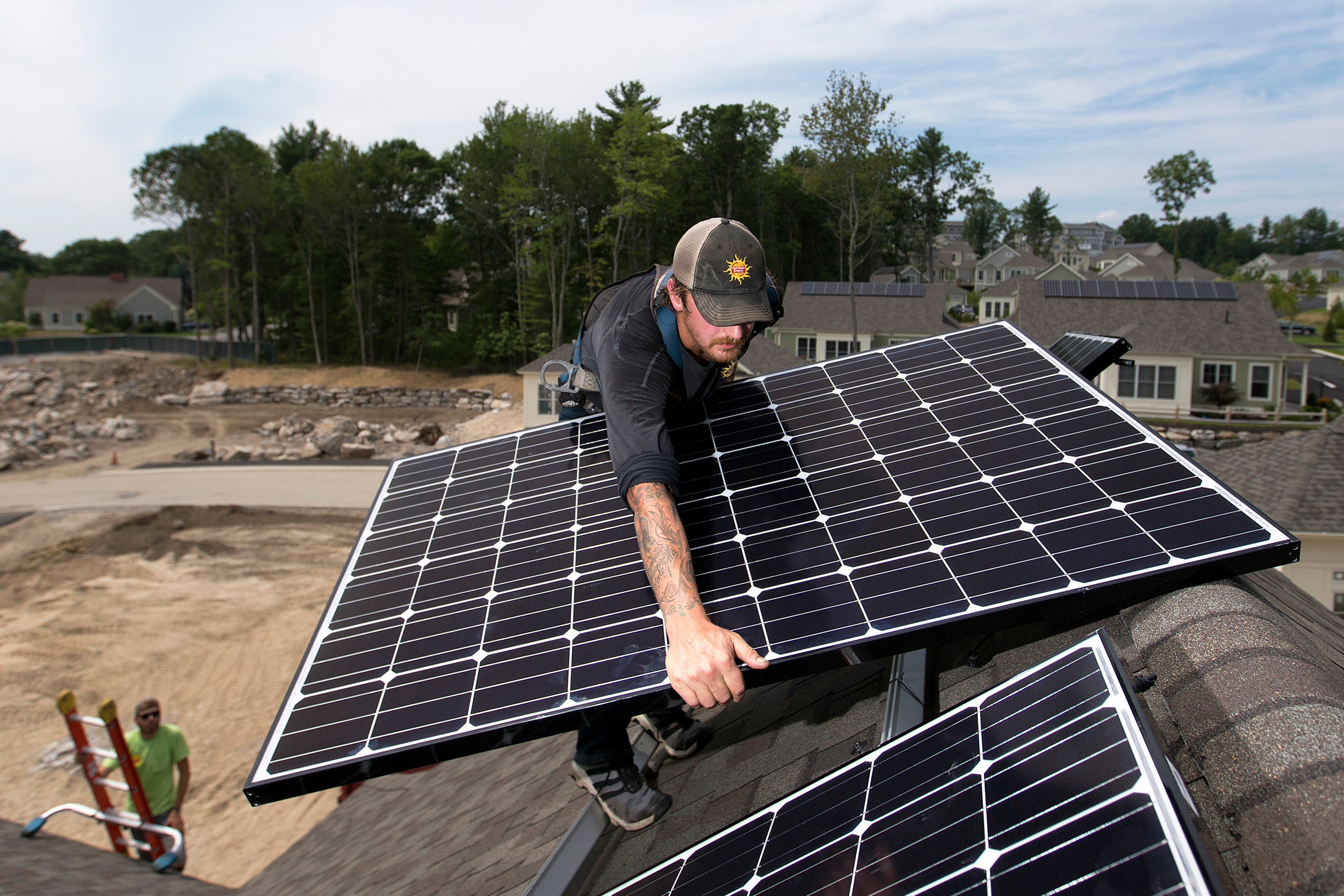
U.S. Rep. Chellie Pingree (D-Maine) who represents Portland and much of the southern seacoast, wrote to Zeldin in August, “it is unconscionable that you would seek to deny access to clean, cheap energy to those who can least afford it.”
Collins, in contrast, chose not to add to her prior statement.
It’s instructive to compare Collins’s reactions to the cancellations of funding for Solar for All and the popular Sea Grant program run by the University of Maine, which funds coastal economic development and marine science education. Although she worked largely behind the scenes in lobbying key administration officials, Collins was publicly credited with advocacy that led to the restoration of the Sea Grant funds.
An Appropriator’s Response?
Solar for All and Maine Sea Grant are just two of the thousands of individual federal funding programs unilaterally frozen, cancelled or held up for political leverage by agencies of the Trump administration. From the initial “DOGE” blitz a year ago to the recent withholding of public health funds from four Democrat-led states, these actions have spawned hundreds of lawsuits. Many areas, from foreign aid to welfare assistance, have been hit hard; clean energy and environmental justice programs, which administration officials refer to as part of a “Green New Deal scam,” are two of them.
Russell Vought, the director of the President’s Office of Management and Budget (OMB), stands at the center of this revolution in presidential spending. Collins voted to confirm Vought, saying he was well-qualified, even if she disagreed with his quite public fringe positions about as fundamental an issue as Congress’s power of the purse.
When Vought appeared before the Senate Appropriations Committee last June to testify about a proposed package of “rescissions” or cuts to already appropriated funding for foreign aid and public broadcasting, Collins questioned him sharply about the wisdom of some of those cuts and ultimately voted against advancing them to the Senate floor. But she did not push Vought on the extent to which OMB was withholding funds without seeking Congressional approval or removing public-facing information crucial to oversight.
This story is funded by readers like you.
Our nonprofit newsroom provides award-winning climate coverage free of charge and advertising. We rely on donations from readers like you to keep going. Please donate now to support our work.
Donate NowSome see a critical lack of leadership. “Both in essentially caving to the executive branch and not protecting the role of the Senate as a check and balance, I think she has really undermined not just the interests of Mainers, but also the health of our democracy,” said Bradley Campbell, president of the Conservation Law Foundation.
Nor has Vought testified again before the Senate Appropriations Committee, even after engaging in a maneuver that stripped a further $5 billion in foreign aid funding, which both Collins and the nonpartisan Government Accountability Office called illegal.
Vought rejected this criticism. His office’s ongoing willingness to impound appropriated funds also threatens to undermine what could otherwise be considered Collins’s signature accomplishment for climate and the environment over the past year: passing a series of fiscal year 2026 appropriations bills that largely preserved existing levels of funding for the work of key agencies like the EPA and National Oceanic and Atmospheric Administration (NOAA), as well as for basic science and health research. Trump had proposed cutting the budgets for both the EPA and National Science Foundation, among others, by over 50 percent.
Congress wrote some guardrails into the bills, intended to keep OMB from withholding or placing its own conditions on the ultimate disbursement of these funds. But Collins and her Republican colleagues did not go as far as top Democrats on the committees wanted; nor, apparently, did OMB feel any new level of restraint. “None of our executive authorities to control spending were compromised by these appropriations bills,” an OMB spokesperson told the New York Times.
Pingree, another top Congressional appropriator as ranking member on the House Appropriations Subcommittee on the Interior and the Environment, said Congress could do far more to rein in OMB, but only with the support of the majority party. “There’s a million things Congress can do,” Pingree said. “They could sue the hell out of those guys for all the horrific things that they’re doing. They could also withhold funds.”
Without those actions? “I don’t have any illusions that this administration is going to be more law abiding, but [the spending package] does require my Republican colleagues to acknowledge that [the language about guardrails] was also in there,” Pingree said.
How Will Voters Respond?
With Americans increasingly uneasy about both the economy and the future of democracy, early polls suggest Collins is facing her toughest electoral test yet. A December poll conducted by Pan-Atlantic Research showed only 39 percent of voters with favorable opinions of Collins, compared to 56 percent unfavorable. The same poll showed Collins in a dead heat with either Maine Gov. Janet Mills or political newcomer Graham Platner, considered the two most likely candidates to win the Democratic primary in June.
Collins is not currently facing a serious challenge from the right. Although Trump has criticized her, there are still no signs of him supporting a primary challenger. “She’s the only person that can win,” Senate Majority Leader John Thune has said of Collins’s chances in increasingly Democratic-leaning Maine, and party donors have helped her build a substantial war chest.
If the election were held today, energy affordability could well be a determinative issue for many Maine voters, even if climate change itself might not be: In the Pan-Atlantic poll, neither climate nor any other environmental issue ranked among the top seven among important issues for surveyed voters. (The poll was released before the recent surge of ICE enforcement in Maine, which has emerged as a crucial campaign issue.) Cost of living, however, ranked first.
That presents an opportunity for those linking Trump’s success in delaying permitted offshore wind projects, including those already under construction, with high energy prices in Maine. That connection is backed by data from groups supportive of wind energy showing the difference those projects could have made in bringing down utility bills across New England last winter. “Right now, people are getting these massive utility bills in their mailbox,” Lee said, “and there’s a very clear case to make about the votes that the climate deniers took and making that connection to family budgets.”
Mills appears well-positioned to make that argument, given her record of support for renewable energy in Maine. Yet doing so may not be simple, given the large increases in utility bills that have occurred during her term in office.
It may be that a different climate policy focused on accountability is what will connect with voters: “I feel really strongly that we need a candidate that is going to stand up and advocate for actions like ‘make polluters pay’ legislation, you know, a climate superfund law—bold action like that is really important,” Carrick Gambell, an agricultural service provider from Scarborough, told ICN.
About This Story
Perhaps you noticed: This story, like all the news we publish, is free to read. That’s because Inside Climate News is a 501c3 nonprofit organization. We do not charge a subscription fee, lock our news behind a paywall, or clutter our website with ads. We make our news on climate and the environment freely available to you and anyone who wants it.
That’s not all. We also share our news for free with scores of other media organizations around the country. Many of them can’t afford to do environmental journalism of their own. We’ve built bureaus from coast to coast to report local stories, collaborate with local newsrooms and co-publish articles so that this vital work is shared as widely as possible.
Two of us launched ICN in 2007. Six years later we earned a Pulitzer Prize for National Reporting, and now we run the oldest and largest dedicated climate newsroom in the nation. We tell the story in all its complexity. We hold polluters accountable. We expose environmental injustice. We debunk misinformation. We scrutinize solutions and inspire action.
Donations from readers like you fund every aspect of what we do. If you don’t already, will you support our ongoing work, our reporting on the biggest crisis facing our planet, and help us reach even more readers in more places?
Please take a moment to make a tax-deductible donation. Every one of them makes a difference.
Thank you,