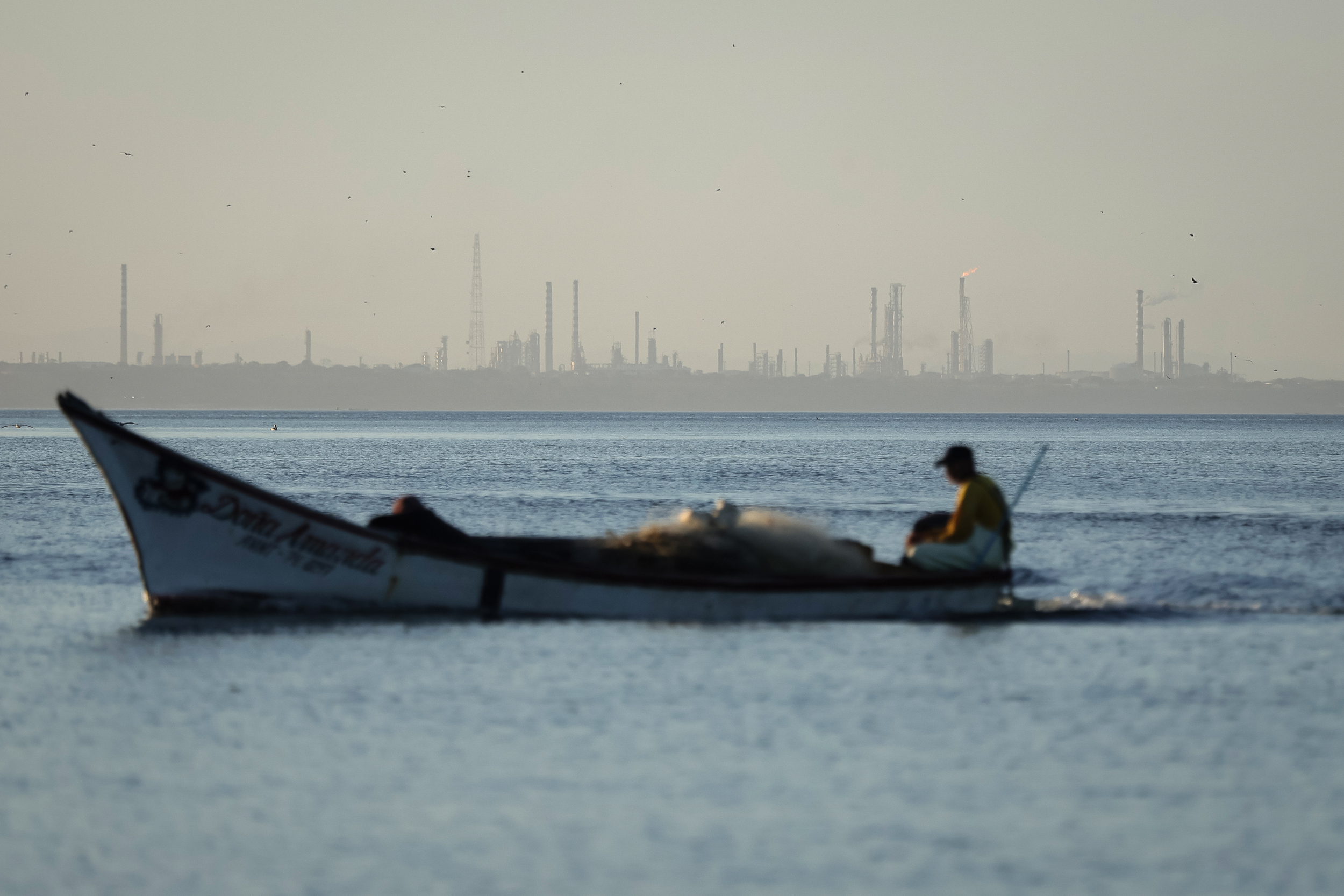


From our collaborating partner Living on Earth, public radio’s environmental news magazine, an interview by Jenni Doering with Paasha Mahdavi, an associate professor of political science at the University of California, Santa Barbara.
Since the U.S. capture of President Nicolás Maduro in early January, there has been a lot of discussion about Venezuela’s massive oil reserves.
But when it comes to the energy sector, it turns out that Venezuela is ideally positioned to harness abundant clean, renewable energy, particularly from wind.
Paasha Mahdavi is an associate professor of political science at the University of California, Santa Barbara, where his research focuses on the impact of oil and gas resources on governance and environmental politics, and a consultant for the Natural Resources Governance Institute. This interview has been edited for length and clarity.
JENNI DOERING: Venezuela is famously rich in oil, but we understand that it also has incredible renewable energy resources. What is it about Venezuela’s geographic situation that makes it well positioned to harness renewable energy?
PAASHA MAHDAVI: Venezuela is indeed so well known for its oil industry; it is now being touted as having the largest reserves in the world. But it also has incredible offshore wind potential in particular, in addition to solar potential, as well as some more advanced kind of geothermal, which is the heat underneath the earth.
But it’s the wind that really catches energy analysts’ eyes, because it is tremendously advantageously positioned. In other words, it’s really windy in shallower waters, and that matters, because when it’s shallower, it’s easier to build wind turbines. It has this incredible windiness that a number of other places have as well, like the Great Plains in the U.S., for example.
So it’s exciting for that reason, and there’s lots of other elements of this that are pretty fascinating and why some in Venezuela themselves are excited as well.
DOERING: What kind of scale are we talking about? What kind of capacity for wind energy could Venezuela, in theory, harness?
MAHDAVI: The World Bank does these great analyses across the world. Venezuela’s potential for offshore wind puts that number at 381 gigawatts of capacity. To put that in perspective, that’s 10 times the country’s current electricity capacity as it stands, of 38 gigawatts. It’s a huge, huge number in terms of its potential, but getting there is a different question.
DOERING: How much renewable energy does Venezuela already use?
MAHDAVI: Almost zero. The catch is hydro power. But we think about hydro differently because of the way that Venezuela’s hydro was constructed and some of the damages that are done, especially when trying to capture hydro power in sensitive areas like the Orinoco River basin or the Amazon. But when it comes to solar, wind, geothermal, it’s effectively zero.
DOERING: How might the extracting and refining oil workforce in Venezuela translate to offshore wind from a labor perspective?
MAHDAVI: I’m glad you asked that, because this is the trillion-dollar question when it comes to how we transition away from oil, which is, how do we ensure a just transition for workers who are impacted?

One of the answers comes down to, what are the skill sets that are easily transferable through either minimal training or retraining, or through altering the existing training pathways when we think about the younger generation, so, those who would have trained to be petroleum engineers can be trained to do something else.
The areas that have the greatest skills transferability when it comes to the renewable energy sector and any kind of decarbonized solution for oil are offshore wind and geothermal. That’s one area where you’ve got rig hands, engineers, even seismic and a whole number of different elements along the oil workers supply chain that are transferable to the offshore wind supply chain.
The other part of it is the whole idea behind creating these offshore wind hubs. Let’s say Venezuela developed 381 gigawatts of wind. That’s crazy, but that’s 10 times what it currently needs, right? And so what would it do with that? Well, typically, the model is that you create adjacent manufacturing hubs that are effectively getting subsidized electricity, and that’s a huge attraction whether it’s for heavy manufacturing, medium manufacturing or port capacity.
Venezuela is well positioned for those things, and that’s where workers that are on the more manufacturing side of the oil and gas industry—refining and processing and things like that—can transfer into. So that’s another part of it, which is not in the actual turbines themselves, but the electrons that are generated that can go to power industries that can rehire oil workers that are transitioning away from oil and gas.
DOERING: What are the main barriers preventing Venezuela from pursuing this transition to this form of energy?
MAHDAVI: There are, effectively, two big barriers. The biggest roadblock is the government. These national oil companies march to one drummer, and that drummer is the government and what the government wants to prioritize. In Venezuela’s case, Maduro and [Hugo] Chávez before him prioritized oil and gas over anything else.
The other barrier is the institutional capacity. And what we mean by that is not just the political will to do this and the government’s decision to do it, but its capability of doing so, of having the kind of filled-out bureaucracy and the clear rule of law and the expectations that exist for companies to come invest, for others to do business in Venezuela, to assist the national companies when it comes to offshore wind in Venezuela. You just haven’t had that technical capability when it comes from a bureaucratic standpoint of getting this off the ground.
This story is funded by readers like you.
Our nonprofit newsroom provides award-winning climate coverage free of charge and advertising. We rely on donations from readers like you to keep going. Please donate now to support our work.
Donate NowDOERING: We have to acknowledge that building out a ton of wind energy in Venezuela would not by itself provide the same kind of exportable energy that its oil resources allow. You can’t exactly load electricity into a tanker to ship around the world, at least not at this point, but walk us through how that wind energy might help power economic activity or be turned into other resources that could be exported.
MAHDAVI: You’re exactly right. You can’t necessarily export electricity as easily. There are opportunities for Venezuela to provide cheap and clean electricity via undersea cable around the Caribbean. But to think about what you do with this, you convert that cheap electricity into reliable electricity.
The wind doesn’t always blow, but it blows predictably, and you can pair it with all kinds of new technologies. It’s not just batteries. There’s other ways to draw out the potential from generating electricity from wind. You put that to use in something that is going to be exportable.
That’s the entire story of the Industrial Revolution, because electricity is an energy and that’s our lifeblood when it comes to creating economic products. So that’s the way to do it, and that’s how a number of other countries have done it when you’re not directly exporting the electricity.
Norway, for example, does directly export some electricity. But opportunities exist if you think about exporting the clean energy products themselves. If you start to get into EVs and innovations in how you build wind turbines, look no further than China, and China now is a larger energy exporter by revenue than Saudi Arabia, which is a wild number.
You have to count a lot of things; it’s not just one product, right? You count up its solar panels, its wind turbines; all of those made more money last year in terms of export revenue than Saudi Arabia’s oil and gas sector. It takes a long time to get there, but it does go to show you that there is a lot of money to be made for governments and economies in the clean energy space, and it’s not just the electricity itself, but so many other things that it opens the door to.
It goes back to my point that Venezuela has the human know-how to do that, and that’s because it’s been an energy producer for a century or more, and that’s what many are hoping to tap into.
DOERING: What examples do we have of nearby countries in South America that have been working to address the climate crisis while also growing their economies?
MAHDAVI: The best example is Venezuela’s neighbor to the west, Colombia. Colombia is an oil and gas producer. It has a national oil company, Ecopetrol, much like Venezuela has a national oil company, PDVSA. But these are two countries that are taking two very different paths, because Colombia has a president that is seeking to decarbonize and move beyond oil and gas. Part of it is because of the profitability in the long term of Colombia’s oil and gas, but the other part of it is a deep belief in solving the climate crisis.
It looks quite different than Venezuela, where the national oil company has been told to just focus on oil and gas. And it has been doing so for well before the actions in early January of taking out Maduro, and that’s because that was Chávez’s vision, that was Maduro’s vision, to keep the golden goose laying eggs.
DOERING: This question of which path Venezuela chooses feels so much bigger than just Venezuela, but this choice that the world faces right now in terms of the stakes for the planet, for human civilization. The total offshore wind capacity in the United States is 4,300 gigawatts—nearly four times the amount of all the electricity currently generated in the U.S. How important is it for us all to get this right?
MAHDAVI: It is the most important thing in the world, at least to me. I have two little kids. We are already experiencing climate change, so it’s not just a future thing, but we have to get it right.
We have these opportunities, these political windows that open up anytime there are new leaders in power, to make that change. One of the founding members of OPEC could become one of the global leaders of clean energy if it chooses to, because it has the ability to do it, it has the human capital to do it, has the resources to do it. It’s a choice.
So it’s tremendously important, not just for all of us around the planet, but for other countries, to be able to point to, “Hey, look, Venezuela did it. We can do it too.”
About This Story
Perhaps you noticed: This story, like all the news we publish, is free to read. That’s because Inside Climate News is a 501c3 nonprofit organization. We do not charge a subscription fee, lock our news behind a paywall, or clutter our website with ads. We make our news on climate and the environment freely available to you and anyone who wants it.
That’s not all. We also share our news for free with scores of other media organizations around the country. Many of them can’t afford to do environmental journalism of their own. We’ve built bureaus from coast to coast to report local stories, collaborate with local newsrooms and co-publish articles so that this vital work is shared as widely as possible.
Two of us launched ICN in 2007. Six years later we earned a Pulitzer Prize for National Reporting, and now we run the oldest and largest dedicated climate newsroom in the nation. We tell the story in all its complexity. We hold polluters accountable. We expose environmental injustice. We debunk misinformation. We scrutinize solutions and inspire action.
Donations from readers like you fund every aspect of what we do. If you don’t already, will you support our ongoing work, our reporting on the biggest crisis facing our planet, and help us reach even more readers in more places?
Please take a moment to make a tax-deductible donation. Every one of them makes a difference.
Thank you,