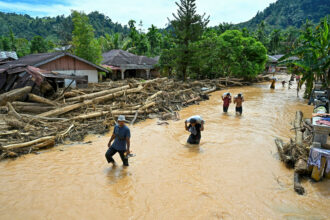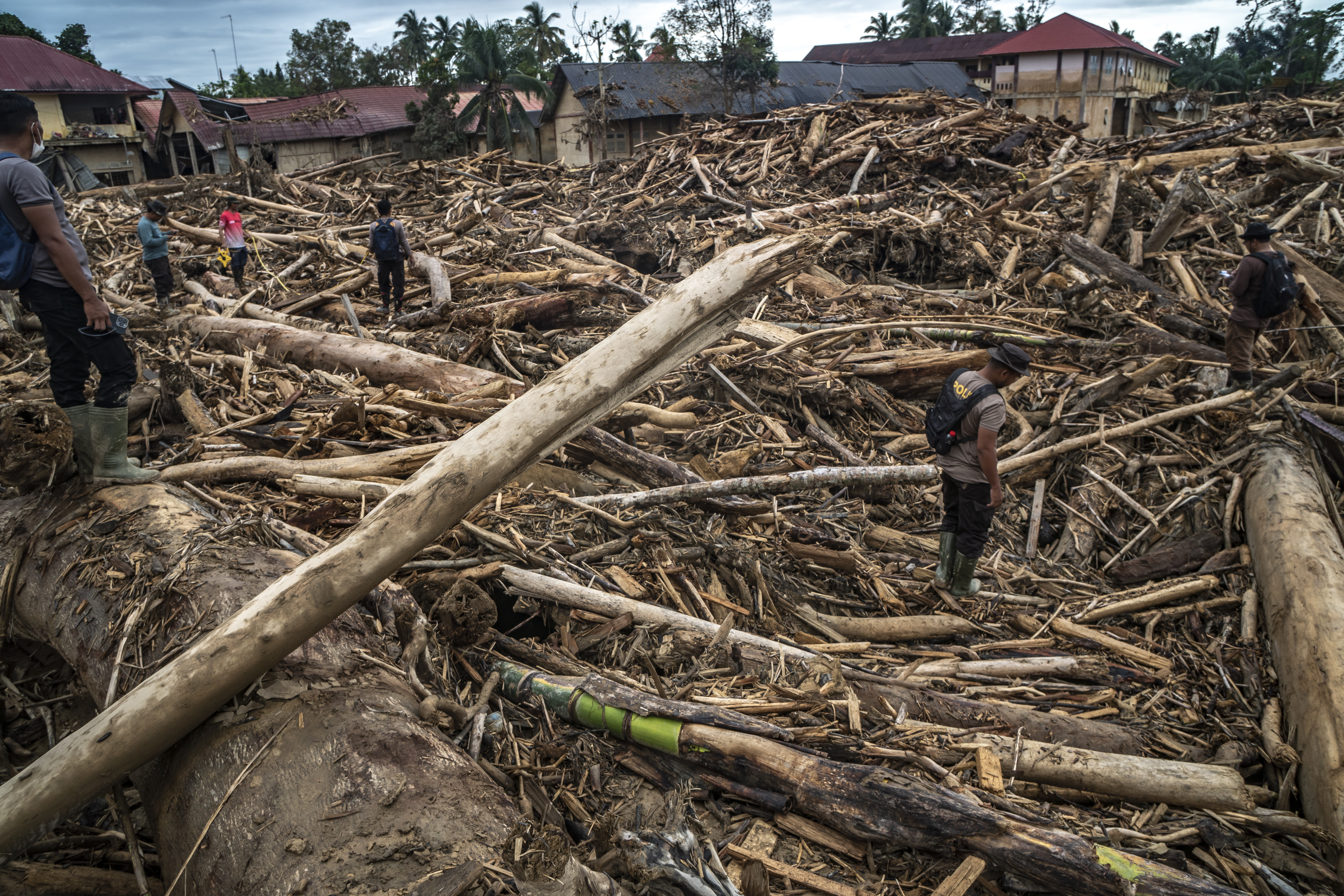


The Indonesian government said it has revoked the licenses of 28 companies for violating forestry regulations in provinces hit by devastating flooding in November. A rare equatorial cyclone, which caused widespread landslides across northern Sumatra, killed some 1,200 people and decimated the population of a critically endangered orangutan that was estimated to have fewer than 800 individuals before the disaster.
The Tapanuli orangutan’s habitat, which covers an area about the size of Los Angeles, lies in one of the regions of Sumatra hit hardest by the storm. That habitat had already been under assault in recent years by the construction of a hydroelectric dam, the expansion of a gold mine and other commercial activity.
Indonesia’s Ministry of State Secretariat announced Tuesday that President Prabowo Subianto had revoked permits for 28 companies that had violated forestry regulations in mining, plantation and forestry sectors across northern Sumatra. While it didn’t name the companies in its press release, multiple reports have said the list includes the dam and mine.
The announcement came one week after Indonesia’s Environment Ministry said it filed civil lawsuits against six companies it said had caused damage, including those that own the dam and mine. The ministry said it was seeking 4.8 trillion rupiah, or about $285 million, for damages and restoration costs.
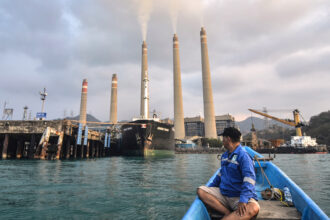
Activists have been fighting for years to block construction of the Batang Toru dam, which is majority owned, built and financed by Chinese state-owned companies. While the dam was not yet operational when the storm hit, construction was thought to be near complete.
Environmental groups have also been trying to stop expansion of the gold mine, which is owned by a multinational conglomerate based in Bermuda but traded on the London Stock Exchange. Groups argued that both projects were threatening to drive the Tapanuli orangutan to extinction.
These efforts have gained little traction with the Indonesian government, however, said Amanda Hurowitz, senior director at Mighty Earth, a global advocacy group that has worked with partners in Indonesia.
“So, for the government to step in and revoke these permits is very, very significant,” Hurowitz said.
Yet she added that many details remain unclear, including whether the revocations will be temporary and whether companies will be allowed to reapply.
The Ministry of State Secretariat has yet to publicly share any revocation orders. A spokesperson for Agincourt Resources, which operates the gold mine, said it had not received an official notification as of Thursday.
Andi Muttaqien, executive director of Satya Bumi, an Indonesian environmental group, said he doubts the revocations will be permanent.
Restu Diantina, the organization’s communications manager, pointed to previous examples of the government suspending licenses, only to take over operations with state-owned companies. She said the dam, in which Indonesia’s state-owned utility holds a minority stake, is “too big to fail. It is almost impossible to cancel this project.”
Soon after Cyclone Senyar unleashed landslides and flooding across northern Sumatra, environmental groups and some scientists said the damage had been worsened by decades of widespread deforestation. Soon after, government agencies joined them, announcing investigations into companies operating in the region.
Muttaqien said analysis of satellite imagery showed landslides hitting above and below several industrial sites. An access road built for dam construction appeared particularly problematic, he said, with images showing logs were left along the riverbank, only to be swept away and carried downstream in the floods, wreaking havoc.
SDIC Power Holdings, the majority owner of the dam and a subsidiary of the State Development and Investment Corp., a large Chinese state-owned enterprise, did not reply to a request for comment. PLN, the Indonesian state-owned utility, also did not respond.
Satellite imagery also shows landslides around the gold mine. Hurowitz said the project had been extending into a hillside and waterway, reaching deeper into the orangutan habitat.
Agincourt Resources did not immediately respond to questions about that but did send a statement saying the company learned about the permit revocation from media reports. The company said it “respects all government decisions and will continue to uphold its rights in accordance with the applicable laws and regulations.” It added that Agincourt “consistently upholds the principles of Good Corporate Governance and remains fully committed to complying with all applicable regulations.”
The Ministry of State Secretariat did not immediately reply to a request for comment.
While there appear to have been extensive landslides near the mine, dam and other commercial operations, an updated assessment of damage in the area by an international team of scientists found the majority of landslides were deep in the forest, said Erik Meijaard. He’s a conservation scientist with Borneo Futures, a scientific consultancy, and an expert on the Tapanuli orangutan.
Meijaard was the lead author on a preprint assessment published last month focused on an area of Tapanuli orangutan habitat known as the West Block. That is the largest of three areas of forest where the ape lives, separated by roads, the Batang Toru river and land cleared for agriculture.
The scientists used satellite imagery to determine the impact of damage on the orangutans’ population. They initially estimated that at least 30 orangutans had been killed by landslides and flooding, based on the extent of damage to the forest. Since then, new imagery has exposed areas previously covered by clouds, Meijaard said in an email, revealing that damage is more widespread.
“We believe that this could have caused the death of about 58 orangutans or some 11% of the West Block population,” Meijaard said. “This is a hammer blow to the survival of the species.”
While Meijaard called the link between landslides and commercial activity “more tentative,” he said the clearest link appeared near land that had been cleared on steep slopes for dam construction.

Nearly two months after the storm hit, activists say recovery has been slow.
“The situation remains dire,” said Andine Fahira Lubis, advocacy officer with WALHI North Sumatra, a local branch of an Indonesian environmental group. In hard-hit regions, she said, many people have received little help from the government.
While the civil lawsuits filed by the Environment Ministry are a welcome development, Lubis said, such litigation can take years to complete. She said Indonesia does not have a dedicated agency or vehicle for any restoration funds recovered from the suits, meaning any money would flow into the general budget and could be difficult to track.
Lubis said the government needed to make the permit revocations permanent and follow with criminal investigations, too, if it wanted to halt damaging activity in the Tapanuli orangutan’s habitat.
Hurowitz, of Mighty Earth, said it was too soon to say what impact the permit revocation could have on the orangutans, but that it clearly won’t be enough.
“There has to be massive restoration for the species to survive,” Hurowitz said. “The cyclone was a huge blow. Revoking these permits could be a step in the right direction.”
About This Story
Perhaps you noticed: This story, like all the news we publish, is free to read. That’s because Inside Climate News is a 501c3 nonprofit organization. We do not charge a subscription fee, lock our news behind a paywall, or clutter our website with ads. We make our news on climate and the environment freely available to you and anyone who wants it.
That’s not all. We also share our news for free with scores of other media organizations around the country. Many of them can’t afford to do environmental journalism of their own. We’ve built bureaus from coast to coast to report local stories, collaborate with local newsrooms and co-publish articles so that this vital work is shared as widely as possible.
Two of us launched ICN in 2007. Six years later we earned a Pulitzer Prize for National Reporting, and now we run the oldest and largest dedicated climate newsroom in the nation. We tell the story in all its complexity. We hold polluters accountable. We expose environmental injustice. We debunk misinformation. We scrutinize solutions and inspire action.
Donations from readers like you fund every aspect of what we do. If you don’t already, will you support our ongoing work, our reporting on the biggest crisis facing our planet, and help us reach even more readers in more places?
Please take a moment to make a tax-deductible donation. Every one of them makes a difference.
Thank you,