

Reporting supported by the Water Desk at the University of Colorado, Boulder.
BROWNSVILLE, Texas—An experiment unfolding at the southernmost tip of this state could irrevocably change the iconic Rio Grande and the communities it sustains.
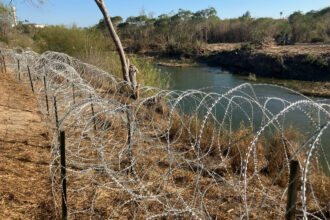
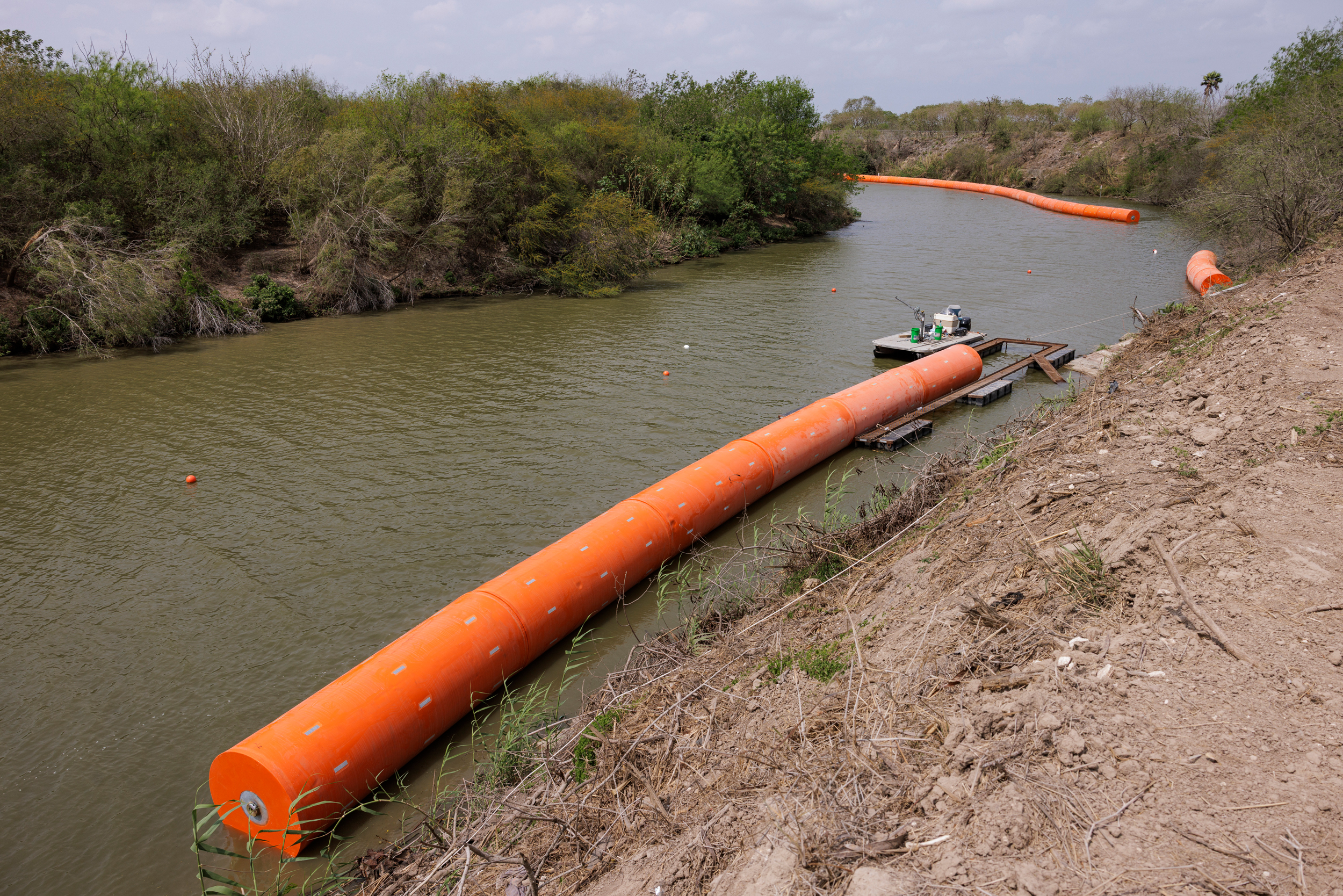
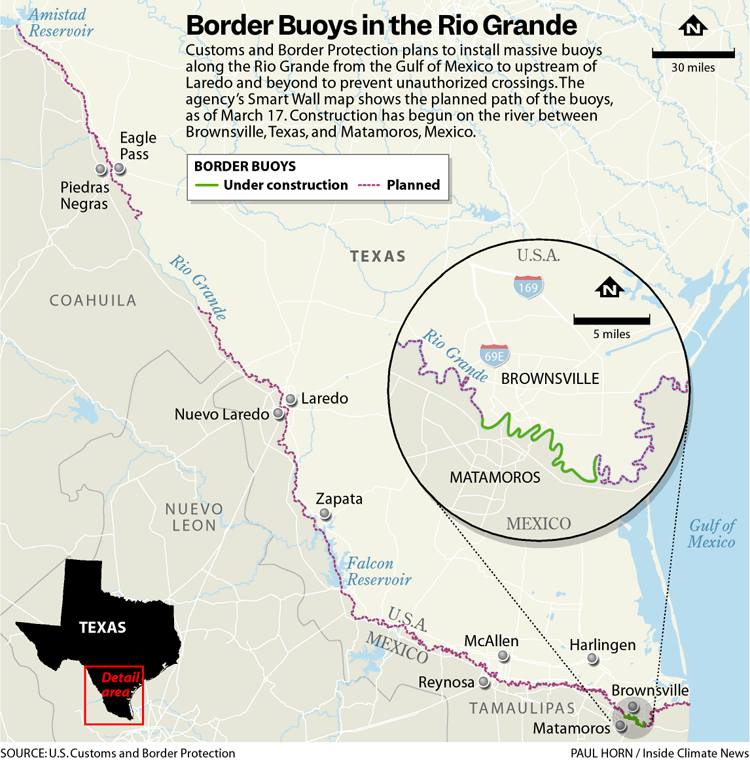
Contractors are installing a 17-mile stretch of cylindrical buoys in the river to prevent illegal crossings from Mexico. These are the first of 536 miles of buoys that the federal government plans to stretch from the Gulf of Mexico deep into South Texas. The Department of Homeland Security has waived environmental laws and issued more than $1 billion in contracts to private companies to install them in continuous chains. Each industrial-style buoy is more than 12 feet long and four to five feet in diameter.
Federal agencies have not made any environmental assessment or flood modeling for the border buoys available to the public. Experts have criticized the secrecy surrounding the project and warn that the buoys could intensify flooding and change the river channel.
Mark Tompkins, a geomorphologist who studies the flow of rivers and conducted an analysis of the buoys for a group opposed to their use, said the lack of public documentation violates the “basic professional standard of care” for projects of this magnitude. The city manager in Laredo, one community where the buoys are planned, said the city is working to obtain engineering and design information from federal agencies.
Experts consulted by Inside Climate News said they knew of no comparable undertaking on a dynamic river anywhere in the world. They warned that the buoys could speed up flood water in a region that already struggles with flooding. The buoys could also accumulate sediment and create new landforms in the river, provoking treaty disputes with neighboring Mexico. The buoys are planned through Cameron, Hidalgo, Starr, Zapata, Webb, Maverick and Val Verde counties.
“The design requirements for these barriers, set by CBP and implemented by contractors, mandate that they withstand a 100-year flood event—consistent with CBP established design standards,” a Customs and Border Protection (CBP) spokesperson told Inside Climate News. “Additionally, the barriers are engineered to endure increased currents and elevated water levels, ensuring operational reliability during extreme weather conditions.”
The spokesperson declined to provide any technical information about the design standards.
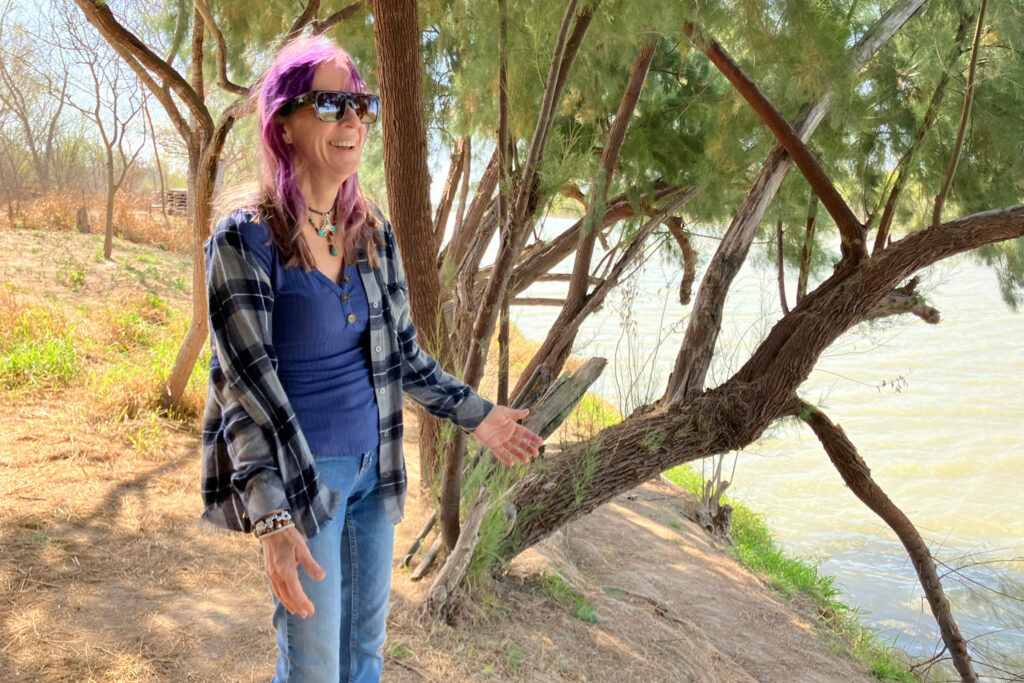
“This is an experiment on a continental scale,” said Elsa Hull, an environmental advocate and resident of Zapata County, near the buoy’s proposed path. “None of this is based on common sense or science.”
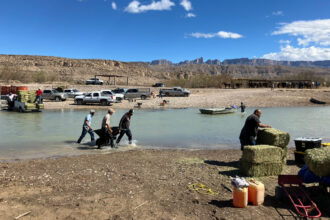
The buoys will also reduce access for boating, fishing and other recreation.
While local opposition grows, day by day, more buoys line the river.
Buoys Move Forward in Second Trump Administration
During the first Trump administration, in 2020, the U.S. Army Corps of Engineers sought solicitations for a “buoy barrier system.” That year the Border Patrol Academy posted, and later deleted, photos of a “buoy barrier demonstration” by the Virginia-based company Cochrane USA. The Army Corps of Engineers referred questions for this story to CBP.
The idea wasn’t implemented before Trump left office. But it resurfaced in July 2023, when the state of Texas installed 1,000 feet of buoys in the Rio Grande at Eagle Pass. The buoys provoked a diplomatic dispute with Mexico and a lawsuit from the federal government.
Unlike the buoys the federal government is now installing, the ones in Eagle Pass were spherical and segmented with saw blades. At least one person was found dead, trapped in the buoys. Advocates warned that the buoys made the dangerous trip across the Rio Grande even more deadly for migrants. More than 1,100 people died attempting to cross the Rio Grande between 2017 and 2023, according to a Washington Post investigation.
Despite the controversy in Eagle Pass, the Department of Homeland Security hatched a massive buoy project once Trump returned to office in 2025.
On July 3, Homeland Security Secretary Kristi Noem waived more than 30 federal laws in a 20-mile area along the Rio Grande in Cameron County to expedite the Waterborne Barrier Project’s first federal border buoys. Among those laws: the National Environmental Policy Act, the Endangered Species Act, the Migratory Bird Conservation Act and the Safe Drinking Water Act.
“A capability gap has been identified in waterways along the Southwest border where drug smuggling, human trafficking and other dangerous and illegal activity occurs,” Noem wrote.
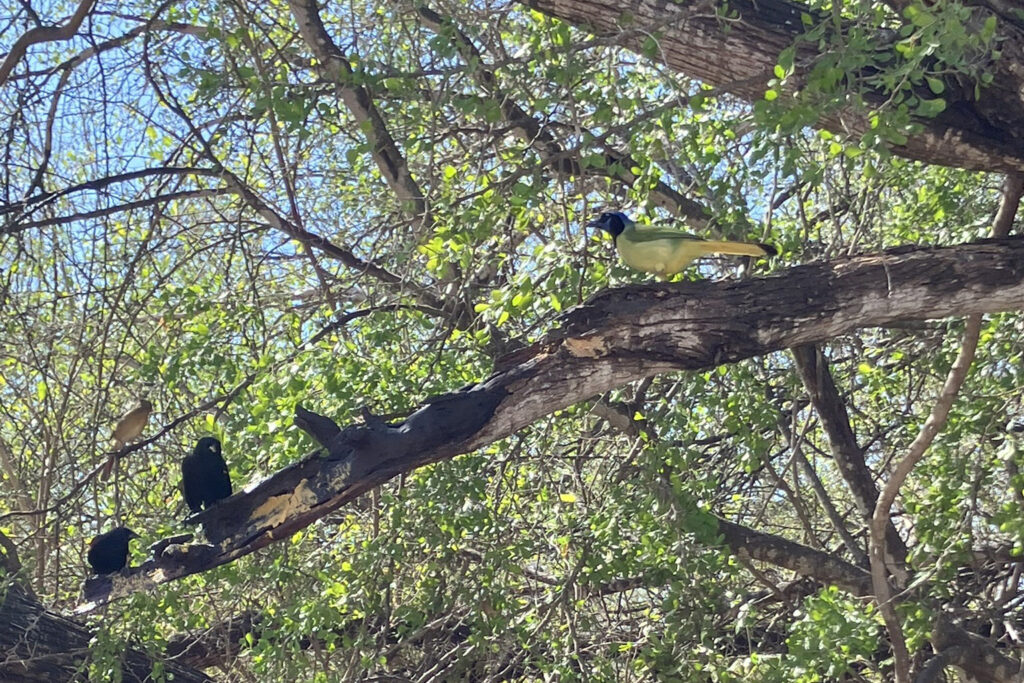
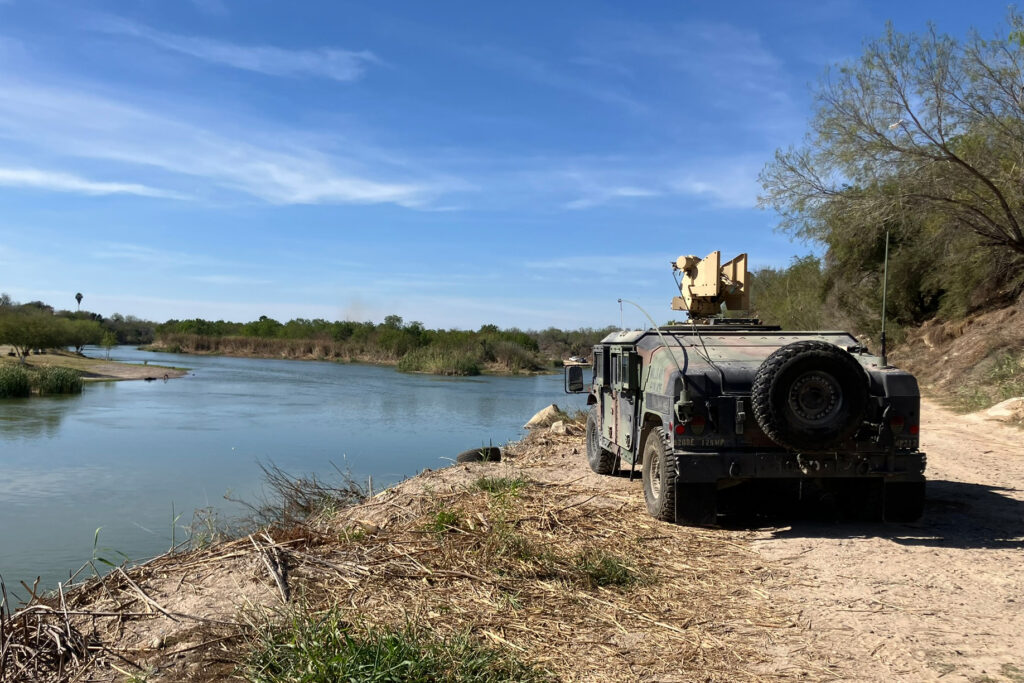
In October, Homeland Security waived contracting and procurement laws along the entirety of the U.S.-Mexico border to speed up construction. Since then, billions of dollars have been awarded to private contractors from the One Big Beautiful Bill Act for border fortifications.
The unprecedented expenditure comes as the number of unauthorized border crossings has dropped precipitously. CBP apprehended 73 percent fewer people in the Rio Grande Valley sector between fiscal years 2024 and 2025, according to agency data.
Noem traveled to Brownsville on Jan. 7 to announce the first buoys. CBP granted access to the conservative news outlet Washington Examiner to see the buoys installed. Border Patrol Chief Michael Banks explained to the reporter that the buoys are designed to roll when someone tries to climb on them.
“It prevents them from ever being able to climb up on it,” he told the reporter. He added that the buoys have been tested in pools with dive teams.
President Donald Trump announced on March 5 that he was replacing Noem as homeland security secretary; she leaves the position on March 31.
Unlike the Eagle Pass buoys, the new buoys are much larger, cylindrical and form a continuous barrier across the river.
BCCG Joint Venture was awarded a $96 million contract for the first 17-mile section of buoys in Brownsville. At this cost of $5.6 million per mile, the whole project would top $3 billion.
Inside Climate News reviewed federal contracts and identified seven along the Texas-Mexico border, totaling over $2.5 billion, that reference either “waterborne barriers” or “waterborne buoys.” Three contracts that referred exclusively to buoys and waterborne barriers totalled $1.22 billion. Another four contracts worth a total of $1.33 billion referenced both buoys and border wall construction.
Cochrane USA was awarded $641 million for “waterborne barrier construction.”
Tucson-based Spencer Construction LLC has obtained four contracts totaling $1.21 billion. Fisher Sand and Gravel, which built border walls later embroiled in legal challenges, was awarded a $316.7 million contract. SLS Federal Services LLC was awarded $382.3 million for waterborne and “vertical” barriers.
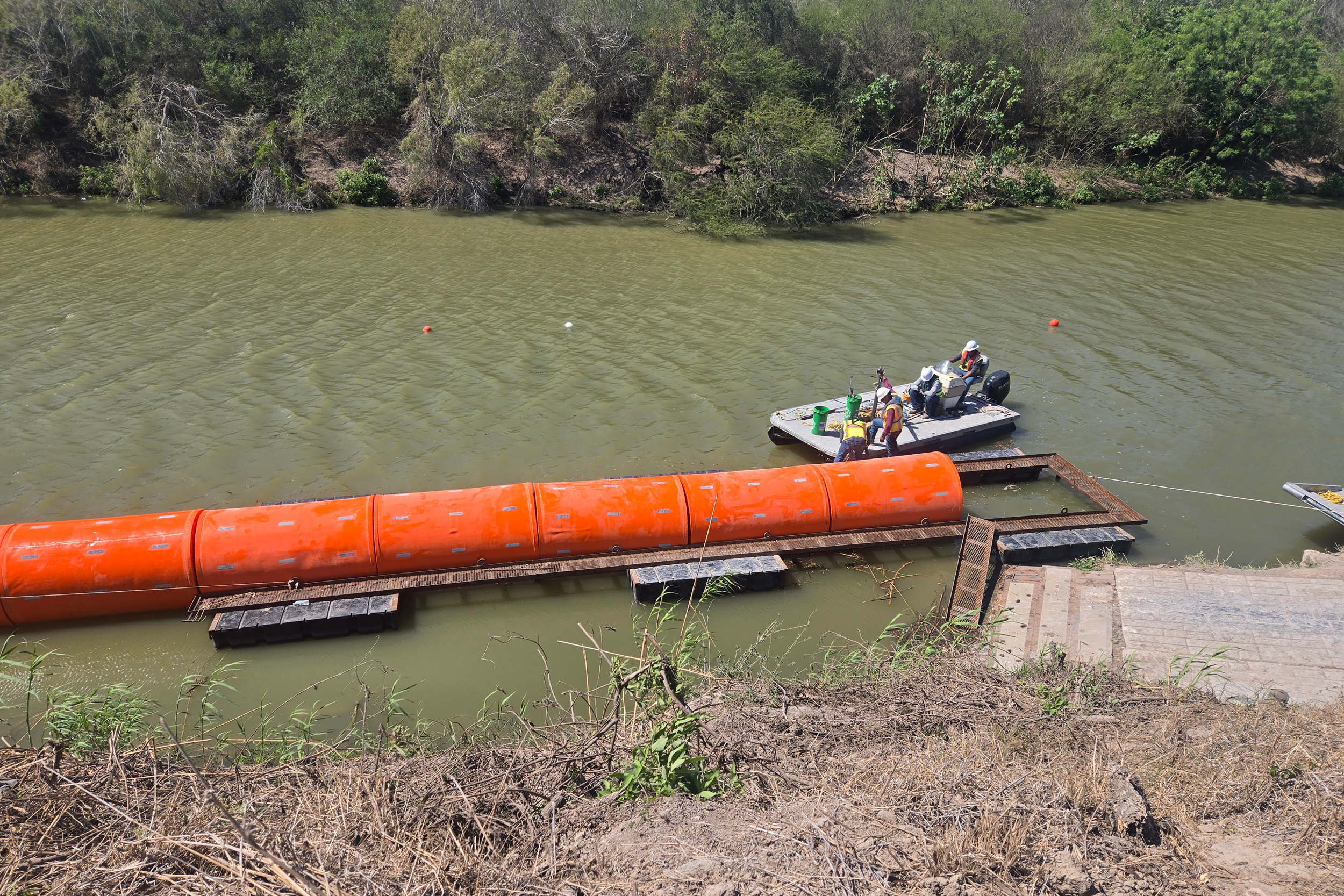
The federal waivers have allowed this unprecedented project to proceed with little scrutiny.
“The laws that have been waived were put in place specifically to protect communities from improperly built structures like the wall,” said Ricardo de Anda, a lawyer in Laredo whose property abuts the river. “The Environmental Policy Act would not have allowed the construction of these structures because they would damage the environment.”
The buoys are planned through the Laredo area, which to date does not have a physical border wall.
“The fact that they have waived these laws means they are creating a law-free zone along the border,” de Anda said. “The problem for the country is that if people become comfortable with that … then it’s coming your way.”
“Potentially Catastrophic”
In Laredo, landowners and local advocates successfully opposed border wall construction during the first Trump administration. Now, old networks are re-connecting to oppose both renewed efforts to build the wall and the buoys.
“There has been no comprehensive information from the feds,” said Tricia Cortez, executive director of the Rio Grande International Study Center in Laredo. “People need to be aware of this quiet, under the radar, but very aggressive move that the federal government is directing on us at the border.”
The organization decided to commission Tompkins, a geomorphologist with the consulting firm FlowWest, to conduct his own study on the potential impacts of the buoys.
Tompkins presented his findings to Laredo’s Rio Grande Riverfront Coordination Ad-hoc Advisory Committee on March 12. He warned that because of the federal waivers there is “a nearly complete lack” of technical information for the buoys.
Tompkins’ report cautions that the buoys could change the Rio Grande in “unpredictable, damaging, and potentially catastrophic ways.”
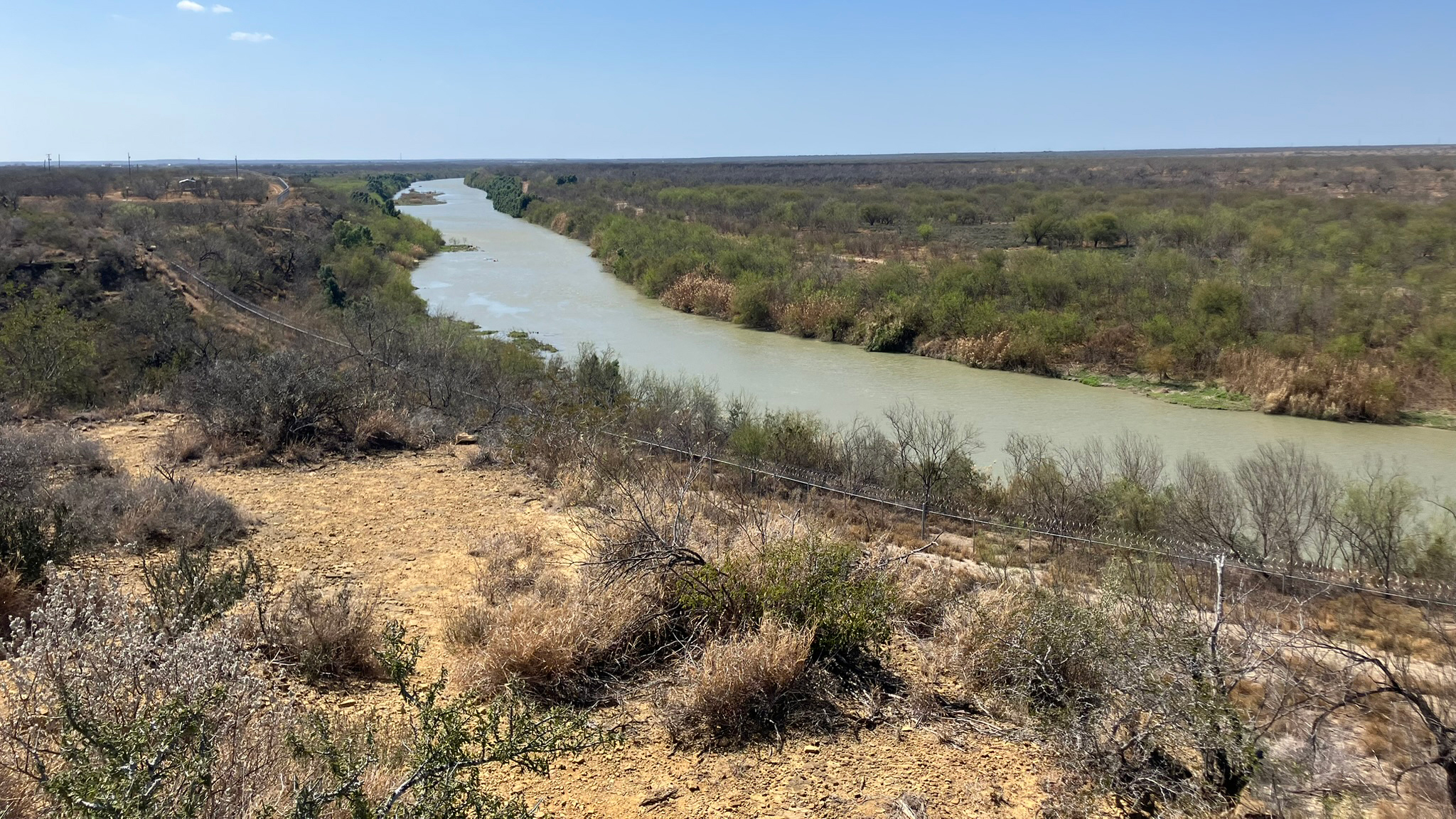
He explained that the Rio Grande picks up trash, debris and uprooted trees during floods. This debris forms “rafts” in the river that could accumulate along the proposed border wall and the border buoys. He said because the Rio Grande has a soft bed, the force of high flows could cause the anchors holding the buoys to break. “It is inevitable that portions of the buoy system will break free and portions of the [border] wall will fail,” he wrote.
“Even very small changes can have very big consequences,” Tompkins told the Laredo committee.
Laredo city manager Joseph Neeb put out a statement following the presentation. He acknowledged the concerns that Tompkins and the Rio Grande International Study Center have raised but cautioned that, in the absence of technical data, the study relied on assumptions. Neeb said the city is working to obtain technical information from CBP, the U.S. International Boundary and Water Commission and the Army Corps.
“Our responsibility is not only to act, but to act correctly,” Neeb wrote. “Any position taken by the City must be based on verifiable, project-specific information that can withstand technical and legal scrutiny.”
Adriana Martinez, a Southern Illinois University geomorphologist originally from Eagle Pass, has studied how the existing state buoys are changing water flows and sedimentation in the Rio Grande.
Drought has lowered the Rio Grande’s level in recent years. But Martinez referenced floods during Hurricane Alex in 2010, when several communities in the Rio Grande Valley were evacuated. She said she has “significant concerns” about how the buoys will act during flooding.
“What would happen if we did experience some of those bigger floods?” she asked.
She said the chains connecting the buoys in Eagle Pass to the riverbed would be tested, likening the design to holding a “giant dense yoga ball” underwater.
Martinez said the federal government’s cylindrical buoys will create an even larger impediment for the flow of water than the spherical ones. The water that the buoys divert has to find a new path, which can change the course of the river.
This story is funded by readers like you.
Our nonprofit newsroom provides award-winning climate coverage free of charge and advertising. We rely on donations from readers like you to keep going. Please donate now to support our work.
Donate NowLow water flows cause a separate set of problems, Martinez said. She observed in Eagle Pass how the buoys rested on a sand bar when the river was low. Vegetation started forming around the buoys. If this process continued, the sand bar could eventually form a new island.
The CBP spokesperson said the buoys will meet “CBP established design standards.”
The federal border wall has been damaged in floods on at least two occasions, both in Arizona. The U.S. Government Accountability Office found in a 2023 report that the border wall has exacerbated flooding.
The CBP spokesperson said the river will remain publicly accessible except in cases when Border Patrol determines conditions are “operationally unsafe.” However, even in normal conditions, the buoys will limit how people can use the river.
Buoys Could Violate U.S.-Mexico Treaty
While federal laws have been waived, the United States is still bound by its treaties with Mexico.
One federal agency that has been publicly silent on the buoys is the U.S. International Boundary and Water Commission (USIBWC). The U.S. and Mexico are signatories to several treaties dictating the sharing of binational waters and the international boundary. The USIBWC implements these treaties, along with its Mexican counterpart, the Comisión Internacional de Límites y Aguas.
In 2023, the USIBWC determined that most of the buoys installed by Texas were on the Mexican side of the river, in violation of treaty terms.
Upon taking office, Trump pushed out the commission’s popular leader, Maria-Elena Giner, who grew up in El Paso and worked for decades along the U.S.-Mexico border. He replaced her with Chad McIntosh, who previously worked for the Ford Motor Co., Michigan’s environmental regulator, and at the Environmental Protection Agency under Trump.
In response to a detailed list of questions from Inside Climate News, a USIBWC spokesperson only replied, “The USIBWC is fully supporting the Trump Administration’s efforts to secure the border.”
Samuel Sandoval Solis, a water resources professor at the University of California, Davis, said the buoys are likely to violate the 1970 U.S.-Mexico treaty. The treaty sought to resolve outstanding boundary disputes and laid out each country’s responsibility to preserve the international boundary.
The 1970 treaty states that both nations will not allow construction in their territory that could cause “deflection or obstruction” of the normal flow or flood flows of the river. The treaty states that if construction by one country causes “adverse effects” on the other country, the offending country must either remove the structures, repair the damage or compensate the other country.
Under the 1970 treaty, the United States would be responsible to repair any damage or compensate Mexico, according to Sandoval Solis.
“We are paying with our federal taxpayer dollars for the border wall and the buoys,” Sandoval Solis said. “But if things move we will also be paying for the restoration.”
The CBP spokesperson said the agency is working with the USIBWC “to ensure that the waterborne barriers deployed by CBP are placed in the United States and do not encroach into Mexico.” He did not respond to other questions about treaty compliance.
A Community Cut Off From Its River
Downstream in Brownsville, where buoys are beginning to line the river, environmentalists are raising the alarm.
On Feb. 24, the Cameron County commissioners voted in favor of a resolution presented by local advocates that opposes the border buoys.
“Unfortunately, the federal government, especially the current administration, doesn’t really inquire as to our concerns,” said County Judge Eddie Treviño Jr., a Democrat, before voting in favor.
He said there are “numerous questions” about the short- and long-term impacts of the buoys.
The vote came the week of Brownsville’s Charro Days, an annual celebration when colorful parades fill downtown streets and the city celebrates its close ties to Mexico. Residents of neighboring Matamoros, Tamaulipas, join in the festivities featuring mariachis and regional Mexican music.
This year, while charrería dancers paraded down Elizabeth Street, contractors were busy placing buoys in the Rio Grande. Bekah Hinojosa, a longtime local activist with the South Texas Environmental Justice Network, spent a morning driving backroads in Brownsville’s Southmost neighborhood searching for a place where she could see the border buoys.
Hinojosa lamented that even in her lifetime, border wall construction and industrial development have significantly restricted access to the Rio Grande and the Gulf of Mexico. She said the new wall construction and border buoys are just the latest step in disconnecting Rio Grande Valley residents from the river and natural spaces.
“Rivers are meant to bring people together,” she said. “These buoys are going to be an ecological disaster.”
She rushed back to downtown Brownsville to prepare for an afternoon protest against the border buoys.
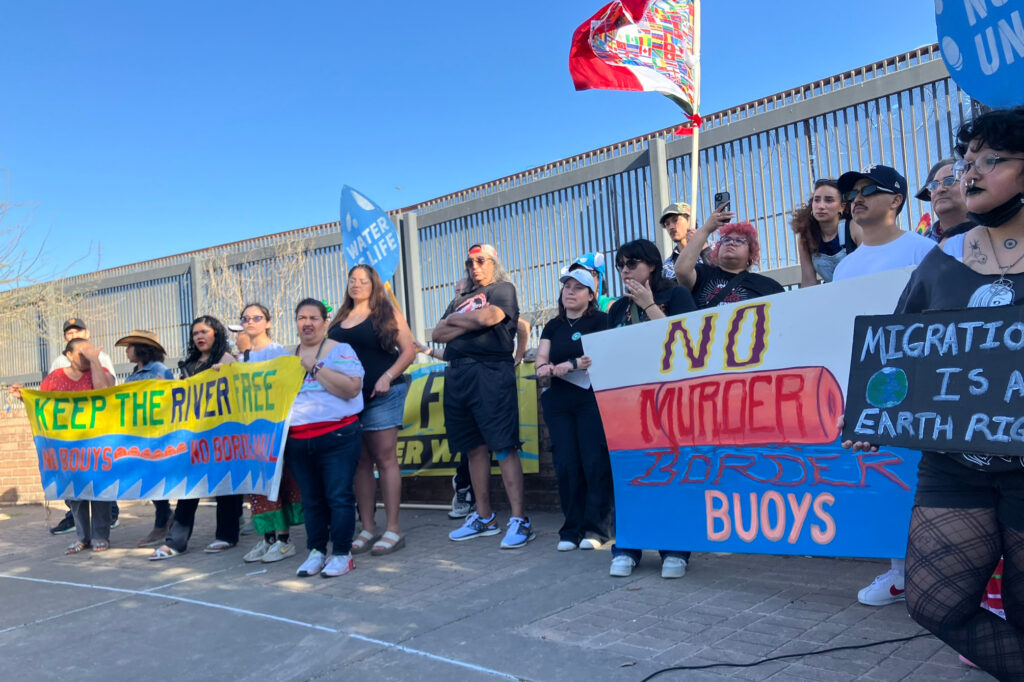
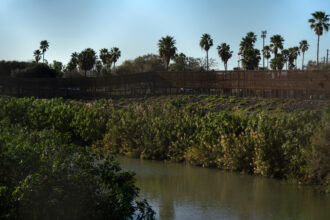
Dozens of people gathered at a postage stamp park in downtown Brownsville for the protest. On the other side of the steel border wall, the placid Rio Grande flowed toward its terminus at the Gulf of Mexico. Border Patrol vehicles circulated on a levee road in between the river and the wall, rolling slowly past the protest. Cars sat in traffic on the international bridge into Matamoros.
Elsa Hull arrived from Zapata County with a banner denouncing the border buoys. River guide Jessie Fuentes drove the five hours from Eagle Pass to share his experience after the first buoys went into the river. Juan Mancias, chairman of the Carrizo/Comecrudo Tribe, spoke to the long history of human settlement along the river delta. He reminded the crowd that rivers don’t respect international boundaries.
They spoke in defense of the Rio Grande, which distant federal officials call a dangerous frontier that must be barricaded. But the people assembled on its banks in Brownsville embrace it as a part of their home worth protecting.
About This Story
Perhaps you noticed: This story, like all the news we publish, is free to read. That’s because Inside Climate News is a 501c3 nonprofit organization. We do not charge a subscription fee, lock our news behind a paywall, or clutter our website with ads. We make our news on climate and the environment freely available to you and anyone who wants it.
That’s not all. We also share our news for free with scores of other media organizations around the country. Many of them can’t afford to do environmental journalism of their own. We’ve built bureaus from coast to coast to report local stories, collaborate with local newsrooms and co-publish articles so that this vital work is shared as widely as possible.
Two of us launched ICN in 2007. Six years later we earned a Pulitzer Prize for National Reporting, and now we run the oldest and largest dedicated climate newsroom in the nation. We tell the story in all its complexity. We hold polluters accountable. We expose environmental injustice. We debunk misinformation. We scrutinize solutions and inspire action.
Donations from readers like you fund every aspect of what we do. If you don’t already, will you support our ongoing work, our reporting on the biggest crisis facing our planet, and help us reach even more readers in more places?
Please take a moment to make a tax-deductible donation. Every one of them makes a difference.
Thank you,

Martha Pskowski
Reporter, El Paso, Texas
Martha Pskowski covers climate change and the environment in Texas from her base in El Paso. She was previously an environmental reporter at the El Paso Times. She began her career as a freelance journalist in Mexico, reporting for outlets including The Guardian and Yale E360. Martha has a B.A. in Environmental Studies from Hampshire College and a master’s degree in Journalism and Latin American Studies from New York University. She is a former Fulbright research fellow in Mexico. Martha can be reached on Signal at psskow.33.