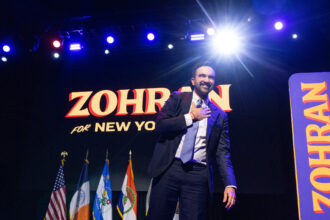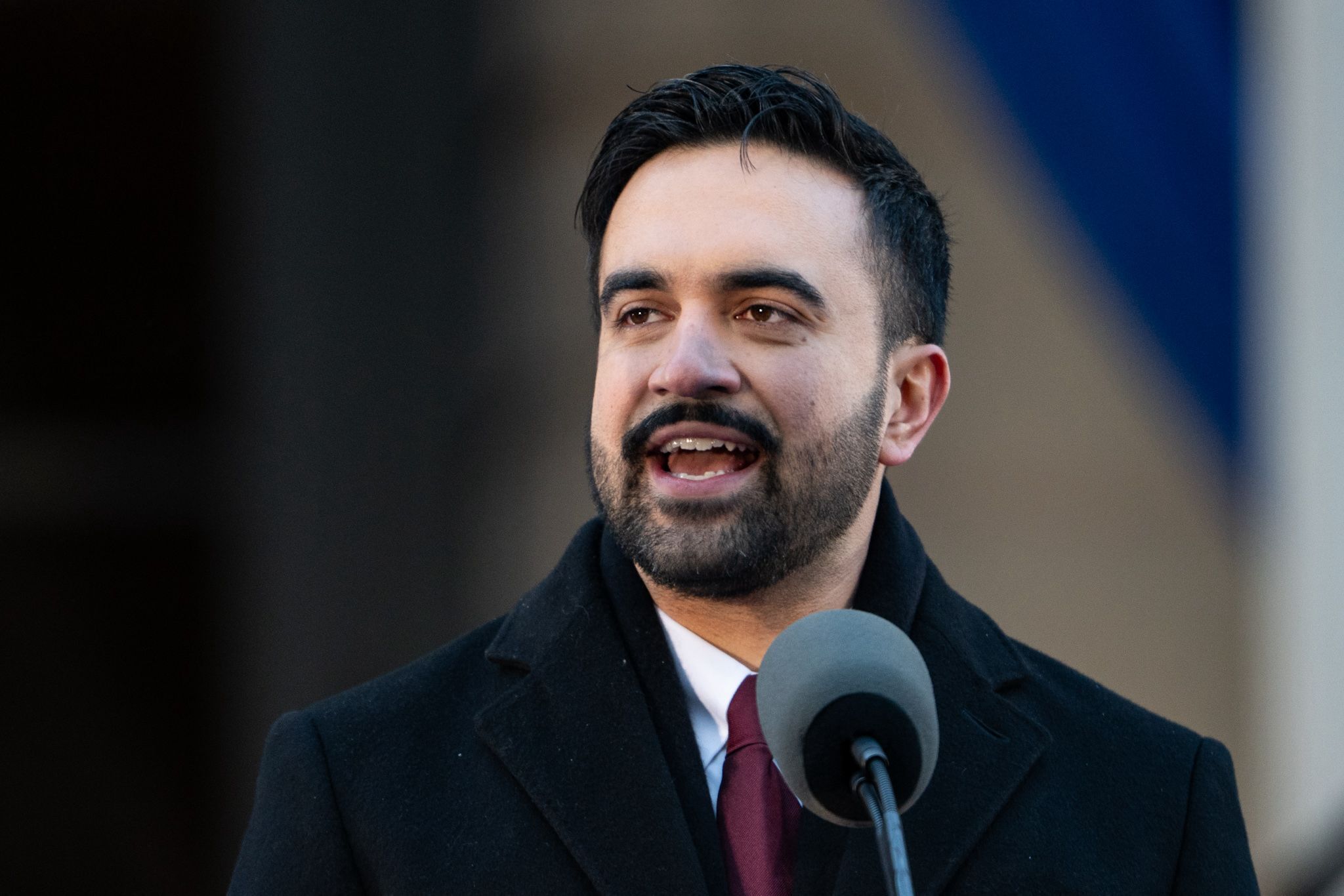


Climate advocates in New York City celebrated when Zohran Mamdani won the mayoral election, applauding his history of opposing the expansion of gas infrastructure in the city and his framing of climate action as important to his affordability agenda. Now, those advocates will closely monitor how he addresses the city’s pressing climate issues, including flooding, heat and pollution.
As he put it in his inaugural address, “every blizzard and flood we withstand, together.” The question of how well New Yorkers withstand them, and how the city responds, rests in part in the hands of the Mamdani administration. And it’s a heavy burden.
According to the city’s 2024 report on environmental justice, nearly half of the city’s population lives in an environmental justice community—an area that has historically been overburdened with environmental hazards such as air pollution.
Under local law, the city must now develop a plan of action to mitigate the environmental issues in these communities. This plan, likely to be released under Mamdani, could meaningfully address the concerns of residents who are disproportionately low-income and non-white.
Summer Sandoval, who worked on the environmental justice report, would like to see more clean energy opportunities for these communities, especially since they often face high levels of air pollution in their neighborhoods due to highways and gas power plants. Sandoval is now the community investment and implementation director of the Urban Sustainability Directors Network.
“I think it’s a very important issue of not only having access to clean energy, but having access to affordable and reliable energy,” Sandoval said. “It’s going to significantly impact people’s quality of life.”
Under former Mayor Eric Adams, City Hall expanded city zoning to allow more solar panels and battery storage to be built in the city. His administration also launched the Blue Highways Pilot Program, part of a larger plan to shift some freight entering the city from roads to waterways—limiting pollution from trucks in environmental justice communities near highways.
Advocacy groups have also pushed for City Hall to dedicate 1 percent of the city’s budget to the Department of Parks and Recreation, which cares for the city’s green spaces, nearly 14 percent of the city. Under Adams, the department’s budget hovered around 0.6 percent.
Chronic underfunding of the department means that parks in low-income neighborhoods often receive less maintenance work. Wealthier areas’ green space, like Central Park or Prospect Park, receive independent funding through conservancies—nonprofits that help fill those gaps.
Hanging over all that, federal funding for environmental justice communities has sharply declined. The Biden administration spearheaded multiple efforts to improve the lives of these communities, while the Trump administration has pulled back.
“That has never stopped New York before,” said Sandoval, “and it shouldn’t now in terms of the city working very closely with the state to create local and state resources that are necessary to address local environmental justice issues.”
520 Miles of Coastline
When New Yorkers think about flooding, Hurricane Sandy looms large. In 2012, it killed 44 city residents, destroyed 300 homes and caused over $19 billion in damages.
The disaster kickstarted the flood resilience conversation in the city, triggering the formation of plans to prevent the “surrender to the sea,” according to Rob Freudenberg of the Regional Plan Association, a civic organization that has conducted research into local flooding problems.
Flooding along the city’s 520 miles of coastline is a significant concern, especially with sea level rise and the likelihood of more frequent and devastating storms due to climate change.
According to a 2025 report by the Regional Plan Association, New York City, the Long Island counties of Nassau and Suffolk and Westchester County, just north of the city, could lose as many as 82,000 housing units due to “permanent, chronic and coastal flooding” by 2040.
Currently, the city has a mix of plans to protect lower Manhattan from storm surge, nicknamed the “Big U.” Developed with a combination of city, state and federal funds, the plan is designed to protect the Financial District and surrounding neighborhoods from coastal storms.
Projects like the East Side Coastal Resiliency Project, which raised a waterfront park by 10 feet to protect nearby residents, will become a feature of the lower Manhattan waterfront. The city is likely to employ a combination of natural solutions, like parks, and hard infrastructure, such as floodwalls, to curb storm-related flooding. Green areas can absorb a lot of stormwater, preventing it from flooding the streets.
Park advocacy groups have been pushing for more park funding for years, in part to better combat the city’s climate pressures. Mamdani has pledged to allocate 1 percent of the city budget to parks and has appointed Tricia Shimamura as the commissioner of the city’s Department of Parks and Recreation. She was previously Manhattan borough commissioner at the department.
The city also has tentative plans to protect areas of Staten Island, Brooklyn and Queens from potential disaster. In Staten Island, the city built hard structures off the island’s coast to break up potential large waves and fitted the structures with small holes to provide habitat for marine life.
In New York, the risk of flooding is not just coming from the coasts; it’s also coming from the skies. As the climate changes, New Yorkers are likely to experience more short bursts of heavy rain—“rain bombs,” as Bill Ulfelder, the executive director of The Nature Conservancy in New York, described them.
“[The new administration] needs to make sure that there’s good coordination between the coast and the areas that flood inland,” said the Regional Plan Association’s vice president of energy and environmental programs Freudenberg. “They’re too often kept separate in approaches.”
Freudenberg hopes to see changes to the city’s flood policy. He believes that a neighborhood-by-neighborhood approach that identifies all flooding sources in an area, along with potential solutions, would offer a clearer picture and enable more coordinated city policy under a new mayoral administration.
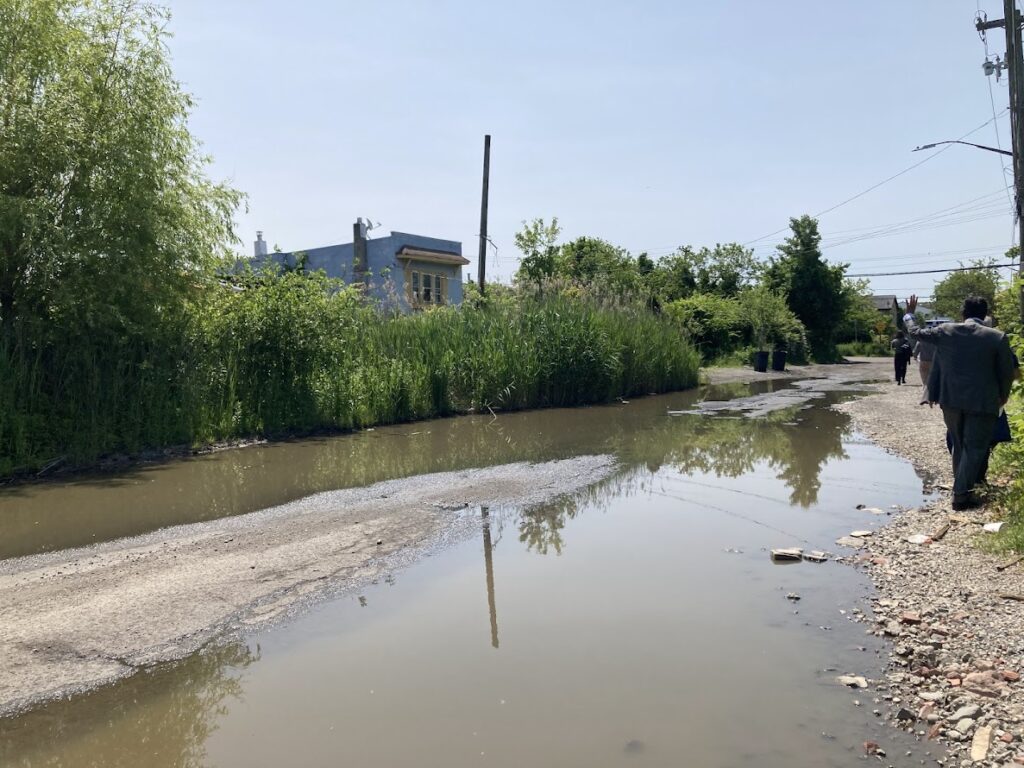
The city has a long history of project-by-project approaches to flooding, Freudenberg says. Under Adams, the city addressed rainfall flooding through a combination of policies such as sewer upgrades and the Cloudburst Management program, which uses a combination of infrastructure and natural solutions to absorb water, preventing street flooding that could overwhelm the sewer system.
The city’s myriad flooding problems may also complicate Mamdani’s campaign promise to build over 200,000 new affordable housing units over the next decade. According to the Regional Plan Association, approximately 77,300 acres, or just over 10 percent, of residential-zoned land could face future flooding.
If the new mayor’s eventual housing policy does not consider future flood risk, his administration may end up building housing units that will be uninhabitable in a few decades. City policy, Freudenberg said, also needs to provide options to those who already live in areas with high flood risk.
“This mayor no longer has the luxury of being a one-issue mayor,” said Freudenberg. “You can be an affordability mayor, you can be a housing mayor—but in order to truly succeed, you need to be a resilience and adaptation mayor at the same time.”
50,000 Polluting Buildings
The city’s building decarbonization law was a hot-button issue during the mayoral race. Local Law 97, passed in 2019, imposes gradually escalating limits on greenhouse gas emissions from large city buildings—starting in 2024.
According to the Urban Green Council, a nonprofit focused on building decarbonization, and energy benchmarking data, around 92 percent of buildings comply with last year’s limit. The more stringent limits will come in 2030, 2035 and 2040. Co-op and condominium owners are concerned about the cost of complying with these limits, which can sometimes require replacing a building’s heating system.
“We’re looking at the next four years and seeing that the priorities are pretty clear, it’s to reduce costs and simplify the process,” said Chris Halfnight, chief operating officer at the Urban Green Council, who served on the Mamdani transition team.
Over the course of his campaign, Mamdani suggested that the city could bulk-buy equipment like heat pumps, which are central to decarbonizing a building’s heating system, in order to provide them at lower prices to some building owners. He also said he wanted to “make it easier” for co-op and condominium owners to comply with the law.
Advocates like Halfnight will be closely watching how Mamdani approaches this issue. Many climate activists were unhappy with how Adams implemented the law. They have advocated for limits on the purchase of renewable energy certificates, which represent electricity generated by a renewable source, to mitigate fines.
This story is funded by readers like you.
Our nonprofit newsroom provides award-winning climate coverage free of charge and advertising. We rely on donations from readers like you to keep going. Please donate now to support our work.
Donate NowImplementing the law stringently while still offering pathways to limit the cost of decarbonization has proven to be a delicate balance. Halfnight and his organization hope the mayor will expand his bulk-purchase campaign proposal to a one-stop shop for compliance with the law.
A program like this would call for the city to bulk-purchase equipment and installation services—hopefully making the process faster and cheaper. The program, Halfnight said, would be funded by public money at first and would ultimately be repaid by building owners through property taxes.
“There’s been some signs from the administration that this approach really aligns well with a joint climate and affordability focus,” said Halfnight.
Climate hazards in the city intersect with a variety of quality-of-life issues, and the Mamdani administration will be scrutinized for how it handles them.
“The elephant in the room is climate change,” said Ulfelder of The Nature Conservancy. “New York City … is unbelievably vulnerable in a climate-changing world.”
About This Story
Perhaps you noticed: This story, like all the news we publish, is free to read. That’s because Inside Climate News is a 501c3 nonprofit organization. We do not charge a subscription fee, lock our news behind a paywall, or clutter our website with ads. We make our news on climate and the environment freely available to you and anyone who wants it.
That’s not all. We also share our news for free with scores of other media organizations around the country. Many of them can’t afford to do environmental journalism of their own. We’ve built bureaus from coast to coast to report local stories, collaborate with local newsrooms and co-publish articles so that this vital work is shared as widely as possible.
Two of us launched ICN in 2007. Six years later we earned a Pulitzer Prize for National Reporting, and now we run the oldest and largest dedicated climate newsroom in the nation. We tell the story in all its complexity. We hold polluters accountable. We expose environmental injustice. We debunk misinformation. We scrutinize solutions and inspire action.
Donations from readers like you fund every aspect of what we do. If you don’t already, will you support our ongoing work, our reporting on the biggest crisis facing our planet, and help us reach even more readers in more places?
Please take a moment to make a tax-deductible donation. Every one of them makes a difference.
Thank you,

Lauren Dalban
Reporter, New York City
Lauren Dalban is a New York City-based reporter with a background in local journalism. A former ICN fellow, she now covers environmental issues in all five boroughs. Originally from London, she earned a B.A. in History and English from the University of Virginia, and an M.S. from Columbia Graduate School of Journalism.