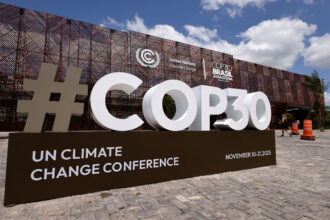


After yet another international climate summit ended last fall without binding commitments to phase out fossil fuels, a leading global climate model is offering a stark forecast for the decades ahead.
The Massachusetts Institute of Technology’s (MIT) “2025 Global Change Outlook” finds the world on track to exceed key climate thresholds under current policies, even as renewable energy expands rapidly. Released amid stalled global cooperation and the United States’ withdrawal from major climate commitments, the report projects continued emissions growth and dangerous levels of warming by the end of the century.
The outlook is based on MIT’s Integrated Global Systems Model framework (IGSM), which links population growth, economic activity, energy use and international policy decisions to changes in the climate system. The United Nations Framework Convention on Climate Change has described it as “a comprehensive tool built to analyze interactions among humans and the climate system.”
“The current trends are very concerning,” said Sergey Paltsev, co-author of the “Global Change Outlook” and deputy director of MIT’s Center for Sustainability Science and Strategy. “We are nowhere near the stated goals of the Paris Agreement.”
Under current trends, the model projects a rapid expansion of renewable energy, led by wind and solar, with renewables supplying more than 70 percent of global electricity by 2050—up from roughly 40 percent today. It also finds that, despite U.S. efforts to revive the coal industry, global coal consumption is expected to continue declining.
Those gains from renewable energy are largely offset by ongoing economic and population growth. Global greenhouse gas emissions are expected to rise until around 2030, driven primarily by growth in developing countries, while emissions in developed nations, as well as in China and India, remain largely stagnant. Much of this increase comes from continued use of liquid fuels and natural gas. Between 2030 and 2050, emissions are projected to decline slowly, only to rise again later in the century, partly due to agricultural emissions linked to population growth.
With no significant emissions reductions on the horizon, the model projects global temperatures are likely to surpass 1.5 degrees Celsius within the next few years, reach roughly 1.8 degrees by 2050, and approach 3 degrees by 2100. These projections represent the model’s “middle of the road path,” or most likely outcome. Across hundreds of simulations, some outcomes show far greater warming, while others fall below that central estimate.
“The findings align with other models and with my own modeling from about a decade ago,” said Ross Salawitch, an atmospheric researcher and climate modeler at the University of Maryland. According to Salawitch, political challenges and energy demand exceeding early projections explain why emissions reductions are not yet clearly reflected in current long-term projections.
More recent independent analyses point to similar outcomes. Rhodium Group estimates “middle-of-the-road” warming of about 2.7 degrees by century’s end, while Climate Action Tracker projects 2.5 degrees to 2.9 degrees, depending on future policy.
Keeping global warming below 1.5 degrees has long been a central goal of the international climate framework. Exceeding the threshold risks triggering critical tipping points and causing irreversible damage. The Paris goal of 1.5 degrees is a global average that masks regional extremes that are, in some cases, two to three times larger, meaning many places experience average warming of 3 degrees to 4.5 degrees Celsius (5.4 degrees Fahrenheit to 8.1 degrees Fahrenheit).
The European Union’s Copernicus Climate Change Service report released last week ranked 2025 as the third-warmest year on record, just a hair cooler than 2023 and within striking distance of 2024, the hottest year on record. Together, the past three years averaged more than 1.5 degrees Celsius above pre-industrial temperatures, the first time any three-year stretch has crossed that threshold.
“Any increase in temperature is an indication that the global system is taking on more energy,” said Adam Schlosser, co-author of the “Global Change Outlook” and deputy director at MIT’s Center for Sustainability Science and Strategy. “That energy has to go somewhere and it shows up as more intense and/or frequent extreme events.”
In addition to fueling deadly heat waves that already kill over half a million people each year, rising global temperatures are projected to intensify extreme weather, make precipitation more erratic, increase the risk of drought and disrupt agricultural production worldwide. The outlook warns these shifts would also accelerate biodiversity loss.
Despite the grim outlook, there is still reason for hope. The report also outlines “accelerated actions”—projections of emissions and climate outcomes if strong economic and policy commitments are implemented.
This story is funded by readers like you.
Our nonprofit newsroom provides award-winning climate coverage free of charge and advertising. We rely on donations from readers like you to keep going. Please donate now to support our work.
Donate Now“Two years ago, governments promised to triple renewable energy, double efficiency and act on methane.” Bill Hare, CEO and senior scientist at Climate Analytics, said in a statement. “Our results show if they achieved this by 2035 it would be a game-changer, quickly slowing the rate of warming in the next decade and lowering global warming this century from 2.6 degrees to about 1.7 degrees.
Achieving rapid electrification and decarbonization will demand substantial public and private investment, coordinated global commitments and a robust regulatory framework. “There’s no one magic bullet,” Paltsev said.
Even if these actions are realized, warming is still expected to exceed 1.5 degrees by 2050, under almost every IGSM projection. In some scenarios, by 2150, global temperatures could return to 1.5 degrees after a brief period of cooling.
“We are more than likely going to overshoot,” Schlosser said. “The question then becomes for how long and how strong.”
“It’s not a reason to give up hope or stop the necessary action,” Paltsev said. “Limiting every degree possible matters, even every tenth of a degree.” Small differences can determine how many lives are lost, how much land becomes uninhabitable and how severe the damage ultimately becomes.
About This Story
Perhaps you noticed: This story, like all the news we publish, is free to read. That’s because Inside Climate News is a 501c3 nonprofit organization. We do not charge a subscription fee, lock our news behind a paywall, or clutter our website with ads. We make our news on climate and the environment freely available to you and anyone who wants it.
That’s not all. We also share our news for free with scores of other media organizations around the country. Many of them can’t afford to do environmental journalism of their own. We’ve built bureaus from coast to coast to report local stories, collaborate with local newsrooms and co-publish articles so that this vital work is shared as widely as possible.
Two of us launched ICN in 2007. Six years later we earned a Pulitzer Prize for National Reporting, and now we run the oldest and largest dedicated climate newsroom in the nation. We tell the story in all its complexity. We hold polluters accountable. We expose environmental injustice. We debunk misinformation. We scrutinize solutions and inspire action.
Donations from readers like you fund every aspect of what we do. If you don’t already, will you support our ongoing work, our reporting on the biggest crisis facing our planet, and help us reach even more readers in more places?
Please take a moment to make a tax-deductible donation. Every one of them makes a difference.
Thank you,