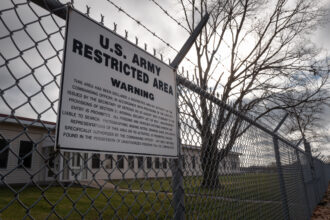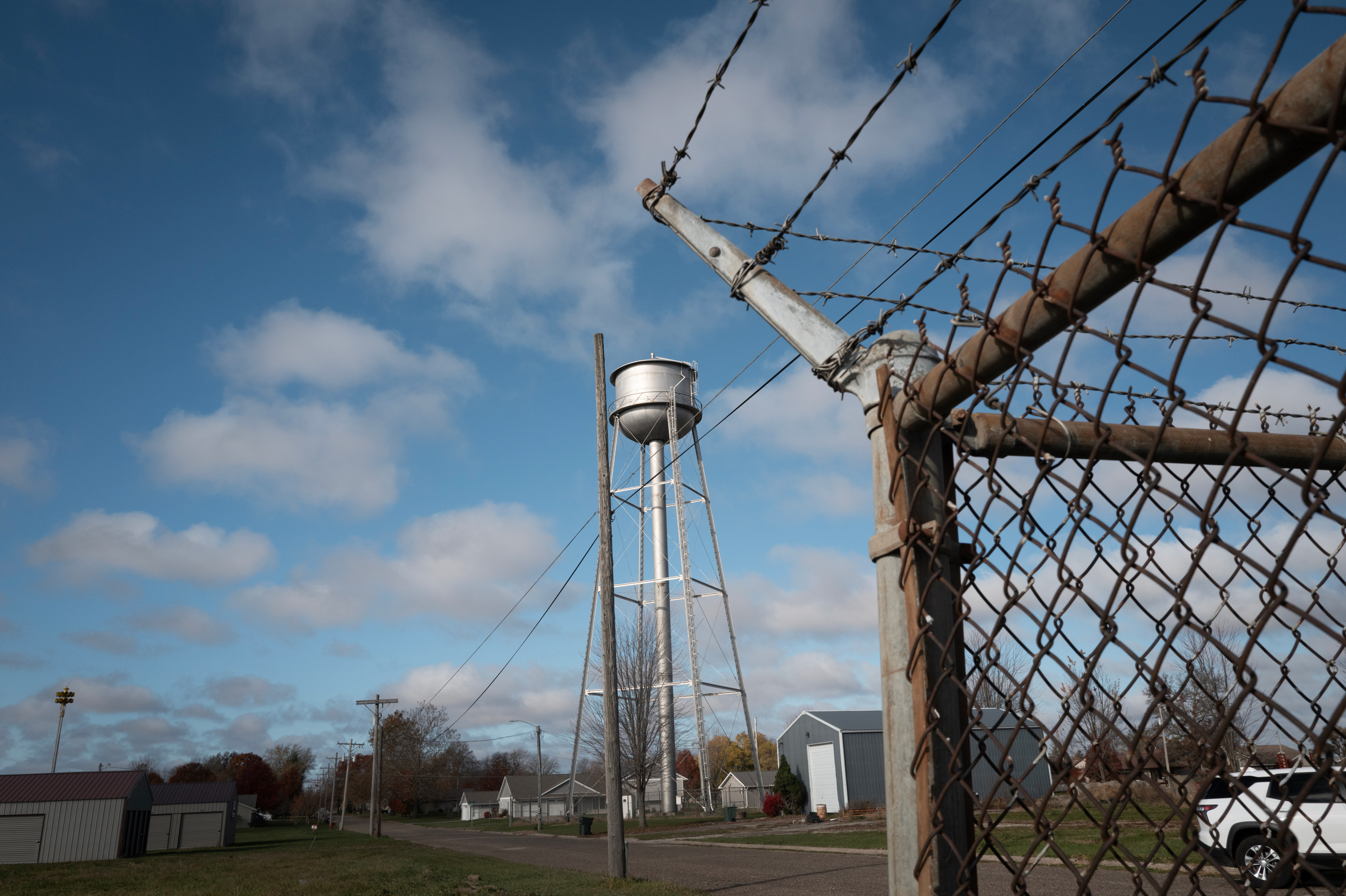


The U.S. Army’s planned detonation of nearly 5 tons of unstable lead azide explosives in southeast Iowa on Wednesday morning will have long-lasting impacts on human health and the environment, experts warn.
Even with mitigation measures in place, such as blast containment walls and water misters, the controlled detonation of bomb-making materials in Middletown will release a toxic dust cloud that the Army projects will travel over 100 miles to the southwest.
There is no safe level of lead, which can damage the brain, nervous system and reproductive health and is particularly harmful to young children. Scientists and health professionals warn that lingering contamination after the detonation, particularly in the air and soil, could pose problems long after the blast for residents in the plume’s path and beyond.
“It’s important to take this seriously, and make sure that everybody’s watching and making sure that the kids are not being exposed,” said Mary Jean Brown, a public health expert and former chief of the lead poisoning prevention branch at the Centers for Disease Control and Prevention.
Following the planned 9 a.m. detonation Wednesday, airborne lead particles will likely travel southwest, over the Missouri River and across Iowa’s border into Missouri. The Iowa Department of Health and Human Services has advised residents in the plume’s path to shelter in place for 24 to 48 hours after the blast.
The Army is encouraging residents within an evacuation cone five miles southwest of the ammunition plant to leave the area for several days. The Federal Emergency Management Agency will help evacuate and shelter residents in that zone. They have offered lodging through Friday, Nov. 27, but say individuals can reach out if they need more flexibility.
Expert Advice to Stay Safe From the Lead Blast
The U.S. Army plans to detonate nearly 5 tons of degraded lead azide explosives on Wednesday in Middletown, Iowa, sending a cloud of toxic lead dust potentially more than 100 miles to the southwest. Here are tips for people within the plume’s path.
- Evacuate if advised.
- Stay inside for the first 24 to 48 hours.
- Wash hands and surfaces often in the weeks after the event, especially before eating.
- Wear an N95 mask outdoors, especially when washing surfaces like cars and sidewalks.
- Take off your shoes before entering your home to avoid bringing settled lead dust inside.
- Test your young children’s blood lead levels routinely.
The Sheriff’s Office for Lee County, south of Middletown, issued a public notice on Tuesday that Army soldiers will go door to door to notify residents of the recommended evacuation.
Evacuation is especially important for vulnerable residents, including pregnant people or families with children under 6, Brown said, adding that leaving the area would be “the very best thing.” Lead can contribute to preterm labor, low birth weight, preeclampsia, neurocognitive and developmental delays, heart and kidney issues and other problems.
In a Tuesday news release, Environmental Protection Agency officials wrote that “a controlled detonation during optimal weather conditions and incorporating robust mitigation measures, compared to an uncontrolled explosion, significantly reduces the potential reach and concentration of lead dust landing on surfaces, such as homes and windows.”
How far airborne lead particles travel after the explosion will depend on their size and weather conditions, factors that will become clearer after the detonation. Smaller particles may travel farther and remain airborne longer, while heavier ones may settle closer to the site within a couple of days.
Snow and rainfall can make lead settle more quickly, lowering the particles out of the atmosphere and onto the ground. Although lead could remain airborne for a week or two after the explosion, it will likely be diluted and spread out, said Nico Perdrial, associate professor of geoscience and faculty fellow at the University of Vermont’s Gund Institute for Environment.
This story is funded by readers like you.
Our nonprofit newsroom provides award-winning climate coverage free of charge and advertising. We rely on donations from readers like you to keep going. Please donate now to support our work.
Donate NowFor Perdrial, the biggest concern is that the explosion will add more lead to the environment, increasing risk of chronic exposure.
“Over the long term, it’s gonna end up in the soil,” Perdrial said. “Lead in the environment means accumulation of lead in the body.”
Low levels of lead can occur naturally in soil, but dust from the explosion and runoff from outdoor surfaces in the days afterward could significantly raise those levels, said Gabriel Filippelli, a biogeochemist and executive director of the Environmental Resilience Institute at Indiana University.
Once airborne lead settles onto surfaces, residents should take steps to minimize the likelihood of touching and ingesting it.
For the next few weeks, Perdrial suggested that people in the path of the plume and surrounding areas should keep dust out of their homes, wash hands and surfaces frequently, and store shoes outside the house.
“People should be trying to be less in contact with dust, less in contact with fine particles when they go outside,” he said.
Residents in and around the plume’s path should wipe down all surfaces inside their homes with a wet rag, even if they kept their windows closed and turned off any heating and cooling systems during the blast, said Filippelli.
Dr. Juanita Mora, a medical spokesperson for the American Lung Association and Chicago-based allergist and immunologist, suggested residents wear an N95 mask outdoors for the first 72 hours after the explosion and when cleaning cars, sidewalks or windowsills in the weeks that follow. Mora also advised filtering and recirculating air in their cars and avoiding the plume’s path while traveling over the Thanksgiving holiday.
“Don’t think that you’re safe just because you’re a few miles away,” Mora warned. “Remember, the wind can definitely bring this lead dust near you or near your area of living.”
Brown, the former CDC lead expert, emphasized that testing young children’s blood lead levels is always good practice, and even more critical after an exposure event like this.
It is difficult to fully predict how lead will disperse after the explosion. That’s why environmental monitoring for lead in the air and soil before and after is critical, experts agree.
In addition to monitoring led by the EPA and the Army, Iowa scientists have mobilized to conduct their own sampling. David Cwiertny, director of the University of Iowa Center for Health Effects of Environmental Contamination, is among them. “In an unprecedented event with so many unpredictable factors, we believe that having more independent data is always better for public transparency and for public health,” he said.
At a Tuesday morning press conference, acting Army Secretary Adam Telle said the Department of Defense is investigating every weapon storage facility nationwide “to ensure that something like this never happens again.”
“Any scientist would agree that any amount of lead exposure is unacceptable,” Telle said.
About This Story
Perhaps you noticed: This story, like all the news we publish, is free to read. That’s because Inside Climate News is a 501c3 nonprofit organization. We do not charge a subscription fee, lock our news behind a paywall, or clutter our website with ads. We make our news on climate and the environment freely available to you and anyone who wants it.
That’s not all. We also share our news for free with scores of other media organizations around the country. Many of them can’t afford to do environmental journalism of their own. We’ve built bureaus from coast to coast to report local stories, collaborate with local newsrooms and co-publish articles so that this vital work is shared as widely as possible.
Two of us launched ICN in 2007. Six years later we earned a Pulitzer Prize for National Reporting, and now we run the oldest and largest dedicated climate newsroom in the nation. We tell the story in all its complexity. We hold polluters accountable. We expose environmental injustice. We debunk misinformation. We scrutinize solutions and inspire action.
Donations from readers like you fund every aspect of what we do. If you don’t already, will you support our ongoing work, our reporting on the biggest crisis facing our planet, and help us reach even more readers in more places?
Please take a moment to make a tax-deductible donation. Every one of them makes a difference.
Thank you,

Anika Jane Beamer
Reporter, Iowa
Anika Jane Beamer covers the environment and climate change in Iowa, with a particular focus on water, soil and CAFOs. A lifelong Midwesterner, she writes about changing ecosystems from one of the most transformed landscapes on the continent. She holds a master’s degree in science writing from the Massachusetts Institute of Technology as well as a bachelor’s degree in biology and Spanish from Grinnell College. She is a former Outrider Fellow at Inside Climate News and was named a Taylor-Blakeslee Graduate Fellow by the Council for the Advancement of Science Writing.

Keerti Gopal
Reporter, Health and Justice
Keerti Gopal covers intersections between climate change, public health and environmental justice at Inside Climate News. Previously, she covered climate activism and movement repression. She is a National Geographic Explorer and has received fellowships from Fulbright, the Solutions Journalism Network, The Lever, and the National Press Foundation.