

From our collaborating partner Living on Earth, public radio’s environmental news magazine, an interview by Jenni Doering with “The Serviceberry” author Robin Wall Kimmerer.
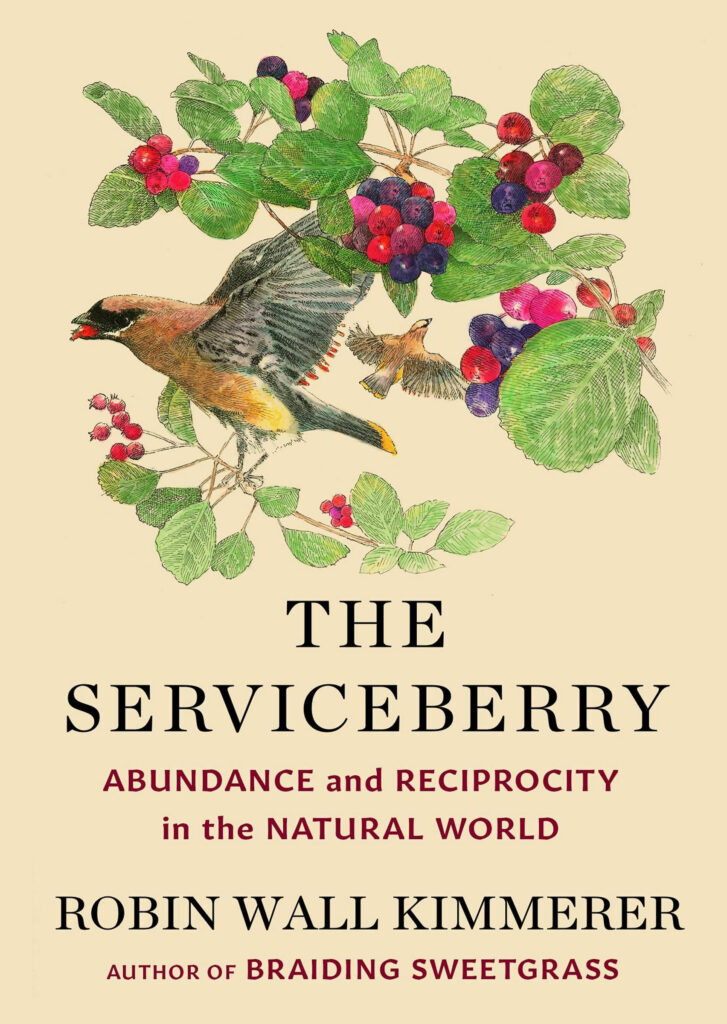
Robin Wall Kimmerer is perhaps best known as the author of “Braiding Sweetgrass,” a book about living in a reciprocal relationship with other beings and the gifts of the Earth. And in her 2024 book “The Serviceberry: Abundance and Reciprocity in the Natural World,” she focuses on gift economies.
You might encounter gift economies in your daily life—Buy Nothing groups on Facebook, community fridges where people share food with neighbors or the little free libraries down the street.
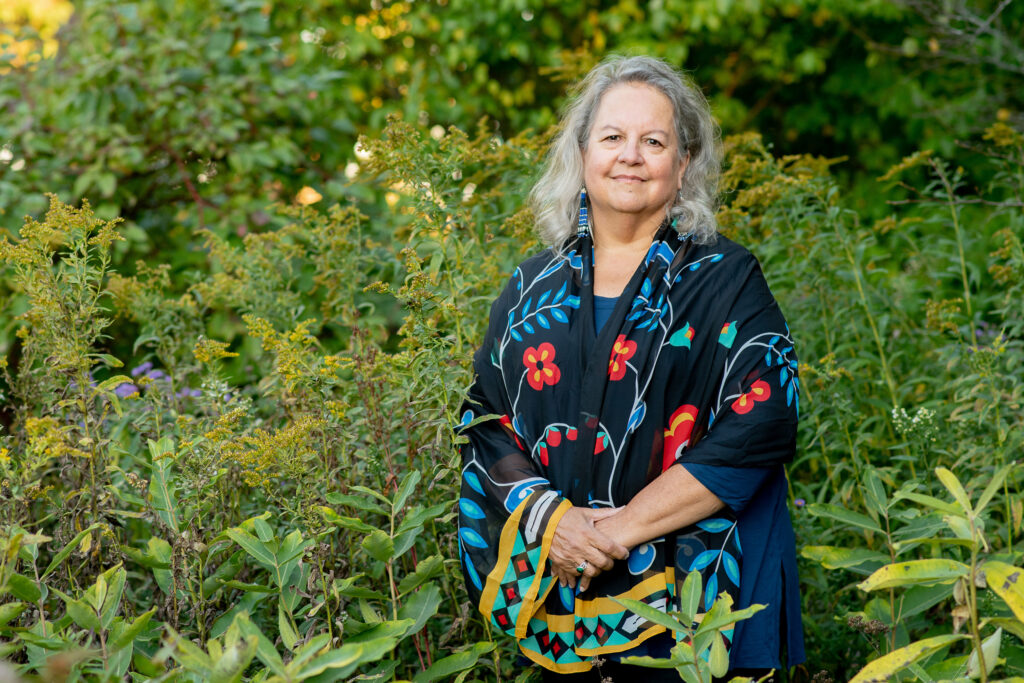
Robin Wall Kimmerer is a member of the Citizen Potawatomi Nation and professor of environmental biology at the SUNY College of Environmental Science and Forestry. This interview has been edited for length and clarity.
JENNI DOERING: What is a serviceberry, and why is it significant to you?
ROBIN WALL KIMMERER: A serviceberry is a beautiful genus of plants. It doesn’t look like much. In fact, I tell my students, you can tell a serviceberry because it’s kind of generic looking in that the leaves are just round, smooth, [with] gray bark.
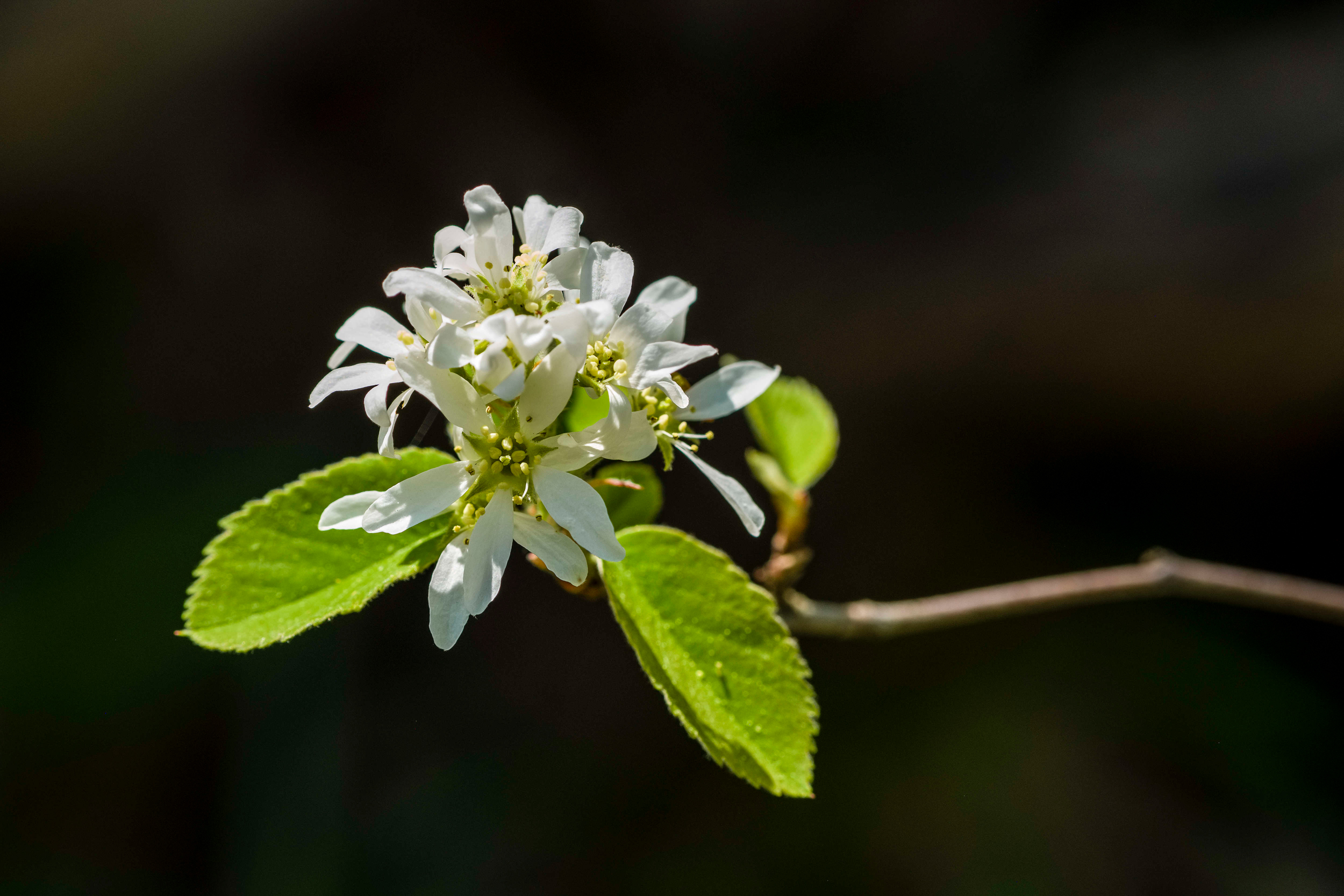
But when it flowers and fruits, it’s a whole different story. In the springtime, there’s just a froth of white blossoms, and then in mid-summer, it’s just heavily laden with these red, juicy fruits. You can mostly find it around edges of water, edges of trails. It’s an ecotone species that kind of likes the forest edge.
DOERING: It sounds like it brings this abundance in season; when these berries are ripe, all kinds of animals and people, including yourself, enjoy them. What does that abundance of serviceberries lead to?
KIMMERER: The abundance of serviceberries leads to an abundance of life all around because, for example, in the early spring, there’s a whole group of bees that rely entirely on those early spring flowers. So it’s feeding the pollinator community.
Then later, when the berries start to ripen, you can find a serviceberry tree because of all the birds; they are all just gathering there, and they’re so noisy. I use them for prospecting. That’s how I find a serviceberry tree—I listen for the birds. So it’s feeding that whole community as well.
Those are the obvious ways that it’s engaged, but it’s also an important host for lots of different larvae of butterflies and the whole food web that grows around this tree.
DOERING: You describe in this book harvesting, putting those berries into a pail, and then being able to share that abundance with your neighbors.
KIMMERER: They are so abundant that on my neighbor’s farm, where they plant the Western variety of serviceberry known as saskatoons, they are just an exemplar of abundance. You can pick them by the handful.
DOERING: Can you turn them into a pie?
KIMMERER: Oh, they make a good pie. They make good jam, good syrup. Traditionally, a lot of native cultures, particularly Western cultures, used it as the major fruit for pemmican. The berries would be dried and pounded into this super food. The berries are really rich in antioxidants and vitamin C. It was an excellent choice to mix into the original energy bars, which were pemmican.
DOERING: Remind me what pemmican is … is that a mix of berries and meat?
KIMMERER: It is, yeah … The berries are dried and pounded, and elk or venison is also dried and pounded, and then the whole thing is bound together with rendered fat. It is quite literally the original energy bar, and our people used it for travel food and for trade. It was a really important way to store excess calories.
DOERING: Tell me about the connection between this idea of a gift economy and the way that resources are shared in the natural world. Could you maybe trace the path of a serviceberry for us? The berry itself falls to the ground or gets eaten by a bird, and what happens next?
KIMMERER: I think it’s important to preface that by talking about what I mean by gift. A gift in my thinking—and this reflects a lot of ancestral teachings—is something that we have not earned, and yet it comes to us, someone bestows it upon you. Let’s follow the thread that you suggest of the growth of a serviceberry.
The sun is the energy that animates all of it, and so all of that sunshine, through photosynthesis, turns into the body of the serviceberry. One could argue that the sun, the sun’s energy, is a gift we have not earned, and yet it comes. That gift of photosynthesis is then shared with others. It’s shared with the larvae of those caterpillars that are eating the leaves. It’s shared in the abundance of fruits that the robins and the cedar waxwings and the blackbirds are all coming to feast on. The gift is shared. It’s passed on.
And then, of course, those birds that are splattering bird poop all over the ground, all of that nitrogen is feeding the food web below ground and building soil. The fox that comes and snatches one of those robins off the ground while it’s all full of berries, the gift stays in motion. If we start with the premise that what life produces for us is a gift, it’s all a gift economy.
DOERING: In the book, you quote an indigenous Brazilian hunter saying, “Store my meat? I store my meat in the belly of my brother.” Can you tell me the story of that quote?
KIMMERER: That story that was shared by an anthropologist, a linguist working with Amazonian Indigenous peoples is at the heart of what we understand to be a gift economy.
In this story, the hunter had been successful that day and came back with a really sizable animal. The anthropologist linguist was talking with them and saying, “Well, how are you going to store the meat? Are you going to dry it or salt it? What will you do to store the meat?” And he reports the astonishment of the hunter, saying, “Store my meat. Why would I do that?” And so he asks again, and he said, “Well, no, I don’t store my meat. I store my meat in the belly of my brother.” Meaning he wasn’t going to hold on to and accumulate this bonus, this surplus of meat. He was going to have a feast. He was going to invite his neighbors, his friends, his extended family, all to come and benefit from what the forest had provided him in the form of game.
The anthropologist was astonished because that breaks all the rules of Western economics, doesn’t it? That says, “Well, you should hold on to that for yourself. You should store it so that when the hungry time comes, as it inevitably does, you’ll have food security.” But essentially, the lesson taught by that story is there are other ways to have material security, food security, and that is through relationship. That hunter was saying, when I feed my neighbors, when I feed my community, they’re going to feed me when their nets are full of fish, they’re going to invite me to a feast if I need their help, we’ve established good relationships of trust and kinship, so they’ll take care of me, because I’m taking care of them.
That is the heart of a gift economy. No money is exchanged. The gift stays in motion. It creates this network of relationships that create the kind of material security that market economics is designed to produce.
This story is funded by readers like you.
Our nonprofit newsroom provides award-winning climate coverage free of charge and advertising. We rely on donations from readers like you to keep going. Please donate now to support our work.
Donate NowDOERING: In our own lives, what advice do you have for centering gift economies, participating in those and reciprocity in our lives while also living in this modern, complex world?
KIMMERER: The book is full of examples of micro-scale gift economies—some of the ones that seem most appropriate to think about in a time of climate crisis. What is it that’s driving the climate crisis? It’s hyper consumption, overconsumption, and gift economies suggest that we don’t all need to own everything that we need in life. We don’t need to each go out and buy a lawnmower. We need, perhaps, one for the neighborhood.
Those kinds of neighborly sharing help to stem hyper consumption, but you also create a web of mutual relationship, which I think as human people, particularly in an industrialized society, we crave. We crave that sense of belonging, of being known, of being needed in our communities. That’s how I think about the role of gift economies, as a sharing economy that produces abundance without market regulation.
I think gift economies can live in coexistence with the dominant model of economics, if we encourage them. I don’t want in any way this idea of trying to promulgate small, highly localized gift economies to excuse us from rethinking capitalism and damage associated with it. In the book, I talk quite a lot about the ethical jeopardy of extractive systems and the cost that that has on the well being of the planet. While we could celebrate and cultivate small-scale gift economies, that doesn’t mean we aren’t still complicit with this larger system that we need to seriously rethink.
DOERING: Can you describe scaling up this gift economy idea and how we can work with this global, interconnected world that we have to integrate more of this gift-economy thinking into that system?
KIMMERER: I began looking for gift economies in modern society after having learned about them from both ancestral and contemporary Indigenous societies. I found them everywhere, once you kind of know what to look for.
“Gift economies are an invitation to the economy of the commons, rather than of private property and individual ownership.”
One of the examples that I like to start with is, when you read a good book, you want to pass it on to a friend. You don’t sell that book to your friend. You give it to them. There it is—a tiny, little gift economy. But how does that scale up? Well, in my neighborhood, we have little free libraries where people leave their books to share with one another. That’s a gift economy. I think about public libraries as gift economies. We don’t own the books. That’s the idea. We have an abundance of literature because we share.
That continuum from giving a book to a friend, to little free libraries, to public libraries, gives us a hint at what gift economies can look like. And at a larger scale, the way that we use our financial resources to invest in commons. Common resources, like libraries, offer us an opening as well. What about things like common lands of parks and trails and water? Those are things we don’t each of us own. We care for them in common. We enjoy them in common. Gift economies are an invitation to the economy of the commons, rather than of private property and individual ownership.
DOERING: How does giving thanks connect with abundance and reciprocity?
KIMMERER: Gratitude is such an important human response to the abundance of the world—deep gratitude. I don’t mean just that polite, toss-off thank you. I mean the kind of gratitude where you recognize that your life is totally dependent upon the lives of other beings; that you would not exist without water or those berries or that medicine; that kind of deep gratitude that allows us to look at the world of abundance and feel as if you have everything that you need.
Let’s be clear: Everything that I need might be quite different than everything that I want. But everything that I need I have and is provided for me as a gift from Mother Earth. It also makes you feel as if you have everything, and so why do you need to buy anything else? It creates a sense of sufficiency and “enoughness” that puts the brakes on consumption. Eco-psychologists have demonstrated that people who practice gratitude consume less than people who don’t.
To think about the world as gift is to think about the world not as objects that belong to us, but as stories. That shirt that you might want to buy, it’s not just as an object, is it? It’s the product of many hands, and it has consequences. It has costs. One of the most important things we can do as consumers is to really think about the stories associated with those objects. Was that fiber in the shirt that you’re interested in, is it recycled? Is it part of a circular economy, or is it part of an extractive economy?
When we see the world as gift, we see that whole story of knowing where everything came from. That’s what helps something be a gift, not a commodity: We know all the relationships that are associated with it. That same attention to the story of an object allows us to decide whether we’re going to buy it or not. Are we going to participate in a dishonorable harvest, or are we only going to purchase those things which safeguard life, make life better?
About This Story
Perhaps you noticed: This story, like all the news we publish, is free to read. That’s because Inside Climate News is a 501c3 nonprofit organization. We do not charge a subscription fee, lock our news behind a paywall, or clutter our website with ads. We make our news on climate and the environment freely available to you and anyone who wants it.
That’s not all. We also share our news for free with scores of other media organizations around the country. Many of them can’t afford to do environmental journalism of their own. We’ve built bureaus from coast to coast to report local stories, collaborate with local newsrooms and co-publish articles so that this vital work is shared as widely as possible.
Two of us launched ICN in 2007. Six years later we earned a Pulitzer Prize for National Reporting, and now we run the oldest and largest dedicated climate newsroom in the nation. We tell the story in all its complexity. We hold polluters accountable. We expose environmental injustice. We debunk misinformation. We scrutinize solutions and inspire action.
Donations from readers like you fund every aspect of what we do. If you don’t already, will you support our ongoing work, our reporting on the biggest crisis facing our planet, and help us reach even more readers in more places?
Please take a moment to make a tax-deductible donation. Every one of them makes a difference.
Thank you,