

Two landmark studies of a rare sperm whale birth observation in the Caribbean are reshaping scientists’ understanding of cooperation in the animal kingdom, revealing that whales in unrelated family lines work collectively to help newborn calves survive.
The birth, documented by researchers with the nonprofit Cetacean Translation Initiative (Project CETI) and published Thursday in the journals Science and Nature’s Scientific Reports, provides the most detailed account of a sperm whale birth to date and the first quantitative evidence of cooperative birthing assistance outside primates.
Together, the findings shed new light on the evolution of complex social behavior among animals.
For decades, scientists have argued that sperm whales live in tight-knit matrilineal groups primarily to protect and raise their young. The theory held that communal care—especially babysitting calves while mothers dove to forage—was the foundation of their social structure.
The new studies move that long-standing hypothesis into documented reality.
The birth took place on a calm July afternoon in 2023 off the coast of Dominica. Shane Gero, who has spent more than two decades studying sperm whales, said the day began like many others—tracking a group of whales known as Unit A. But things took an unexpected turn.
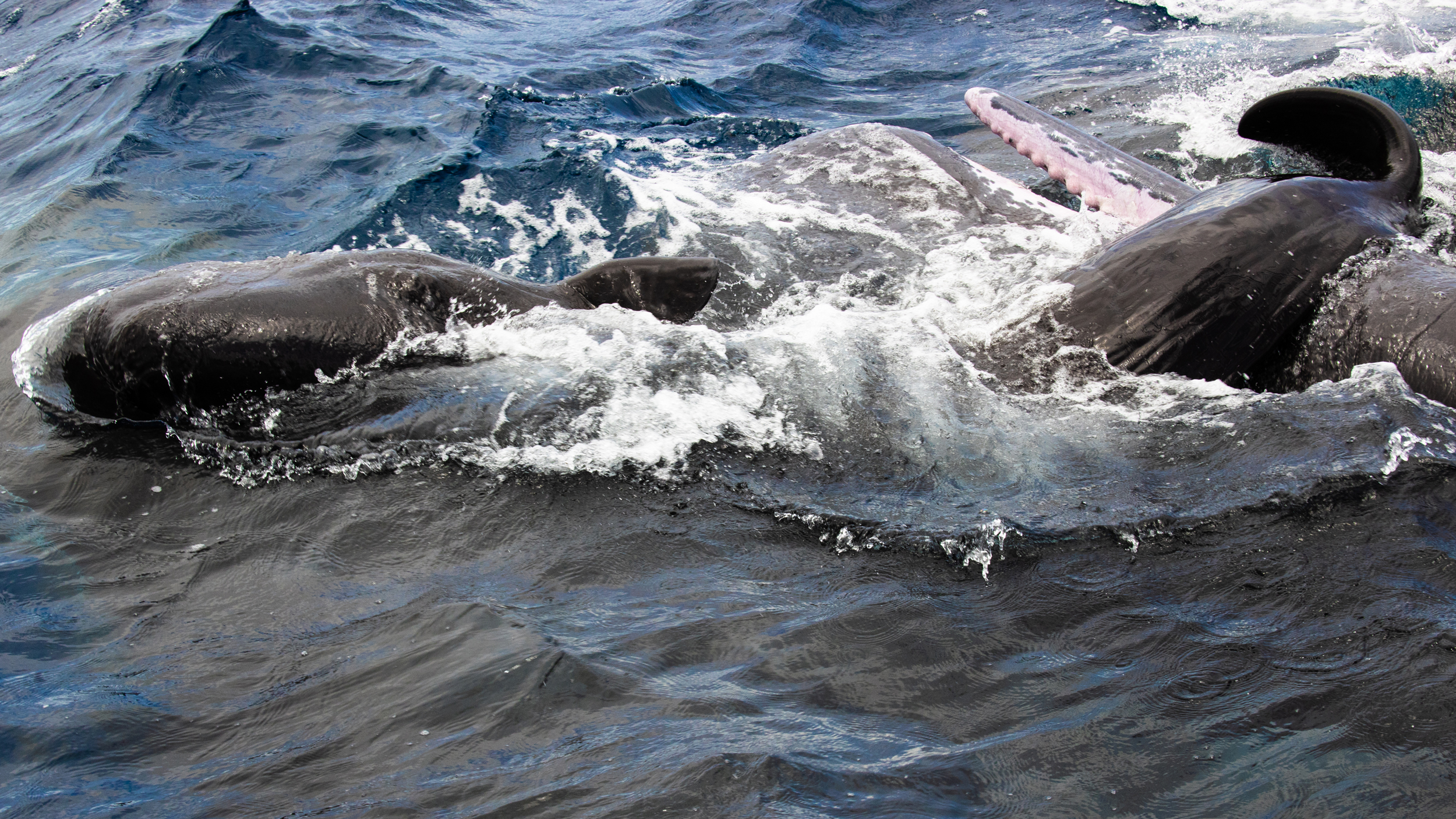
Instead of spreading out to forage or diving in small clusters, the whales tightly grouped together at the surface, circling a single female named Rounder.
“We realized pretty quickly that something unusual was happening,” said Gero, lead biologist at Project CETI, founder of the Dominica Sperm Whale Project and a co-author of both new reports. “They were orienting toward Rounder in a way we hadn’t seen before.”
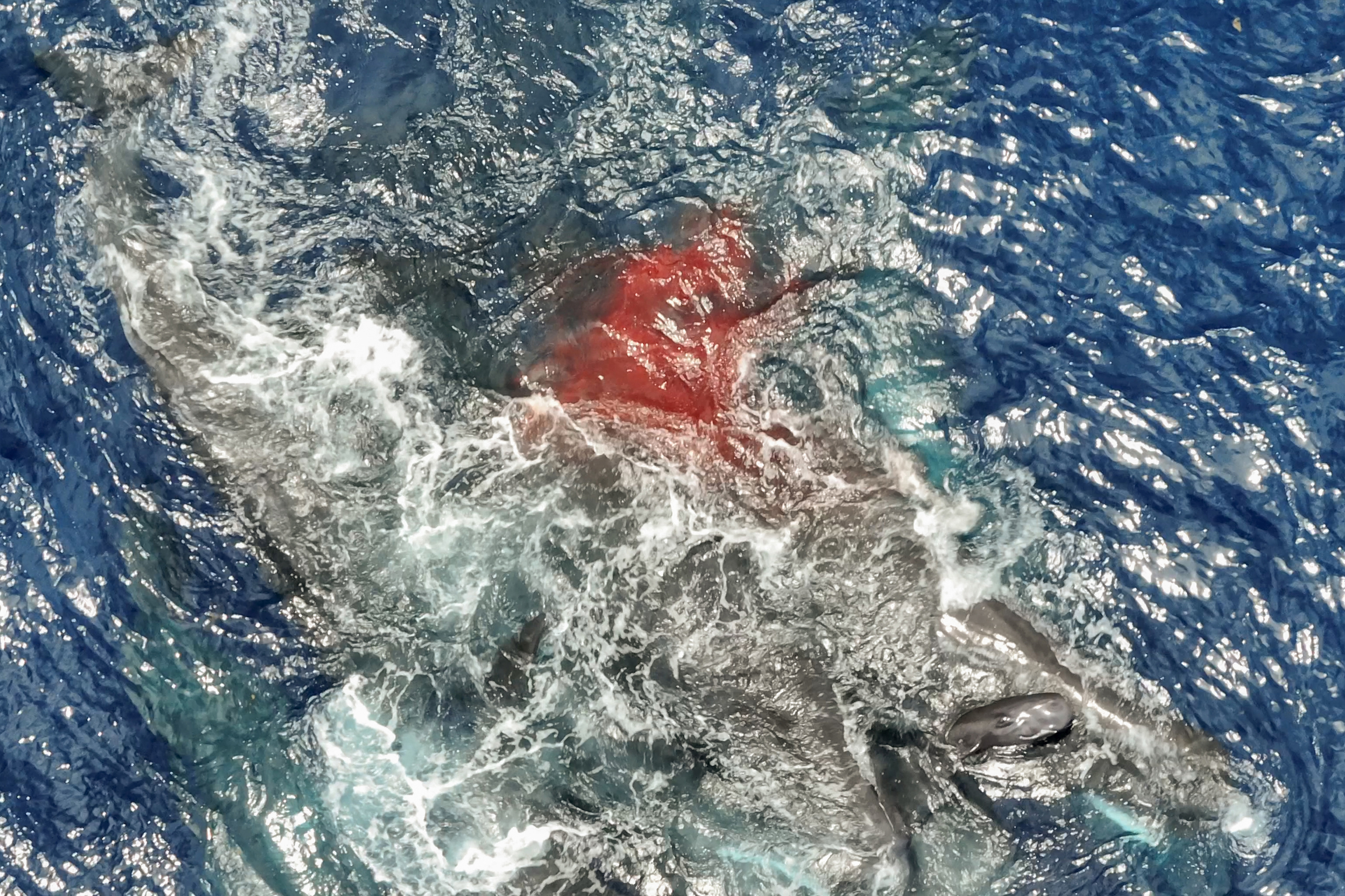
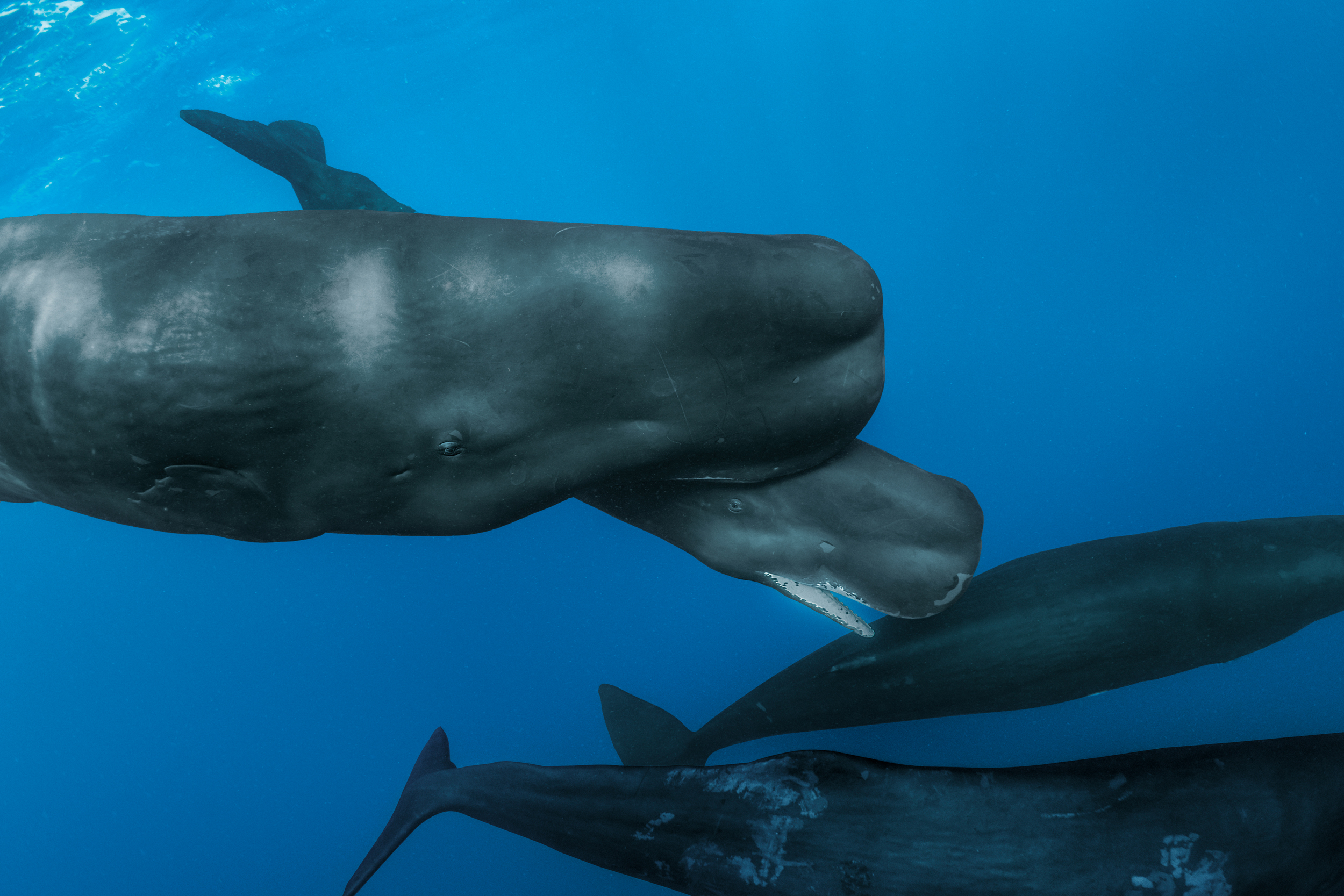
As Rounder began her 34-minute labor, the group—which included two distinct matrilines of grandmothers, mothers, daughters and one juvenile male—shifted its behavior.
Under normal conditions, the two matrilines forage separately and maintain a degree of social distance, even when traveling together, researchers said. But as the calf’s flukes began to emerge, those boundaries “dissolved.”
Using high-resolution drone footage and custom computer vision tools, the Project CETI team tracked the movements of every whale in the unit. A female family member led the initial assistance, but once the calf was born, each whale took a turn helping.
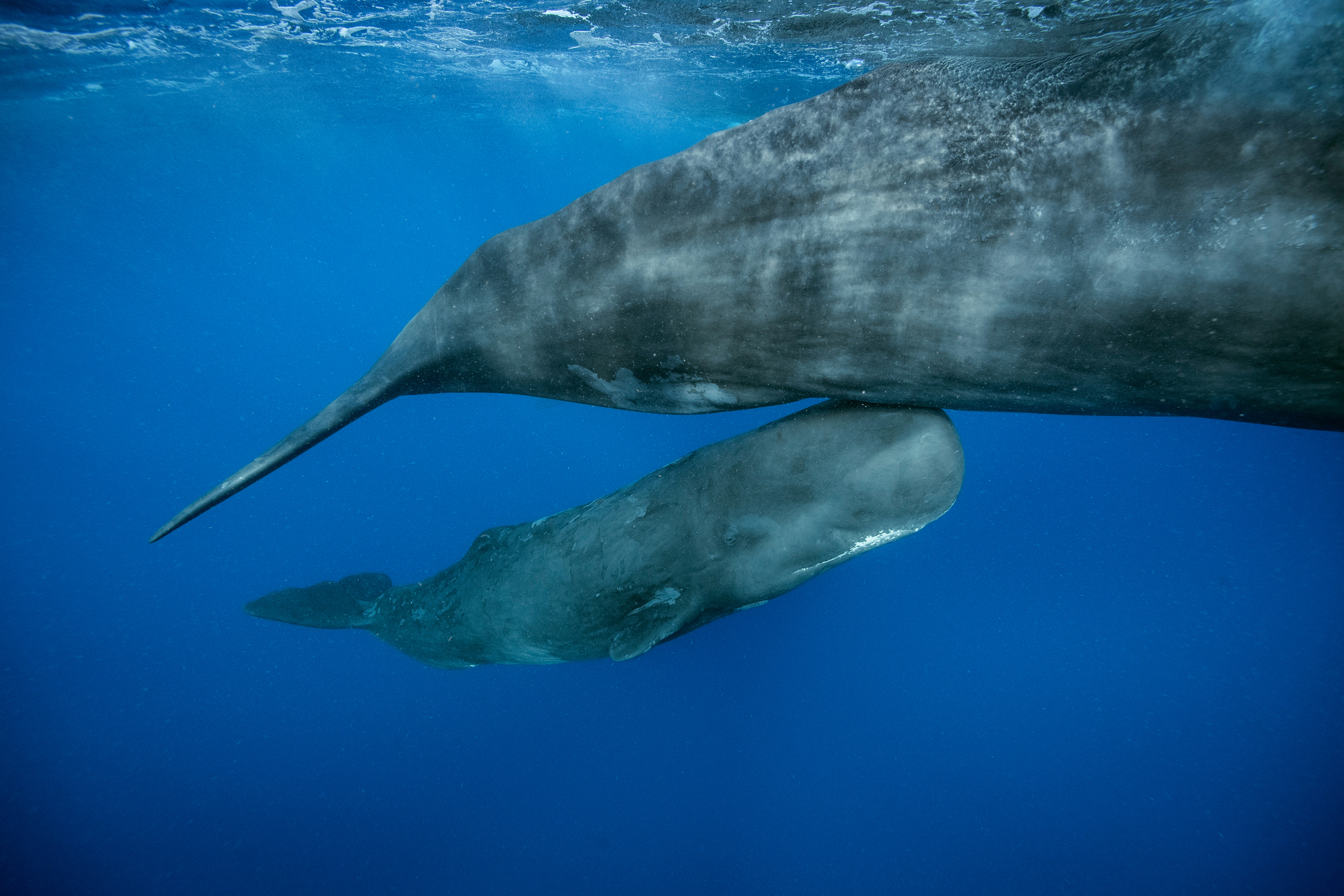
Researchers observed the whales repeatedly lifting the newborn toward the surface—an essential behavior for a mammal born underwater that must reach the air to breathe. With little oil in their heads and folded flukes, newborn sperm whales sink easily and risk drowning in their first moments of life.
Witnessing such an event is extremely uncommon. There is only one previous scientific observation of a sperm whale birth over the past six decades, and just four other accounts post-birth from whaling activities.
“It’s incredible how rare this is,” said Giovanni Petri, Project CETI’s network science lead. “But we were prepared—we have been developing the technology and tools to do big science, to listen and observe.”
Petri’s team with Project CETI used network science—a field that describes how systems and people interact—to “reverse engineer” the birth event, treating the whales like guests at a party where the language is unknown but the behavior is telling. By mapping who was close to whom and how those clusters changed as the birth progressed, they were able to quantify the interactions between the two matrilineal groups.
Those interactions, Petri said, “were closer than could be expected.” They revealed a level of cooperative care previously thought to be largely limited to humans and a small number of other primates.
“These findings fundamentally reshape how we understand whale society,” said David Gruber, founder and president of Project CETI and a professor at the City University of New York.
“What we’re seeing is deeply coordinated social care during one of the most vulnerable moments of life,” he added.
What the Whales Are Saying
Gruber founded Project CETI in 2020 with the ambitious goal of listening to and decoding sperm whale communications. The initiative uses noninvasive acoustic recording devices and drones to collect data, then leverages artificial intelligence and linguistic expertise to decode the vocalizations.
Sperm whale communications are known as codas—rhythmic bursts of clicks produced when air is pushed through their nasal passages and over the “phonic lips” in their heads.
Previously, Project CETI researchers discovered a sperm whale “alphabet” and vowel and diphthong-like spectral patterns. They’ve also found that codas shift with conversational context and carry social meaning.
The birthing event provided a rare testing ground for Project CETI’s tools.
The drone footage, computer vision systems and network science analysis used in the studies are the same technologies the project plans to rely on to connect whale sounds to behavior and social context—an essential step toward interpreting what the animals may be saying to one another.
“You can record whales forever,” Gero said, “but connecting sound to behavior is what makes it meaningful.”
While the audio analysis in the Scientific Reports paper shows broad shifts in vocal activity during the birth, linking specific calls to specific individuals remains painstaking and time-intensive, Gero said, often requiring manual annotation of recordings. By combining drone imagery, behavioral tracking and automated audio analysis, researchers are beginning to train machine-learning models that could eventually perform that work at scale.
Gero described the new research as a “microcosm” of CETI’s broader mission.
Rare and emotionally charged moments like births provide unusual social contexts that can reveal patterns in communication that would otherwise remain hidden in routine daily behavior.
In much the same way that a rare emergency reveals the underlying rules of human society—police, courts and social norms only become visible when something goes wrong—extraordinary whale interactions can expose the structure and function of their communication systems, Gero said.
“If you were an alien observing humans and only recording conversations in a dentist’s office, you might think root canals were central to human society,” he added.
Birth events offer a much broader window into whale life, helping scientists begin to understand which sounds matter most and how communication helps coordinate some of the most critical moments in their social world.
While Project CETI’s researchers are still in the midst of analyzing the codas made during the birth, the Scientific Reports paper documents some groundbreaking insights. One is that the whales changed their vocal styles during key moments of the birth, marking a change from their communications during everyday activities such as foraging or socializing.
The vocal patterns were more intense and divergent than usual, suggesting the whales were using specialized communication during the birth. The researchers are still working to understand what the sounds mean and plan to provide more analysis in a forthcoming paper, Gero said.
Certain codas serve as identity markers, shared among families that belong to the same cultural clan.
One of the most common codas recorded during the birth, known as 1+1+3, is the identity coda of the Eastern Caribbean clan, the cultural group that includes Rounder’s family.
The 1+1+3 coda’s presence during the event suggests that whales were not only coordinating behavior but also reinforcing social identity and belonging in a critical moment.
“These kinds of events reinforce the social bonds and the sense of ‘we’—who belong together and who support each other,” Gero said.
In addition to the clan-level coda, researchers also detected frequent use of a 4R coda, a vocal pattern previously shown to be characteristic of the specific family involved in the birth.
The heavy overlap of vocalizations—sometimes six to eight whales calling at once—may itself be meaningful, Gero said. He compared it to “vocal grooming,” a concept drawn from primate research in which communication helps strengthen social ties in species, like whales, that cannot physically groom one another.
Gero likened it to people singing a national anthem together or recognizing a fellow traveler by a shared flag or language. The shared vocal patterns may reinforce group identity and cohesion, particularly during events like births.
New Technology and Ancient Evolution
The discovery was not just a matter of being in the right place at the right time. It was also the result of years of technological development that allowed researchers to turn a rare observation into scientific evidence.
The research relied on a suite of new technologies, including drones and computer vision models that tracked individual whales as they moved around the mother and newborn. The system allowed scientists to follow animals even as they dove beneath one another and shifted positions rapidly—analysis that would have taken years using traditional video methods.
Drones were particularly important because they gave researchers a clear view from above, allowing them to measure distances between whales, track body orientation and see how individuals positioned themselves around the mother and calf. The aerial footage revealed a pattern: Nearly every whale supported the newborn by diving beneath the mother and helping lift the calf to the surface.
That level of detail is what made the new studies possible—and provided insights into the role cooperation played in the birth.
In evolutionary biology, cooperation refers to behaviors that increase another individual’s chances of survival or reproduction, often with some cost to or effort from the helper, Gero explained.
During the birth, whales were seen lifting the calf to the surface, assisting the mother and closely attending to both animals—actions that likely improve calf survival and reproductive success. Those behaviors create what scientists call “fitness benefits,” allowing mechanisms like reciprocal altruism—help now, receive help later—to operate within the group.
What makes the finding especially important is that many of the assisting whales appeared to come from a different family unit.
This story is funded by readers like you.
Our nonprofit newsroom provides award-winning climate coverage free of charge and advertising. We rely on donations from readers like you to keep going. Please donate now to support our work.
Donate NowIn many species, cooperation is explained by kinship: Aiding relatives helps pass on shared genes. But here, that explanation is weaker, suggesting sperm whales may rely on long-term social bonds and delayed exchanges of support rather than simple genetic ties.
Because female sperm whales give birth only every several years, such cooperation would require memory, social awareness and an expectation that help provided today could be returned far in the future.
The birth observation strengthens the idea that cooperation during reproduction itself helps hold sperm whale societies together, reinforcing the long-term relationships that allow groups to function and survive.
Decentering Humans
The birth observation is raising new questions for Project CETI. Chief among them is whether researchers can begin predicting whale behavior from their sounds—a key step toward understanding sperm whale communications.
The event created an unusually rich dataset, with six to eight whales vocalizing and moving simultaneously, far more intricate than the typical two- or three-animal exchanges researchers usually record.
Gero said the next challenge involves the predictive models Project CETI is building.
“Can we use the sounds and behavior we observe early in the video to predict what happens later?” he said.
Beyond inching closer to understanding what the whales are saying, for Gero and Petri, the birth event offered a powerful lesson for humans.
Petri said the discovery is part of a broader scientific shift in how humans understand intelligence and life on Earth.
“It feels like a kind of revolution—a moment of decentering humans,” he said. “We’re learning that we’re not the only form of intelligence on this planet.”
Different species, he added, may process information and experience the world in fundamentally different ways.
“Some intelligences look a bit like us; others look very different, like sperm whales,” Petri said. “There may be entirely different ways of organizing life and experiencing the world, and studying them helps us better understand both them and ourselves.”
This deeper understanding of whales’ intelligence is also helping to advance the rights of nature movement, aimed at getting governments to recognize that wildlife and ecosystems have inherent rights, such as the right to exist. Last year, Gruber, Project CETI’s founder, and lead linguist Gašper Beguš co-authored a paper arguing that the initiative’s science could bolster the push for whales’ rights.
Gero noted that sperm whales are profoundly different from humans. They are, he said, animals the size of school buses that spend most of their lives in deep ocean environments humans can barely explore even with advanced submarines. Yet the birth revealed something strikingly familiar.
“What we see is that the best way to overcome unimaginable obstacles is by working together,” Gero said. “Mammals need to collaborate to succeed.”
That overlap between species is what makes the moment so meaningful. Sperm whales experience the world in ways humans may never fully understand, Gero said, and much of their social and cognitive lives will likely remain unknowable.
But when researchers do find shared patterns—cooperation, caregiving, social support—those similarities point to something fundamental about life itself. Collaboration, that suggests, may be a core survival strategy across species.
The discovery is also a reminder of how much remains unknown in the natural world, Gero added. And how often humans place themselves at the center of it.
“We talk about evolution and complex societies and all these scientific ideas,” Gero said. “But at the end of the day, being on the boat, it felt like I had been invited to the hospital by someone I’ve cared about for a very long time.”
About This Story
Perhaps you noticed: This story, like all the news we publish, is free to read. That’s because Inside Climate News is a 501c3 nonprofit organization. We do not charge a subscription fee, lock our news behind a paywall, or clutter our website with ads. We make our news on climate and the environment freely available to you and anyone who wants it.
That’s not all. We also share our news for free with scores of other media organizations around the country. Many of them can’t afford to do environmental journalism of their own. We’ve built bureaus from coast to coast to report local stories, collaborate with local newsrooms and co-publish articles so that this vital work is shared as widely as possible.
Two of us launched ICN in 2007. Six years later we earned a Pulitzer Prize for National Reporting, and now we run the oldest and largest dedicated climate newsroom in the nation. We tell the story in all its complexity. We hold polluters accountable. We expose environmental injustice. We debunk misinformation. We scrutinize solutions and inspire action.
Donations from readers like you fund every aspect of what we do. If you don’t already, will you support our ongoing work, our reporting on the biggest crisis facing our planet, and help us reach even more readers in more places?
Please take a moment to make a tax-deductible donation. Every one of them makes a difference.
Thank you,