

In her 40 years as an environmental justice organizer, Cheryl Johnson had never seen environmental funding as revolutionary as the Community Change grant.
“It gave real money to disinvested communities like mine, funding to clean up and to revitalize our communities,” Johnson said. “And then a stroke of another pen from the current administration just took that all away.”
The grants were introduced under the Biden administration’s Justice40 initiative to ensure that agencies—including the U.S. Environmental Protection Agency—address communities “marginalized by underinvestment and overburdened by pollution,” a description that fits Johnson’s South Side neighborhood in Chicago and many other communities of color nationwide.
“We watched some of these really historic climate programs, environmental health programs getting off the ground,” said Ella Mendonsa, senior manager of the Natural Resources Defense Council’s equity center. “In January 2025 and in the resulting months, the Trump administration not just cut ongoing grants, but actually went and cancelled grants that had already been signed with communities across the United States.”
Paired with federal moves to roll back a wide range of pollution rules and dismantle other environmental-justice efforts, 2025 was a crushing year for residents in overburdened communities. In total, more than 100 Community Change grants had been awarded across 41 states, territories and tribal nations, funding projects ranging from toxic-chemical removal to flood mitigation. Mendonsa said that, to her knowledge, no organization has fully received the grants promised to them. Lawsuits challenging the legality of the unprecedented pullback are ongoing.
Johnson, who leads People for Community Recovery, an environmental justice organization, is among those harmed by these cuts. Months later, Johnson is still mourning what could have been if the money had been fully dispersed.
Her group was promised money through a $2.7 million Community Change grant jointly awarded to Friends of the Chicago River, the Metropolitan Planning Council and the Calumet Collaborative. The plan: expand community engagement on projects alongside Chicago’s rivers, which have been battling back from decades of pollution.
Margaret Frisbie, executive director of Friends of the Chicago River, said the Community Change grant was a “major endeavor” to apply for. The organization, which submitted its application in the summer of 2024, started receiving the funding in February of this year. In May, all of it was terminated.
Friends of the Chicago River had planned to pass funding along to several community groups that are a part of the River Ecology and Governance Task Force, a coalition of local agencies and community leaders that helps plan a broad array of river projects. The goal: help the Coalition for a Better Chinese American Community, McKinley Park Development Council and several other groups engage with their communities to inform river-related planning, allowing them to more meaningfully participate in task force meetings.
“Community groups often do not have the ability to pay staff to go to meetings, and these kinds of meetings happen during the day,” Frisbie said. “What we were hoping was to be able to provide resources to these organizations so that they could dedicate staff time to participating in all of these planning meetings in order to drive change in their own neighborhoods.”
In an email, an EPA spokesperson said the Community Change grants were a part of a “radical agenda of wasteful DEI programs and ‘environmental justice’ preferencing” under the Biden administration. The Trump EPA has frequently suggested that efforts to reduce disproportionate environmental harms are counter to the agency’s goals, rather than a longstanding part of its mission.
“The Trump EPA will continue to work with states, tribes, and communities to support projects that advance the agency’s core mission of protecting human health and the environment,” the agency’s statement added.

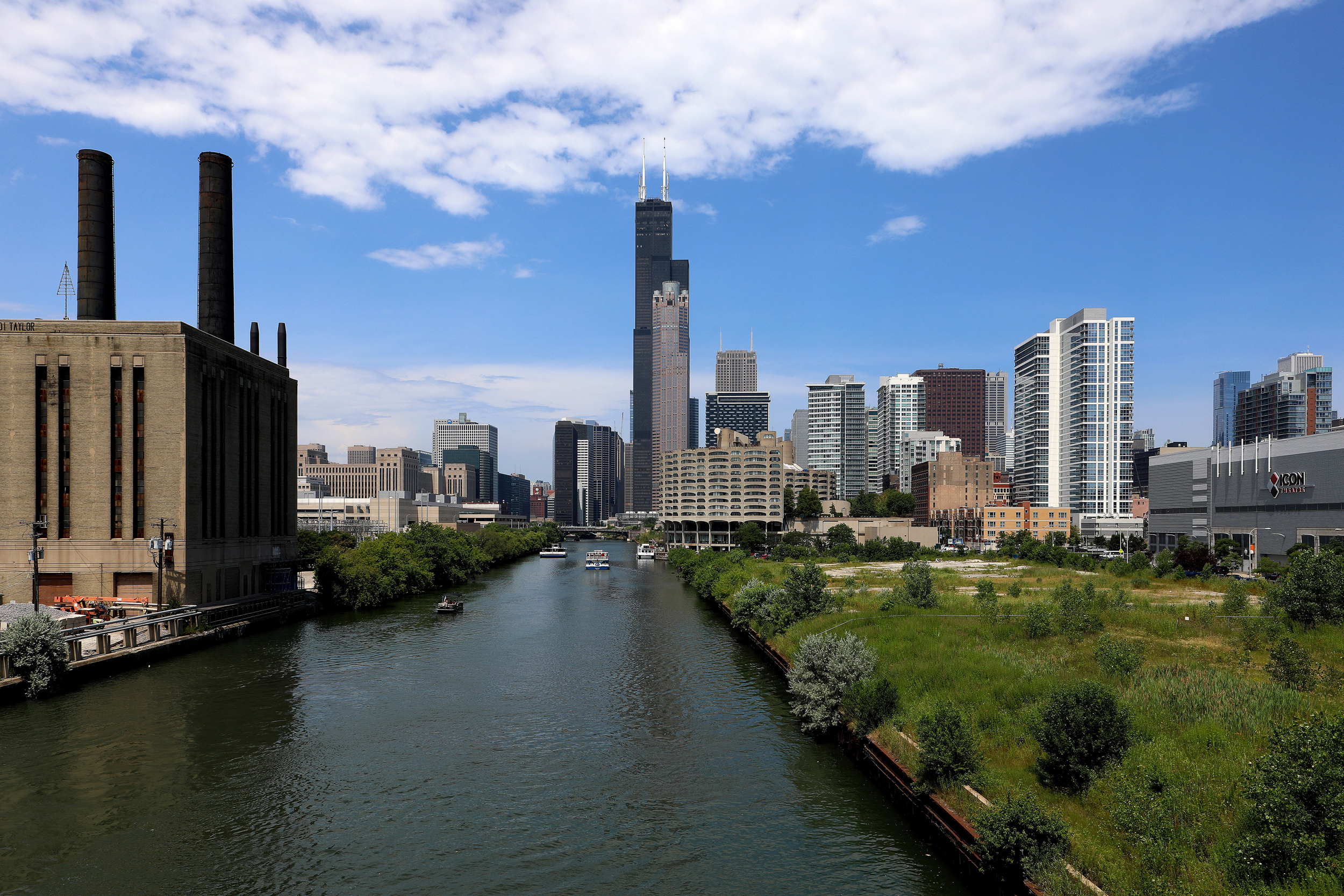
The 156-mile Chicago-Calumet river system flows through Lake and Cook counties, including through the city of Chicago. Historically, parts of this river system have been dominated by industry and highly polluted. One fork of the Chicago River, nicknamed Bubbly Creek, was effectively a waste dump for decades, used by the Union Stock Yards to dispose of animal waste—the decomposition of which literally created a bubbling effect.
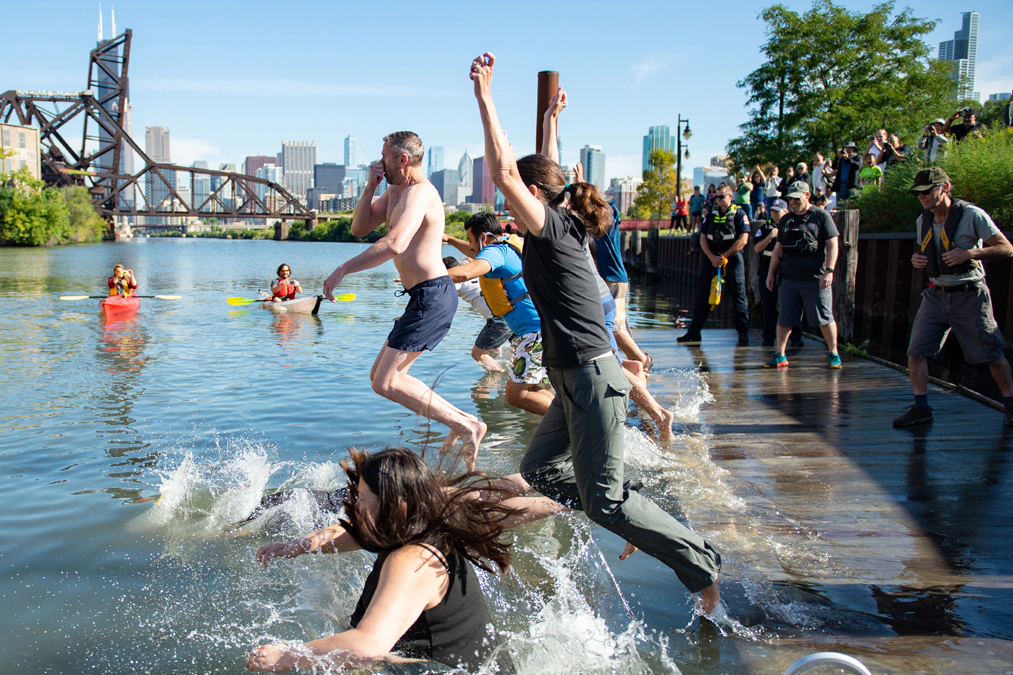
But as industrial sites have closed, recreational use of the riverfront is increasing. In September, hundreds of residents dove into the Chicago River for the first open swim in nearly a century.
At the same time, interest in riverfront development is rising. Not all the outside investors have been good actors, community members say, which is why it was so important for local stakeholders to have a seat at the table, Frisbie said. That would be their opportunity to advocate for riverfront changes that could best serve them.
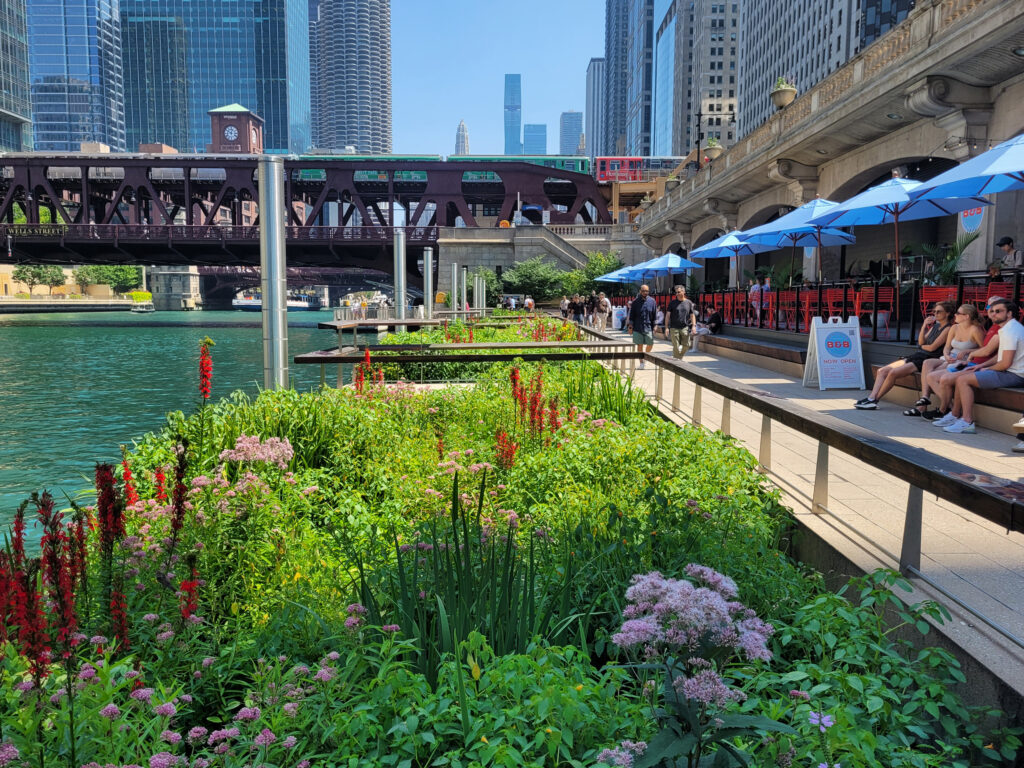
“It’s literally rapid development, and part of why it’s important to have community voices is because it’s happening so fast,” Frisbie said. “We need to make sure that people are in the room being able to fight for what they want, for their own communities, as opposed to having outsiders come in and tell them what they need.”
The McKinley Park Development Council has been working on a long-term project to complete a bicycle and pedestrian path that connects four Chicago neighborhoods with new river infrastructure—ensuring that pedestrians and cyclists have a safe route.
Kate Eakin, the council’s executive director, said the organization planned to use its share of the Community Change grant to fund staff time to implement the project. Eakin said her group was lucky to receive another grant to help offset the loss of the federal one.
This story is funded by readers like you.
Our nonprofit newsroom provides award-winning climate coverage free of charge and advertising. We rely on donations from readers like you to keep going. Please donate now to support our work.
Donate Now“A grant is not a handout. It’s a contract to do work, and the work does need to be done,” Eakin said. “We have this golden opportunity right now where economic conditions on the river are creating a once-in-a-lifetime opportunity to capture these properties for public green space, and it will not come around again.”
Grace Chan McKibben, executive director of the Coalition for a Better Chinese American Community, an organization that helps engage immigrants and older residents in Chinatown and surrounding areas in public policy discussions, said her group had planned to aid the McKinley Park council’s connectivity project with the help of the Community Change grant, improving Chinese-speaking residents’ engagement with the river through workshops and outreach.
With the loss of funding, the coalition has scaled back and shifted the focus of its work.
As for Johnson’s People for Community Recovery, the group had planned to use the funding to advocate for proper cleanup of the Little Calumet River—historically one of the most toxic hubs for industrial pollution along Chicago’s river systems.
“We have this golden opportunity right now where economic conditions on the river are creating a once-in-a-lifetime opportunity to capture these properties for public green space, and it will not come around again.”
— Kate Eakin, McKinley Park Development Council
“Most of the time, the people who are making decisions about our community do not live in our community and never step foot in our neighborhood,” Johnson said. “They tend to do more harm than what they are trying to do good in our community because they’re not listening to the voice of the community. The voice of the community is not sitting at the table. We are experts.”
For Johnson, the grant termination not only marks the loss of a way for People for Community Recovery to have a say at the decision-making table—the money would have also helped her employ a member of her community.
She said the group is still trying its best to attend task force meetings.
“As a grassroots organization, we don’t have the luxury as big as the river organization to continue this process,” she added. “We have to find other means to make ourselves sustainable, because we don’t get grants like them. We have to deal with the bias, the racism and the prejudice.”
People for Community Recovery also spent months working on an application for a Community Change grant of its own to revitalize a neighborhood school building. Trump cut the program before that application could be reviewed.
Mendonsa said she’d like to see philanthropists and other outside funders step in to fund projects throughout the U.S. amid the federal pullback. Many organizations, she added, have been doubly harmed by the cuts to Community Change grants because they had devoted so much energy applying for the life-changing money—time they couldn’t spend looking for other support.
“We’re going to continue to do the work, we just need to figure out other sources of funding and other opportunities to work together,” Frisbie said. “But at least the River Ecology and Governance Task Force will carry on as an organized collaboration to keep the voices active, even if we can’t do as much work as we had hoped.”
About This Story
Perhaps you noticed: This story, like all the news we publish, is free to read. That’s because Inside Climate News is a 501c3 nonprofit organization. We do not charge a subscription fee, lock our news behind a paywall, or clutter our website with ads. We make our news on climate and the environment freely available to you and anyone who wants it.
That’s not all. We also share our news for free with scores of other media organizations around the country. Many of them can’t afford to do environmental journalism of their own. We’ve built bureaus from coast to coast to report local stories, collaborate with local newsrooms and co-publish articles so that this vital work is shared as widely as possible.
Two of us launched ICN in 2007. Six years later we earned a Pulitzer Prize for National Reporting, and now we run the oldest and largest dedicated climate newsroom in the nation. We tell the story in all its complexity. We hold polluters accountable. We expose environmental injustice. We debunk misinformation. We scrutinize solutions and inspire action.
Donations from readers like you fund every aspect of what we do. If you don’t already, will you support our ongoing work, our reporting on the biggest crisis facing our planet, and help us reach even more readers in more places?
Please take a moment to make a tax-deductible donation. Every one of them makes a difference.
Thank you,

Amber X. Chen
Fellow
Amber X. Chen is a senior at UC Berkeley where she writes for The Daily Californian, the independent, student-run newspaper. She was an AAAS Mass Media Fellow at Smithsonian Magazine and a Puffin student writing fellow at The Nation. Originally from Los Angeles, her writing has also appeared in The Guardian, Teen Vogue, Atmos Magazine, Los Angeles Public Press and the Los Angeles Times.