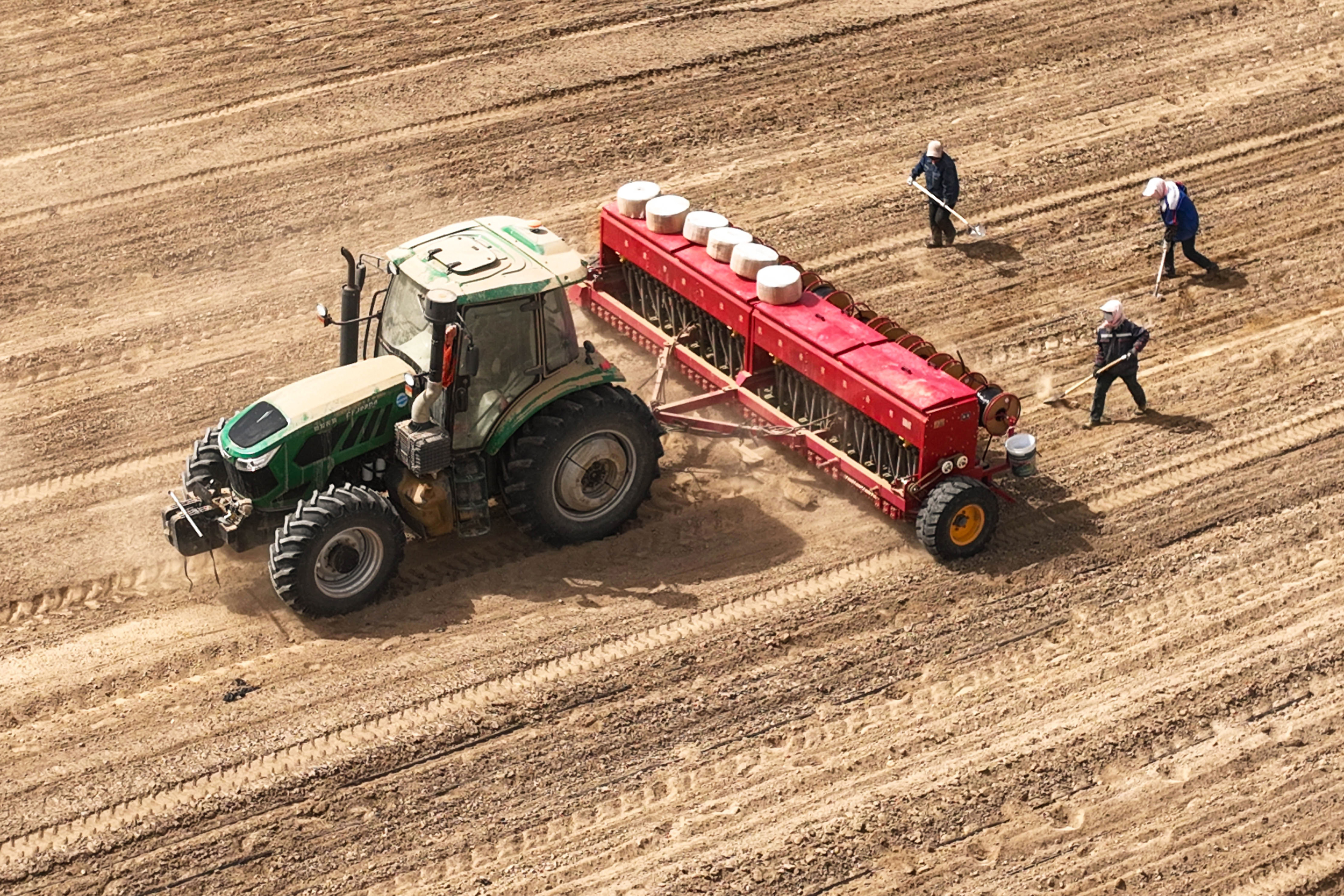


Picture an American farm in your mind.
You might envision a red barn. Some cows. A field of corn. You might even see a tractor in this idealized landscape. Maybe a classic John Deere, its kelly green cab atop giant yellow-hubbed tires.
Now think of that tractor another way, not as a vestige of American farm nostalgia, but instead a super-sophisticated, million-dollar computer on wheels that’s linked to satellite systems, cloud-based storage, machine learning and artificial intelligence. A harvester of data. Even a robot that can think and adapt.
In the 1990s, John Deere widely marketed the first tractor to use GPS, allowing farmers to steer across a gridded field based on coordinates. That innovation, arguably, kicked off the “precision agriculture” era in which data and digitization have become integrated in large-scale farming across much of the globe.
Three decades later, agriculture has become so digitally advanced that farming is now a highly data-driven, algorithmic enterprise. The global digital farming market was worth nearly $30 billion in 2025 and is projected to reach more than $84 billion in eight years.
All of this has come with a promise: that greater precision in the field will conserve resources, reduce pesticides and lower fertilizer use, along with its associated greenhouse gas emissions.
But over the past year, some farm and conservation advocacy groups have started to raise questions about how digital or precision agriculture is pushing small-scale farmers out of business or expanding agriculture in ways that worsen pollution and carbon emissions. Some say they’re concerned that tech giants have gotten too chummy with their counterparts in agriculture. They also worry lawmakers in Congress are pushing for funding and policies, including in a recent draft of the Farm Bill, that will further entrench the relationship. Increasingly, researchers and advocates are questioning the evidence behind the assertions that precision agriculture leads to real climatic or environmental benefits.
“There are many claims that precision agriculture, in a way, is like a silver bullet for sustainability,” said Celize Christy, an organizer with the HEAL (Health, Environment, Agriculture, Labor) Food Alliance, which issued a critical report last year. “But it really is not that much different.”
In a report published this week, the International Panel of Experts on Sustainable Food Systems, an alliance of researchers that tracks farm consolidation and corporate control in the global food system, published its latest critique.
It says a “powerful new alliance between Big Tech corporations,” including Google, Microsoft, Amazon and Alibaba, and “Big Ag firms is rapidly gaining control of farming under the guise of innovation.”
“These Big Tech titans are providing cloud platforms and AI-driven decision tools being integrated into all parts of industrial agriculture, from seeds to chemical inputs to machinery,” the report says. “As a result, they are shaping what technologies are developed, how food production decisions are made, and what the future of farming looks like.”
While there is ample evidence showing agriculture currently produces enough food to feed the planet’s population and global hunger is largely the result of access and distribution, not production, the world will have about 2 billion more people to feed by 2050. Feeding them all on a finite planet—without destroying forests, trashing vital ecosystems and overheating the atmosphere—is a massive challenge.
Data-driven or precision agriculture is the most efficient way to meet it, many argue.
The International Society of Precision Agriculture defines its namesake discipline as “a management strategy that gathers, processes and analyzes temporal, spatial and individual data and combines it with other information to support management decisions for improved resource use efficiency, productivity, quality, profitability and sustainability of agricultural production.”
In practice that means, for example, that sensors on a tractor and satellite imagery generate reams of data that are fed into algorithms to produce advice for farmers—about how much fertilizer to apply, how much pesticide to spray and with what equipment or what seeds to plant and where to plant them.
But critics and researchers argue there is little evidence that it has improved much on the resource efficiency or sustainability fronts. A peer-reviewed study published as part of the Nature portfolio in January analyzed the existing research on the environmental benefits of precision agriculture, finding some evidence that it reduced fertilizer use. But overall the study found limited research, or research that overstated the environmental benefits. The authors wrote that environmental sustainability claims, including reduced fertilizer, pesticide and water use or lower greenhouse gas emissions, were “not fully tested nor supported by evidence.”
“This finding is significant,” they continued, “both for upholding rigor within the scientific community and for implementing more sustainable agricultural practices around the world.”
Last year, HEAL published a report pointing out that pesticide and fertilizer use have increased since the onset of precision agriculture. The latter is particularly important for greenhouse gas emissions reductions: Agricultural soils, largely from fertilizer application, are the biggest emitters of nitrous oxide, a greenhouse gas with at least 265 times the atmospheric warming power of carbon dioxide. Nitrous oxide emissions rose 40 percent between 1980 and 2020.
The HEAL report also notes that precision agriculture has increasingly gotten more taxpayer funding. While there’s no single figure that identifies federal spending on precision agriculture, according to a 2024 report by the Government Accountability Office, the U.S. Department of Agriculture (USDA) and the National Science Foundation spent $200 million on research and development between 2017 and 2021, and the USDA spent another $290 million between 2008 and 2018 toward automation projects, some of which use precision tools.
The most recent draft of the Farm Bill, which was released by the House Agriculture Committee this month, would allow precision agriculture practices to qualify as conservation measures, with the government paying as much as a 90 percent share of farmers’ costs through the Environmental Quality Incentives Program and the Conservation Reserve Program.
Lim Li Ching, one of the authors of the new iPES Food report, acknowledged that technological innovations could be critical for producing more food, more efficiently, for more people on an climatically volatile planet. “The point of the report,” she said, “is to ask: How are these technologies governed? Who do they benefit? Does this actually end up empowering farmers or does it shift the control and decision making on farms away from farmers into corporations that have the technologies to be able to figure out what to do on the farm?”
The answer, the authors argue, is that the growing alliance of Big Tech and Big Ag means less control for individual farmers and more consolidation in agriculture, which then leads to ever-larger industrial operations that typically grow or produce one commodity. These types of monocultural systems, they argue, tend to be more resource-intensive, requiring more fuel-based fertilizers and equipment while depleting soils of their carbon-storing capacity, among other climate and environmental problems. These large farms are less able to adapt to rapidly changing climate conditions because they rely on externalized information and input, rather than knowledge of or sensitivity to local ecologies.
This story is funded by readers like you.
Our nonprofit newsroom provides award-winning climate coverage free of charge and advertising. We rely on donations from readers like you to keep going. Please donate now to support our work.
Donate NowBig Tech companies, they note, are finding ways to take advantage of their unique capacities in the roughly $10 trillion global food system.
“They can certainly see that there’s a big market for food,” said Pat Mooney, another of the report’s authors, who has extensively researched consolidation in agriculture. “It extends their markets in interesting ways … The information systems and data management, the data centers, all the sensors and satellites, all fit together, and they can happily monitor oceans and cropland.”
Gathering and consolidating data—about weather, soil conditions, farm topography, fertilizer application, seed types—allows the tech companies to control decisions about farming through proprietary algorithms, while also taking ownership of data collected on farms and profiting from that data, the authors say. “Control over data is thus becoming a new source of power and profit in agriculture,” they write. Some companies, including Alibaba, have created their own platforms for managing crop and livestock data in real time.
Ultimately, the authors argue, this control over data will remove human intuition and knowledge from farming, with broad ecological and climate consequences.
That argument is deeply philosophical—agriculture has, in one way or another, always advanced with new technologies and innovation, and often at the expense of natural resources. But, the authors argue, the agricultural industry and policy makers have been too quick to embrace a tech-centered vision of the future.
“The Googles, the Amazons, the Nvidias—they’re all involved,” Ching said. “And when you look at the recent press around it, there seems to be a lot of: Well, you know, this is going to be the way forward for agriculture.”
The report points out that precision farming systems are linked to digital infrastructure, especially data centers that house the technology needed to store, process and distribute digital information. By 2026, the report notes, data centers’ electricity consumption could rival that of Japan’s total electricity usage. These power-hungry centers will ultimately generate more emissions and climate-driven extreme weather, creating yet more challenges for farmers across the globe.
The agriculture lobby has been largely on board, albeit somewhat tentatively.
“We embrace this new frontier through the lens of our policy,” wrote Zippy Duvall, head of the American Farm Bureau Federation, the country’s largest farm lobby group, in a 2024 blog post. “I’ll call it a cautious approach. Farmers and ranchers see the potential of AI in enhancing productivity and sustainability on the farm, but we recognize the importance of ensuring that AI technologies are deployed ethically and responsibly, safeguarding the interests of farmers and ranchers.”
In 2025, 154 Nobel and World Food Prize laureates made an unprecedented plea for “planet-friendly ‘moonshot’ efforts leading to substantial, not just incremental, leaps in food production for food and nutrition security” to address the looming global food security crisis.
“Beyond research, success will require science-based policies, regulations, and incentives that are enabling and aligned with this goal, including those pertaining to AI, computational biology and advanced genomic techniques,” they wrote. “Reversing our current trajectory towards a tragic mismatch of global food supply and demand by mid-century requires definitive action now.”
The iPES Food and HEAL researchers would not disagree.
“People say, well, farmers can’t really innovate, but that’s not true,” Ching said. “We know that from agroecological practice, from farmer seed systems, that actually farmers are innovating all the time … What we want to do is refocus the narrative to what farmers are doing on the ground.”
About This Story
Perhaps you noticed: This story, like all the news we publish, is free to read. That’s because Inside Climate News is a 501c3 nonprofit organization. We do not charge a subscription fee, lock our news behind a paywall, or clutter our website with ads. We make our news on climate and the environment freely available to you and anyone who wants it.
That’s not all. We also share our news for free with scores of other media organizations around the country. Many of them can’t afford to do environmental journalism of their own. We’ve built bureaus from coast to coast to report local stories, collaborate with local newsrooms and co-publish articles so that this vital work is shared as widely as possible.
Two of us launched ICN in 2007. Six years later we earned a Pulitzer Prize for National Reporting, and now we run the oldest and largest dedicated climate newsroom in the nation. We tell the story in all its complexity. We hold polluters accountable. We expose environmental injustice. We debunk misinformation. We scrutinize solutions and inspire action.
Donations from readers like you fund every aspect of what we do. If you don’t already, will you support our ongoing work, our reporting on the biggest crisis facing our planet, and help us reach even more readers in more places?
Please take a moment to make a tax-deductible donation. Every one of them makes a difference.
Thank you,