

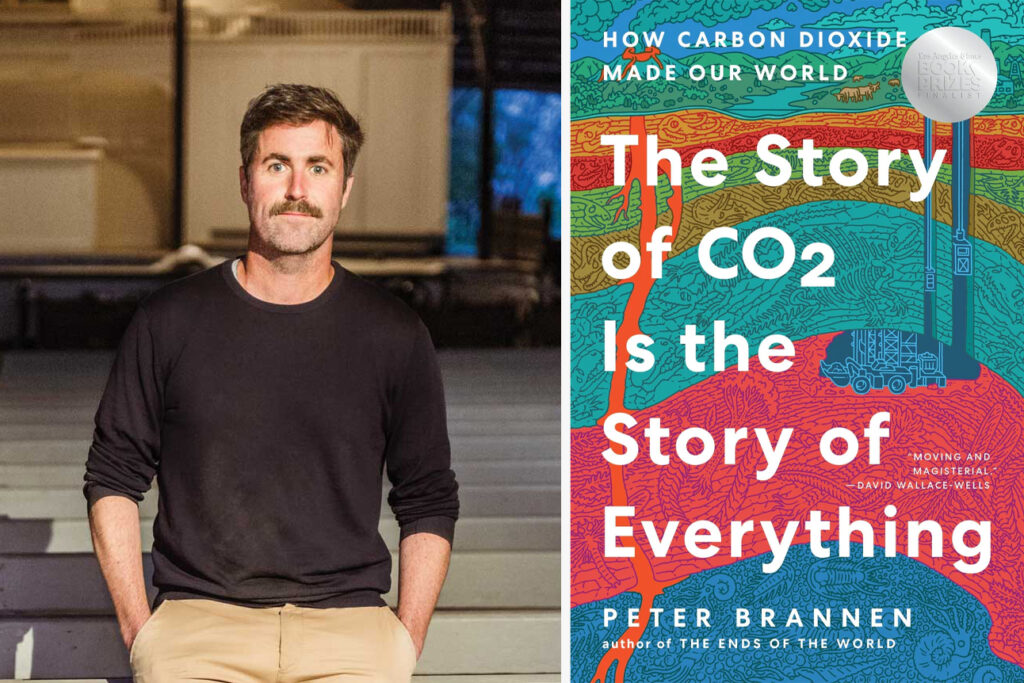
From our collaborating partner Living on Earth, public radio’s environmental news magazine, an interview by Jenni Doering with Peter Brannen, the author of “The Story of CO2 Is the Story of Everything.”
Throughout billions of years of Earth’s history, the planet has gone through a lot of change, to put it mildly. Earth froze over almost completely, more than once, and then lost all its ice as crocodiles basked in a balmy Arctic.
Over and over, continents have collided to form supercontinents like Pangaea and have then been wrenched apart again. And of course, carbon-based life arose, adapting to all this change and eventually leading to humans. Much of all this has to do with the notorious greenhouse gas, CO2.
All known life on Earth is made of carbon dioxide and the other carbon chemistries it cycles through. It’s also the primary thermostat for the Earth, and any time the Earth has seen changes in atmospheric CO2, the planet has experienced extreme climate whiplash. Now, humanity has its finger on the thermostat, as we burn fossil fuels and release tons of carbon dioxide and other planet-warming gases.
Journalist Peter Brannen wrote “The Story of CO2 Is the Story of Everything: How Carbon Dioxide Made Our World.” This interview has been edited for length and clarity.
JENNI DOERING: One of my favorite quotes from the book is from the intro, and it reads, “Today, as in the beginning, life is still made out of carbon dioxide, and the world’s problems are made out of carbon dioxide as well.” This feels to me like a thesis for the whole book. Can you talk about that?
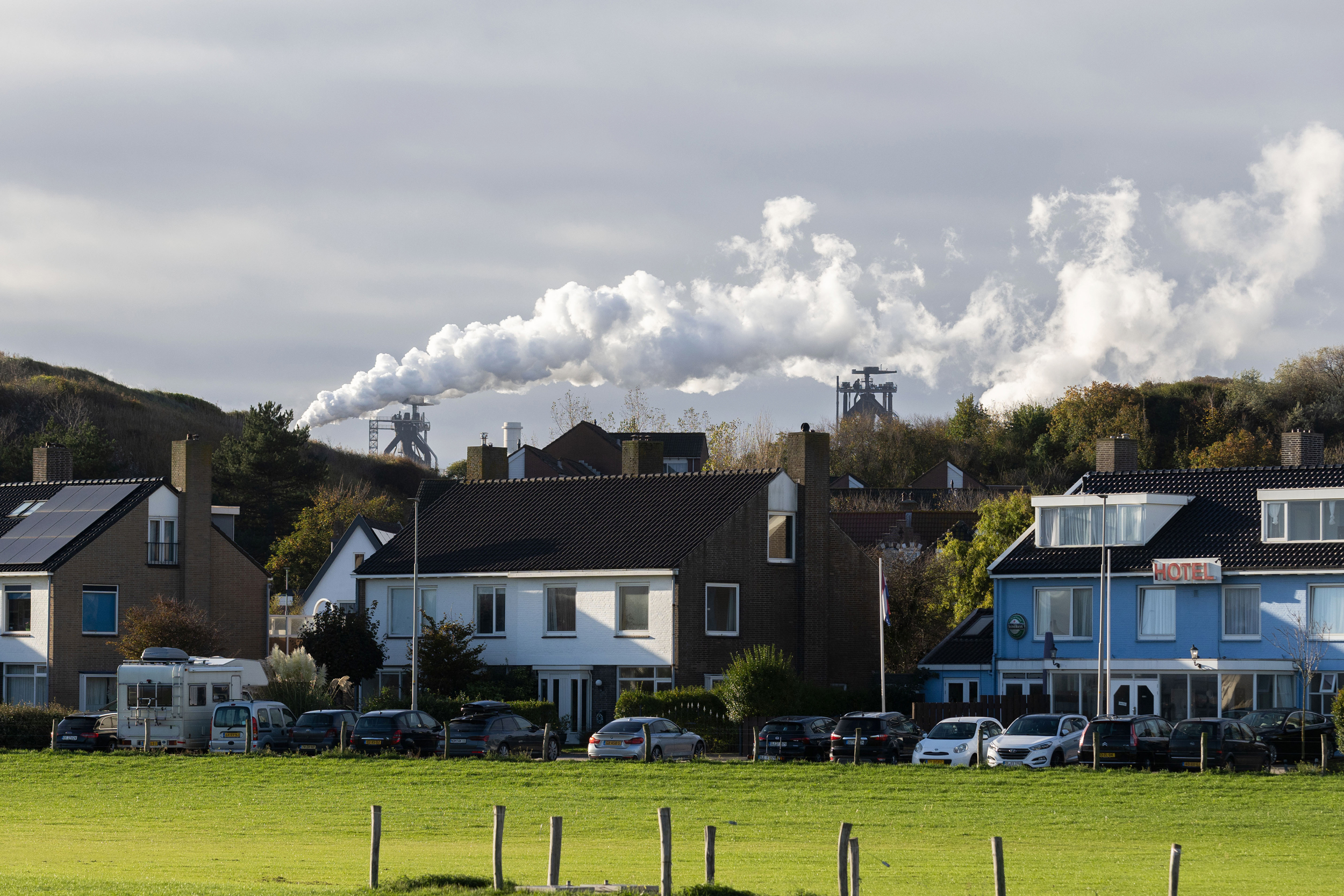
PETER BRANNEN: My motivation for writing the book was to pull back from the headlines and reintroduce people to this thing that they read about in the news, carbon dioxide, as this industrial pollutant that comes out of smokestacks, that causes warming and all these bad things on our planet. I wanted to reintroduce the reader to this idea that CO2 really is fundamental to how the planet operates and has been maintained over hundreds of millions of years.
In certain times in Earth history, like right now, when lots of it goes into the atmosphere all at once, it causes warming and all sorts of scary stuff. But in the bigger picture, it has this sort of miraculous centrality to the story of life on Earth, where not only does it cause warming when there’s too much of it, it also maintains a habitable temperature for animal life.
DOERING: One of my favorite parts about reading your book was how much I felt like I was there watching Earth history unfold like some kind of film on fast forward. Some of the fascinating parts about this history are the numerous times when the climate really went haywire, and CO2 has a lot to do with that. What happened when the planet turned into “Snowball Earth,” around 700 million years ago?
BRANNEN: Over hundreds of millions of years, the planet has navigated this narrow window of habitability, but sometimes things go haywire in ways that are relevant to our current moment.
There’s a couple amazing things about Snowball Earth. One is just how severe it is. It was a global glaciation that lasted for 60 million years, briefly thawed, and then went back into a global glaciation for a couple million years longer. The temperature at the poles might have been almost cold enough to freeze out CO2 from the atmosphere; you only see that on Mars. We’re not even talking about Earth anymore. This is like a different planet.
DOERING: Wow, frozen CO2 at the poles.
BRANNEN: Yeah, which is potentially incredibly dangerous because you could get into a fatal, eternal Snowball Earth. Animal life would never arise.
DOERING: Why did the world not stay forever frozen?
BRANNEN: To set this up I need to explain these big geological processes that sequester CO2. The main one over millions of years is rock weathering, which is when CO2 reacts with rainwater, making it more acidic, and that rainwater reacts with rocks. Eventually what was once CO2 in the air gets washed out into the oceans and precipitates as things like shells and limestone. What was once CO2 becomes rock at the bottom of the ocean. That’s the planet’s main thermostat for getting rid of the stuff.
But in Snowball Earth, when you suddenly cover up all of the land with ice, none of that precipitation is reacting with rocks. So you’re not burying any CO2, but you still have this steady stream of it from volcanoes that are emerging out of the ice sheets. When humans aren’t around, volcanoes are the main source of CO2 for the planet; they emit it at about 1/100th of the rate that humans do. You have no CO2 being buried, you’re in this ice world, but you still have these volcanoes puffing into the sky. It’s just building up over millions of years until suddenly it reaches this insanely high CO2 concentration.
Today we’re worried, rightly, that CO2 is now at 420 parts per million, which is concerning because CO2 hasn’t been that high in 3 million years, when the sea level was a lot higher and it was a lot warmer. Now apply that to what might have been the case in the thaw of Snowball Earth, where CO2 might have gotten up to something like 100,000 parts per million.
You need it to get that high in order to thaw global glaciation. So the aftermath of Snowball Earth is extremely hot and chaotic.
The thaw-out of Snowball Earth is absolutely wild, at least the fossil record of it. There’s estimates that the whole thing melted within a few millennia, and suddenly the planet was covered in a mile deep of 120-degree fresh water from all the melted ice. There’s evidence for the wildest weather in Earth history. It’s kind of amazing that complex life was forged by the most extreme climate catastrophe in the planet’s entire history.
DOERING: One of the parts that I found really interesting was the section about Pangaea. I think most of us think of it as the home of the dinosaurs, but it was also the setting for a series of mass extinctions. What was Pangaea like?
BRANNEN: If you imagine you have a giant supercontinent, it would be very hard for weather to reach the interior. For the most part, Pangaea had this vast, arid interior, and the planet seemed to really struggle to make it through. There’s two major mass extinctions. The one that wiped out the dinosaurs seems to be mostly driven by a big rock falling out of the sky. That’s not really relevant to our story today as human beings, where we’re worried about CO2.
But it turns out there are these older mass extinctions before the dinosaurs that were caused by huge eruptions of carbon dioxide into the atmosphere from these mind-bending volcanic eruptions. The one I focus on is the End Permian mass extinction. It’s the biggest mass extinction by far.
Paleontologists went back to this much bigger [extinction] looking for evidence of asteroid impacts. There really isn’t any convincing evidence for an impact. Instead, there’s this huge swath of Siberia, which you can even see on Google Earth today. It’s sort of this grayish-brown stuff that covers a lot of Siberia; these ancient lava flows date exactly to the moment of the mass extinction. To give you some perspective for how mind-blowing these volcanoes were, they erupted enough lava and enough magma intruded into the crust that it could cover the lower 48 United States a kilometer deep in lava.
This story is funded by readers like you.
Our nonprofit newsroom provides award-winning climate coverage free of charge and advertising. We rely on donations from readers like you to keep going. Please donate now to support our work.
Donate NowDOERING: And all that lava and magma comes with a lot of CO2.
BRANNEN: Right. As crazy as that is, it doesn’t explain why things at the bottom of the ocean on the other side of the world are all going extinct at the same time. And for that, you really need the gases coming out of the volcanoes to change the chemistry of the whole planet.
It gets really hot. The best estimates are 10 degrees Celsius warming over a few thousand years. The oceans acidify, which is what happens when too much CO2 reacts with sea water. We’re seeing it today on our own planet. So the Permian really is the worst-case scenario. If you want to know what happens [with] what we’re doing today, just several centuries into the future, if we just keep our foot on the gas, you can eventually end up at this planetary Armageddon, essentially, which is the End Permian. It’s this helpful cautionary tale in the rocks of what can happen.
DOERING: In the very last moment, basically, of Earth history, we humans arrive, and we are an Ice Age species. But we’re scrawny, hairless creatures. We prefer temperatures above 70 degrees Fahrenheit. What climate are humans evolved for?
BRANNEN: The last two and a half million years have been really volatile; we have dropped into these deep Ice Ages. Then you’ll have these brief breaks called interglacials, where it’s planetary springtimes for a few thousand years, but then you’ll go back into an Ice Age. This is a volatile world where you have to be incredibly adaptive to survive. It wasn’t our thick hides or our big fangs that kept us alive during this period, it was culture and the ability to pass down technologies over generations and reorganizing societies adaptively to a changing landscape.
You can imagine why having such a close relationship with fire would be a useful thing during the Ice Ages. It allowed us to not only stay warm in higher latitudes, but also cook our food, which allowed us to have these huge brains because a lot of other primates and mammals have to spend a lot of their day chewing their food and digesting it.
We’ve outsourced our digestion to this stuff, fire, that does a lot of the work for us. Instead, we get to invest our energy in these massive brains that allow us to have language and culture and technology and all these things that allowed us to survive the Ice Ages.
I don’t know what the next few decades are going to look like because I’m as worried about the headlines as everyone else. But if you look at our history, it’s kind of an inspiring one of adaptation and our ability to innovate, both technology wise, but also societally. I think that ultimately, we’re going to figure out a way of living on this planet that is more in keeping with these big global, planetary cycles. The very things that the Ice Age forged in us to keep us alive, I think, are our best hope for keeping us alive in the future.
DOERING: I don’t think I had really understood just how much of an edge we get from this “external metabolism,” as you call it, you know, from using fire, using heat to transform lentils or grains into things that are more easily digestible, that give us the energy that we need to power the work that we do.
BRANNEN: Fire is fundamental to our survival. But I also tie it into the fact that this is a precondition for the Industrial Revolution. We’d been using fire in the same way that we had for the entire Pleistocene Ice Ages. But then you start having people use it to brew beer or evaporate brine to get salt, so we’ve put it to use in all sorts of other ways.
“The legacy of the entire history of life on Earth, we’ve brought up to the surface and basically just lit it on fire in the past few centuries.”
The thing that took the lid off the Industrial Revolution was the steam engine, because finally you were able to use fire to literally do work on the surface of the planet and essentially automate human labor with machines. Once you tie that ability to do work with fire through these steam engines, you connect it with all of the plant energy that’s ever existed—these things called fossil fuels. The legacy of the entire history of life on Earth, we’ve brought up to the surface and basically just lit it on fire in the past few centuries. There’s no way to do that without completely transforming the surface of the planet.
DOERING: What did you take away most from writing this book?
BRANNEN: Even though it might sound gloomy, a lot of the stuff that I’ve been talking about, I ended the experience of writing the book with this sense of cosmic gratitude that I was even alive to begin with, or that we’re able to have this conversation.
When you read about all the incredible contingent things that happened in Earth history to get us to the point where I can be alive and have a breathable atmosphere, it’s just kind of miraculous that animal life was never wiped out completely, even though things got pretty close. But it really does take this 4-billion-year span to get to the point where I get to be alive for a couple decades and look around this weird planet, meet all these cool people, and try and figure it out. I feel really lucky in that respect.
The Earth is an unbelievable place. It’s a miracle that we’re alive. And given how precious it is and how miraculous that is, it just redoubles my conviction about how important it is to preserve it and be good stewards of the planet and be appreciative for being alive to begin with.
About This Story
Perhaps you noticed: This story, like all the news we publish, is free to read. That’s because Inside Climate News is a 501c3 nonprofit organization. We do not charge a subscription fee, lock our news behind a paywall, or clutter our website with ads. We make our news on climate and the environment freely available to you and anyone who wants it.
That’s not all. We also share our news for free with scores of other media organizations around the country. Many of them can’t afford to do environmental journalism of their own. We’ve built bureaus from coast to coast to report local stories, collaborate with local newsrooms and co-publish articles so that this vital work is shared as widely as possible.
Two of us launched ICN in 2007. Six years later we earned a Pulitzer Prize for National Reporting, and now we run the oldest and largest dedicated climate newsroom in the nation. We tell the story in all its complexity. We hold polluters accountable. We expose environmental injustice. We debunk misinformation. We scrutinize solutions and inspire action.
Donations from readers like you fund every aspect of what we do. If you don’t already, will you support our ongoing work, our reporting on the biggest crisis facing our planet, and help us reach even more readers in more places?
Please take a moment to make a tax-deductible donation. Every one of them makes a difference.
Thank you,