

Heather Talley’s life savings are tied up in a Swannanoa, North Carolina, home she can’t live in after Hurricane Helene. Bill Gould wants to rebuild his home after it was burned down in the wildfires that destroyed Altadena, California, but can’t get soil contamination testing approved.
Michael McLemore relives the terror of the tornado that tore through St. Louis every time he steps outside and sees streets of battered homes. Brandy Gerstner won’t forget that when her sister was swept two miles from home by a flooding river last summer in Texas, little help came from the Federal Emergency Management Agency (FEMA) for three days.
They and others affected by recent disasters across the country are calling on Congress to restore FEMA as an independent agency, one no longer beholden to what they call the politicized leadership of Homeland Security Secretary Kristi Noem.
As the agency designated to help them continues to operate under the Department of Homeland Security (DHS), it’s become slower, more restrictive and less accountable, a group of disaster survivors said at a virtual press conference on Thursday arranged by the New Jersey Organizing Project, itself founded by disaster survivors.
From its inception in 1979 until 2003, FEMA reported to the president and Congress. It was then moved to the newly formed DHS, where numerous federal agencies were consolidated after the terrorist attacks of Sept. 11, 2001. Since then, disaster recovery has been treated like a political afterthought, the survivor group said in a statement, held hostage inside an agency now focused on increasingly violent immigration enforcement.
Since the start of his second term, President Donald Trump has floated the idea of abolishing FEMA and has cut thousands of jobs from the agency. This week unions and local governments said in a legal filing that the administration plans to slash agency staffing in half.
FEMA has faced backlash for delaying nearly $11 billion in promised reimbursements for states last year.
In April, meanwhile, the agency said it was ending a program that helped fund measures to reduce disaster risk and canceling already-awarded grants, all while climate change is making large-scale weather disasters more likely and more intense. After 20 states sued, a court ruled in December that FEMA can’t do that.

The White House did not immediately respond to a request for comment.
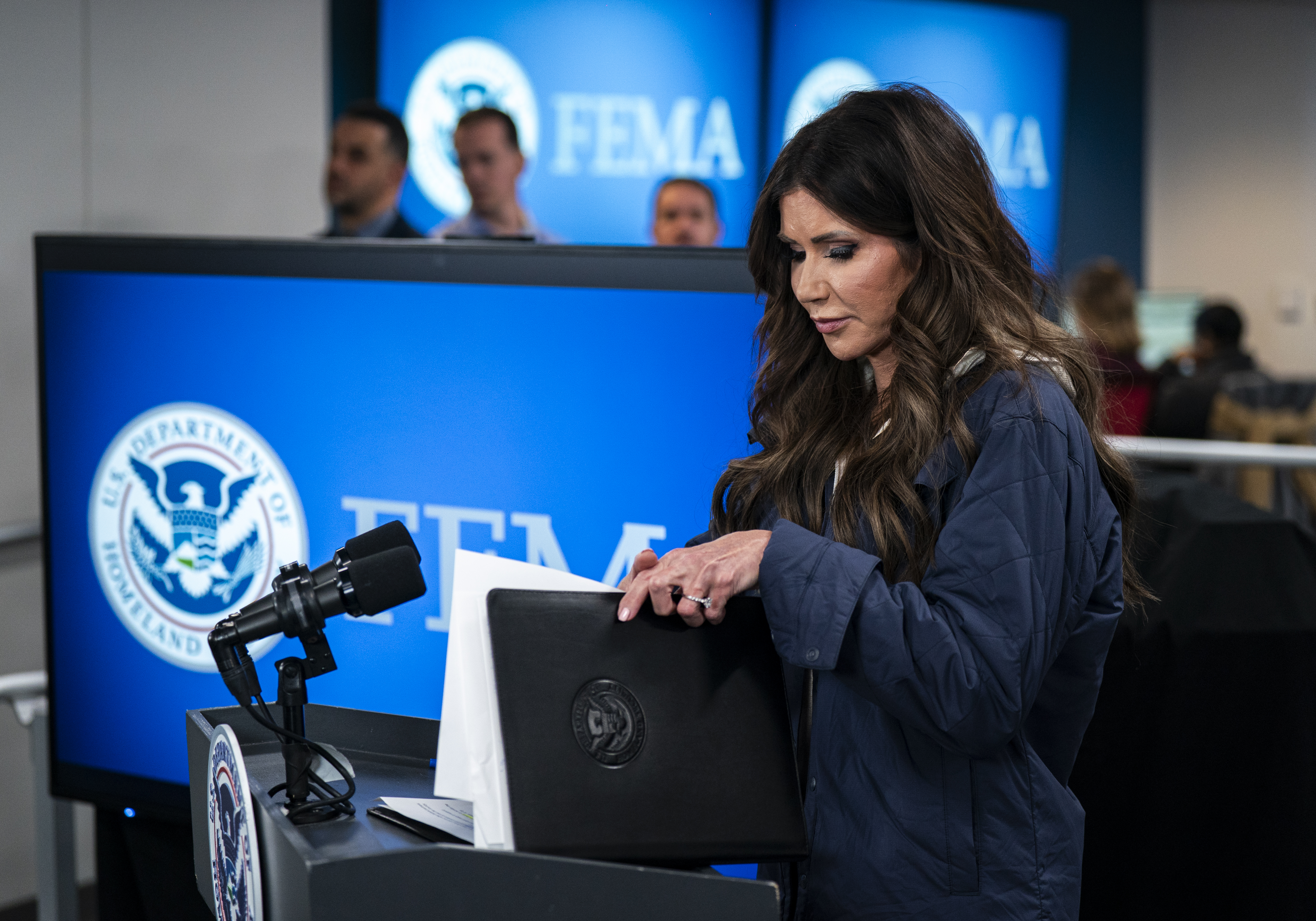
As head of DHS, Noem oversees multiple large federal agencies, including Immigration and Customs Enforcement, the Transportation Security Administration, the U.S. Coast Guard and the U.S. Secret Service. The former governor of South Dakota also controls FEMA’s budget priorities and spending approvals.
Among the changes Noem made is that expenditures above $100,000 require her personal sign-off. That’s caused delays getting aid out as disasters happen, including in Texas last summer. As floodwaters overtook several Hill Country towns, FEMA could not quickly get search and rescue crews from across the country into position there because they were awaiting Noem’s approval, CNN reported.
Meanwhile, the life Gerstner and her family built around their Leander, Texas, home disappeared.
Over the 36 years she’d lived along Sandy Creek, the property had become her family’s working hobby farm and an artisanal spice business. Her daughter lived across the driveway and her sister on the other side of the creek. The Fourth of July night when debris-filled floodwaters rushed into her home, she called her daughter to say goodbye.
Both made it through. The flood turned her sister’s house into a pile of mangled scraps and swept the woman away, but she survived by clinging to a fence.
All told, Gerstner’s family lost three houses, five cars, their business, barns, bees and livestock. “Still, we were some of the lucky ones,” Gerstner said. She lost six neighbors.
Gerstner and most of those affected by the Hill Country floods were stranded for days without power or water. It was neighbors, volunteers and local emergency response crews who helped, she said. Official help was scarce. It took more than 72 hours for FEMA to arrive, she said.
When Noem celebrated FEMA’s response, Gerstner could not believe it. She called that characterization “a lie that insults the memory of those lost in the floods.”
Read More

Climate Change Helped Fuel Heavy Rains That Led to Devastating Texas Flood
By Arcelia Martin
In Missouri, initial cleanup efforts after the tornado took weeks. In California, only a handful of homes have been repaired despite more than 13,000 structures destroyed in the Los Angeles-area wildfires. In North Carolina, some 16 months after Hurricane Helene, survivors are desperate to move on with their lives.
Talley has lived in eight places since Helene and said her friends and neighbors can’t continue to support her indefinitely. Despite being unable to live in her home after the storm, she said she’s still on the hook for her mortgage.
“We desperately need answers and resources from FEMA,” she said, tears welling.
The staffing and budget cuts of FEMA have turned these survivors into unlikely advocates seeking to reform a federal agency. After one year of Noem at the helm, the group provided the Homeland Security secretary a report card:
“Our grade is unanimous,” said Brandon Lamar, president of the NAACP’s chapter in Pasadena, California, who helps organize local wildfire recovery efforts. “That grade is ‘F.’”
About This Story
Perhaps you noticed: This story, like all the news we publish, is free to read. That’s because Inside Climate News is a 501c3 nonprofit organization. We do not charge a subscription fee, lock our news behind a paywall, or clutter our website with ads. We make our news on climate and the environment freely available to you and anyone who wants it.
That’s not all. We also share our news for free with scores of other media organizations around the country. Many of them can’t afford to do environmental journalism of their own. We’ve built bureaus from coast to coast to report local stories, collaborate with local newsrooms and co-publish articles so that this vital work is shared as widely as possible.
Two of us launched ICN in 2007. Six years later we earned a Pulitzer Prize for National Reporting, and now we run the oldest and largest dedicated climate newsroom in the nation. We tell the story in all its complexity. We hold polluters accountable. We expose environmental injustice. We debunk misinformation. We scrutinize solutions and inspire action.
Donations from readers like you fund every aspect of what we do. If you don’t already, will you support our ongoing work, our reporting on the biggest crisis facing our planet, and help us reach even more readers in more places?
Please take a moment to make a tax-deductible donation. Every one of them makes a difference.
Thank you,

Arcelia Martin
Reporter, Texas Renewables
Arcelia Martin is an award-winning journalist at Inside Climate News. She covers renewable energy in Texas from her base in Dallas. Before joining ICN in 2025, Arcelia was a staff writer at The Dallas Morning News and at The Tennessean. Originally from San Diego, California, she’s a graduate of Gonzaga University and Columbia University Graduate School of Journalism.