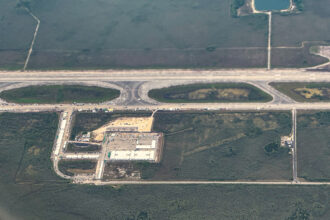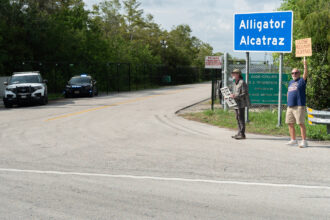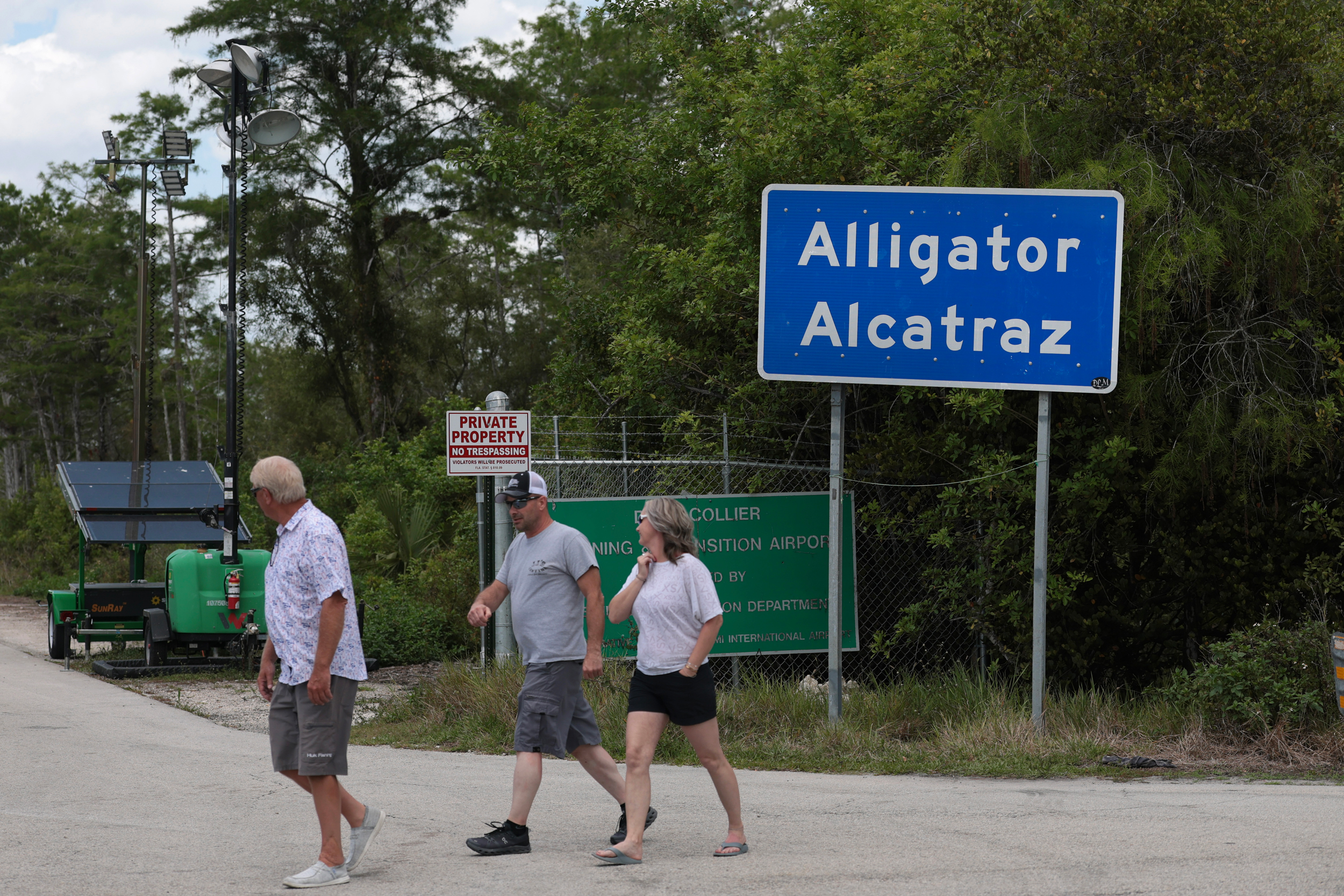


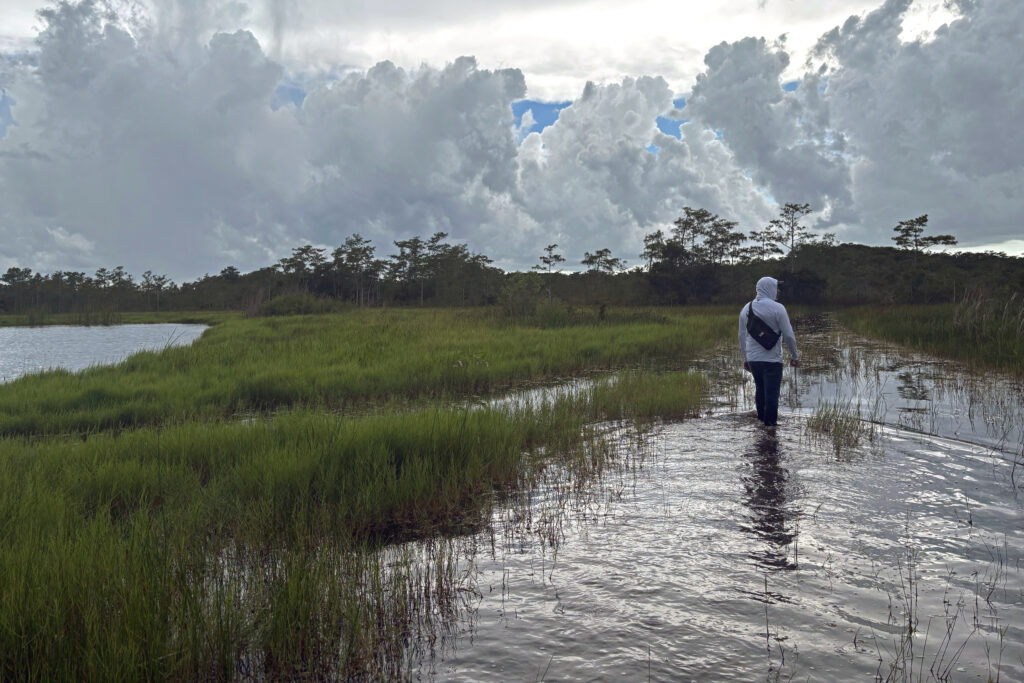
Every spring Florida’s Miccosukee Tribe observes its corn dance season on lands the tribe holds as sacred within the fragile Everglades. But this year’s festivities are different, because of the migrant detention site that now looms among the tribal lands, Alligator Alcatraz.
One hindrance is that the light emanating for miles from the facility interferes with an important aspect of the Miccosukee’s religion, the orientation of the stars, said Curtis Osceola, the tribe’s chief operating officer. If not for the light pollution the stars would gleam bright here in the night sky above the vast sawgrass prairies and cypress marshes of the remote river of grass.
“It’s hard to explain, and not everyone will understand our relationship with the land,” he said. “It’s as if someone went to a holy place, whether it was like church land, and said, ‘We’re going to raze this church land and put up a prison and put up a detention center.’ People would be up in arms. This is our place of worship. This is a sacred place. This doesn’t seem fair.”
The tribe, along with environmental groups, say they will continue their litigation over Alligator Alcatraz, where thousands of undocumented migrants have been detained since the facility opened last summer as part of the Trump administration’s immigration crackdown. The 11th U.S. Circuit Court of Appeals last week invalidated a preliminary injunction issued by District Judge Kathleen Williams, who had ordered in August a winding down of the facility. The case now will go back to Williams, who will decide next steps.
The ruling means the detention site may keep operating while the environmental groups and tribe’s litigation proceeds. In the case, the Miccosukee and their fellow plaintiffs accused the federal and state governments of unlawfully rushing the facility to completion without a required environmental review under the National Environmental Policy Act (NEPA). The government agencies have contended the site is a state and not a federal one, and that the federal review is not necessary. The agencies also said the facility’s impact on the environment is minimal. The Everglades, which span central and south Florida, are responsible for the drinking water of millions of people in the state. A $27 billion restoration effort is among the most ambitious of its kind in human history.
“This is our place of worship. This is a sacred place. This doesn’t seem fair.”
— Curtis Osceola, Miccosukee Tribe
The appeals court, in siding with the government agencies, said the plaintiffs failed to prove the federal government controlled the site. Judges William Pryor and Andrew Brasher also said Williams’ preliminary injunction violated in part a statutory prohibition on enjoining immigration enforcement. The judges reasoned that for the site’s Florida operators to follow federal immigration standards does not transform the facility into a federal one. They compared the situation with that of an office building owner who adheres to the Americans with Disabilities Act. Compliance with the federal law does not make the building federal, they said.
But Judge Nancy Abudu dissented. She characterized the federal and state roles in Alligator Alcatraz as one where the federal government enlisted the state not as an equal partner but as a “deputy of the federal government operating at its request.” She said her colleagues’ analogy involving the office building owner and Americans with Disabilities Act was weak.
“Here, the detention facility’s only goal is to house thousands of people under DHS and ICE’s control, in a secluded area, away from the public, without any accountability,” Abudu wrote. “If not for its partnership with DHS and ICE, Florida’s housing of these individuals (and in some cases families) would be more akin to kidnapping and, at its most extreme, perhaps human trafficking. The state cannot detain a non-citizen without the proper authority to do so.”
The court’s ruling was disappointing, but the environmental groups and tribe remain optimistic they eventually will prevail, said Elise Bennett, Florida and Caribbean director and senior attorney at the Center for Biological Diversity, one of the plaintiffs in the case.
“We were prepared for any potential outcome, but that doesn’t make it sting any less because we know that there is irreparable harm ongoing in the Everglades, from water pollution to impacts to the Florida panther and bonneted bat,” she said. “We were hopeful we would put an end to that harm in the early stages in the case. Now we’re reinvigorated to get back in there and win.”
This story is funded by readers like you.
Our nonprofit newsroom provides award-winning climate coverage free of charge and advertising. We rely on donations from readers like you to keep going. Please donate now to support our work.
Donate NowFriends of the Everglades, the third plaintiff in the case, said public records obtained through a separate lawsuit filed by the advocacy group show the Federal Emergency Management Agency promised hundreds of millions of dollars to Florida to build and operate the facility. Friends of the Everglades and the Center for Biological Diversity filed the lawsuit last June in the U.S. District Court in the Southern District of Florida, with the Miccosukee Tribe joining later on. The secretary of the Department of Homeland Security, acting director of U.S. Immigration and Customs Enforcement, executive director of the Florida Division of Emergency Management and Miami-Dade County, which owns the property, are named as defendants in the case. The government agencies did not immediately respond to requests for comment on the appeals court ruling.
During the First and Second Seminole Wars, in the first half of the 19th century, the Miccosukee were pushed deep within the watery wilderness of the Everglades and found sanctuary on the tree islands scattered here. For them the land is sacred, because it saved their tribe from annihilation. Osceola said the detention site’s close proximity to tribal lands and the Big Cypress National Preserve is a concern. Within a three-mile radius of Alligator Alcatraz are 10 Miccosukee villages, including one a mere 1,000 feet from the facility. A school is 10 miles away.
“We survived in the Big Cypress. It cared for us. The Everglades likewise cared for us and helped us survive. The plants and animals of those lands sustained our existence, and we were able to make it through that wartime period,” he said. “We have a very strong religious connection with the land. And so activities like this are going to disrupt that relationship, that sort of strong relationship we have with the sacred land.”
About This Story
Perhaps you noticed: This story, like all the news we publish, is free to read. That’s because Inside Climate News is a 501c3 nonprofit organization. We do not charge a subscription fee, lock our news behind a paywall, or clutter our website with ads. We make our news on climate and the environment freely available to you and anyone who wants it.
That’s not all. We also share our news for free with scores of other media organizations around the country. Many of them can’t afford to do environmental journalism of their own. We’ve built bureaus from coast to coast to report local stories, collaborate with local newsrooms and co-publish articles so that this vital work is shared as widely as possible.
Two of us launched ICN in 2007. Six years later we earned a Pulitzer Prize for National Reporting, and now we run the oldest and largest dedicated climate newsroom in the nation. We tell the story in all its complexity. We hold polluters accountable. We expose environmental injustice. We debunk misinformation. We scrutinize solutions and inspire action.
Donations from readers like you fund every aspect of what we do. If you don’t already, will you support our ongoing work, our reporting on the biggest crisis facing our planet, and help us reach even more readers in more places?
Please take a moment to make a tax-deductible donation. Every one of them makes a difference.
Thank you,

Amy Green
Reporter, Florida
Amy Green covers the environment and climate change from Orlando, Florida. She is a mid-career journalist and author whose extensive reporting on the Everglades is featured in the book MOVING WATER, published by Johns Hopkins University Press, and podcast DRAINED, available wherever you get your podcasts. Amy’s work has been recognized with many awards, including a prestigious Edward R. Murrow Award and Public Media Journalists Association award.