

This story was co-published and supported by the journalism nonprofit the Economic Hardship Reporting Project.
Chris Warner has been harvesting seafood in coastal Maine since he was a teenager. It’s never been easy, but he’s never let the obstacles stand in his way. Sometimes, he says, it feels like he’s spent 34 years in an endless state of adaptation.
Warner was on a boat the last day before the regional shrimp moratorium went into effect in 2013. He saw the sea urchin industry rise and fall. He was out there the day limits were put on haddock. Still, he and his fellow harvesters found ways to pivot and keep themselves afloat, fighting to preserve one of the region’s few reliable industries and their place in shaping Maine’s identity.
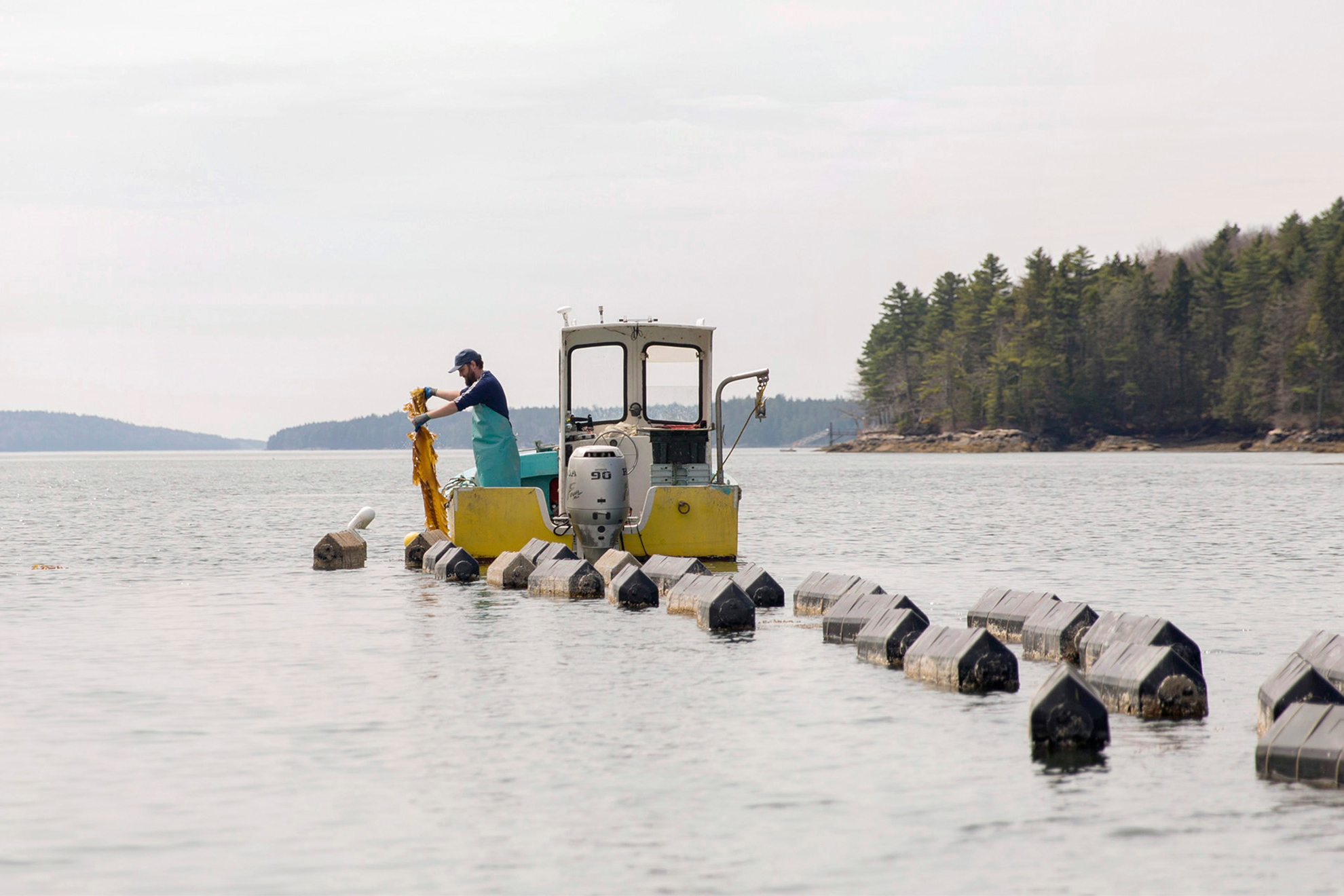
Today, Warner farms oysters and digs softshell clams for half his income and makes the rest as a real estate agent. But even what remains is now threatened, he said, by an uptick in harvest closures driven by increased pollution along Maine’s booming coastline and heavier and more frequent rains washing it into waterways.
Commercial shellfisheries in Maine and beyond are regulated by the National Shellfish Sanitation Program, an interstate compact developed in 1925 and administered at the state level to protect the public from unsafe seafood. In Maine, two inches of rain within a 24-hour period automatically triggers an emergency closure of shellfish growing areas under the NSSP; harvesters can’t get back to work until the state’s water-quality testing shows the risk of shellfish polluted by fecal coliform has subsided. Many of the state’s growing areas are on stricter limits, closing for as many as 14 days after rainfall totals as low as three-quarters of an inch—closures that can be extended for weeks by intervening storms.
Each of those closures deals a blow to the community of shellfish harvesters whose work helps sustain Maine’s seafood economy. As climate change coincides with a post-pandemic rush of residents and tourists to the state’s serene seaside towns, overtaxing septic systems and bringing a surge of new pollution, those working on the water describe being pushed to the brink. Warner and others like him are tangling with the reality that they may need to pivot once again—only this time, they’re running out of options.
“It’s horrifying,” Warner said. “Every time it rains, you’re done.”
“An Onslaught of Issues”
Maine’s iconic lobster remains the undisputed heavyweight of the state’s commercial fisheries, but clams and oysters rank second and third, respectively, bringing in about $15 million each in 2024. Because both are filter feeders, their safety for consumers relies on water quality that’s become harder to maintain.
Since 1970, Maine’s annual rainfall has increased by four inches, according to a Climate Central report, powered by higher temperatures that trap more moisture in the air. Across the Northeast, the heaviest rain events now bring 60 percent more precipitation. And Maine faced more 2-inch rainfall events in the 2010s than any previous decade, while anticipating overall precipitation to rise annually by 5 to 14 percent in the decades to come. All that rain carries polluted runoff into the mudflats and estuaries where shellfish grow.
Maine’s shellfish industry has faced “an onslaught of issues in the past couple decades,” said Marissa McMahan, senior director of fisheries at the nonprofit Manomet Conservation Sciences, where she works to build resilience in fishing communities and marine ecosystems. The Gulf of Maine is warming faster than 99 percent of the world’s oceans, and those warmer waters have contributed to an influx of invasive green crabs and other predators, as well as algal blooms and other biotoxins that lead to separate harvest closures under the NSSP. Ocean acidification adds another layer of concern. By reducing the amount of calcium carbonate in the water, it makes it harder for clams and oysters to grow their protective shells. Conditions could drop below critical levels for shellfish health by 2050.
“There are still places that are thriving and viable,” McMahan said. “But now those places are being closed because of water quality. It’s just compounding the issue.”
To make matters worse, climate change is bringing more people to Maine, sending housing prices through the roof and making it harder for shellfish harvesters to stay in the towns where they live. Because harvesting licenses are tied to residency, some are faced with an unenviable choice: keep working in increasingly unaffordable coastal towns or move and give up their license. In the midst of what Warner calls a “perfect storm,” commercial shellfish licenses fell from 1,510 in 2022 to 1,207 in 2024, a 20 percent decline, according to the state’s Department of Marine Resources.
Even before Maine’s coastal towns were inundated with people “from away,” the economic toll of rainfall-related closures was putting a pinch on shellfish harvesters. A 2016 study from the University of Maine found that temporary closures sapped more than one-quarter of total shellfish revenue from Machias Bay in the state’s Downeast region.
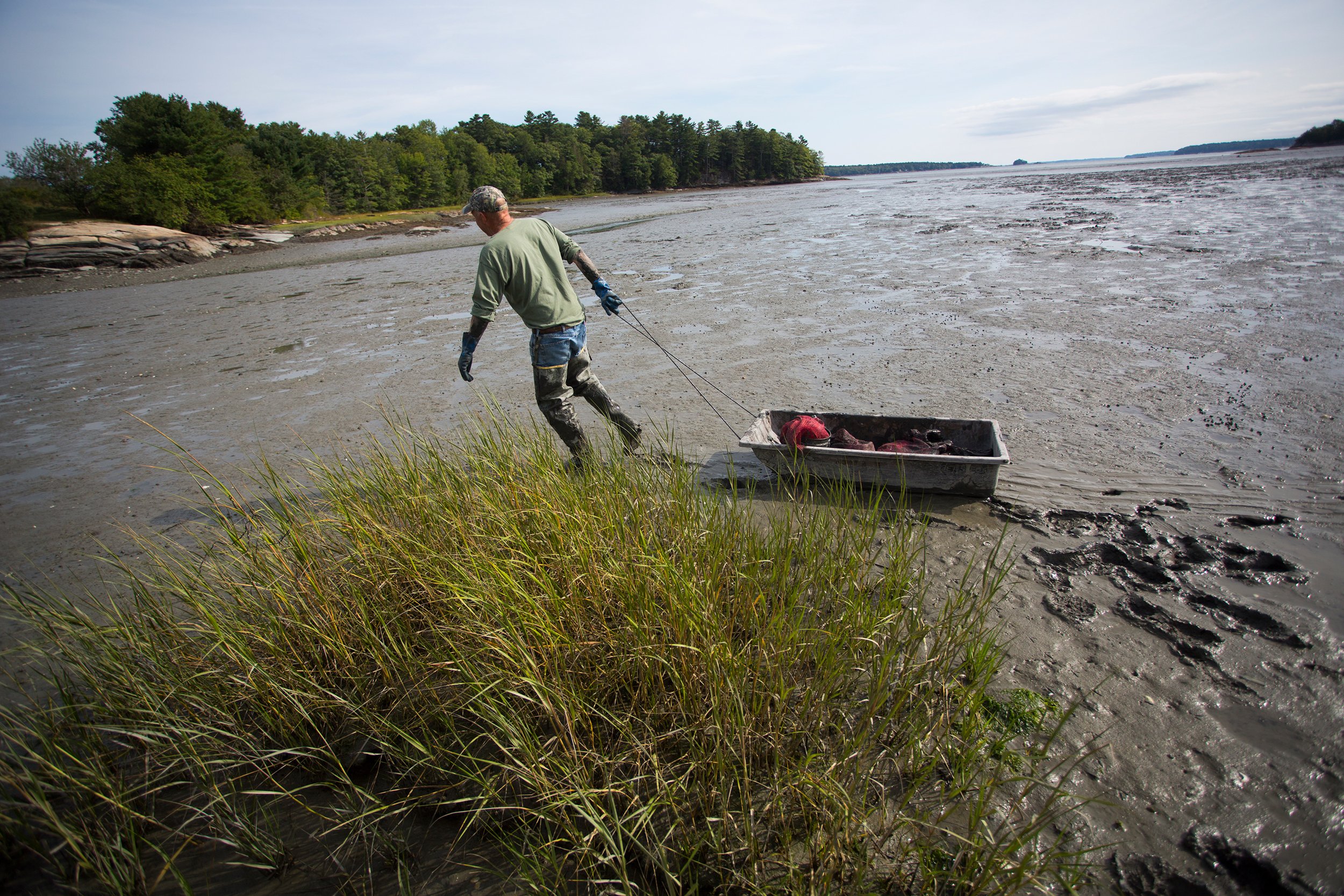
The confluence of factors is also affecting an even more vulnerable group, McMahan said. The low cost of a recreational license—often between $10 and $20—opens the door to sustenance fishing. Digging a pack of clams a day provides more than enough food to feed a family and requires little more than a sturdy pair of boots and a clam hoe for raking the catch out of the mud. Rainfall-related closures, which limit commercial and recreational clamming, are likely taking food directly off of dinner tables, McMahan said. “There’s a real danger that we’re overlooking how important it is for food security for people.”
Strain on the System
Unable to stop the rain, many harvesters have turned their ire on the Department of Marine Resources, which implements the NSSP in Maine. The agency is tasked with monitoring 47 growing areas, each of which comprises numerous coves that are assigned a different status depending on their historic water quality and monitored via 1,179 sampling stations. In some areas, harvesting is fully approved or fully prohibited; in others, harvesting is conditional upon weather patterns, closing down seasonally or following heavy rains. Still others are restricted, meaning shellfish can’t be taken to market until they’ve gone through depuration, a process in which they spend time in clean water to purge low-level contamination.
The DMR always aims for the least-restrictive classification, which often leads to conditional designations that allow areas to be kept open in good weather, according to Bryant Lewis, one of the agency’s two growing-area supervisors.
Half the department’s role is classifying and monitoring growing areas; the other half is promoting the shellfish industry. But it isn’t responsible for or capable of addressing pollution sources that lead to classification downgrades and harvest closures. Around a dozen DMR employees conduct shoreline surveys along the state’s nearly 3,500 miles of coastline, rotating through growing areas across a 12-year cycle. They search for failing or overwhelmed septic systems, dog parks and other sources leeching fecal coliform—bacteria found in the intestines of warm-blooded animals that indicate a heightened risk of dangerous pathogens—into rivers and bays. The agency informs towns of any concerns, at which point remediation is up to municipalities.
Garnering support for the remediation and any necessary changes to prevent future contamination, though, is often an uphill battle. There’s a “societal trade-off” being made in small communities bearing the brunt of harvest closures, said Bob Rheault, executive director of the East Coast Shellfish Growers Association. In budget conversations, sewer improvements are up against schools and policing and often fall to the end of the line, he said.
“What are your priorities as a community? Do you want to have open growing areas that you can harvest freely from on a regular basis?” Rheault said. “If you do, then you need to invest in your wastewater treatment infrastructure where your population centers exist.”
The DMR does what it can in Maine, Lewis said, but lacks the authority to compel individuals to replace failing septic systems or to make towns reduce combined sewer overflows.
Unfortunately, McMahan said, there’s a “mismatch in the pace at which we’re seeing more and more sources of pollution versus what the DMR is capable of doing and what that ultimately means for the industry and impact to harvesters.”
In Brunswick, a Midcoast town with about 22,000 residents and 61 miles of coastline, a section of Maquoit Bay that has been harvested for generations—and once fed the Wabanaki and Micmac tribes—was recently reclassified to be closed for two weeks every time it rains an inch, said Dan Devereaux, the town’s coastal resource manager. Based on last year’s particularly rainy weather patterns, he calculated that the area could now be closed for up to half the year, removing around 400 productive acres—25 percent of the town’s total—from harvest.
“You close down these areas, you better make damn sure you’ve done everything you can to keep them open,” he said. “And I don’t think that’s necessarily happening here.”
Devereaux and others have lamented the collision of a rigid regulatory structure with a water quality testing regime that hasn’t kept up with the increased pressure on Maine’s coastline, even while acknowledging the DMR lacks the staffing and resources necessary to meet the challenge. Faced with a complicated set of circumstances, the state and its municipalities need to do more—both in terms of testing and addressing pollution—to avoid unnecessary closures, he said.
“The most conservative way to do it for public health is just to keep everything closed, but because of our heritage and our rich history, we can’t sit around and let that happen to our community,” Devereaux said. “We have 100 years of people making a living off the clam flats in this region and across the state and a municipal responsibility as part of the management partnership.”
Rainfall closures and growing area reclassifications have a pernicious effect on Maine’s 150 or so oyster farmers, too. Eric Oransky, whose Maine Ocean Farms is situated in the town of Freeport in Casco Bay, said he and his partner studied years of water quality data before choosing their location but have lost tens of thousands of dollars because of harvest closures in the past two years.
Shellfish farmers don’t have the ability to simply harvest in another location if theirs is temporarily closed, and unexpected breaks can disrupt relationships with wholesalers or restaurants that require consistency from their suppliers. Unlike wild harvesters, farmers can keep their shellfish in the water until harvesting is allowed and recoup any losses, although doing so takes a level of financial flexibility that not everyone can muster.
“We want to protect public health more than anyone,” Oransky said. He and his colleagues believe more diligent testing and shoreline surveying can balance the needs of consumers and producers. He wants to see “better science, more data and people who are asking questions with an eye on how this affects people’s ability to earn a living along the water.”
Rainfall and Remediation
Despite the challenges, some towns have found ways to successfully navigate the increase in harvest closures as rainfall rises.
In Biddeford, a town of around 22,000 people south of Portland, residents just approved a $20 million overhaul of the municipal sewer system. Brunswick, meanwhile, has given grants to individuals to update their septic systems, said Carissa Maurin, the aquaculture program manager at the Gulf of Maine Research Institute. Harvesters along the Medomak River in the Midcoast region formed a working group that identified and remediated pollution from a kelp processor.
“There are towns and communities working toward that goal because they see how important it is to the livelihood of people in their communities,” Maurin said.
This story is funded by readers like you.
Our nonprofit newsroom provides award-winning climate coverage free of charge and advertising. We rely on donations from readers like you to keep going. Please donate now to support our work.
Donate NowChanges to the state’s sampling regime could also make a meaningful difference, McMahan said. Monthly sampling—as opposed to the current six annual tests—could balance the state’s busier summer months with calmer winter months to lower scores and keep growing areas in less-restrictive classifications. Harvest peaks between May and October but takes place year-round.
If the state conducted hydrodynamic modeling, it could get a better idea of how effluent moves through its waterways when it rains, perhaps making clear that shellfish in certain areas are unaffected, McMahan said. “Most towns don’t have the capacity to do that,” McMahan said. “And the state says they don’t have the capacity. So who’s going to do it?”
David Taylor has been doing his part since 2019. A former harvester who started digging when he was 13, he’s now 71 and put down his clam hoe a few years ago. Taylor collects water samples along the Georges River and sends them to a professor at the University of New Hampshire for DNA testing that reveals the source of fecal coliform, rather than just its presence, as DMR tests indicate. (The agency won’t use his data, he said.)
With that information, Taylor has helped ameliorate pollution and informed the reopening of multiple growing areas, he said. In all the testing he’s seen, he’s never come across a sample that doesn’t include dog waste, so he carries a straightforward message with him when he speaks with towns and residents about the connection between their land use and the shellfish they love to eat: Pick up after your pets.
“Please work with us,” he said. “You’re talking about people’s livelihoods.”
Keeping Tradition Alive
Even after more than three decades fishing, Chris Warner still loves it. Some nights he’s so excited to wake up and get to work he has to take Benadryl to sleep. But it’s getting harder to stay with it as the rains fall more intensely and more often. The longest harvest closure he’s faced while working the Kennebec River was 78 days.
For 30 years, he said, “I’ve lived and died on water quality.”
Closures, for Warner, are about more than a day’s pay. He’s seen the tangible impact on the lives of his fellow harvesters—lost income, sure, but foreclosures and divorces that followed, too. “People don’t get to do what they enjoy, what they do best, what they’ve been brought up to do,” he said.
As he’s watched precarity edge its way into shellfish harvesting, he’s started to question whether he made a mistake passing on the tradition to his son, rather than steering him toward another career. He encourages young people to get as much education as they can and diversify their options, rather than rely solely on clamming.
He’s not ready to give it up himself, even though he’s taken his own advice by becoming a real estate agent to supplement his income. A prospective buyer recently remarked on the constant reinvention required by his fellow fishermen. “You’re more resilient than anybody,” they told him.
“We believe in fighting for that,” Warner said.
About This Story
Perhaps you noticed: This story, like all the news we publish, is free to read. That’s because Inside Climate News is a 501c3 nonprofit organization. We do not charge a subscription fee, lock our news behind a paywall, or clutter our website with ads. We make our news on climate and the environment freely available to you and anyone who wants it.
That’s not all. We also share our news for free with scores of other media organizations around the country. Many of them can’t afford to do environmental journalism of their own. We’ve built bureaus from coast to coast to report local stories, collaborate with local newsrooms and co-publish articles so that this vital work is shared as widely as possible.
Two of us launched ICN in 2007. Six years later we earned a Pulitzer Prize for National Reporting, and now we run the oldest and largest dedicated climate newsroom in the nation. We tell the story in all its complexity. We hold polluters accountable. We expose environmental injustice. We debunk misinformation. We scrutinize solutions and inspire action.
Donations from readers like you fund every aspect of what we do. If you don’t already, will you support our ongoing work, our reporting on the biggest crisis facing our planet, and help us reach even more readers in more places?
Please take a moment to make a tax-deductible donation. Every one of them makes a difference.
Thank you,