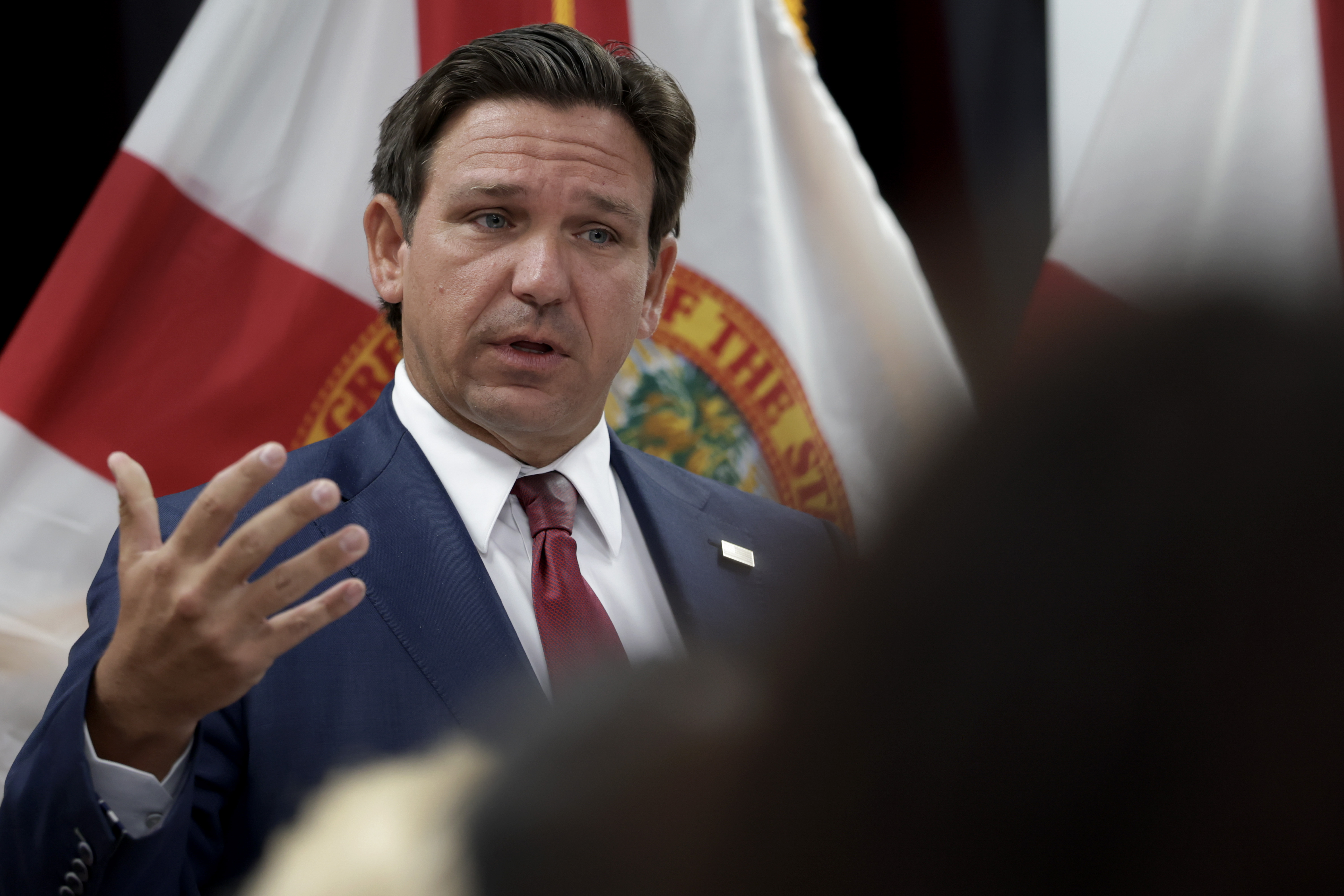


A few weeks after the U.S. government began incarcerating undocumented migrants in the fragile Florida Everglades, Gov. Ron DeSantis held a news event some 57 miles from the facility, in beachy Marco Island, that went somewhat unnoticed at the time among the national media.
At the event, the governor and Acting Assistant Secretary of the Army D. Lee Forsgren signed an agreement to expand the state’s role in Everglades restoration.
When it was introduced, the $27 billion effort, one of the most ambitious of its kind in human history, was designed to be shared evenly by the federal and state governments. During the July event, DeSantis, a Republican, said the new arrangement would empower the state to expedite restoration projects, specifically a $3.5 billion reservoir south of Lake Okeechobee, in a region called the Everglades Agricultural Area, that he has characterized as the “crown jewel of Everglades restoration.” The governor said the new agreement would push the reservoir to completion five years ahead of schedule, in 2029.
“There will be projects in the EAA that will be completed by the state of Florida on behalf of the Army Corps,” he said. “It will be using the allocated federal funds, and it will allow us to accelerate the commitment and the investment in the project to ensure that we’re not waiting until 2034, that actually we’re going to get it done five years earlier, in 2029.”
But six months after the leaders executed the agreement, many questions remain about what the revision to the federal-state partnership means for the monumental effort to save the watershed, which is responsible for the drinking water for millions of people in the state. The Everglades face increasing pressure as global temperatures warm, storms intensify and tides rise.
The agreement allows the state to provide technical and on-the-ground support and personnel for the construction of the EAA reservoir, which, once complete, will be the largest of its kind the Army Corps of Engineers has built anywhere in the country. Despite that arrangement and any costs it may impose on the state, DeSantis’ state budget proposal, unveiled in December ahead of the start of the annual legislative session earlier this month, allocates $810 million toward Everglades restoration, about the same as what he called for last year. The governor appears to be planning on a full federal reimbursement for any state work. Legislators will take up DeSantis’ proposal during their annual session, which is underway and concludes in March.
“If his budget proposal isn’t reflecting what’s required of the agency to take on the largest wetlands restoration project the world has ever known, then it reflects a misunderstanding of what is required,” said Jaclyn Lopez, director of the Jacobs Public Interest Law Clinic for Democracy and the Environment at Stetson University.
The South Florida Water Management District, the state agency overseeing Everglades restoration, declined Inside Climate News’ request for an interview with Drew Bartlett, the agency’s executive director. But the water management district issued a statement touting record state funding for the restoration effort during DeSantis’ time in office. The governor put $3.3 billion toward the river of grass during his first term and called for another $3.5 billion at the start of his second term, which concludes in January 2027.
“Governor DeSantis’ final budget shows that the environment remains a cornerstone of his administration. The State of Florida continues to lead the way with projects that advance Everglades restoration, improve water quality, ensure water supply for people and the environment, increase the capacity of water storage, reduce damaging discharges from Lake Okeechobee and send more clean water south,” Chauncey Goss, chairman of the South Florida Water Management District, said in the statement. “This budget ensures we continue our strong momentum to advance projects that are critical for Floridians.”
Other questions remain about how government agencies will accommodate the new timeline for the EAA reservoir and whether the accelerated pace may increase costs. The Army Corps similarly declined a request for an interview with Col. Brandon L. Bowman, district commander in Jacksonville, but provided a statement expressing ongoing support for the federal-state partnership in Everglades restoration.
“President Trump and his administration are biased toward action,” Adam Telle, assistant secretary of the Army for Civil Works, said in the statement. “The Office of the Army Civil Works remains fully committed to cooperating with our partners in Florida to share in the cost and work required for timely delivery of the Comprehensive Everglades Restoration Plan.”
Lopez speculated the new agreement may be part of a broader federal and state effort that also encompasses the migrant detention center known as Alligator Alcatraz. The detention site has prompted multiple lawsuits, including one filed by environmental groups and the Miccosukee Tribe, which argues the facility was unlawfully rushed to completion without the required environmental review under the National Environmental Policy Act (NEPA). The government agencies contend the facility is a state and not a federal one, and that a federal review is unnecessary. The site remains open while the litigation is pending before the 11th U.S. Circuit Court of Appeals. A hearing is scheduled for April.
Lopez said the arrangement may represent another attempt to circumvent NEPA on the part of the federal and state governments, with Alligator Alcatraz serving as a test case. The agreement establishes a new process for Everglades restoration projects, similar to the approach used for the detention site, where the federal government commissions the state to do the work and reimburses it later with federal funds.
“That is an important detail because one of the ways that the state and federal agencies are now arguing what used to be joint projects should no longer be subjected to NEPA is to say that when the federal government reimburses payment that is not a major federal action for NEPA purposes,” she said. “It’s the principal way that conservation organizations engage with these agencies as they’re making their decisions about these ecosystems. Many of these individuals and organizations have a lot of on-the-ground information about the real-time effects.”
For a quarter century, the Army Corps and South Florida Water Management District have worked jointly on the Comprehensive Everglades Restoration Plan (CERP). The effort involves dozens of massive infrastructure projects such as the EAA reservoir, which, when complete, will span 10,000 acres and hold more than 78 billion gallons of water. The work has not always been shared evenly. While a lack of federal funding during CERP’s initial years slowed progress, recent record federal and state funding has propelled the work forward at an unprecedented pace. Projects are complete or under construction in nearly every region of the Everglades.
“When CERP was authorized by Congress in 2000, the partnership was highlighted as a strength so that there would be shared responsibility, because there was also shared responsibility for the degradation of the Everglades,” said Eve Samples, executive director of Friends of the Everglades. “It was also identified as a need because there had to be mutual benefits to protecting state priorities like water supply and federal priorities like water quality standards. There was a very good reason for having both entities at the table.”
Everglades restoration has been a priority for DeSantis since he was elected in 2018 amid a widespread outbreak of toxic blue-green algae and red tide that sickened Floridians and wiped out wildlife across the state. The horrible-smelling fluorescent-green blooms choked lakes and rivers, and beaches were left deserted save for tons upon tons of dead fish washed ashore by the foul tide. The centerpiece of the governor’s environmental policy has been the EAA reservoir, which is designed to help address the problems by restoring the river of grass’ historic flow southward. DeSantis’ attention to the issues has earned him praise from some environmental groups.
“Governor Ron DeSantis, in his eighth budget recommendation, has once again recommended that the state fully fund Everglades restoration,” according to a statement attributed to Eric Eikenberg, chief executive officer of the Everglades Foundation. “This level of funding will ensure that the momentous progress the state of Florida has made on restoring America’s Everglades will continue, so that Floridians and our economy can realize its benefits.”
DeSantis’ administration earned widespread condemnation for its role in locating Alligator Alcatraz in a delicate region of the Everglades, as part of President Donald Trump’s crackdown on immigration. Now some advocates are raising concerns that the new agreement with the federal government may undermine the effort to restore the river of grass.
“He has held the ball the whole time, the whole eight years. I must give this man that credit,” said Jacqui Thurlow-Lippisch, a former board member for the South Florida Water Management District. “But looking at it critically, with the future at hand, we should all be really nervous.”
The agreement and an accompanying memorandum of understanding are between the Department of the Army, the Florida Department of Environmental Protection and the South Florida Water Management District. The arrangement detailed in the documents is based on the premise that the state can carry out Everglades restoration projects more quickly and efficiently, while preserving the federal-state partnership and federal funding.
The documents also call for a Federal-State CERP Oversight Group. The group is to consist of the assistant secretary of the Army, the deputy commanding general of the Army Corps, the secretary of the Florida Department of Environmental Protection, the executive director of the South Florida Water Management District and a representative designated by the governor. The group is tasked with identifying federally funded projects suitable for the state to take over while also monitoring the progress of the restoration effort. Samples said she would expect there to be greater transparency around the group.
“It’s supposed to meet quarterly. I haven’t seen a schedule, and what projects are being targeted? The way it was rolled out and the way Florida is moving ahead, it’s already short-changing public input,” said Samples, whose organization is one of the groups involved in the Alligator Alcatraz litigation. “It feels like we’re entering an era where more details of Everglades restoration projects, they’re being hammered out behind closed doors.”
Any federal projects the state assumes authority over still must align with the same legal and technical requirements that would apply if the federal government were carrying them out, according to the documents. The language raises questions about whether the state would be responsible for conducting environmental reviews on projects.
“I don’t think they will,” Thurlow-Lippisch said. “The state of Florida has no desire to go through all of the responsibilities that the federal government did, and right now we have someone in office who would probably encourage them not to do it.”
With Florida in a gubernatorial election year, she pondered who might be the next governor; DeSantis is term-limited and cannot run. Thurlow-Lippisch pointed out that the governor gutted the South Florida Water Management Agency governing board after taking office in 2019, in another attempt to address the toxic algae problem, and that his robust funding for Everglades restoration has contrasted sharply with that of his predecessor, Rick Scott, who now is a U.S. senator.
“Are these people going to have the same goals? I would say probably not. And the way I look at it, the long-standing relationship between the Army Corps of Engineers and the South Florida Water Management District as the local sponsors of Everglades restoration, it’s been very painful but it has worked,” she said. “We have gotten through some very turbulent times together.”
About This Story
Perhaps you noticed: This story, like all the news we publish, is free to read. That’s because Inside Climate News is a 501c3 nonprofit organization. We do not charge a subscription fee, lock our news behind a paywall, or clutter our website with ads. We make our news on climate and the environment freely available to you and anyone who wants it.
That’s not all. We also share our news for free with scores of other media organizations around the country. Many of them can’t afford to do environmental journalism of their own. We’ve built bureaus from coast to coast to report local stories, collaborate with local newsrooms and co-publish articles so that this vital work is shared as widely as possible.
Two of us launched ICN in 2007. Six years later we earned a Pulitzer Prize for National Reporting, and now we run the oldest and largest dedicated climate newsroom in the nation. We tell the story in all its complexity. We hold polluters accountable. We expose environmental injustice. We debunk misinformation. We scrutinize solutions and inspire action.
Donations from readers like you fund every aspect of what we do. If you don’t already, will you support our ongoing work, our reporting on the biggest crisis facing our planet, and help us reach even more readers in more places?
Please take a moment to make a tax-deductible donation. Every one of them makes a difference.
Thank you,

Amy Green
Reporter, Florida
Amy Green covers the environment and climate change from Orlando, Florida. She is a mid-career journalist and author whose extensive reporting on the Everglades is featured in the book MOVING WATER, published by Johns Hopkins University Press, and podcast DRAINED, available wherever you get your podcasts. Amy’s work has been recognized with many awards, including a prestigious Edward R. Murrow Award and Public Media Journalists Association award.