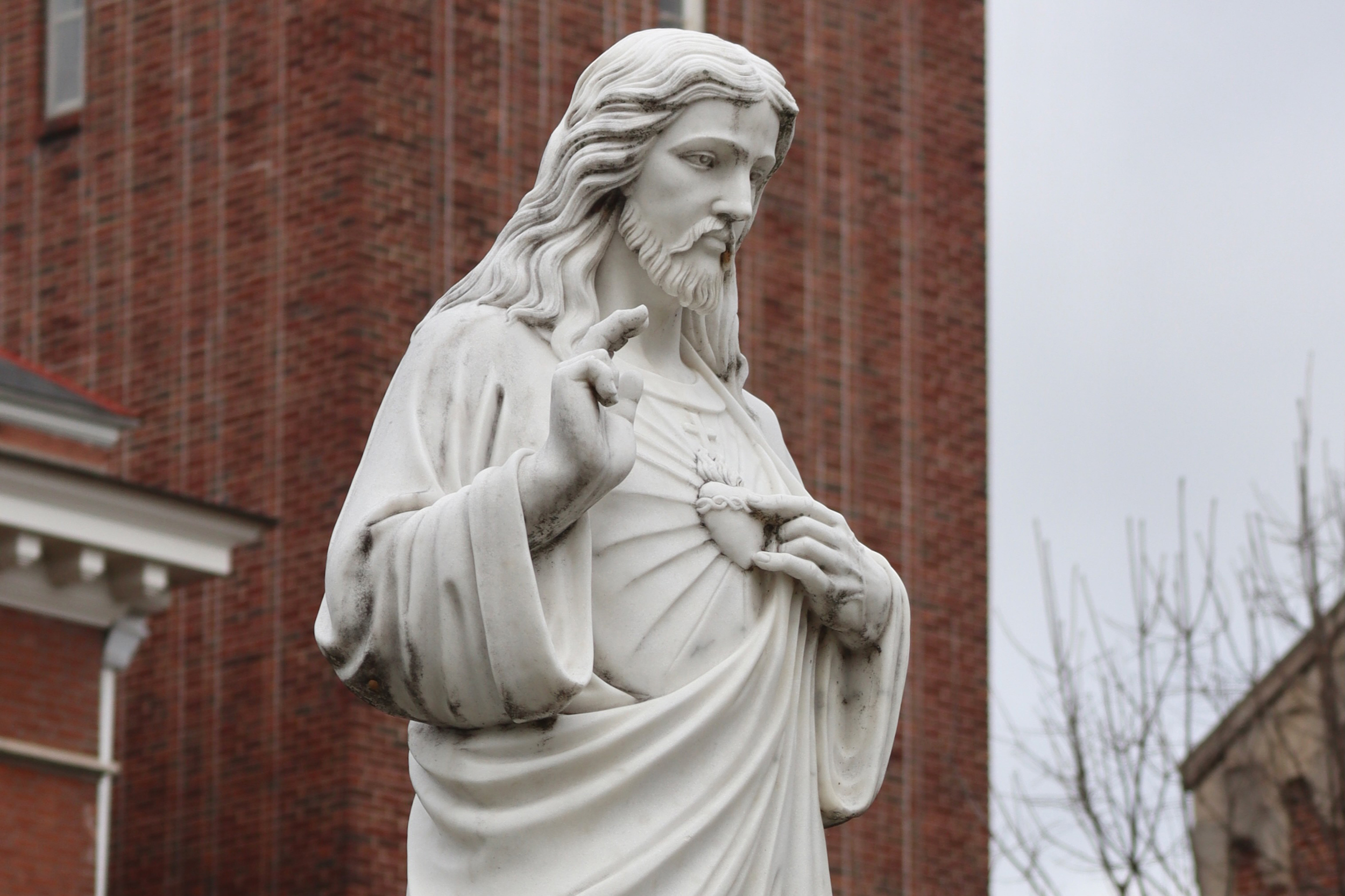


LOUISVILLE, Ky.—Father Joe Mitchell, a Passionist priest, returned home here in 2004 to create a nonprofit center that focuses on what he saw as two major disconnects.
One is a gap between people and God. The other is between people and the natural world.
Educated at Bellarmine University, a private, Catholic liberal arts college in Louisville, as well as at the Catholic Theological Union in Chicago and the California Institute of Integral Studies, Mitchell has a deep understanding of cosmology and people’s place in a sacred universe.
The Passionist Earth & Spirit Center, which he led for most of the past two decades, sits on 27 acres between a Passionist monastery established more than a century ago and one of the three branches of Beargrass Creek, the stream that drains most of Louisville into the Ohio River.
The center hosts programs, classes and activities for students of all ages, with a focus on mindfulness and meditation, social justice and environmental education.
Previously, he lived in California, where he ran a Passionist retreat center near Sacramento.
His classes in cosmology and meditation, taught from an interfaith perspective, rely on Buddhist, Christian and other traditions.
“If I’m giving a talk on taking care of the Earth, I’ll ask, ‘What comes to your mind?’ And they think of climate change, or saving spotted owls, or recycling. And I say, ‘Would you ever think it’s about taking care of you? Because we are the Earth in human form,” Mitchell said in mid-March during an interview in his apartment at the monastery.
“We don’t have this close connection to the Earth,” he added. “It’s kind of the background in which we live our lives, or it’s a resource for our consumption. That’s one disconnect. The other is between ourselves and the divine. When we think of God, we think of God as being up there or out there. We pray up above, way out there. And so to overcome that disconnect is to find the divine within.”
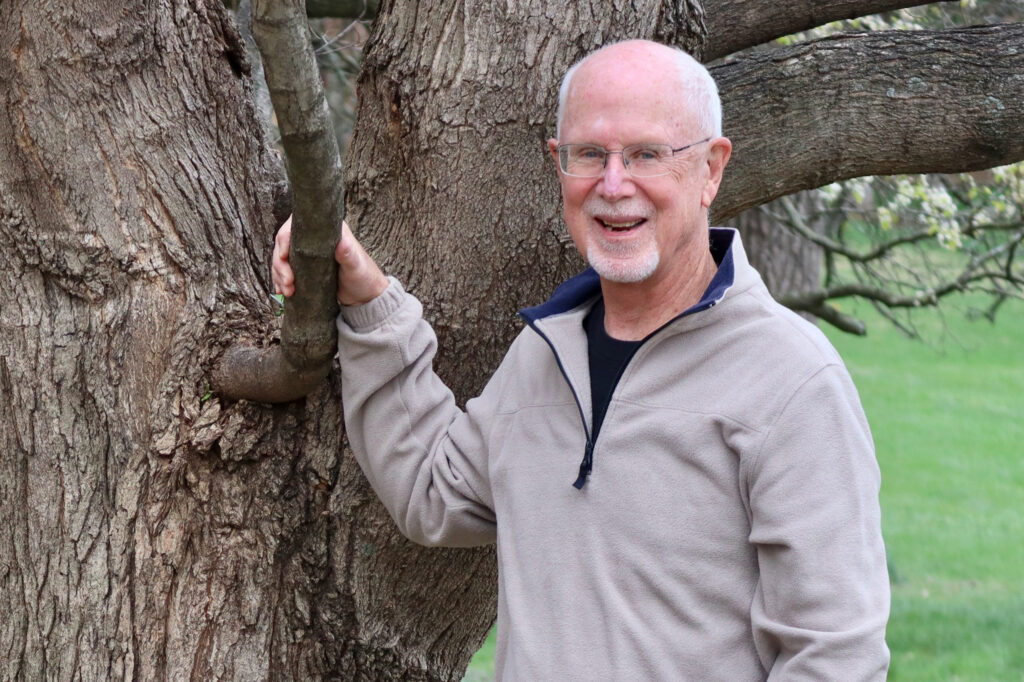
There are more than 1.4 billion Catholics, the largest Christian denomination in the world. The Passionists Order, founded in the early 1700s, is a global community of more than 2,000 priests, brothers, nuns and lay people dedicated to keeping alive the memory of Jesus’ suffering and death, as an expression of God’s love.
Mitchell said his thinking has been greatly influenced by Thomas Berry, a Passionist priest, religious scholar and cultural historian who explored a deep perspective on humanity’s relationship to the Earth and advocated for a different narrative, or “a new story,” based on the interconnectedness of people and nature. Berry, who died in 2009, was considered a visionary in the field of ecological spirituality.
Mitchell also credits Brian Swimme, a Berry collaborator, under whom Mitchell studied cosmology at the California Institute of Integral Studies, with influencing how he views the environment, faith and humanity’s place in the universe.
With the world facing a worsening ecological crisis, Inside Climate News recently sat down with Mitchell to discuss the intersection of faith and the environment. A small crucifix hung on a wall behind him, representing Christ’s sacrifice. A small statue of the Buddha, symbolizing his training in and understanding of the Buddhist tradition, rested on a nearby corner table.
Mitchell, who recently left the Earth & Spirit Center, said he has hope. “What’s the other option?” he said. “Despair?”
This interview has been edited for length and clarity.
JAMES BRUGGERS: I’ve been doubting whether scientists raising alarms about climate change, the loss of biodiversity or other environmental problems are getting through to the public and policymakers. Can faith play a role in moving people towards addressing this shared ecological crisis?
JOE MITCHELL: Science collects data and facts, but it’s not very good at changing hearts. Information is available. People get that, yet what’s being asked for is not just us understanding what’s going on but us changing our lifestyle. That’s where faith comes in, or faith traditions. They’re about conversion.
And so Pope Francis’ encyclical, Laudato Si’, is not just about information. Most of it is about changing our lifestyle. And that’s where religion has had experience for many years.
The other way I would reply is with insights from Thomas Berry, who’s been my mentor through Brian Swimme, but also I knew Thomas, and I’ve studied his work extensively. He would say that science gives us information about the Earth, but it doesn’t give us a narrative, and narratives are what actually [bring about] change.
Human beings are driven by stories. Thomas Berry says what we need is not more information, but we need a new story. We need a story about the Earth and the human connection to it. Religions are very helpful because they teach us the power of narrative in presenting origin stories.
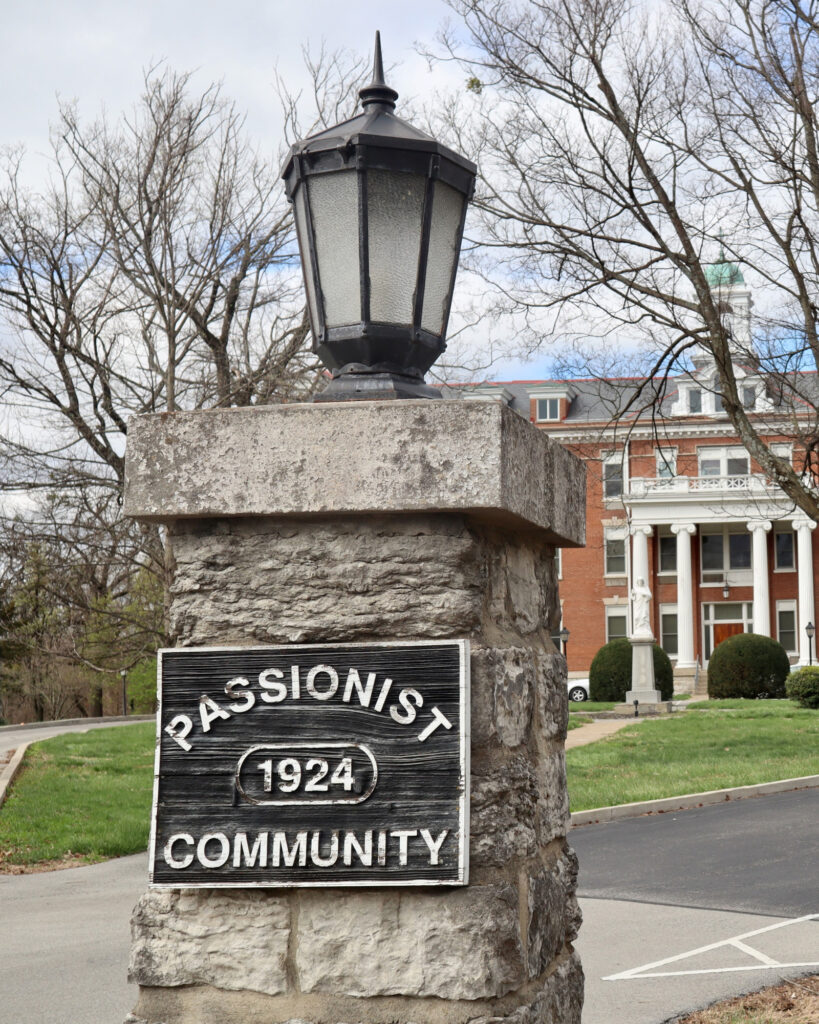
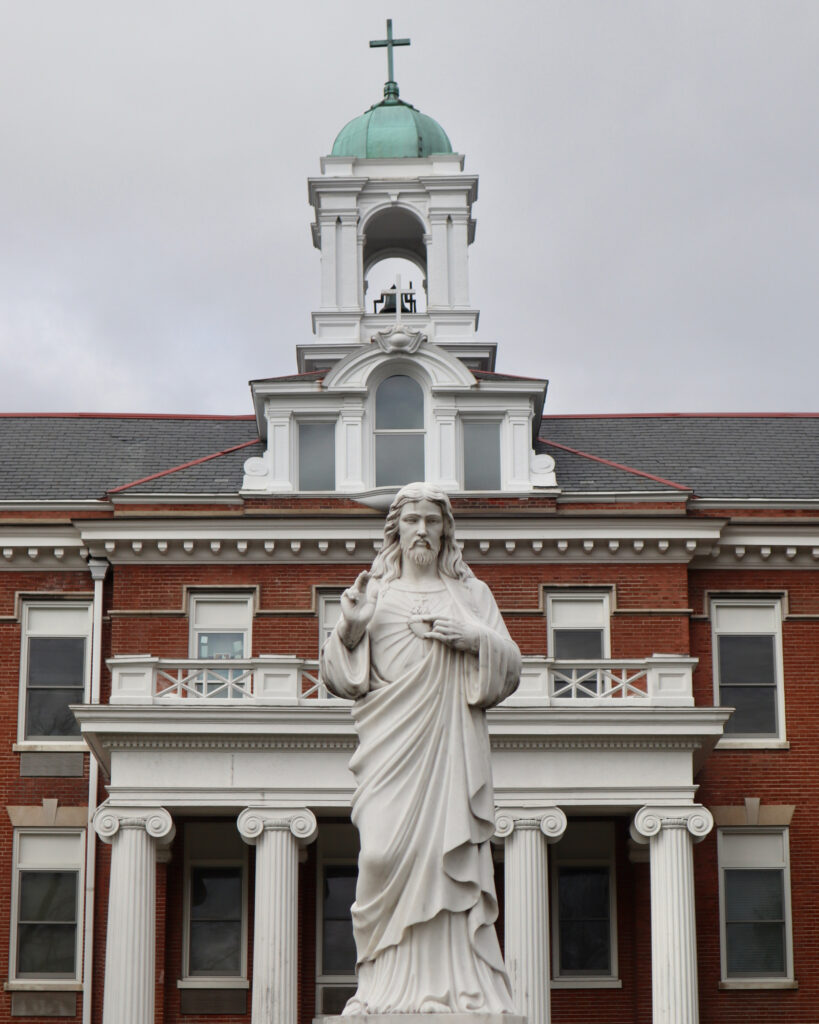
The Sacred Heart Monastery in Louisville, Ky. Credit: James Bruggers/Inside Climate News
BRUGGERS: Just about every faith tradition I know of has issued statements about the need to address climate change. Why do you think that is?
MITCHELL: Most religions respect the Earth as the first revelation of God. And in the book religions—Islam, Christianity, Judaism—God is primarily revealed through the scriptures, but preceding that, God revealed God’s self in the natural world.
In fact, when you read the scriptures, where did people meet God? They met God in thunderstorms. They met God in deserts. They met God at rivers and streams. And so I think religions recognize that the natural world is our first place of meeting the divine, so nature deserves our respect and reverence for that reason.
Secondly, it’s because religions are trying to respond to current situations—what’s going on in the world. And as we become more aware of the destruction of the natural world, religions are rising to speak about that.
BRUGGERS: We are coming up on the 11th anniversary of Laudato Si’, the late Pope Francis’ landmark teaching letter on the environment and climate change. I’ve reported on research that shows that at least in the United States, Francis’ message hasn’t widely reached Catholics. How significant is Laudato Si’ and why, and have you observed an impact from it?
MITCHELL: When a religious figure of that magnitude makes a statement like that, it’s not just his own statement but it becomes church teaching. It’s an encyclical, which means it’s not optional anymore.
I’ve seen a lot of action. Religious communities have started new initiatives. Now, I don’t think many people are preaching about it from the pulpit, and that’s unfortunate. And I think one reason is political.
Many priests hesitate because it all of a sudden becomes a political argument if you preach about it. The other is that many are not confident that they know enough about it to be able to speak meaningfully about it.
BRUGGERS: I was struck by how clearly Francis identified the problem and causes of climate change, and also how clearly he described the impact of that problem on people who are most affected, and spoke to their concerns.
MITCHELL: In the encyclical, he addresses what he calls an integral ecology, or care for the Earth and care for the poor and the marginalized. It’s not one or the other. He’s raising both of them as being of mutual concern.
The key to understanding the encyclical is in its subtitle: On Care for Our Common Home. Care. Common. Home.
“A hotel is a place we stay when we’re traveling through, when we’re transients, and many of us live on Earth like it’s a hotel.”
It’s significant that he called the Earth our home, because many people live with the unexamined assumption that the Earth is simply a place we kind of hang out in until we really graduate and get to our true home, which is heaven or somewhere else. So for many Christians, we’re kind of here in a testing place. It’s a classroom. It’s been called a valley of tears, where we suffer, and eventually we get to our true home. But Pope Francis is saying this also needs to be considered our home.
We live very differently in a home as a hotel. A hotel is a place we stay when we’re traveling through, when we’re transients, and many of us live on Earth like it’s a hotel. In a hotel, many people will have the air conditioner on and the windows open. They’ll leave wet towels on the floor. They won’t make their bed and so forth.
So when we begin to change our mentality, that this is not just a place that we’re passing through, that it’s a place where we really are at home, we take care of it the way we do our home.
Common is something we share with other people. It’s this whole interconnectedness that we have with other human beings, but also with the natural world itself.
We have a responsibility as citizens who share a common home and a common responsibility, and to shift to care from dominance.
Many people read Genesis Chapter 1, which is that human beings were meant to dominate the Earth, to subdue it and conquer it. But we need to refocus on Chapter 2 of Genesis, which is a whole different creation story about how human beings were put here to tend and care for the Earth, and [Pope Francis] focused on that aspect.
So if you put those three together, you get the message of Laudato Si’. It’s beautiful.
BRUGGERS: For Christians, the book of Matthew in the Bible includes what has been described as the greatest commandment from Jesus to his followers: “You shall love the Lord your God with all your heart, with all your soul, and with all your mind, and you shall love your neighbor as yourself.” In the meditation class that I took from you, you described an expansive understanding of that second part—that the commandment to love our neighbors includes caring for the Earth. What did you mean by that?
MITCHELL: Jesus said to be a follower of his, you must take up your cross daily and die to yourself. What does that mean to die to yourself? To me, it means you die to your ego self. It doesn’t mean you kill your human body. And so in the spiritual tradition, there’s been a sense that we are not just our own ego; there’s something deeper in us.
Thomas Merton [the influential Trappist monk and author who lived in Kentucky] called it our true self. He says our true self is that deepest part of who we are, where we’re connected to God. And when we die, the ego goes and what’s left is the true self.
And so the way I have come to interpret it is that the more I die to my connectedness and obsession with my ego self, if I die to that, I can truly live my life, because I’m no longer just living an isolated life in this skin-encapsulated ego.
This story is funded by readers like you.
Our nonprofit newsroom provides award-winning climate coverage free of charge and advertising. We rely on donations from readers like you to keep going. Please donate now to support our work.
Donate NowWe create boundaries regarding how our body is separated from other people. We often forget that 100 percent of the human body is composed of the Earth.
We forget that the water that we drink is going to become us, and if it becomes toxic, we become toxic. The air we breathe is going to become part of us, and if it’s toxic, we become toxic.
Even though we think this body is separate from the natural world, we’re deeply interconnected with the natural world because everything about our body comes from the natural world.
BRUGGERS: What else leads you to believe that God wants people to care for the Earth?
MITCHELL: I don’t pretend to know the mind of God, first of all. I’ve got to be very humble about what God wants us to do.
But I would be inclined to believe that a high priority for God, or the divine, would be caring for the Earth because Jesus said, “I come that you may have life in abundance.” And what does it mean to live an abundant life, a full life, a life you might call flourishing?
One of the reasons I founded the Earth & Spirit Center was that we want people to have a flourishing life. We can’t say our life is flourishing if we don’t have a sense of serenity and peace. And so we offered meditation classes to be able to purify the mind of what are called afflictions in the mind.
“We forget that the water that we drink is going to become us, and if it becomes toxic, we become toxic.”
We can find inner peace through meditation practices and other spiritual practices that the peace of the world cannot give. The world can give us peace when it goes our way. When we get what we want. Jesus said he gives us a peace that the world doesn’t give. And so that’s what we’re looking for, is that kind of inner peace.
You also can’t flourish alone. In other words, I can’t just say, “Here I am flourishing and everybody else is floundering.” If I want to flourish, I need to care about other people’s flourishing as well, because we’re in this together. We can’t flourish alone while others struggle.
So we need to develop a sense of justice and responsibility and care for others, especially the most vulnerable. And you can’t flourish if the Earth doesn’t, because if the Earth becomes toxic, we become toxic.
If there is a loss of species, that is also a loss of modes of divine presence. We’re losing modes where God reveals God’s self through these different aspects of life. How can we say we’re flourishing if our Earth doesn’t? So I think God wants us to care for the Earth because God wants us to flourish, and God wants us to care for other human beings because God wants us to flourish as well.
BRUGGERS: What can Christians and non-Christians alike learn from Buddhist teachings about caring for the Earth?
MITCHELL: The Buddhist teachings are beautiful. One of the great Buddhist teachers, Thich Nhat Hanh, would talk about interbeing. We don’t exist alone, but we only exist because we are intertwined with all of life. And so that’s one of the many great contributions Buddhism can make, because it amplifies a teaching in Christianity. It offers a different perspective on the teaching in Christianity about dying to yourself, or transcending yourself to realize you’re part of something bigger than your own little skin-encapsulated ego, body and mind.
BRUGGERS: How do you find hope when you look at the condition of the world right now, specifically relating to the environment and issues like climate change?
MITCHELL: It’s very difficult to live a life in despair, and so I think we choose to be people of hope, despite all the evidence to the contrary. And it’s not a kind of Pollyanna wishful thinking, but it’s a belief that’s similar to what Martin Luther King Jr. would say: “The moral arc of the universe is long, but it bends towards justice.”
I know I’m inspired when I see people doing little things, going out of their way, sacrificing themselves for another person or for a cause. And so each of us can do something. We don’t need to do everything, but we can each do something, and that can be empowering.
I would add that Thomas Berry writes about “The Great Work.” We each have individual work to do, meaning professional work, using our talents, our interests, our skills, as a journalist, as a priest, as a teacher, whatever. But how do we participate in a work that’s being called for at this time in human and Earth history?
Previously, humans developed agriculture. It’s a great work. It didn’t happen with one human being. It happened over time. We go back even farther and we didn’t always have language. There was a time when some human beings developed the capacity for language. That was a great work. At another point, some humans developed methods of writing. That’s another great work.
And right now, Thomas Berry writes, the great work is to bring forth a new kind of human presence on the planet, which is going to be mutually beneficial for the Earth and the human species. It’s called a new cosmology, a new story, a new way of being human.
Now we have a new understanding that we human beings are part of a 13.8 billion-year-old evolutionary story of the Earth. And the work now is to bring that story to life, to live inside that story, to live inside that information.
Our basic mindset is that the world is a machine. How do we break that, because we know the world isn’t a machine? It’s a living system. So how do we live inside that?
If I can be part of a great work to help human beings transition to that new understanding and that new way of being alive as human beings on the planet, that gives me hope, knowing that I’ll never accomplish it in my own life, and I’ll never accomplish it alone, but that I’m part of something very important and very exciting. That’s hope.
About This Story
Perhaps you noticed: This story, like all the news we publish, is free to read. That’s because Inside Climate News is a 501c3 nonprofit organization. We do not charge a subscription fee, lock our news behind a paywall, or clutter our website with ads. We make our news on climate and the environment freely available to you and anyone who wants it.
That’s not all. We also share our news for free with scores of other media organizations around the country. Many of them can’t afford to do environmental journalism of their own. We’ve built bureaus from coast to coast to report local stories, collaborate with local newsrooms and co-publish articles so that this vital work is shared as widely as possible.
Two of us launched ICN in 2007. Six years later we earned a Pulitzer Prize for National Reporting, and now we run the oldest and largest dedicated climate newsroom in the nation. We tell the story in all its complexity. We hold polluters accountable. We expose environmental injustice. We debunk misinformation. We scrutinize solutions and inspire action.
Donations from readers like you fund every aspect of what we do. If you don’t already, will you support our ongoing work, our reporting on the biggest crisis facing our planet, and help us reach even more readers in more places?
Please take a moment to make a tax-deductible donation. Every one of them makes a difference.
Thank you,

James Bruggers
Reporter, Southeast
James Bruggers covers the U.S. Southeast, part of Inside Climate News’ National Environment Reporting Network. He previously covered energy and the environment for Louisville’s Courier Journal, where he worked as a correspondent for USA Today and was a member of the USA Today Network environment team. Before moving to Kentucky in 1999, Bruggers worked as a journalist in Montana, Alaska, Washington and California. Bruggers’ work has won numerous recognitions, including best beat reporting, Society of Environmental Journalists, and the National Press Foundation’s Thomas Stokes Award for energy reporting. He served on the board of directors of the SEJ for 13 years, including two years as president. He lives in Louisville with his wife, Christine Bruggers.