Hydrofluorocarbons – or HFCs – are gases most people have never heard of, even though almost everybody in America has bought their fair share of them.
They come inside cars and air conditioners and refrigerators as the newest gases of choice in cooling systems and are many thousands of times more potent than CO2 as climate warming agents.
Use of these gases is expected to mushroom with rising prosperity in developing nations, and if left unchecked could be equivalent to as much as 45% of CO2 emissions in 2050. It is an invisible emergency within a climate emergency whose outsized contours were confirmed in a scientific paper published last month by the National Academy of Sciences.
The public is barely aware of the issue, though, and as the White House works to hammer out its policy, it seems to want to keep it that way.
As a result, HFCs have become one of the most important sleeper issues in the international climate arena, caught in a Byzantine crossfire of conflicting interests and turf wars both within the administration and outside it. At stake right now is an opportunity for the U.S. to demonstrate international leadership and score a big victory for the climate during meetings in Geneva next week. Most stakeholders fear a golden opportunity to build momentum ahead of Copenhagen climate talks will be squandered, even though many see an inspiring victory within easy reach.
"We can take HFCs out before Copenhagen and offer it as Exhibit A to the world to show what can be done to protect the climate," said Durwood Zaelke, founder and president of the Institute for Governance and Sustainable Development.
"This is exactly the kind of signal the climate markets need, and the big question now is what will the U.S. do."
NGOs want to see the Montreal Protocol – dubbed "the treaty that never fails" – amended to allow it to control HFCs, since securing a new climate treaty that can do the job as quickly and efficiently is an uncertain prospect at best. The Montreal treaty has a working international mechanism on the ground in every country, and in the 20 years since ratification, it has successfully phased down the use of more than 95 similar substances. With little left to do, the treaty mechanism could easily be tapped for climate duty.
Nobody is quite sure what U.S. policy will be, because from the White House, mum’s the word, inaugural promises of transparent and science-base policymaking notwithstanding.
EPA issued a statement weeks ago when the scientific paper on HFCs was published, saying the agency "anticipates robust and meaningful discussions of HFCs at July’s Open-Ended Working Group meeting of Montreal Protocol Parties" in Geneva. Questions sent this week by e-mail and by voice mail to the State Department, EPA and the White House, asking for detail on U.S. policy going in to the meetings, have not been answered.
Bush Was More Open About HFCs
NGOs like Zaelke’s that have been working on the issue for years have encountered the same closed door, frozen out from meetings and kept in the dark about the substance of discussions. They are so frustrated that they have taken to publicly calling out the Obama administration for lack of access as compared to the Bush administration, a low blow with truth to it, in the hope of piercing the cone of silence.

"If the Bush team had been doing this, we would have been hammered," said George David Banks, who served in the Bush administration and now works for IGSD, Zaelke’s group. "Under President Bush, we used to hold large public stakeholder meetings at the White House to advance policy on HFCs."
Banks, who won an EPA climate protection award this year, notes that the strategy to use the Montreal Protocol to phase down the super greenhouse gases took shape and gained momentum during the Bush administration. The talks in Geneva next week were put in motion before the Obama team took office, and it was the ozone experts within the various executive branch agencies who continued to carry the ball through the transition. That legacy might be part of the problem.
The ozone experts at EPA, State and other agencies didn’t do the political work of seeking buy-in from the newly installed and empowered climate team, stakeholders say. That’s why momentum on HFCs that continued through the first months of the transition hit a wall in May, when conflict within the administration surfaced publicly. Kert Davies of Greenpeace, who has worked on HFCs for more than a decade, called it a problem of "too many cooks in the kitchen."
Ozone Versus Climate
The rift between the ozone and climate camps has its roots in the strange origin of the HFC problem.
Parties to the Montreal Protocol – with help from industry leaders like Dupont and Honeywell – had worked out a plan in the 1990’s to replace CFCs, chemicals that destroyed ozone, with a class of gases that did not. The replacement gases are the HFCs. They do not destroy the ozone, but they do warm the climate, ferociously compared to CO2. In solving one problem, they exacerbated another.
No one disputes that the Montreal Protocol is the best mechanism available for phasing out HFCs, but now that the U.S. has become engaged on climate change, a Montreal solution for HFCs can no longer proceed on its own. HFCs must be addressed as part of a broader climate regime, and as a result, they have become ensnared in a complicated web of competing interests.
America’s climate negotiators want to tread more lightly on the issue lest they run afoul of international sensitivities. The EU has already enacted policies to control HFCs in the expectation that they would count toward emission reduction targets under a climate regime. The head of the UNFCCC, Yves de Boer, has said he will not let HFCs out of the Kyoto basket of gases, to be usurped by the Montreal treaty.
The two approaches offer fundamentally different ways of solving the problem:
The Montreal Treaty attacks the production and consumption of HFCs – so that these intentionally manufactured substances are phased out entirely and never have the chance of getting into the atmosphere.
The Kyoto climate treaty treats HFCs like waste gases, and can only control their emission into the atmosphere – after they have been produced and used in billions of products.
There is also a complicated set of economic issues tied to HFCs, for which EPA has reportedly been developing models. Stakeholders said that economists in the White House believe that HFCs can be used to help keep down the price of carbon in a cap-and-trade regime, on the theory that including it as another trading option would increase the efficiency of markets in finding the lowest cost solutions.
The speculation, however, is not borne out by the direction of domestic U.S. policy. The Waxman-Markey bill, which passed the House two weeks ago, includes a section on HFCs. The bill proposes to control HFCs largely through a dedicated and tightly controlled cap-and-trade program. In other words, HFCs could not be traded in U.S. carbon markets.
The Offset Gambit
It is possible for HFCs to impact carbon prices in U.S. markets through a back-door, however. If HFCs are kept in the Kyoto basket and traded internationally, they could theoretically enter the U.S. carbon market as international offsets.
The Waxman-Markey bill provides a generous safety valve of 1.5 billion international offset credits that can be tapped in lieu of domestic CO2 reductions. HFCs could provide an easily verifiable source of abundant offsets.
But HFCs can have a severely distorting effect on carbon markets and lead to windfall profits, as prior EU experience has shown. The poster child is HFC-23, a potent byproduct of the manufacturing process of a common refrigerant. Both China and India have cashed in on a loophole of the Clean Development Mechanism of the Kyoto Protocol – to the tune of $6 billion – by manufacturing the gas for the credits alone.
HFC-23 now comprises a disproportionate total of the entire CDM market, demonstrating how easily the international offset market can be manipulated. CDM contracts with China and India for HFC-23 destruction are still in place.
Michael Wara of Stanford Law School, an expert on the HFC-23 issue, has suggested a series of reforms. Allowing offsets only from CO2 sources is one. Breaking apart the basket of GHG gases for the purposes of international trading is another.
A Hybrid Alternative?
Amid the guessing game swirling around closed-door White House policy is the speculation that the U.S. wants to hold on to HFCs as a bargaining chip for use in negotiations with China and India, to help bring those nations to the table in Copenhagen.
There is also talk of an alternative strategy to tap the Montreal mechanism to phase down HFCs and simultaneously tie them to a climate regime that provides valuable credits for the reductions. It’s tricky and uncharted terrain, with NGOs mistrustful of too clever economic thinking that could imperil the planet more than anything else.
"It looks to me like the administration is leading from the back," said Sam LaBudde, campaign director at the non-governmental Environmental Investigation Agency.
"We can easily control the production and use of HFCs through the Montreal Protocol and steal a march on the whole problem. The question of how HFCs fit into a climate regime can be deferred – a new climate deal won’t come into force until 2012 anyway, and we’re running out of time."
NGOs are girding themselves for disappointment, expecting that the U.S. will show up in Geneva not opposing the move to tap the Montreal Protocol, but not supporting it either.
"Are they going to go to Geneva and say ‘we’re still thinking about it’ while the world goes to hell," Zaelke said. "I don’t understand where the problem is, what is preventing the U.S. from leading the way on this."
Right now, the banner of leadership is in the hands of the Federated States of Micronesia and Mauritius – two small island nations that submitted an amendment to the Montreal Protocol so that it can be used to phase down HFCs. The U.S. has withheld support, saying it is studying the situation. Labudde calls the circumstance "absurd."
Also weighing in is Greenpeace, which supports the Montreal approach with some original nuance. Davies is concerned that industry players hold all the cards in what is still an insider’s game. The organization has long championed an inexpensive and readily-available alternative refrigerant opposed by industry, which wants to profit from developing and selling new alternatives.
"This issue is invisible to the public," Davies said, "and industry wants to keep it that way."
U.S. policy on HFCs will start to come in to public view next week at the Geneva meetings. Stakeholders will be parsing every official U.S. comment for meaning, first at a seminar on HFCs on Wednesday, and then over the next three days as the Open-Ended Working Group rolls up its sleeves and gets down to work.
They will have to look to Geneva to find out what’s been going on at interagency meetings at the White House.
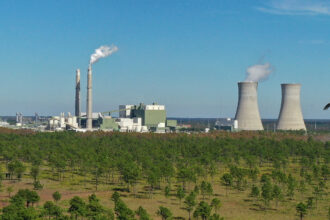
(Photo: Ezra Clark/EIA)
See also:
HFC Briefing Paper (Environmental Investigation Agency)
Island Nations Plead for Help from Obama on HFCs
Study Confirms Growing Threat of Super Greenhouse Gases
Class of ‘Super GHGs’ Becoming Focus of Heightened Concern
State Department Plans to Tap Montreal Protocol for Urgent Climate Duty
Administration Rift Over Handling of Super GHGs Continues
State Department Climate Move Hits Snag at White House
About This Story
Perhaps you noticed: This story, like all the news we publish, is free to read. That’s because Inside Climate News is a 501c3 nonprofit organization. We do not charge a subscription fee, lock our news behind a paywall, or clutter our website with ads. We make our news on climate and the environment freely available to you and anyone who wants it.
That’s not all. We also share our news for free with scores of other media organizations around the country. Many of them can’t afford to do environmental journalism of their own. We’ve built bureaus from coast to coast to report local stories, collaborate with local newsrooms and co-publish articles so that this vital work is shared as widely as possible.
Two of us launched ICN in 2007. Six years later we earned a Pulitzer Prize for National Reporting, and now we run the oldest and largest dedicated climate newsroom in the nation. We tell the story in all its complexity. We hold polluters accountable. We expose environmental injustice. We debunk misinformation. We scrutinize solutions and inspire action.
Donations from readers like you fund every aspect of what we do. If you don’t already, will you support our ongoing work, our reporting on the biggest crisis facing our planet, and help us reach even more readers in more places?
Please take a moment to make a tax-deductible donation. Every one of them makes a difference.
Thank you,