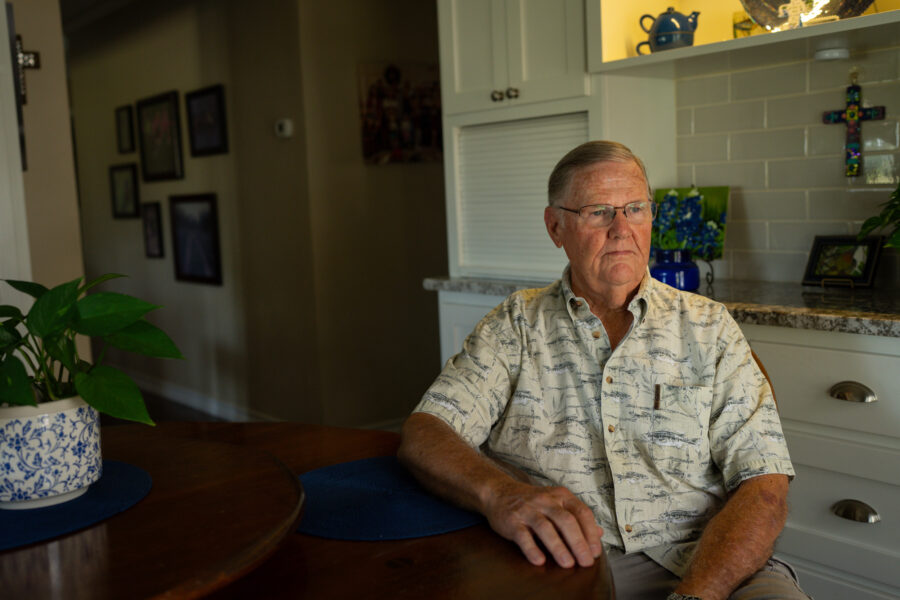
When Robert Lestz was a research engineer at Chevron in the 1990s, he began searching for a way to extract deeply buried gas and oil deposits without using the vast quantities of chemically enhanced water needed for hydraulic fracturing. The industry’s increasing reliance on such large amounts of water seemed unsustainable, both economically and ecologically.
At first, Lestz experimented with nitrogen and liquid carbon dioxide. But he wasn’t satisfied.
Then one night at home, while he was on the phone with a co-worker, his wife asked him to turn off the gas grill. “I said ‘I got it.’ My wife thought I was talking to her, but I was talking into the phone.”
Lestz eventually developed a fracking process that substitutes propane, or liquid petroleum gas (LPG), for water. Chevron wasn’t interested in LPG fracking, Lestz said. But in 2006, a business friend in Canada took the idea and started GasFrac, where Lestz is now the chief technology officer. Based in Calgary, Alberta, GasFrac is apparently the only company that offers LPG fracking.
LPG’s proponents say it is less environmentally intrusive than hydraulic fracking and that it also can be more profitable in the long run because it reduces infrastructure and waste. (Here’s a story from InsideClimate News and the Albany Times-Union with more details about propane fracking.)
But persuading an established and profitable industry to accept a new technology has been difficult, Lestz told InsideClimate News in a wide-ranging interview.
The company recently got a $100 million loan that will help ease some of its growing pains, and it has hired Zeke Zeringue, a former president of Halliburton Energy Services Group, to replace its retiring founder and CEO.
On Tuesday night, GasFrac was honored by the industry with the first annual World Shale Gas technological innovator award.
“Although the award was originally to reflect the greatest breakthrough of the last 12 months, the committee felt that the potential impacts of LPG fracturing are so far reaching (economically, environmentally, and a chance for the industry to present themselves in a new light to the public/government) and that the technology is still new enough to warrant being hailed as the greatest breakthrough at the event this year,” said the letter notifying Lestz of the award.
 Why did you want to frack with a fluid other than water in the first place? Were you driven by environmental concerns? Were you looking for a better way to drill?
“It was initially driven by a recognition that the techniques we were using to fracture wells were under-preforming, and that there had to be a better answer. We also recognized that these massive water fracks would work in the short term, but that it was questionable whether that would be sustainable.
“But the primary driver was well performance. So we started with a clean slate, and looked at fluids based on their performance, safety and sustainability. With sustainability, I look at economics and the environment going hand and hand.”
What kind of impact do you think LPG fracking will have on the drilling industry?
“Obviously I’m biased coming from GasFrac, but I think it’s going to have a substantial game-changing impact on the industry. This can deliver greater returns or, in farming terms, greater yields from the land with less impact. Today this is a new technology. Over time this will become standard practice, in my vision.
“Today we’re the only company doing LPG, so the infrastructure for it is relatively poor. Equipment is needed, people need to be trained and the overall literacy of the oil and gas industry needs special attention and investment.
“I liken it to the cell phone and the bag phone. The bag phone that we used to use was maybe five pounds. Today, we’re not only carrying a miniature phone in our pockets, but it’s also a computer with access to the Internet. So there will be improvements to the technology over time, in terms of how it’s applied. But the core, fundamental breakthrough—that genesis has been brought by GasFrac at this point.”
The drilling industry is heavily invested in water-based fracking infrastructure. How tough has it been to introduce an entirely different technology?
“With our challenges of getting it into the market, the quote I always give is: ‘Good is the enemy of great.’ Many companies are getting good results today, so when presented with a disruptive technology that can bring them great results or much-improved results, they’re skeptical to take the risk, because they’re already making good economic returns on their money.
“But there’s a handful of people out there who have reached out to say: ‘Can we do better? Good is not the enemy of great for us.’
“What we’ve tried to do is match the growth of GasFrac to the growth of those companies. Once those first adopters have successful results, then there’s always the second tier adopters that want to try to catch up to their competitors. It’s a “not me first” syndrome; once somebody else has proved it, everybody else wants to jump on the bandwagon. Currently in the U.S., we’re completely sold out with our equipment. Typically, there’s about a two-month backlog of work.
“The other challenge is that much of the existing drilling infrastructure is for water. And it’s relatively easy because it’s water. You make mistakes with water, there are negative impacts. They’re not instantaneously recognized, because they don’t result in a catastrophic event immediately. But in the long term, it can be catastrophic with contamination, whether it be to aquifers or surface water.”
You’ve said the Canadian industry has been more willing to embrace LPG fracking than the U.S. industry. Why is that?
“It’s well known in the oil and gas industry that the earliest adoption of new technologies is typically on the Canadian market. In Canada, just about every oil and gas company sits on the same block in downtown Calgary, and they’re much more in tune with what their neighbors are doing. Everybody is scratching and clawing for a competitive advantage.
“So when there’s a new technology that would give them a chance to step up ahead of everybody else, there’s a typical willingness to jump on that. They want to be the first, to advertise to the Canadian industry that they are the most progressive company, driving the best results compared to their competitors. And it’s that way in many different applications throughout the industry. They’re highly respected and proud of how they approach new technologies.”
Are government environmental regulations also different in Canada?
“That’s a difficult question to answer, because in the U.S. so many of the regulatory bodies that have primacy over drilling are from the individual states. You might have some states that have more stringent requirements than what you see in Canada, and other states that have less. It’s a mixed bag.”
It would seem that environmentalists might be interested in LPG fracking. Have you reached out to any of them?
“We are very interested in working with environmental groups from a pragmatic perspective. As in any subject, there’s a spectrum from extremist to pragmatic to the other side of the extremism. And we want to work with people who want to work for solutions. There are many environmental groups that are concerned with finding solutions that have less impact.
“So I’ve talked with Patty Limerick from the Center of the American West, at the University of Colorado at Boulder. She’s been a very strong advocate of exactly that: How do we tune down the shouting, and how can we build solutions together? I’ve given presentations to and have had good conversations with the Environmental Defense League, out of New York City. I’ve spoken with some professors from Columbia University who are concerned.
“There’s a lot of issues out there, and I think when we sit down and talk about them, a lot of them can be addressed. The use of water, emissions and flaring are issues with conventional hydraulic fracturing that our technology is minimizing. And a lot of the more environmentally friendly solutions actually turn out to be the better technical solutions. That’s why we’re excited about the intersection of technology and environmental sustainability.”
One concern with LPG is the large quantity of propane it requires and the risk of fires or explosions. You’ve already dealt with a small fire at a GasFrac well site in January. How do you address that risk?
“The one disadvantage of working with propane is the flammability or the volatility. So just like anything else, we go through a full-blown internal evaluation and also bring in external experts to identify risks and steps to eliminate and minimize those risks. The first thing is the protection of people—any people around the location. The equipment is operated 100 percent remotely. There’s no people in what we define as the hot zone, which is 50 meters away from the wellhead, which is about 150 feet.
“(Since the January fire) our process has substantially changed. We’re continuously learning. We now have over 20 sensors that are monitoring for propane or any other vapors. We have multiple closed circuit TVs, and we have infrared cameras looking for changes in temperatures that would infer that there is any type of propane leak. There are also pressure sensors to identify any type of premature failures. And a large part goes into training our people. We have to have the people trained and have the right processes and procedures. Everything is documented and has been reviewed by another company that specializes in the pumping of flammable fluids.”
Some skeptics of propane fracking say it hasn’t worked in the past. Why do you think GasFrac will be different?
“The biggest difference between our technology and what was tried back in the seventies is how we’re deploying it. We’re actually using an entirely closed loop system with nothing exposed to the vapors. Whereas in the past they had what we call a blender, a piece of equipment that mixes the liquid with the sand. So when you have propane at standard atmospheric conditions, there wants to be a lot of vapors and it wants to boil. So in that situation, it was very tenuous.”
Some people are skeptical that anything besides water will work for drilling. But you say propane fracking can be more efficient …
“Say we want to get oil or gas out of an area of shale about 500 feet long. It would take maybe 20,000 gallons of propane. If I want to do 500 feet with water, I might need 80,000 or 100,000 gallons of water. And with propane, we get almost all of that 500 feet. For every gallon of propane, it takes five gallons of water to produce from the same area of shale.
“Using propane results in less traffic, less emissions, less noise and quicker and better production results. That’s where we get to the concept of sustainability.”
You’ve said you want to go beyond a niche market. How much of the fracking services market do you hope to capture, say within the next decade?
“I would argue that even now, we’re not a niche market, because we have worked on just about every type of oil and gas wells that there are, including gas storage wells. Our technology is broad enough to cover a large range. Obviously we have visions of growing, but that’s really not something from an SEC [Securities and Exchange Commission] perspective that I can talk about publicly.”
If one of the larger companies, like Halliburton, offered to buy GasFrac, would you consider it?
“As a public company, obviously our focus is in providing the best financial returns for our shareholders. If offers like that come through, they have to be vetted by our board of directors. It’s not something for me to speculate on. I will say this: Many of the people in our company, from senior to lower level positions, have a real passion for this technology, because of its potential impact in changing the oil and gas industry for the positive, both from a well-performance and environmental perspective. We have people who when they came to our company were retired. They said, ‘Hey, this is so good. I’ve been in this business for 30, 40 years. I want to be part of this big change.'”
Perhaps another question for the board: Would you consider licensing the technology, if GasFrac couldn’t meet demand?
“I would say that there are a range of alternative business models that are open to consideration.”
You’ve said that a company is currently using your technology to drill in Pennsylvania, in the Marcellus Shale. Can you say what kind of results it’s getting?
“That operator approached GasFrac about preparing a technical paper for the industry on the results of those wells. GasFrac was more than pleased to share those results and have them known by everybody. …However the operator’s parent companies — who owned the well — did not want that work shared broadly. So one can draw their own conclusion to how that work came out. Unfortunately through confidentiality agreements with our customers, which we value, we’re not at liberty to share the actual results.
There’s currently a fracking moratorium in New York State, but some landowners there have expressed interest in GasFrac. Will you be working in New York when regulators approve drilling?
“We have proactively worked with people in New York, the Tioga County Landowners Coalition. We’re very interested in working with them to develop this looking forward in the Marcellus. And not only the Marcellus, but other shales — specifically the Utica Shale — are attractive opportunities for our company.
“The largest impediment to our working in the Northeast has been issues with the terrain in southwestern Pennsylvania. If that wasn’t the issue, there are already operators that have basically agreed for us to come and do work for them. But upon inspection of where their leases are — on the sides of the mountains — that’s made it a little bit more difficult for the size of the equipment we have, because it’s not designed to be going up and down mountains. But there’s definitely an interest within our company to make adaptations where necessary.”
Why did you become a petroleum engineer?
“My dad was a petroleum engineer, from Lancaster, Pennsylvania, and got a master’s degree in petroleum engineering in 1959. He was not so much interested in being in the oil and gas business, but the research side. We lived in New Jersey, where he worked for SO [Standard Oil] Research, which is now Exxon. He later transferred to San Antonio in ’68, and we grew up down there.
“Growing up as a kid, we used to load up our station wagon and go up to the hill country, and basically take rock hammers and beat up rocks on the sides of the mountains and then take them home and polish them. My dad would then sit us down and explain the rocks to us. So I became interested in geology, rocks and minerals. Then I started understanding the challenges of how you make petroleum flow under the ground and actually end up producing it, bringing it up to the surface.”
About This Story
Perhaps you noticed: This story, like all the news we publish, is free to read. That’s because Inside Climate News is a 501c3 nonprofit organization. We do not charge a subscription fee, lock our news behind a paywall, or clutter our website with ads. We make our news on climate and the environment freely available to you and anyone who wants it.
That’s not all. We also share our news for free with scores of other media organizations around the country. Many of them can’t afford to do environmental journalism of their own. We’ve built bureaus from coast to coast to report local stories, collaborate with local newsrooms and co-publish articles so that this vital work is shared as widely as possible.
Two of us launched ICN in 2007. Six years later we earned a Pulitzer Prize for National Reporting, and now we run the oldest and largest dedicated climate newsroom in the nation. We tell the story in all its complexity. We hold polluters accountable. We expose environmental injustice. We debunk misinformation. We scrutinize solutions and inspire action.
Donations from readers like you fund every aspect of what we do. If you don’t already, will you support our ongoing work, our reporting on the biggest crisis facing our planet, and help us reach even more readers in more places?
Please take a moment to make a tax-deductible donation. Every one of them makes a difference.
Thank you,