Over the last decade, Charles and David Koch have emerged into public view as billionaire philanthropists pushing a libertarian brand of political activism that presses a large footprint on energy and climate issues. They have created and supported non-profit organizations, think tanks and political groups that work to undermine climate science, environmental regulation and clean energy. They are also top donors to politicians, most of them Republicans, who support the oil industry and deny any human role in global warming.
What is less well documented are the many Koch businesses that benefit from the brothers’ efforts to push the center of American political discourse rightward, closer to their own convictions. At the top of the list are the Koch family’s long and deep investments in Canada’s heavy oil industry, which have been central to the company’s initial growth and subsequent diversification since 1959.
Because Koch Industries is a privately held company, the public has little access to information about the depth and diversity of its Canadian oil sands holdings. Over the past several months, however, InsideClimate News has pieced together a rough picture of the company’s involvement in the industry, using published reports from the National Energy Board of Canada; documents and data extracted from the website of Canada’s Energy Resource Conservation Board; securities disclosures and filings of Koch businesses in Canada; court documents from an inheritance battle that pitted Charles and David Koch against their two other brothers; Canadian and U.S. media reports; company newsletters and press releases; and two books, one written by Charles Koch and the other the autobiography of a long-time Koch company director.
These sources reveal that Koch Industries has touched virtually every aspect of the tar sands industry since the company established a toehold in Canada more than 50 years ago. It has been involved in mining bitumen, the hydrocarbon resin found in the oil sands; in pipeline systems to collect and transport Canadian crude; in exporting the heavy oils to the U.S.; in refining the sulfurous, low-grade feedstock; and in the subsequent distribution and sale of a variety of finished products, from jet fuel to asphalt. The company has also created or collaborated with other companies that have become leading players in the development of Alberta’s oil resources, and it remains deeply invested in western Canada’s oil patch.
Koch Industries declined to answer any questions for this story.
Bitumen from Canada’s tar sands is dirtier and thicker than conventional oil. Extracting and processing this unconventional fossil fuel creates far more greenhouse gases than drilling for the light, sweet oil most Americans are familiar with. Environmentalists, supported by many scientists, want tighter regulations imposed on this crude to minimize its role in the U.S. economy as part of a larger effort to move beyond petroleum.
The oil industry is fighting these efforts in court, in public and behind the scenes. A turn toward clean fuels, or the regulation of greenhouse gas emissions, or the adoption of a tax on carbon would diminish sales and profits for the major players in the oil sands, including the Kochs. Most of Canada’s oil exports end up in the United States.
The Kochs are also active in Canadian politics.
Their company recently added another lobbyist in Alberta to lobby the provincial government about energy and resource development issues. The Kochs have also been longtime contributors to the Fraser Institute, an influential policy shop closely allied with Prime Minister Stephen Harper and as bullish as he is on the development and export of oil sands crude to global markets. They contributed $500,000 between 2007 and 2010 alone.
Today Koch Industries has both upstream and downstream interests:
• The company is one Canada’s largest crude oil purchasers, shippers and exporters, with more than 130 crude oil customers.
• It is among the largest U.S. refiners of oil sands crude, responsible for about 25 percent of imports.
• It is one of the largest holders of mineral leases in Alberta, where most of Canada’s tar sands deposits are located.
• It has its name attached to hundreds of well sites across Alberta tracked by Canadian regulators.
• It owns pipelines in Minnesota and Wisconsin that import western Canadian crude to U.S. refineries and also distribute finished products to customers.
• It owns and operates a 675,000 barrel oil terminal in Hardisty, Alberta, a major tar sands export hub.
• And this year it kicked off a 10,000 barrel-a-day mining project in Alberta that could be the seed of a much larger project.
Analysts say that Koch Industries, alongside ExxonMobil, BP, ConocoPhillips, Total and other industry titans, stands to profit handsomely as pipelines that connect Alberta’s landlocked oil to global markets come online, either through new construction or flow reversals. Plans have been floated to build more than 10,000 miles of pipeline over the next five years to carry more than 3.1 million additional barrels a day out of Alberta. That includes the Keystone XL pipeline, which has become a political flashpoint in America.
“The winners will be the companies upstream in the production end in Canada, the pipeline builders, and the mid-continent refiners all the way down to the Gulf coast,” said Jan Stuart, head of energy research at Credit Suisse. “It will grow at a measured pace and remain an important part of the oil landscape.”
Kochs are Silent
Koch Industries has always placed great value on its ability to do its business in private.
“We do not publish figures and bare our souls regularly through filings with the Securities and Exchange Commission, the New York Stock Exchange, and other public bodies,” J. Howard Marshall, the late company director and family loyalist wrote in his autobiography. “Most of the major oil companies court publicity, but all Koch worries about is serving its customers and reinvesting the proceeds, which is the way the capitalistic system is supposed to work.”
The company has been especially tight lipped about its substantial achievements in developing Canada’s heavy oil resources, even with its own employees.
The phrase “oil sands” appears nowhere in Charles Koch’s 2007 book, The Science of Success. Koch corporate publications, facts sheets and websites are similarly silent. Although many smaller tentacles of the company’s sprawling interests are detailed in the employee newsletter Discovery, the issues available online (2007-2012) don’t contain a single overt mention of the company’s oil sands activities.
The names of the two subsidiaries currently at the heart of the company’s Canadian oil sands development activities—Koch Exploration Canada L.P. and Koch Oil Sands Operating G.P.—are also absent from Discovery‘s pages.
Only once is there a hint that Canadian oil might be of importance to the company. A map in the January 2008 issue of Discovery shows “highlights of recent international acquisitions, expansions and investments” of the company’s global operations. A small purple dot marks a spot in Western Canada, annotated in small type with the words: “One million acres of property, mostly in Alberta.”
Last year, during Congressional hearings on the Keystone XL pipeline, Rep. Henry Waxman (D-CA) tried to persuade the House Committee on Energy and Commerce to invite the Koch brothers to testify to learn more.
“This pipeline and the legislation that supports it will enable the oil companies to charge American consumers more for their gasoline, while increasing carbon pollution and endangering precious water supplies,” Waxman said during an Energy and Power Subcommittee hearing. “We know who will lose. We also need to find out who will benefit.”
Waxman’s request was turned down by Fred Upton (R-MI), the committee chairman, and Ed Whitfield (R- KY), chair of the Subcommittee on Energy and Power.
According to an article last year in the Los Angeles Times, Koch Industries and its employees were the largest oil and gas industry donors to the committee’s members, contributing $279,500 to 22 of 31 Republicans, including Upton and Whitfield, and $32,000 to five Democrats. The paper also reported that nine of the 12 new Republicans on the panel signed a pledge distributed by a Koch-founded and funded advocacy group, Americans for Prosperity, to oppose regulation of greenhouse gases.
Koch Industries has repeatedly denied any connection to the Keystone XL.
“Koch Industries has no financial stake in the Keystone pipeline and we are not party to its design or construction,” Phillip Ellender, the company’s head of government affairs, said last year, after InsideClimate News reported that the company was well-positioned to benefit financially from the pipeline. “We are not a proposed shipper or customer of oil delivered by this pipeline.“
Heavy Oil Heritage
Heavy oil is part of the Koch family heritage. The career of the company’s patriarch, Fred Koch, was defined by a discovery he made in 1927, five years after graduating as a chemical engineer from MIT: an improved thermal cracking process for converting heavy oil into gasoline.
A consortium of larger oil companies sued Koch for patent infringement and blocked him from selling his process in the United States. He then turned to the Soviet Union, where he helped Joseph Stalin build 15 refineries. David Koch has said that his father had no idea who the Bolsheviks were when they arrived at his west Texas office asking for his help.
After some of Fred Koch’s Russian associates died at the hands of Stalin, Koch became a lifelong opponent of communism. In 1958 he helped found the John Birch Society, and in 1960 he self-published a 40-page anti-communist screed called A Businessman Looks at Communism that he sold for 25 cents a copy.
In 1952, Fred Koch won the last of the dozens of lawsuits the oil industry filed over his thermal cracking process and secured a $1.5 million settlement. He went on to build a modest fortune around pipelines and refineries within an entity finally called Rock Island Oil and Refining Company.
After Koch died in 1967, the company was renamed in his honor by the four grateful sons who inherited it. Charles Koch, then 32 years old, became chairman and CEO. The company’s annual revenues at the time were $177 million, less than two one-thousandths of what they are today.
One of Fred Koch’s acquisitions had been a one-third ownership interest in the Pine Bend refinery, then known as the Great Northern Oil Company. It had been built in 1955 in Rosemount, Minn. by his old friend, a storied oilman named J. Howard Marshall II. It was designed to refine heavy, sour Canadian crude oil and when it opened it could handle 25,000 barrels a day.
“I remarked to the Koch people that at Great Northern, we could run the lousiest crude in the world and make high-quality products,” Marshall wrote in his autobiography, Done in Oil.
In court papers, feuding Koch family members refer to the feedstock for the Pine Bend refinery as “garbage crudes” from Canada whose value lay in their ability to deliver high margins.
In 2001, Moody’s Investors Services gave the Koch subsidiary that owns Pine Bend an A1 rating, citing the group’s “strong capitalization and strategic importance to Koch Industries” and its refinery that can “process low-grade crude into higher value products.”
Charles Koch secured a controlling interest in Pine Bend in 1969. In his 2007 book he called that acquisition “one of the most significant events in the evolution of our company.” The refinery was a doorway that permitted Koch Industries “to enter chemicals and, more recently, fibers and polymers,” he said.
By the turn of the century Pine Bend was refining 285,000 barrels a day and its thirst for Canadian oil had made Koch Industries the world’s number one exporter of oil out of Canada, ahead of Mobil and Amoco.
In 1997, Steve Kromer, then president of Koch Exploration, told Canada NewsWire that “Koch is committed to the Canadian heavy oil industry… As the demand for heavy crude continues to grow at Koch’s Minnesota refinery, we intend to meet that demand with heavy crude from Canada.”
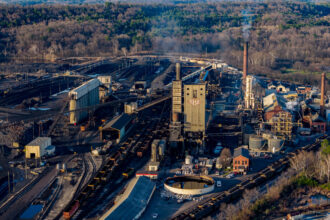
Today Pine Bend receives up to 320,000 barrels a day of heavy oil from western Canada. The facility covers 1,000 acres and has 10 miles of its own roads, as well as thousands of miles of pipe. This single Koch refinery is now responsible for an estimated 25 percent of the 1.2 million barrels of oil the U.S. imports each day from Canada’s tar sands territories.
Figures published in 1997 by Canada’s National Energy Board show that Koch wasn’t permanently displaced as Canada’s number one exporter until 2001, after Exxon and Mobil merged and took the top spot. The company dropped to number three in 2003, after Conoco and Phillips Petroleum merged.
In 2006 the National Energy Board stopped releasing company-specific information, but in a 2011 newsletter Koch told its employees that the Pine Bend refinery had had a record year. On the website of Flint Hills Resources, a Canadian subsidiary of Koch Industries that now handles its Canadian oil export business and owns the Pine Bend refinery, Koch still claims to be “among the largest processors of Canadian crude in the United States.”
Tracing Koch Leaseholdings Difficult
The Kochs’ heavy oil strategy isn’t limited to refining.
InsideClimate News’ research shows that Koch Industries has been buying and selling mineral leases for large holdings in Western Canada’s tar sands region since the late 1960s. It is difficult to piece together the full extent of the company’s holdings because most Canadian land sales records aren’t publicly available, and because land agents commonly make purchases on behalf of oil companies without revealing the companies’ names.
Court documents from the Koch family dispute in the 1980s show that at that time the company held 50,000 acres of leases in the Cold Lake area of Alberta, making it the sixth largest landholder there. In 1983, the company acquired an additional 44,000 acres in shallower zones thought to contain gas reserves that could be used to develop its oil sands leaseholds.
Periodic government announcements of some Alberta land sales, available online beginning with the year 1997, show that Koch has bought about 10,000 acres in its own name over the last 15 years. The most recent purchase was in January of this year, about 2,500 acres sold to Koch Oil Sands Operating ULC.
In 2006, Koch put up for sale more than 374,000 acres “with 47 billion barrels of oil resource estimated to be in place,” according to a sale announcement released by Koch Exploration Canada Corporation. That year the company also embarked on a buying spree. Geologist Ryan Morrison, who left Koch Exploration Canada in 2011, has written that he was directly involved in helping the company purchase two million acres of leases in Alberta’s three primary oil sands regions of Athabasca, Cold Lake and Peace River between 2006 and 2008. He also wrote that Koch is one of the largest holders of oil sands assets in Alberta.
Koch has made efforts to develop some of its leaseholdings. Canada’s Energy Resource Conservation Board maintains various lists, each hundreds of pages long, of well pads and other facilities that have been established on leaseholds in the oil sands region. InsideClimate News found that almost 500 well sites and facilities tracked by regulators under the Koch name are scattered across the oil sands regions.
Pipelines and Terminals
One of Koch Industries’ fundamental business capabilities has been transporting oil, ever since its founding as Rock Island Oil and Refining, which was built around oil gathering assets. Over the span of four decades in Canada the company came to own four “feeder” pipeline systems, three in Alberta and one in Saskatchewan that by the late 1990s had a throughput of more than 300,000 barrels per day.
In 1997, Koch Industries formed Koch Pipelines, a publicly traded company, and bundled these pipeline assets together into a sale that netted $375 million (Canadian) on the Toronto stock exchange. Koch retained almost half the shares and maintained control as the general partner.
As a publicly traded company, Koch Pipelines had to conduct business with transparency unusual for the private company. The company’s first annual report made rare public disclosures about its energy-related interests in Canada.
“Koch is directly involved in crude oil exploration and production, oil and gas trading, and providing risk management services to the energy sector,” the report said. “In fact, Koch has grown to become the largest exporter and one of the largest refiners of Canadian crude oil.”
Koch expanded its feeder system and increased Canadian oil exports to Montana refineries, rewarding shareholders with tens of millions of dollars in annual distributions. But throughput on the system remained flat and Koch sold its interests in 2002. Koch Pipelines was renamed Inter Pipeline, which today can handle more than 600,000 barrels of oil sands crude a day.
In 1998, Koch also established a presence in Hardisty, Alberta, an oil transport hub. It built five storage tanks with a combined total capacity of 670,000 barrels for blending feedstock for the refinery in Pine Bend. The regulator who granted the permit noted that “the flexibility and confidentiality afforded by the operation of its own facility was of the utmost importance” to Koch Industries.
Koch said its facility would handle custom-blended products “involving unconventional diluents and heavy oils,” as well as 85,000 barrels a day from various sources, including 30,000 barrels from Suncor through a 10-year supply contract. Suncor was the first company to start commercial oil sands production in Alberta, and the contract with Koch, its largest to that point, was an important milestone in Suncor’s growth.
Today the flow of oil to Pine Bend begins at the Hardisty transport hub, where Enbridge pipelines take it across Canada and into Enbridge’s Lakehead system in the United States. At Clearbrook, Minn. it is moved into a pipeline system owned by Koch Industries and Marathon Oil. It is then taken to Pine Bend.
The Kochs also own a 537-mile pipeline system that distributes products from Pine Bend to regional customers. Pine Bend is responsible for a large percentage of the jet fuel used at the Minneapolis-St. Paul International Airport, as well as about 40 percent of Wisconsin’s transportation fuel. It also supplies gasoline to the Kwik Trip convenience store chain, which has hundreds of outlets in Wisconsin, Minnesota and Iowa.
Pine Bend has allowed Koch to develop other profitable lines of business. A barrel of bitumen yields only about 15 percent of the gasoline that a conventional barrel of oil does, but Koch turns the “bottoms” in each barrel into products, like asphalt, that boost its returns. In 2001 the company was granted a permit to build two storage tanks for asphalt cement with a combined capacity of 4.2 million gallons at a facility it owns in Marshall, Minn. that already had 40 storage tanks on site.
How big Koch’s asphalt business became is indicated by two transactions the company concluded in the last decade. In 2005 Koch sold 47 asphalt terminals in the U.S. and 13 in Mexico, plus other related assets, to SemGroup, a Mexican company. The price wasn’t disclosed. The following year, Koch sold asphalt interests it had developed in China to Royal Dutch Shell. Shell highlighted the acquisition of asphalt resources, also called “bitumen,” in its annual report.
“The deal increases Shell’s bitumen production—more than doubling it in China to 6,600 tonnes per day, which represents around 20% of Shell Bitumen global volume,” the report said.
Even after these divestitures, Koch was still in the asphalt business. The company announced it was retaining facilities in North Dakota, South Dakota, Minnesota, Wisconsin, Iowa and Nebraska to receive asphalt produced at Pine Bend.
Burned by Kyoto
Less than 10 years ago Koch Industries made an abrupt and attention-getting exit from one of the biggest oil sands mines under development in Alberta at the time.
Its TrueNorth Energy Corp held a 78 percent stake in what is known as the Fort Hills project, estimated to contain 2.8 billion barrels of recoverable oil. But in 2003, after investing years of effort and $125 million, Koch decided to indefinitely defer development of the project, closed its offices and terminated its staff, citing “general uncertainty regarding the potential impacts of the Kyoto Accord” as one of the reasons.
Kyoto is the international agreement that in its first phase imposed modest emissions reductions on participating industrial nations. Canada ratified the agreement in 2002 and set aside money to begin reducing greenhouse gas emissions. When the Kochs pulled out of Fort Hills, Canadian media reports described it as the first casualty of Kyoto in Alberta’s oil patch. Koch eventually sold its interest in the project.
In hindsight, the oil industry regards the sale as a missed business opportunity for the Kochs. Today Fort Hills is owned by Suncor, Total, and Teck Resources, and is one of the biggest oil sands mines in development in Alberta.
The Harper government pulled Canada out of the Kyoto agreement last year and has been moving swiftly and aggressively to remove environmental and regulatory obstacles that could stand in the way of exporting western Canadian oil to global markets.
Now, the Kochs are more visibly re-entering the oil production business. In November, Alberta’s Energy Resource Conservation Board published a notice for a Feb. 22 hearing on the company’s application to begin an oil sands project in the Cold Lake area. Named Gemini, the project would produce 10,000 barrels of oil a day using a recovery process known as Steam Assisted Gravity Drainage, or SAGD (pronounced sag-dee).
Cold Lake, population 13,839, is in the middle of the Canadian wilderness, about 400 miles north of the U.S. border where Alberta touches Saskatchewan. The Koch Gemini project will occupy about 90 acres of land next to a pristine body of water called Angling Lake.
From well pads located about 400 yards from shore, the project will drill down and horizontally to reach bitumen deposits directly beneath the lake. Using the SAGD process, drillers will then inject steam to liquefy the bitumen and pump it out. This will continue for as long as the well produces, probably about 30 years.
“The 10,000 barrel a day figure is a legally important limit,” said Bill McElhanney, a lawyer based in Edmonton, the capital city of Alberta, in a telephone interview with InsideClimate News. “It allows producers to avoid a comprehensive environmental assessment, which is only required of projects producing more than 10,000 barrels a day.”
Once a project gets going, McElhanney explained, it can be expanded easily, and continue to enjoy the advantage of avoiding a comprehensive federal review.
McElhanney is a partner with Ackroyd LLP, Barristers and Solicitors, a firm that specializes in representing aboriginals, landowners and ranchers. He negotiated with Koch Exploration Canada on behalf of landowners near the Gemini project, who fear it will pollute the air or contaminate their water. Some filed official complaints with the government.
McElhanney said that in Alberta most oil developments are approved, and there was only so much he could do for his clients. In this case, he was able to persuade Koch to pay for an independent environmental review, which was used as the basis for negotiating confidential agreements with the landowners, who then withdrew their complaints. As a result, the public hearing in Cold Lake was cancelled, and the project is quietly moving forward.
Researcher Lisa Schwartz contributed to this report.
About This Story
Perhaps you noticed: This story, like all the news we publish, is free to read. That’s because Inside Climate News is a 501c3 nonprofit organization. We do not charge a subscription fee, lock our news behind a paywall, or clutter our website with ads. We make our news on climate and the environment freely available to you and anyone who wants it.
That’s not all. We also share our news for free with scores of other media organizations around the country. Many of them can’t afford to do environmental journalism of their own. We’ve built bureaus from coast to coast to report local stories, collaborate with local newsrooms and co-publish articles so that this vital work is shared as widely as possible.
Two of us launched ICN in 2007. Six years later we earned a Pulitzer Prize for National Reporting, and now we run the oldest and largest dedicated climate newsroom in the nation. We tell the story in all its complexity. We hold polluters accountable. We expose environmental injustice. We debunk misinformation. We scrutinize solutions and inspire action.
Donations from readers like you fund every aspect of what we do. If you don’t already, will you support our ongoing work, our reporting on the biggest crisis facing our planet, and help us reach even more readers in more places?
Please take a moment to make a tax-deductible donation. Every one of them makes a difference.
Thank you,

David Sassoon
Founder & Publisher
David founded Inside Climate News in 2007 after learning about climate change working as a contract writer for foundations and NGOs grappling with the issue. He identified an unmet need—fair and accurate media coverage of climate science—and launched a blog which grew into ICN over the last 19 years. A history major at Harvard, after graduation David traveled around the world as a documentary black-and-white photographer, for many years based out of Kathmandu, Nepal. He returned to earn a master’s degree from Columbia University’s Graduate School of Journalism. He then worked as a writer, editor and publisher on public interest issues for a variety of employers and started two other publications before launching ICN. He has overseen the growth of the organization from a staff of two to a staff of 42 today and guided the development of ICN’s powerful and innovative operating model with the help of many colleagues and supporters.