

RICHMOND, Va.— President Donald Trump is expected on Wednesday to sign his “Ratepayer Protection Pledge,” a deal he claims to have negotiated with major tech companies for data centers to pay their own energy costs. But he hasn’t disclosed details on how his plan would work or what roles Congress and state electricity regulators would play.
“We’re telling the major tech companies that they have the obligation to provide for their own power needs,” Trump announced during his State of the Union address last week. “They can build their own power plants as part of their factory, so that no one’s prices will go up. And in many cases, prices of electricity will go down for the community, and very substantially down.”
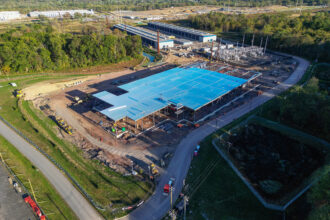
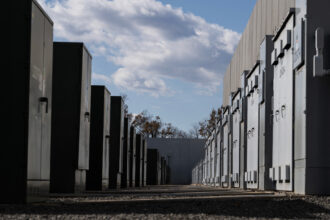
Trump’s announcement coincides with his push to win the global race to develop artificial intelligence. That computing power for that competition comes from data centers, the massive warehouse-like facilities providing server functions. Data centers are energy intensive, requiring new electricity generation, transmission and distribution grid upgrades, with costs that have to date already been paid by ordinary residential utility customers.
But details of Trump’s deal haven’t been made public beyond a scheduled signing event with tech giants Amazon, Google, Meta, Microsoft, and more.
“Under this bold initiative, these massive companies will build, bring, or buy their own power supply, ensuring that Americans’ electricity bills will not increase as demand grows,” White House spokeswoman Taylor Rogers said, declining to share more specifics. “President Trump is committed to ensuring American AI dominance while simultaneously lowering costs for working families.”
Members of Congress have been working on legislative efforts to address this concern for months, but so far it hasn’t been clear how much interest there is on the part of Republican leaders.
One proposal could pause data center development entirely. A bill from Sen. Chris Van Hollen, D-Md., would have data centers bring their own power generation and pay for transmission upgrades that wouldn’t have occurred if not for the industry’s build out.
“The problem’s already bad and getting worse,” Van Hollen said earlier this year on a media call while referencing a Union of Concerned Scientists report finding all customers, including individual homeowners, have paid $7.7 billion over the past two years for the transmission costs associated with data centers.
But how data centers power themselves will ultimately be influenced by rules from regional grid operators like PJM Interconnection, which includes Virginia, the world’s largest data center market. Any co-location rules from PJM would have to be approved by the Federal Energy Regulatory Commission. Local and state authorities also have to sign off on data center power projects, too, for things such as land use, emissions permits and water use.
“It’s complicated, as you might imagine, and much more complicated than Trump made it sound,” said Nick Guidi, a senior attorney with the Southern Environmental Law Center.
Behind the Meter
All these rules are centered around co-location of a data center and a power plant, which can come in the form of “behind-the-meter” options, in which the power plant serves only the computing facility and is not attached to the electric grid, or “front-of-the-meter” grid options, in which the power plant provides most of its power to the data center but remains part of the grid. Under rules FERC wants revised and PJM is updating, data centers could bring their own behind-the-meter natural gas plants to avoid taking electricity from the grid.
Currently, many data centers have numerous, smaller diesel generators to supply themselves with power at times of high electricity demand on the grid. The giant server farms, some of which consist of a dozen or more large buildings the size of big-box stores, run continuously, requiring power 24 hours a day throughout the year.
Theoretically, utilities wouldn’t need to build out the grid and recover those costs from all ratepayers, including residential ones, if data centers build their own power plants. But data centers often seek redundant sources of power to operate 24/7 in the event their gas turbines go down for maintenance, or experience some kind of failure. So, grid upgrades could still be needed to serve data centers at times, even if they had their own power sources.
Under old rules, data centers could use the amount of electricity their own on-site power generators create to reduce—with no limit—how much service from the grid they pay for, letting them avoid the full cost of grid upgrades that regular customers still had to pay for. PJM, the regional grid operator, now wants to cap that offset at 50 megawatts.
“You can’t let these loads just put a massive generator on site, net that out completely and just not pay for the grid upgrades that are required,” Guidi said.
Adding to complications, if data centers aren’t buying electricity from the grid, that means less sales revenue for utilities. An old grid still needs to be upgraded regardless of whether data centers show up or not, and those costs would still need to be made up from residential ratepayers.
“If new customers are contributing significantly greater costs, but they’re not necessarily bringing in the same revenues because they’re allowed to go off grid, depending on how that is designed, that can absolutely impact utility bills,” said Charles Hua, founder and executive director of PowerLines, a nonprofit consumer education nonprofit.
And, fewer opportunities to build upgrades to serve data centers means fewer opportunities for utilities to earn guaranteed profit margins that come with spending on construction projects, analysts say. Some utilities and grid operators are already spending to upgrade high-voltage power lines in anticipation of data center needs. But if that need doesn’t materialize, individual ratepayers could get stuck with the costs of those upgrades.
Dominion Energy, Virginia’s largest electricity provider, did not respond to requests for comment on Trump’s plan.
Front of the Meter
Data centers that don’t choose to build their own power plants can negotiate a power purchase agreement to buy electricity from an independent power plant, bypassing a traditional utility. That power plant sits outside the fence of the data center, connected to the broader grid.
Federal regulators are already wrestling with how to handle this. FERC, the federal agency that oversees interstate electricity markets, has reviewed at least one such application and has launched a formal process to write new rules governing these arrangements.
In November 2024, an Amazon data center in Pennsylvania sought to buy electricity from Talen Energy’s Susquehanna nuclear power plant in Pennsylvania. FERC voted 2-1 to reject the deal, which would’ve let Amazon offset some 960 megawatts of electricity from its utility bill to achieve savings.
Meanwhile, PJM, the grid operator for most of 13 states and the District of Columbia, is considering its own fast-track process—called the Critical Issue Fast Path—that would address the same issue. PJM’s work on the issue comes after requests from several governors in the region, and the White House, earlier this year.
“First, you have a reliability problem. You’re taking an existing generator that in PJM is serving the whole grid,” Mark C. Christie, former FERC chairman who is now director of the Center for Energy Law & Policy at William and Mary Law School.
This story is funded by readers like you.
Our nonprofit newsroom provides award-winning climate coverage free of charge and advertising. We rely on donations from readers like you to keep going. Please donate now to support our work.
Donate NowChristie, who voted against the Amazon deal in Pennsylvania, said that “the other issue in this arrangement is, ‘are they going to pay the full cost of their transmission charges?’ Because if they don’t, then, of course you have a cost shift to residential consumers.”
State oversight of the electric grid is paramount to make informed decisions, said Christie, who added he’s worried FERC’s own rulemaking could become a hindrance under Trump.
“The devil is in the details,” said Christie of Trump’s proposed plan. “Any agreement is not going to work unless the states are empowered to use their existing authority to protect their consumers. The states have to be empowered, not preempted.”
State Authority
In Virginia, state oversight of the grid happens through the State Corporation Commission.
If a data center relied solely on a behind-the-meter gas plant, it could avoid the SCC entirely, needing only local land use approval and an air permit from the Virginia Department of Environmental Quality to operate its own generators since there would be no interaction with the grid.
But then a new gas distribution pipeline might need to be built to supply the behind-the-meter plant, meaning the data center would then be competing for limited gas during the winter, pushing up prices for other customers and utilities, and ultimately all ratepayers. The state’s carbon market rules under the Regional Greenhouse Gas Initiative, a cap-and-trade program that makes power plants pay for carbon emissions, could apply to data centers then, too.
“I don’t know that they’ve gotten that far in the process yet. It’s all political right?” said Gregory Abbott, a former SCC deputy director. “There’s no getting around it. It’s causing increases in prices however you want to…It just will.”
If a data center or an independent power producer wants to build a front-of-the-meter gas plant smaller than 5 megawatts, which would power 5 percent of a typical 100 megawatt data center, it wouldn’t need SCC approval either. But that source might then need to comply with competitive service provider requirements. And, in order to receive electricity from that front-of the-meter source, the data center would have to be connected to the grid and then consider taking up an option known as retail choice, or shopping. That option was already limited under Virginia’s laws, which give Dominion Energy near monopoly control, and became more restricted under new rate case terms.
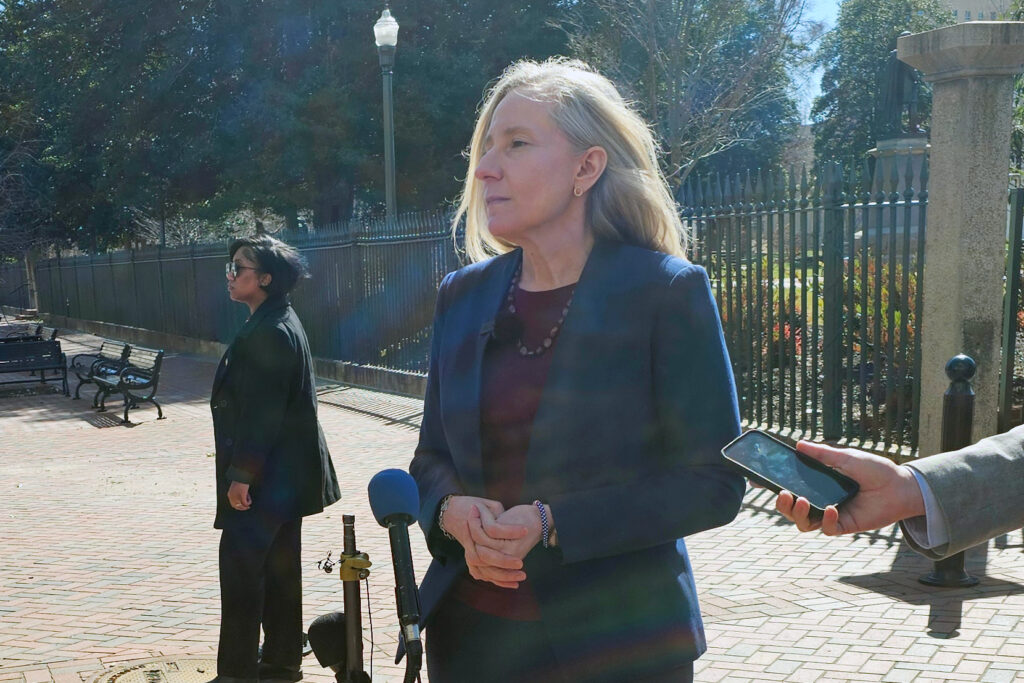
PJM and FERC need to finalize the rules they are considering, and then Virginia lawmakers and regulators would potentially need to make adjustments in response to those. Since the Virginia legislature is ending March 14, before Democratic Gov. Abigail Spanberger takes any actions on bills, Trump’s plan likely couldn’t have any effect in the state until next year, if and when the Democrat-controlled House and Senate decide to take up any law changes to make it a reality.
“We are basically done with [the legislative session] by the time the State of the Union comes around,” said Dana Wiggins, director of the Center for Economic Justice for the Virginia Poverty Law Center. “Any changes that might be necessary to accomplish would have to come next year.”
Asked what role the SCC might play in reviewing plans from a data center to build either a behind-the-meter or front-of-the-meter project, spokesperson Greg Weatherford said, “This is an emerging issue.”
“Because there is no precedent or legislation to guide the SCC on this question, we can’t say what the SCC’s role would be,” Weatherford said. “It may be something the Commission would decide at some point.”
Legislation was making its way through the Virginia General Assembly to have the SCC review data center connection requests, but a House subcommittee killed it, opting instead to send a letter to the SCC asking them to consider the issue. Other measures, like a bill from Sen. Russett Perry, D-Loudoun, could have made more structural changes to cost allocation methodologies that would shield residential ratepayers from the costs of upgrading the grid to serve data centers, but the same committee continued it to next year.
Ari Peskoe, director of the electricity law initiative at Harvard University, said that’s something “utilities, not hyperscalers,” should entertain, because they are “the entities that can protect ratepayers from the costs of serving data centers.”
“The ‘Ratepayer Protection Pledge’ appears to be an unenforceable corporate ESG commitment intended to trick the public into thinking that the White House is doing something about rising energy costs,” Peskoe said.
Spanberger has indicated a desire for data centers to pay their fair share, but hasn’t publicly said how that should happen and if there should be clean energy requirements.
Asked by Inside Climate News how Trump’s desires could play out in Virginia, Spanberger said, there’s “a lot of conversations” about data centers.
About This Story
Perhaps you noticed: This story, like all the news we publish, is free to read. That’s because Inside Climate News is a 501c3 nonprofit organization. We do not charge a subscription fee, lock our news behind a paywall, or clutter our website with ads. We make our news on climate and the environment freely available to you and anyone who wants it.
That’s not all. We also share our news for free with scores of other media organizations around the country. Many of them can’t afford to do environmental journalism of their own. We’ve built bureaus from coast to coast to report local stories, collaborate with local newsrooms and co-publish articles so that this vital work is shared as widely as possible.
Two of us launched ICN in 2007. Six years later we earned a Pulitzer Prize for National Reporting, and now we run the oldest and largest dedicated climate newsroom in the nation. We tell the story in all its complexity. We hold polluters accountable. We expose environmental injustice. We debunk misinformation. We scrutinize solutions and inspire action.
Donations from readers like you fund every aspect of what we do. If you don’t already, will you support our ongoing work, our reporting on the biggest crisis facing our planet, and help us reach even more readers in more places?
Please take a moment to make a tax-deductible donation. Every one of them makes a difference.
Thank you,

Charles Paullin
Charles Paullin is a Richmond, Virginia-based reporter focusing on energy and environment issues. He’s won several awards for his previous work covering state policy with the Virginia Mercury and local news with the Northern Virginia Daily in the Northern Shenandoah Valley. His first reporting gig was with the New Britain Herald in Connecticut, a couple years after attending the University of Hartford, where he first studied sports journalism.