

This week, delegates from around the world gathered at the International Seabed Authority’s headquarters in Kingston, Jamaica, to continue ongoing negotiations over a long-debated “mining code”—a set of rules and regulations that would determine how commercial deep-sea mining could proceed in international waters.
Established under the 1982 United Nations Convention on the Law of the Sea, the International Seabed Authority (ISA) serves as the primary decision-making body responsible for overseeing all mineral-related activities on the seabed beyond national jurisdictions in what is known as “the Area.” Its mandate is to ensure these operations are carried out for “the benefit of humankind as a whole,” while also protecting the marine environment from potential harm.
ISA Secretary-General Leticia Carvalho said she hopes the mining code can be finalized this year, emphasizing that establishing rules before industrial activity begins is essential.
“Without rules, there are no enforceable protections. The chance to have these in place before activities commence is unique in human history,” Carvalho said Monday during opening remarks of a two-week long session the ISA is holding to further develop rules for seabed mining, which have been debated since 2019. Pushing for their implementation, she said, “does not mean less ambition, less protection or a rush to mining—it means a tangible pathway to realized and holistic ocean governance.”
In the process, environmental advocates and Indigenous leaders from across the Pacific, who are also attending the talks, are urging policymakers to consider the ecological and cultural stakes of opening the deep ocean to such industrial activity.
Inside Climate News spoke with Solomon Pili Kahoʻohalahala, a seventh-generation Native Hawaiian elder and activist who is attending the negotiations to advocate for the inclusion of Indigenous perspectives as decisions are being made about the future of the deep sea. This interview has been edited for length and clarity.
TERESA TOMASSONI: Can you start by introducing yourself and your involvement in ocean conservation and governance?
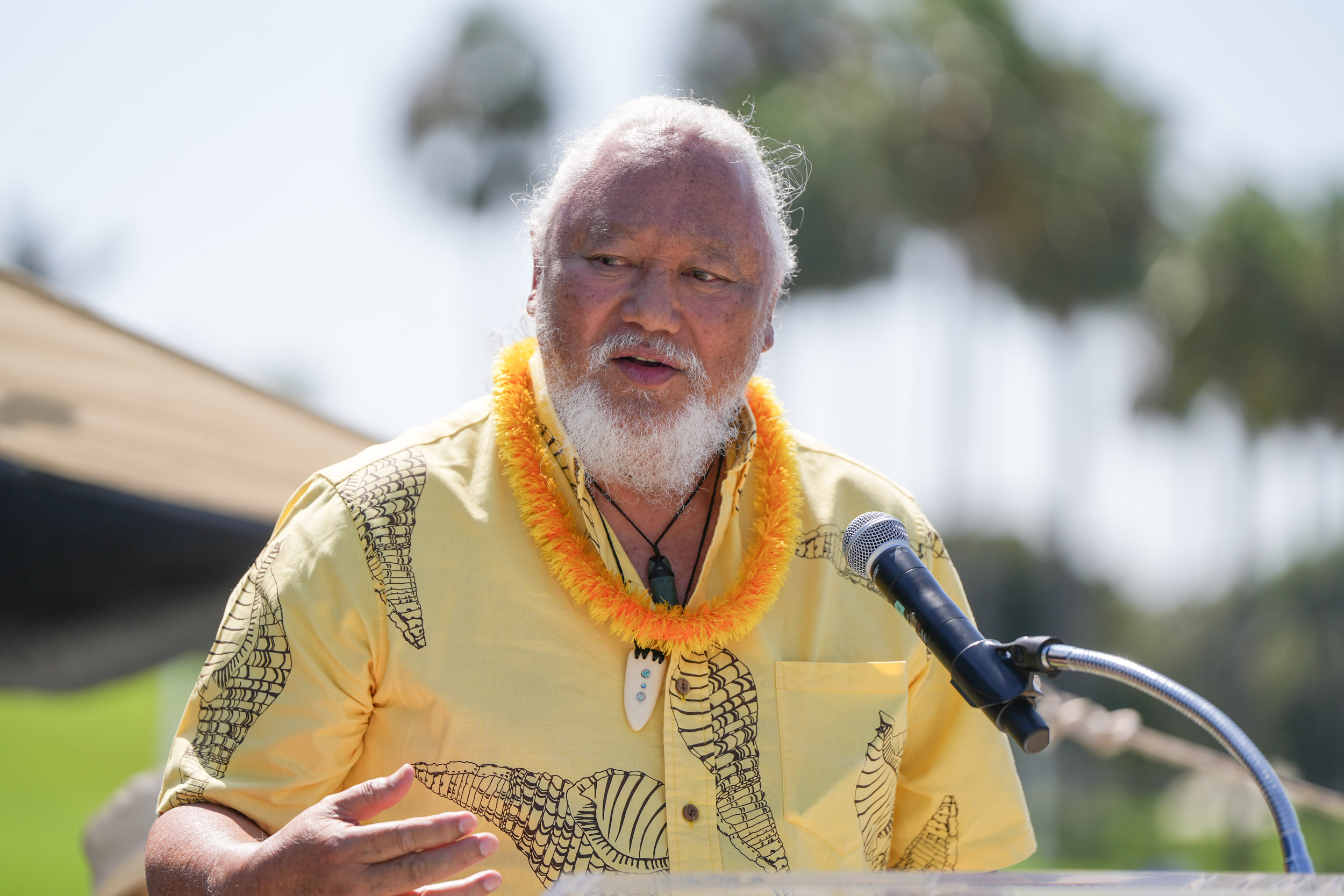
SOLOMON PILI KAHO’OHALAHALA: Aloha. My name is Solomon Pili Kahoʻohalahala. Most people call me “Uncle Sol.” I’m part of a nonprofit organization called the Maui Nui Makai Network, which works to protect and restore marine ecosystems using traditional knowledge across three of Hawaii’s islands—Maui, Molokai and my island home, Lanai. I’m also affiliated with an initiative I helped kick off at the United Nations Ocean Conference called One Oceania. This initiative aims to elevate the voices of the people of Oceania in decision-making spaces like the International Seabed Authority (ISA) in light of the fact that most deep-sea mining activities are focused within the waters of Oceania, which is home to not just myself, but many of the people who inhabit the largest ocean on the planet—the Pacific.
TOMASSONI: Where exactly is deep-sea mining being proposed in the Pacific and what is at stake?
KAHOʻOHALAHALA: The main area of concentration for deep-sea mining is called the Clarion-Clipperton Zone, a 2.3-million-square-mile ocean area located between Hawaii and Mexico. That entire area of the ocean and its seabed has already been subdivided by the ISA. Now they are trying to come up with rules and regulations for mining minerals there, which to date, has never taken place. So far, the area has only been explored to assess what is there on the seabed floor.
In the case of Hawaii, this area is adjacent to our home. For the last four and a half years, I’ve been attending and participating in discussions at the ISA, raising Indigenous peoples’ concerns about the potential impacts deep-sea mining could have not only on the physical places they call home, but also their cultural values and beliefs.
TOMASSONI: What are those concerns?
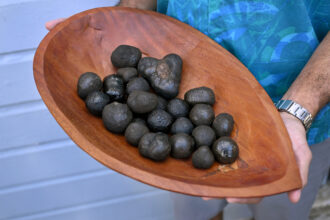
KAHO’OHALAHALA: We are told that deep-sea mining is necessary to support the green economy. That we need to extract these polymetallic nodules at the bottom of the sea so we can create electric batteries to run automobiles without using carbon fuels. But deep-sea mining is such a destructive process.
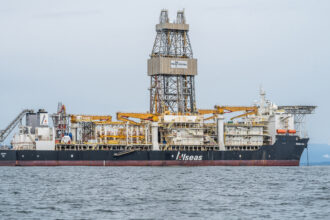
When I first started to attend ISA meetings, I saw demonstrations of mining activity in the deep sea. It just tore me apart. I was literally in tears when I saw that. There was machinery there that was tearing and sucking and grabbing, and all they wanted to do is to collect those nodules, and then, in the process of their extraction, they would lift them to the surface of the ocean and drop them into the ships, and then dump everything right back into the ocean. And the surface of the water was just a mass of turbidity.
We have no idea what the consequences will be from those actions. After seeing that, I said, as much as I can, I’m going to stop this process from happening. It is much more serious than most people would understand. It threatens my life, and that of the global community.
TOMASSONI: How would you describe the connection Native Hawaiians have to the deep sea?
KAHO’OHALAHALA: Our genealogy speaks to the fact that we come from the deep sea. We have a creation chant we call the Kumulipo, which says in the deepest, darkest part of the ocean, there is an area of sediment and organic matter that we refer to as the Waliwali, which is like the genetic soup to create potential life. From that Waliwali, the first living creature was created, which was the coral polyp. In my view, deep-sea mining is a form of erasure. It’s creating my genocide and perhaps not only my genocide, but our genocide. This story of creation in the deep sea is not just an exclusive story for me as a person of Oceania; it is a story of the Earth itself. If we do not pay attention to that, then perhaps we are now ultimately destroying our ability to continue to live here.
“We look at the ocean as one place, not as subdivided places that have different authorities in the same body of water that is our home.”
TOMASSONI: How else does the Indigenous perspective of the ocean differ from the way it is currently divided and governed under international law?
KAHO’OHALAHALA: We do not see a division of a seabed, floor and vertical water column that can be separated by lines. The ocean is fluid. The creatures move through it, and they see no line. But we are expected to create rules and regulations based on imaginary lines that give authority to one body and then a nation state on the other side as if our decisions on one side won’t affect those on the other side. That is not the Indigenous perspective. We live in one ocean, not a divided ocean. We look at the ocean as one place, not as subdivided places that have different authorities in the same body of water that is our home.
TOMASSONI: How have member delegates of the ISA responded to you sharing your perspective?
KAHO’OHALAHALA: In the last meeting, I was told by one of the legal advisors at the ISA that it’s like “too little too late.” And I looked at them and said, I’m sorry but I don’t accept that as a premise. Thirty some years ago, when the ISA was created, there was very little to no involvement of Indigenous peoples in that process. They’d never thought to consider Indigenous perspectives.
But 30 years ago, the conditions were not the same as they are today. We are facing a climate crisis now. Our island nations are disappearing from sea level rise. Our coral reefs and fisheries are suffering due to warmer temperatures and ocean acidification. Horrendous kinds of hurricane and cyclone events are causing flooding and torrential rains beyond anything we’ve ever experienced.
I said, if your policies are going to continue to remain static like from 30 years ago, then you have made no provisions to accommodate change in time. I’m here to raise the questions about accommodating change. I may be here 30 years later, but I believe I’m on time.
This story is funded by readers like you.
Our nonprofit newsroom provides award-winning climate coverage free of charge and advertising. We rely on donations from readers like you to keep going. Please donate now to support our work.
Donate NowTOMASSONI: How do you see today’s push for deep-sea mining in the Pacific in the context of the region’s history with colonialism and resource extraction?
KAHOʻOHALAHALA: The Pacific has already been abused through colonization in ways that have been destructive for many lifetimes. Nuclear blasting and nuclear testing were done in the Pacific, and people were relocated from their homes and left with nothing but devastation. Even today, because of that nuclear activity, many are still unable to return home.
The powers of the world decided it was acceptable to use a place that belonged to the people of Oceania—removing them, destroying their homes and leaving entire communities in havoc. And they are still suffering the consequences.
Now, we are not talking about nuclear testing, but we are looking at going to the same place in the ocean that belongs to Indigenous people and we’re telling them that we’re going to mine your area for the sake of a green economy. In the process, we could possibly destroy your ability to live here. We could disrupt the food chain.
“This may be one of the last places on this planet that still sustains life in ways we do not fully understand. And yet we are willing to go there and destroy it without knowing what the consequences will be.”
It means we are continuing on the same track of colonial thinking—this idea of being dominant and having dominion over everything. In the past, people were removed from their island homes. Now the thinking is that we can go into their ocean and destroy that space instead, because nobody lives there.
But we have a story that tells us that this is the place where life itself was created. From our perspective, this may be one of the last places on this planet that still sustains life in ways we do not fully understand. And yet we are willing to go there and destroy it without knowing what the consequences will be.
TOMASSONI: Do you see progress being made in regards to including more Indigenous voices in these conversations since you first started attending ISA negotiations?
KAHO’OHALAHALA: The ISA is now allowing us to share our perspectives as part of an intersessional working group called the Intersessional Working group on Underwater Cultural Heritage. At some point, the group has to come out with recommendations for consideration, for inclusion into the rules and regulations that will make up the mining code. I want to be sure that in the process of creating these rules for exploitation that considerations are raised by not just myself from Hawaii, but from other nation states, from within Oceania. But that remains to be seen.
About This Story
Perhaps you noticed: This story, like all the news we publish, is free to read. That’s because Inside Climate News is a 501c3 nonprofit organization. We do not charge a subscription fee, lock our news behind a paywall, or clutter our website with ads. We make our news on climate and the environment freely available to you and anyone who wants it.
That’s not all. We also share our news for free with scores of other media organizations around the country. Many of them can’t afford to do environmental journalism of their own. We’ve built bureaus from coast to coast to report local stories, collaborate with local newsrooms and co-publish articles so that this vital work is shared as widely as possible.
Two of us launched ICN in 2007. Six years later we earned a Pulitzer Prize for National Reporting, and now we run the oldest and largest dedicated climate newsroom in the nation. We tell the story in all its complexity. We hold polluters accountable. We expose environmental injustice. We debunk misinformation. We scrutinize solutions and inspire action.
Donations from readers like you fund every aspect of what we do. If you don’t already, will you support our ongoing work, our reporting on the biggest crisis facing our planet, and help us reach even more readers in more places?
Please take a moment to make a tax-deductible donation. Every one of them makes a difference.
Thank you,

Teresa Tomassoni
Oceans Correspondent
Teresa Tomassoni is an environmental journalist covering the intersections between oceans, climate change, coastal communities and wildlife for Inside Climate News. Her previous work has appeared in The Washington Post, NPR, NBC Latino and the Smithsonian American Indian Magazine. Teresa holds a master’s degree in Journalism from the Craig Newmark Graduate School of Journalism at CUNY. She is also a recipient of the Stone & Holt Weeks Social Justice Reporting Fellowship. She has taught journalism for Long Island University and the School of the New York Times. She is an avid scuba diver and spends much of her free time underwater.