

Jill Mauer spent more than 30 years as a government inspector, watching over meat plants as workers slaughtered and processed animals into market-ready chops and wings.
Now she has a warning.
In comments Mauer submitted last month to the U.S. Department of Agriculture, she wrote that recent Trump administration proposals to speed up processing in slaughterhouses will endanger workers, forcing them to work more quickly in already dangerous conditions.
“I am one of many meat inspectors who have raised concerns about the USDA’s efforts to increase line speeds through high-speed, reduced-inspection models and pilots. Many inspectors feel they cannot speak openly about what they have seen,” Mauer wrote. “I made the decision to step forward publicly because of what I witnessed firsthand over many years, particularly at my own plant.”
On average, 27 U.S. slaughterhouse workers suffer an amputation, loss of an eye or other injury serious enough to require hospitalization every day, according to data from the 29 states that are required to report to the federal Occupational Health and Safety Administration. Speeding up slaughter lines risks making this even worse, Mauer and other critics say.
Animal welfare, food safety and worker advocacy groups have railed against the proposals, and against waivers the first Trump administration gave the meat industry that allowed dozens of slaughterhouses to surpass existing line speed limits. Most of the critiques so far have focused on working conditions, animal cruelty and the demonstrated and increased potential for contamination that come with faster line speeds.
In a letter submitted April 30 to the USDA, two senators and three U.S. representatives called for the agency to halt the proposal, writing it “is unacceptable to create a work environment that will increase the harm to workers and to subject them to more life-changing injury and the public to more foodborne illness.”
But now many of these critics are also warning that faster line speeds will lead to more water use, more polluted waterways and more greenhouse gas emissions—more evidence, they say, that worker safety, animal welfare and climate concerns overlap and intertwine in underappreciated ways.
“The environmental piece often gets overlooked,” said Delcianna Winders, director of the Animal Law and Policy Institute at the Vermont Law and Graduate School. “Even if you set aside the rest of the supply chain, the slaughterhouse itself is incredibly harmful environmentally, in terms of use of water, direct discharge of water and air pollution.”
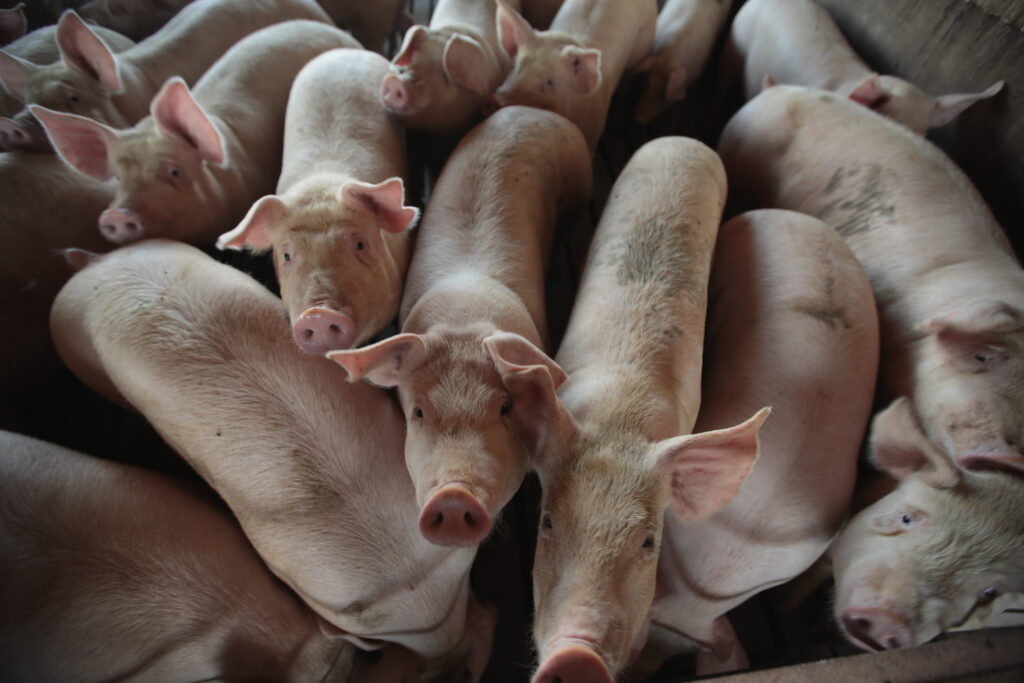
The new proposed rules, released in February, would allow poultry slaughtering facilities to kill 175 chickens per minute, up from the 140 currently allowed, an increase of roughly 25 percent. Hog slaughtering facilities, which are currently allowed to slaughter 1,106 pigs an hour, would have no limit at all. Some “high speed” hog-slaughtering facilities have already been allowed to kill at even higher speeds—about 1,300 animals an hour.
Along with a colleague, Patti Truant Anderson, a researcher and food systems expert at the Johns Hopkins Center for a Livable Future, decided to analyze the numbers.
The USDA projects that the faster line speeds will lead to an additional 1.4 billion pounds of poultry within five to 10 years of the rule’s enactment. Truant Anderson calculated that this will lead to an additional 114 billion liters of water used each year—or the equivalent of 45,400 Olympic-sized swimming pools—and an additional 2 billion kilograms of heat-trapping carbon dioxide emissions, or roughly the emissions of 467,000 gasoline-powered vehicles driven over one year.
Based on the agency’s projections for hogs—an additional 500 million pounds slaughtered—Truant Anderson calculated an additional 95.4 billion liters of water used a year, equivalent to about 38,000 Olympic-sized pools, and an additional 1.5 billion kilograms of carbon dioxide emitted, or about 350,000 gasoline-powered vehicles driven for one year. (The USDA did not project a time frame for the increase of 500 million pounds.)
Despite these potential impacts, the USDA has said that the Food Safety and Inspection Service (FSIS), which oversees slaughterhouses, is categorically excluded from requirements under the National Environmental Policy Act (NEPA).
In an emailed response, a USDA spokesman wrote that the agency’s NEPA regulations say “‘FSIS’ programs and activities do not normally result in reasonably foreseeable significant impacts on the natural or physical environment and as such are excluded from preparation of an environmental assessment or environmental impact statement. As stated in recent rulemaking on USDA’s NEPA regulations, USDA decided to retain the categorical exclusion. Establishments must follow applicable laws regarding air and water quality under the jurisdiction of the Environmental Protection Agency and state or local authorities.”
The new proposals drew more than 72,000 comments. According to the United Food and Commercial Workers (UFCW), the union that represents thousands of slaughterhouse workers, roughly 22,000 comments opposed the poultry line speed increase, and 20,000 comments opposed the hog rule.
Much of the opposition focused on human safety or public health concerns.
“As a mother of two, I see food safety as a matter of life and death. Based on my direct experience, I believe these high speed models lead to lower-quality meat products and increase the likelihood that unsafe food reaches the public,” Mauer wrote. “At higher speeds, there is less time to observe, less time to react, and less margin for error. Inspectors may see issues—dressing defects, contamination, or signs of disease—but not have the time or support to fully address them before the next carcass arrives.”
Other comments address the potential distress and suffering the line speeds will cause animals. Undercover investigations have exposed appalling conditions in a high-speed hog slaughter facility where pigs were pushed and dragged to their deaths.
“The faster you’re moving, the more likely it is an animal is not going to get stunned before their throat is slit, and sometimes they’re still going to be alive when they go into the scald tank,” Winders said. “We know they’re going to be violently handled to just keep pace with the line. And we know that from eyewitness testimony.”
While beef and dairy cattle are the biggest source of greenhouse gas emissions from the livestock industry, Winders noted that 9 billion chickens are slaughtered in the U.S. every year—more than any other animal.
“Even though it’s not as extreme as beef,” Winders said, “the climate impact isn’t nothing.”
In comments filed on behalf of more than 70 animal, environmental and farm advocacy groups, the commenters said: “Increased capacity at slaughterhouses will also drive up pollution from the factory farms that supply them with pigs. Like slaughterhouses themselves, the CAFOs [concentrated animal feeding operations] that supply the vast majority of pigs to swine slaughterhouses create major pollution problems that contribute to the harms the heavily concentrated meat industry thrusts upon communities.”
Amanda Hitt, an attorney also with the Vermont Law and Graduate School, said rising temperatures are affecting slaughterhouses in ways that haven’t been factored into the proposals.
Misters are often used to cool animals down as they wait to enter the slaughter facilities, but water shortages mean that they are often turned off.
“One of the problems is they have many, many more swine coming in in extreme heat, but they won’t turn the misters on,” Hitt said.
Another is that extreme temperatures are causing malfunctions in the carbon dioxide machines used to stun pigs en masse.
“You can’t run a high speed [facility] with a concussive stunner because you just have to do so many pigs at a time,” Hitt explained. But the carbon dioxide chambers often fail in extreme heat or cold. “I had a worker at a plant saying all the pigs were coming out still conscious, and so they had to run around and shoot them with a pneumatic gun.”
The USDA says in the proposed rule the changes will allow facilities to slaughter birds and swine “more efficiently while continuing to ensure food safety and effective online carcass inspection.” It has also said the changes will not mean that facilities will necessarily increase the number of animals they slaughter, but some critics doubt that.
The agency insists it doesn’t have to do any environmental analysis under NEPA, “yet in their very same document they talk about the production benefits over 10 years,” Hitt said, “so they invalidate their own argument within the proposed rule itself. So, yes, of course, higher line speeds [are] for the purpose of higher production.”
This story is funded by readers like you.
Our nonprofit newsroom provides award-winning climate coverage free of charge and advertising. We rely on donations from readers like you to keep going. Please donate now to support our work.
Donate NowIncreased production capacity, critics worry, will spur the number of livestock raised in confinement. And more livestock could mean more emissions, not just methane from the livestock’s burps and their manure, but from crops grown to feed them and the land conversion to grow those crops.
“The two are inextricable,” Winders said. “Ninety-nine percent of the animals in our food system are in factory farms.”
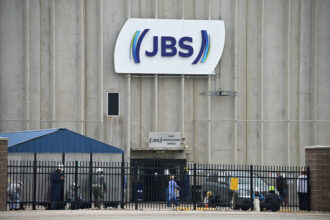
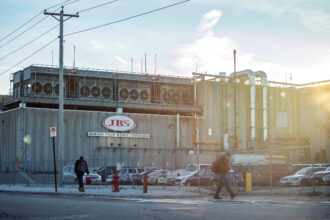
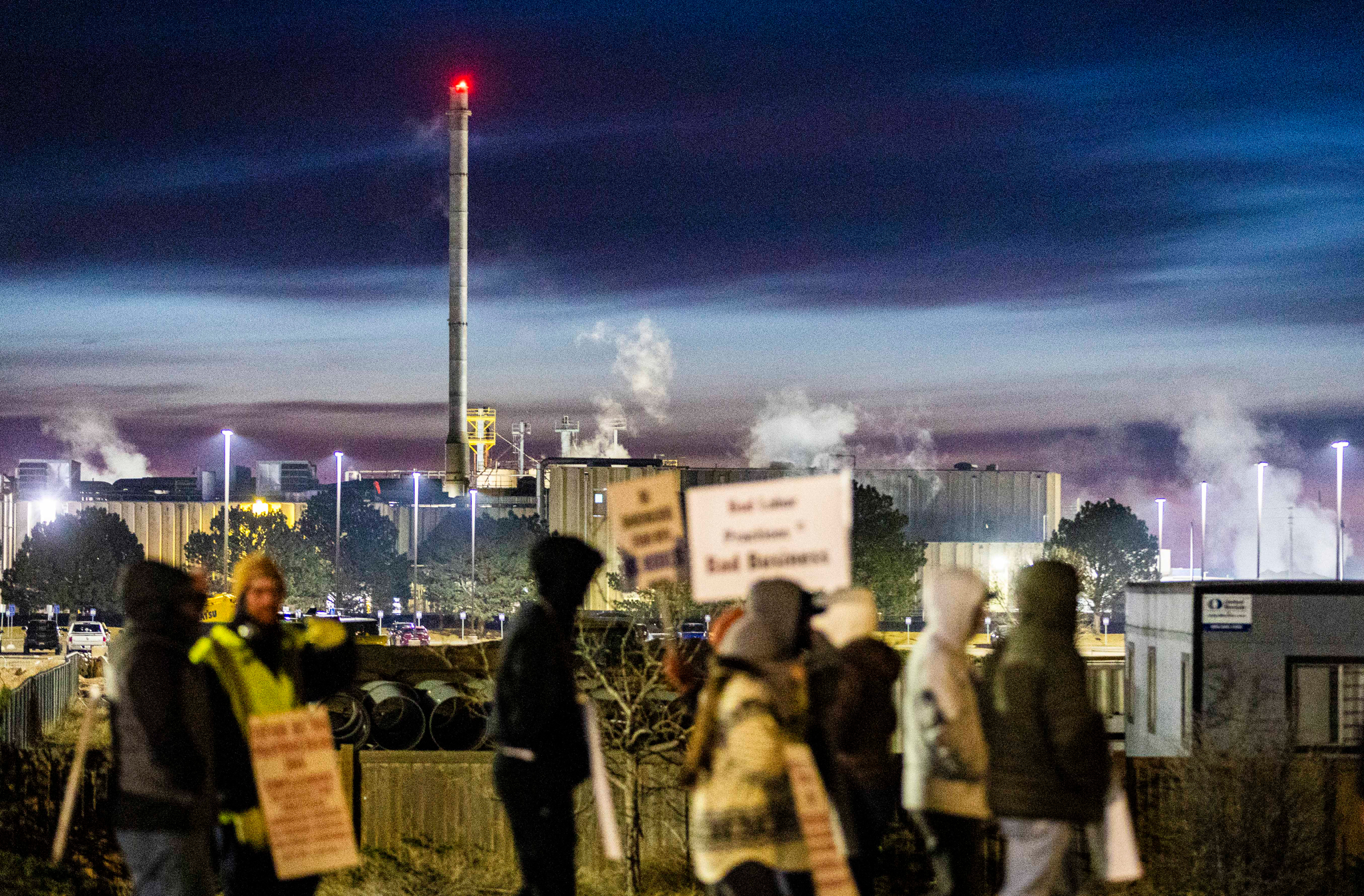
In March, workers at a JBS-owned slaughtering plant in Greeley, Colorado, walked out on strike to protest working conditions at the facility, one of the biggest in the country.
The UFCW, which represents 3,800 Greeley workers, said among its concerns was JBS’s insistence that workers slaughter more animals at higher speeds.
“While they’re speeding up line speeds, they’re trying to get as much work done in shorter hours,” said Kim Cordova, the president of the union in Colorado and Wyoming. “There’s not even enough crewing and engineers in our plant to support staffing for those lines.
“There were a lot of reasons for this strike,” Cordova added. “But we need advocates and real laws that have teeth and limits around line speeds. It’s both staffing and line speeds. Those are the really big issues.”
The walk-out was the first at a meat processor in 45 years. Most of the workers are immigrants, who risked exposing themselves to Trump’s immigration crackdown. But conditions inside the plant were so bad, they said, that they felt they had no choice but to take on their employer—the world’s largest meat company, with a track record of worker abuse and environmental damage.
JBS and the workers struck a deal, including an initial 70-cent per hour pay raise, in April.
JBS did not respond to questions from Inside Climate News.
Working conditions at the country’s slaughterhouses have seen little regulation or improvement in recent decades. The new proposals, critics say, will only make them more dangerous for both people and animals.
If the administration finalizes these proposals, it would deliver on a meat industry goal that surfaced during the first Trump administration, when, in 2019, the USDA granted waivers to processing plants that allowed them to speed up their slaughter lines.
The Greeley plant does not have a line speed waiver, but a lawsuit filed on behalf of plant workers in 2025 says it regularly exceeds its 390-head per hour regulator limit. Cordova confirmed that the plant is “running 420 or 430 an hour.”
Already, Winders said, the beef industry has started to contemplate increased line speed for beef slaughter. JBS subsidiary Pilgrim’s Pride was the single-biggest donor to President Donald Trump’s campaign, which critics say facilitated a controversial decision by the Securities and Exchange Commission to allow the company to list on the New York Stock Exchange after a decade of attempting to do so.
The political and regulatory environment favors a possible change in line speeds in cattle slaughterhouses, critics say.
“They’re experimenting with high speed cattle, too,” Winders said. “I think it’s just a matter of time before we see a similar proposal.”
Cordova, for one, would not be surprised.
“There’s a real reason there hasn’t been a strike in 45 years,” she said. “The industry has a lot of friends. Their political influence is broad because their pockets are so deep, so they do whatever they want.”
The USDA said it “has approved waivers at certain beef slaughter establishments in order to evaluate the potential for a new beef slaughter inspection system. These include waivers from certain regulatory requirements for inspection staffing, facilities requirements, handling of bruised parts, and sampling.”
The agency said it stopped considering beef slaughter waiver applications in January of this year.
About This Story
Perhaps you noticed: This story, like all the news we publish, is free to read. That’s because Inside Climate News is a 501c3 nonprofit organization. We do not charge a subscription fee, lock our news behind a paywall, or clutter our website with ads. We make our news on climate and the environment freely available to you and anyone who wants it.
That’s not all. We also share our news for free with scores of other media organizations around the country. Many of them can’t afford to do environmental journalism of their own. We’ve built bureaus from coast to coast to report local stories, collaborate with local newsrooms and co-publish articles so that this vital work is shared as widely as possible.
Two of us launched ICN in 2007. Six years later we earned a Pulitzer Prize for National Reporting, and now we run the oldest and largest dedicated climate newsroom in the nation. We tell the story in all its complexity. We hold polluters accountable. We expose environmental injustice. We debunk misinformation. We scrutinize solutions and inspire action.
Donations from readers like you fund every aspect of what we do. If you don’t already, will you support our ongoing work, our reporting on the biggest crisis facing our planet, and help us reach even more readers in more places?
Please take a moment to make a tax-deductible donation. Every one of them makes a difference.
Thank you,