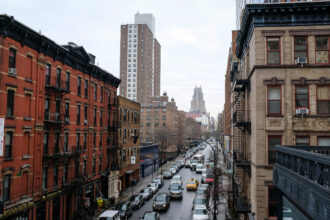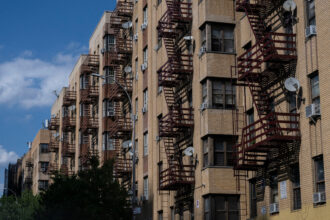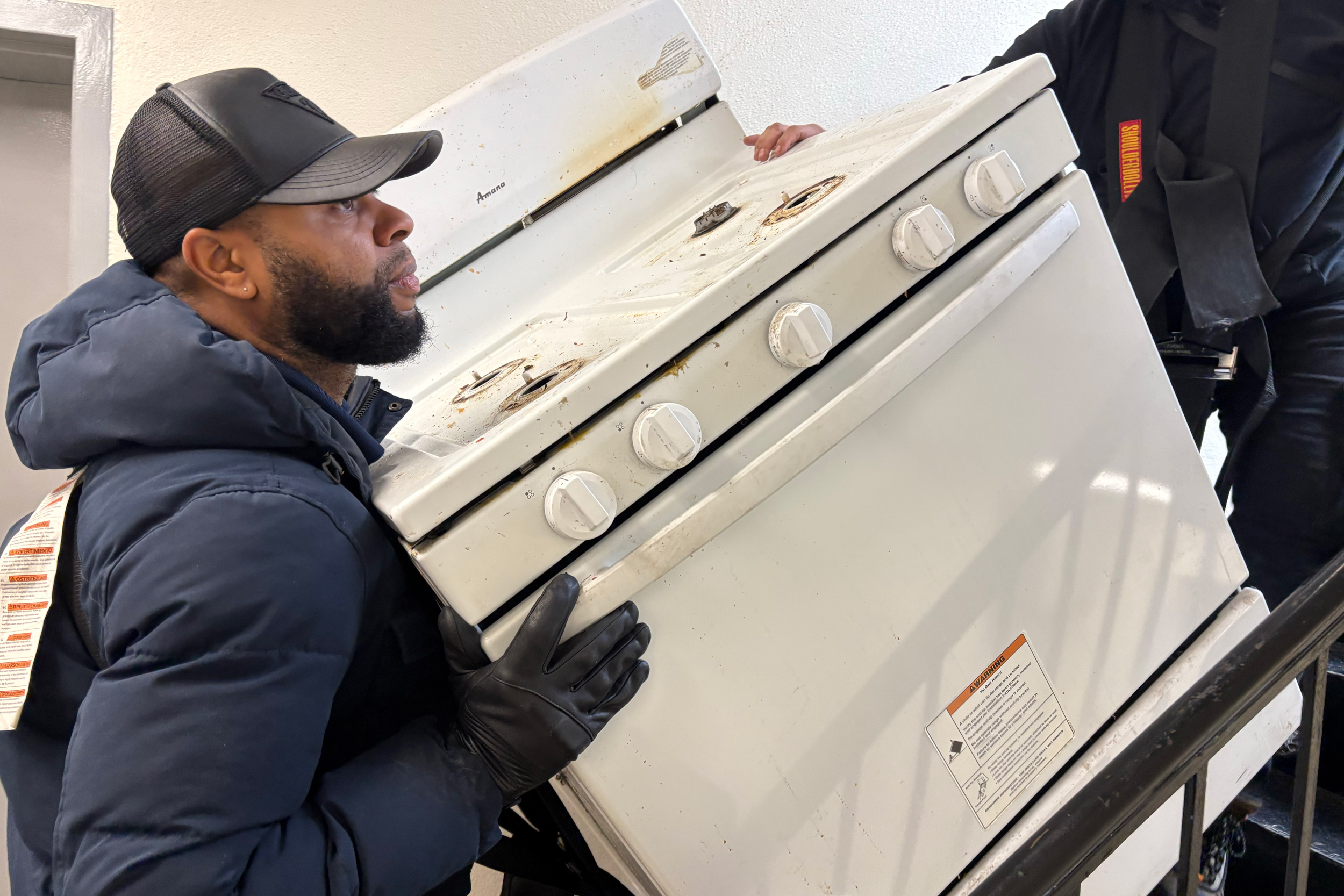


Facing each other, two appliance installers strapped a 350-pound stove to their bodies, with thick black cords wrapped around their backs to support it. One of the workers walked up the stairs backwards as they carefully maneuvered up the narrow staircase of a Bronx walk-up. Like many pre-World War II apartment buildings, it has no elevator.
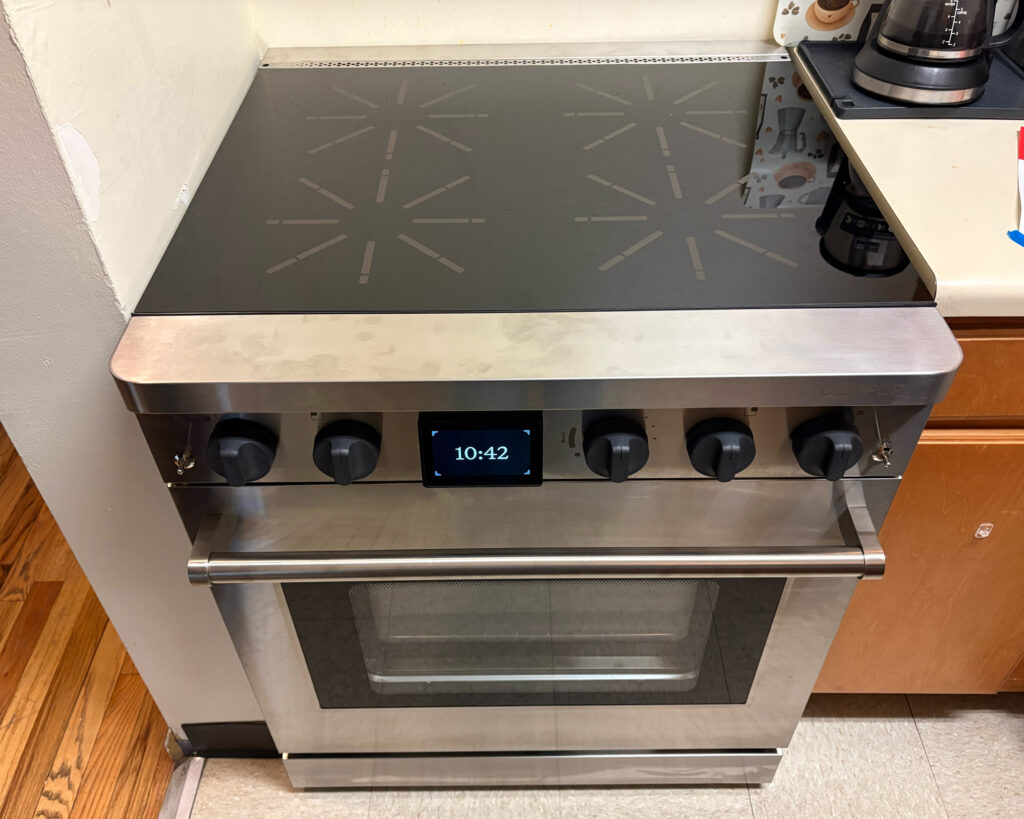
The fourth floor of the building on Seneca Avenue was buzzing with activity. SEBCO Development Inc., an affordable housing nonprofit, was updating each unit with a new induction stove, an appliance that uses electromagnetic waves to heat food. The stoves are often more efficient and are powered by electricity rather than natural gas.
It was the induction stove company’s first full-building installation in New York City—but it wouldn’t be its last.
Thousands of public housing apartments are slated to receive similar stoves as part of a $32 million commitment the state made to electrify cooking appliances. The program aims to improve indoor air quality and address gas outages in public housing.
In 2027, state agencies will conduct a performance review on 100 installed stoves, said a spokesperson for the New York Power Authority. If that goes well, similar stoves are slated for installation in 10,000 public housing apartments in the city over the following five years.
The appliance is equipped with four burners, an oven and a battery. In the event of a power outage, it would be able to provide enough power to cook around two full chickens or 150 cups of soup, said Joshua Land, the chief development officer for Copper, the company that manufactures the induction stoves.
This winter’s severe weather has caused several power outages in the city. Emilie Nelson, the chief operating officer of New York Independent System Operator, the agency that manages New York’s grid, has said the city could face blackouts as early as this summer due to rising demand.
Hunts Point, where the building is located, is surrounded by multiple highways and warehouses, which attract near-constant truck traffic.
The child hospitalization rates for asthma in Hunts Point are double the citywide average, and residents are considered part of an environmental justice community—a group that has historically been overburdened with environmental issues, often due to past disinvestment.
Studies suggest that replacing a gas stove with an electric one can meaningfully reduce nitrogen dioxide levels in a home—a pollutant that contributes to respiratory illnesses such as asthma. A 2025 study found that gas stoves can account for more than half of Americans’ exposure to the pollutant.
Most residential buildings in cities use natural gas to heat homes and cook food. Burning this fuel releases methane, a potent greenhouse gas. Many of the city’s gas mains are more than 50 years old and are leaky in many places, sometimes forcing buildings to undergo extensive gas shutoffs. New York City’s Local Law 97 mandates a reduction in greenhouse gas emissions for city buildings. Over the next few decades, the law’s goal is to require property owners to switch from gas to electric heating and cooking appliances.
The Seneca Avenue building is ahead of the curve. The Association for Energy Affordability, a nonprofit that works to make existing buildings more energy-efficient, has electrified the building’s heating system by replacing its radiators with heat pumps. Apartment windows have also been upgraded to reduce hot and cool air leakage, insulating the unit from outside temperatures.
Despite federal, state and city incentives, the cost of electrification has been a common complaint across the city, especially in co-operative housing and condominium buildings.
A common expense is rewiring a building to handle the increased electrical load from heating and cooking devices. But increasingly, companies are developing appliances that can plug into standard wall outlets, which are designed for around 120 volts of electricity.
The induction stove connects to these outlets—that’s why it has a battery, so, when needed, it can draw more energy than the building’s electrical system allows. This was a requirement for installation in public housing apartments.
The “Clean Heat For All” challenge, another state initiative that provides new heat pumps for public housing units, also requires that they plug into normal outlets.
The appliances will operate essentially like window air conditioners—but they will provide both heating and cooling. The heat pumps are designed to avoid large spikes in energy use when they turn on. Instead, they run more continuously, adjusting the room temperature over time.
Over time, concerns have cropped up that the grid will struggle to handle the rising energy demands of widespread electrification. If buildings install more efficient technologies, that puts less pressure on the grid, reducing the investment needed to accommodate electrification, said Jonathan Buonocore, an assistant professor of public health at Boston University who studies energy policy.
“You can’t put a wind farm somewhere and … a heat pump somewhere else, and call it a day,” he said. “You need to have the transmission lines, the substations and all the things that are needed to make the electrical system work.”
About This Story
Perhaps you noticed: This story, like all the news we publish, is free to read. That’s because Inside Climate News is a 501c3 nonprofit organization. We do not charge a subscription fee, lock our news behind a paywall, or clutter our website with ads. We make our news on climate and the environment freely available to you and anyone who wants it.
That’s not all. We also share our news for free with scores of other media organizations around the country. Many of them can’t afford to do environmental journalism of their own. We’ve built bureaus from coast to coast to report local stories, collaborate with local newsrooms and co-publish articles so that this vital work is shared as widely as possible.
Two of us launched ICN in 2007. Six years later we earned a Pulitzer Prize for National Reporting, and now we run the oldest and largest dedicated climate newsroom in the nation. We tell the story in all its complexity. We hold polluters accountable. We expose environmental injustice. We debunk misinformation. We scrutinize solutions and inspire action.
Donations from readers like you fund every aspect of what we do. If you don’t already, will you support our ongoing work, our reporting on the biggest crisis facing our planet, and help us reach even more readers in more places?
Please take a moment to make a tax-deductible donation. Every one of them makes a difference.
Thank you,

Lauren Dalban
Reporter, New York City
Lauren Dalban is a New York City-based reporter with a background in local journalism. A former ICN fellow, she now covers environmental issues in all five boroughs. Originally from London, she earned a B.A. in History and English from the University of Virginia, and an M.S. from Columbia Graduate School of Journalism.