


MAIKIUANTS, Ecuador—By the time Olger Kitiar reached the ridge, his shirt was wet with sweat, clinging to his back. Built with the solid frame of a linebacker, he moved through the rainforest with a quick, even rhythm that defied the steep, slick climb.
Then he froze.
“Stop,” he hissed in Spanish, his hand snapping up.
Jhostin Antún, a few steps behind, halted mid-stride. To an outsider, the trail ahead looked like any other patch of churned Amazonian mud—slick, brown and dense enough to swallow a boot. But Olger’s eyes, trained by a lifetime in the Shuar territory of Maikiuants, saw it instantly. He squatted down, pointing to a deep, four-toed indentation. The track was fresh. And massive.
“Jaguar,” he whispered, a grin spreading across his face.
The print belonged to a cat bigger than the female they’d recorded on a camera trap in October, one month earlier. The men photographed the imprint carefully, not as a memento, but for legal evidence.
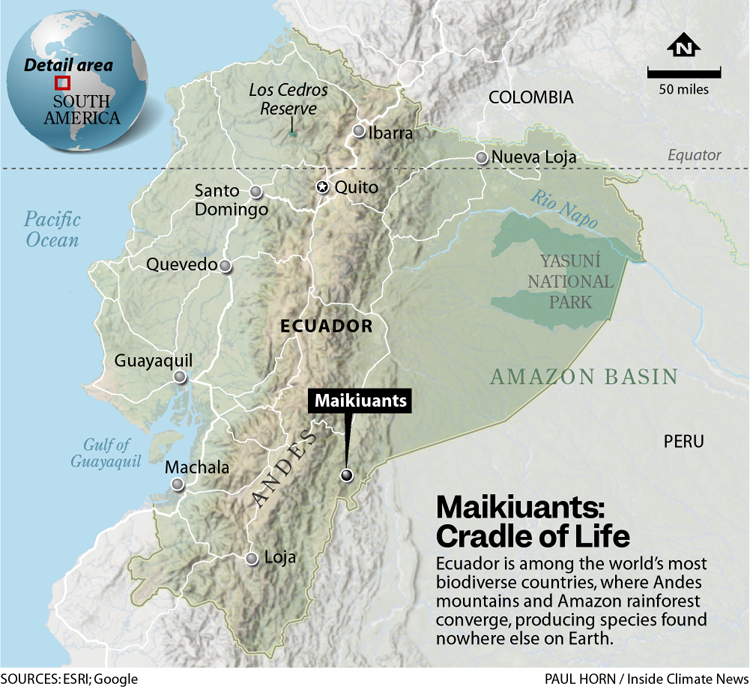
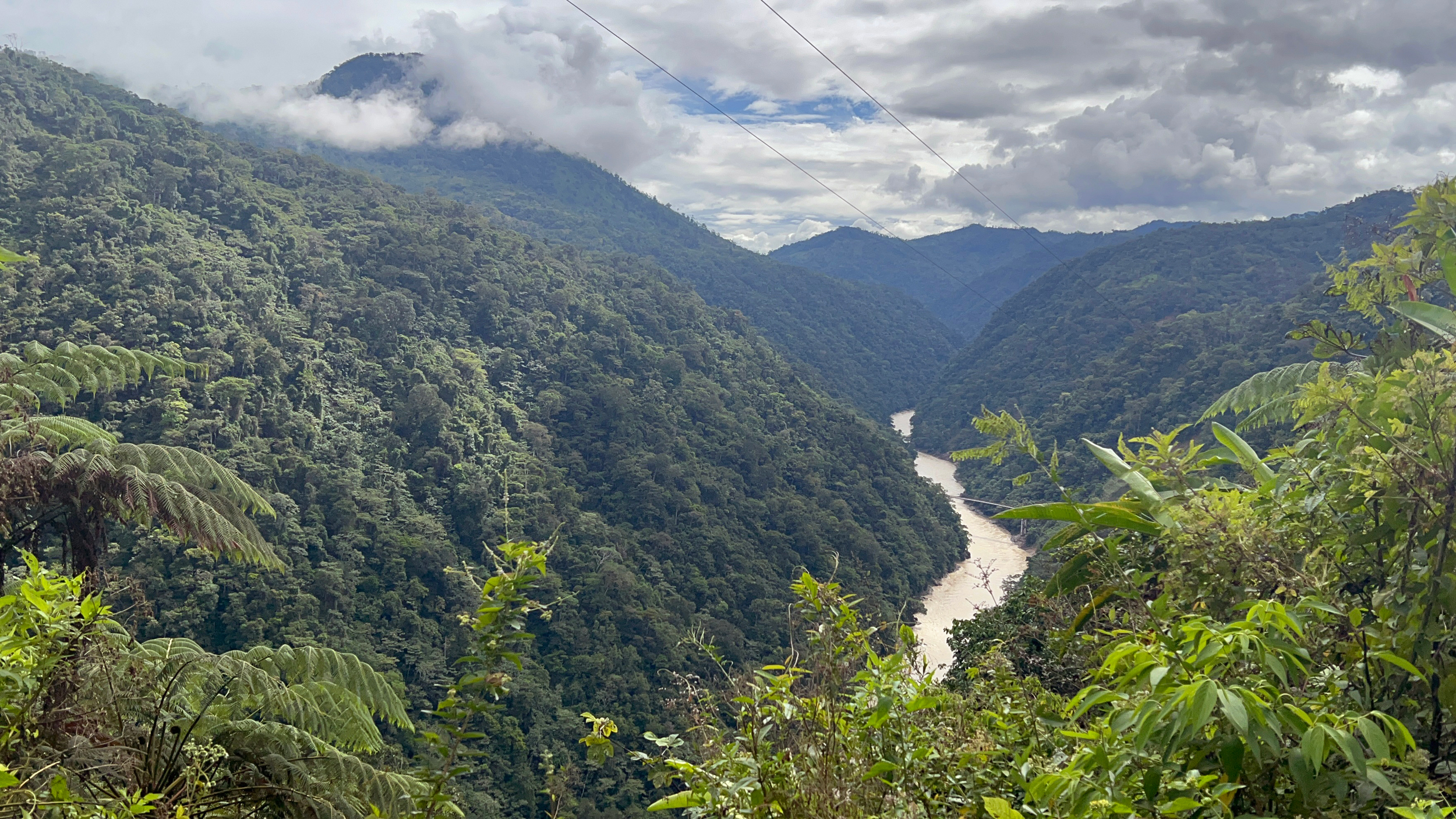
Maikiuants, perched high in Ecuador’s southeastern Amazon highlands near the Peruvian border, sits atop copper-rich ground now claimed by Solaris Resources, a Canadian mining company seeking to gash an open-pit mine into these mountains. If extraction moves forward, the forest Jhostin and Olger were walking through—home to endangered species, waterfalls, medicinal plants, generations of Indigenous knowledge and undiscovered beings—could be permanently altered.
The jaguar’s presence here holds weight as a matter of law. In Ecuador, endangered species—and nature more broadly—have legal rights. The government must clear a far higher bar than under conventional laws before approving projects like large-scale mining.
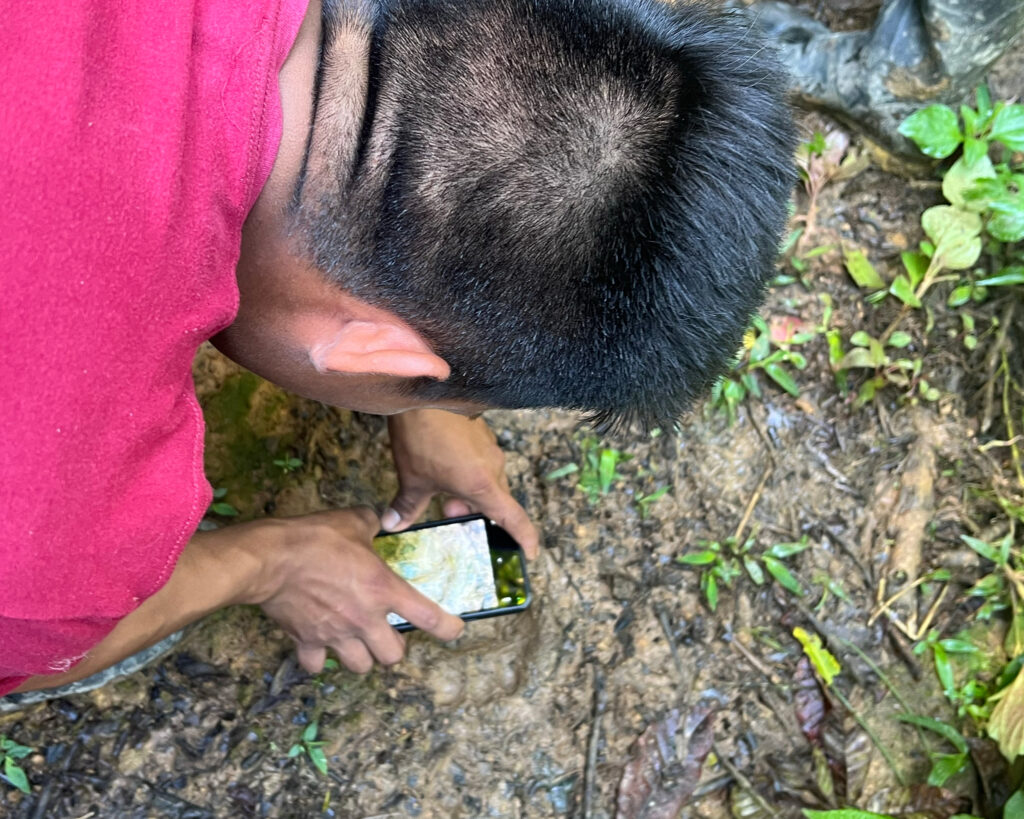
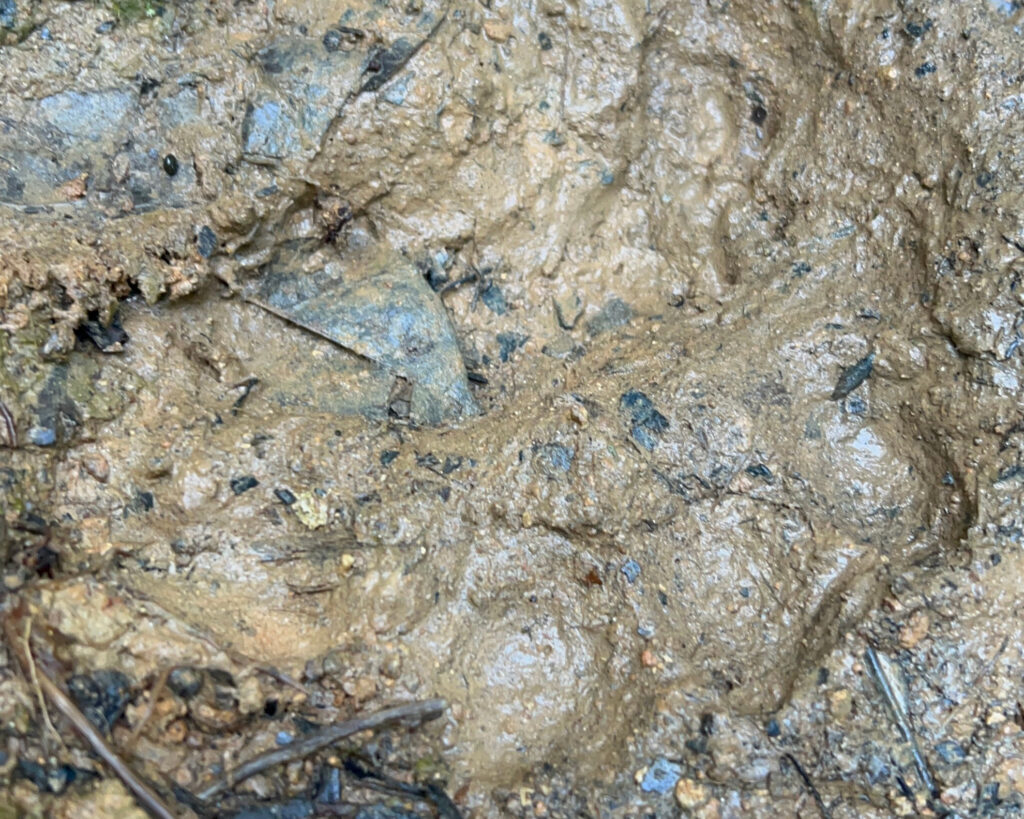
Jhostin Antún snaps photos of a large jaguar track imprinted in the mud on a rainforest trail in the Ecuadorian Amazon on Nov. 29, 2025.
Jhostin and Olger are paraecologists, people who document life in their homelands using generations of ecological expertise and scientific methods. They work with Ecoforensic, a nonprofit that trains paraecologists—paramedics for ecosystems—to document how ecosystems function and how they are harmed. Ecoforensic works in places in Ecuador like Maikiuants: biodiverse regions where scientific data is thin or nonexistent.
The data paraecologists collect, such as species inventories and water samples, is then translated into evidence that carries weight in courts. Increasingly, it’s winning cases.
In 2023, in Ecuador’s Intag Valley, community paraecologists helped halt a proposed mega copper mine by documenting threats to endangered species that the company’s environmental studies had failed to account for. The ruling hinged on Ecuador’s “rights of nature” laws, enshrined in the country’s constitution in 2008.
Those laws rewrote the legal status of ecosystems, transforming them from property or objects—like a car or a microwave—into living subjects with rights to exist, regenerate and maintain their vital cycles. Since then, courts have repeatedly applied those rights, siding with forests, rivers, marine ecosystems and wild animals, and thwarting large-scale extractive activities that judges found would harm them irreversibly.
But like any right, nature’s rights are not absolute.
Ecuador, among the world’s most biologically diverse countries, also holds enormous reserves of oil, copper, gold and other minerals. Global markets want them. Multinational companies are itching to dig. And a cash-strapped government is eager to sell. The legal battles are intensifying.
Ecoforensic is helping to prove that the rights of nature can go toe to toe with those forces. The work now underway in Maikiuants may be its most consequential effort yet.
For Jhostin, Olger and the rest of Maikiuants’ 480 residents, the outcome is existential. Protecting their territory, Jhostin explained, is inseparable from protecting their own lives—they are nature protecting nature. If the forest is destroyed, so are the people who live within it.
Their people did not migrate to this region. They are from here. Every generation before them was born on this land, a continuity that Jhostin, 21, says his grandparents impressed upon him as a responsibility. His elders’ message was simple and unambiguous: This place must be defended.
Now, that duty rests with him.
That’s why the two paraecologists step carefully around the jaguar’s tracks and continue climbing toward a camera trap tucked deep inside their forest. The device has been silently recording for weeks and they are eager to see what it captured.
Thousands of Mining Concessions
Days earlier, a white pickup truck had wound down the Amazonian mountainside above Maikiuants, its wiper blades squeaking as they swept away the rain.
Inside, British ecologist Mika Peck tapped the brakes, peering through the windshield as dense fog closed in. His wife, Inde Kaur Hundal, squeezed the bar above her seat, bracing against a pothole the size of a bathtub. The co-founders of Ecoforensic were on their way to deliver good news: The organization will establish a permanent research station in Maikiuants.
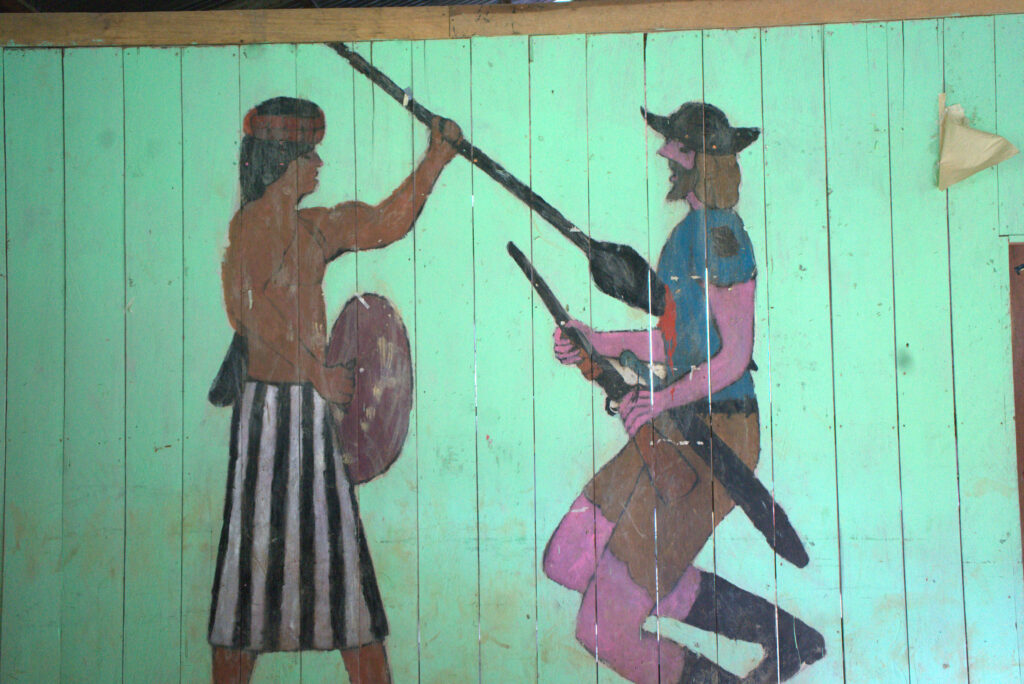
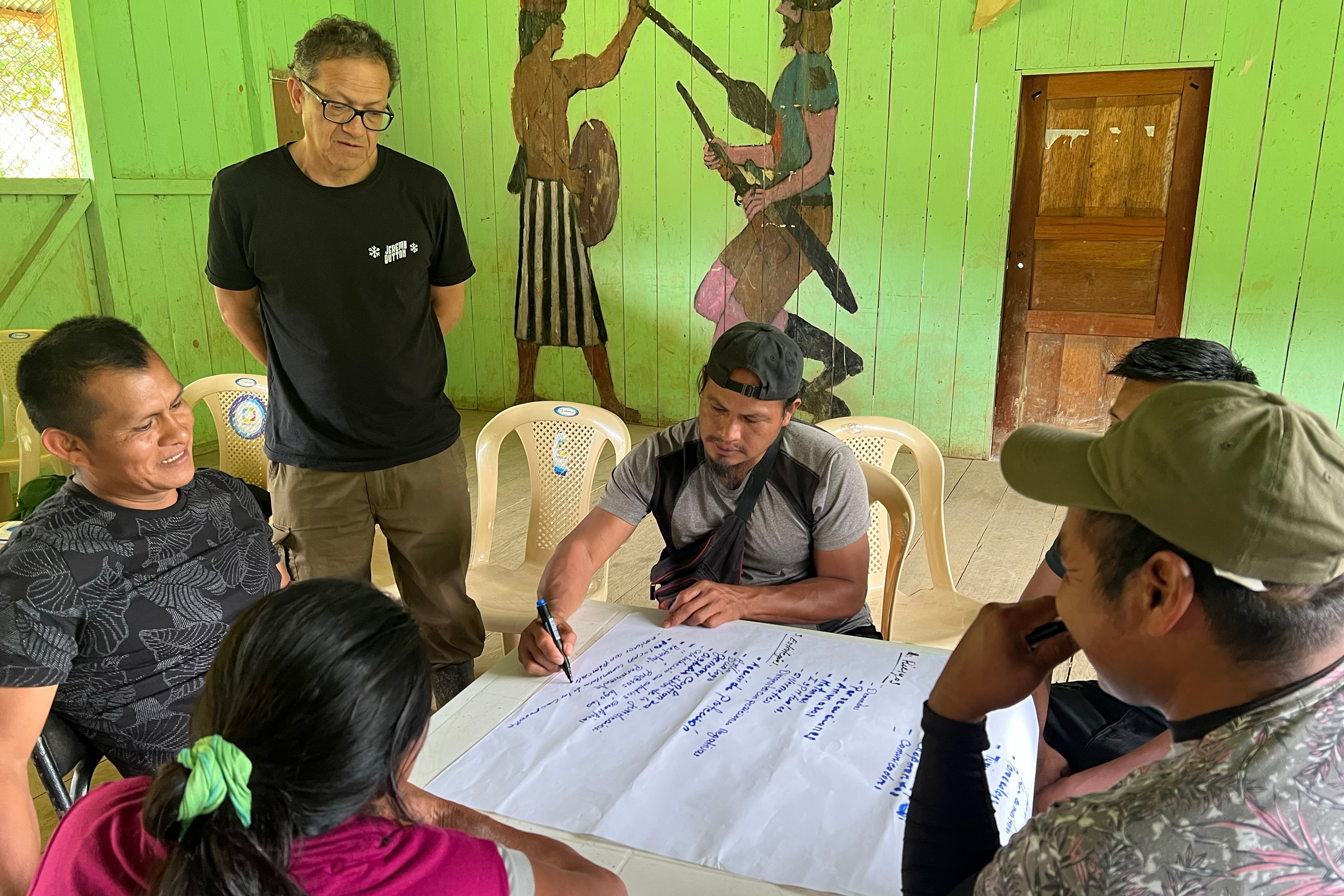
It had been two years since they first sat down with residents there to talk about Ecoforensic. They had met in a wooden community center featuring a mural of a Shuar warrior spearing a colonist. For over an hour, the community had grilled the couple. They wanted to know what Ecoforensic would do with the data paraecologists produced—and whether Peck and Hundal were just more outsiders there to extract knowledge, then disappear with it.
Most of all, they wanted to know how Ecoforensic could help protect their territory.
The Ecuadorian government had been carving up Shuar territory into mining concessions since the 1990s, but the threat had been confined to maps and paperwork until 2019. That was when Solaris Resources acquired the Warintza Project. Since then, the company’s mineral exploration subsidiary has been a constant presence, scouring the region for copper and gold while attempting to win over a handful of nearby Shuar communities that would be displaced or otherwise impacted, their ancestral mountains blown up.
Maikiuants was a wall of resistance. But communities facing extractive giants fight an almost impossible battle, with financial, political and legal power stacked against them. In Ecuador’s Amazon, that’s been the story of oil for decades. Now, mining is the new frontier.
Ecuador’s rights of nature laws offer communities a fresh and powerful legal foothold, but winning court cases requires rigorous ecological proof. That was the gap Ecoforensic was built to fill, Peck told Maikiuants’ residents during that first meeting.
Peck and Hundal were inspired by a landmark 2021 rights of nature ruling by Ecuador’s highest court, a case that defined how nature’s rights in Ecuador could be enforced. The decision centered on Los Cedros, a protected cloud forest.
The government granted a Canadian company a mining concession in 2016 covering more than half of the forest, despite its protected status. Local residents and scientists challenged the decision using decades of ecological research.
Some of that evidence came from Peck’s own work. Through a paraecologist project he launched in 2005, local researchers documented critically endangered brown-headed spider monkeys in the region. That effort formed part of a broader scientific record showing that more than 240 near-threatened, vulnerable, endangered or critically endangered species lived in Los Cedros—many absent from the company’s environmental impact studies used to justify its operations.
That body of evidence proved decisive. In siding with the forest, the court found that mining would threaten Los Cedros’ biological integrity and disrupt evolutionary processes unfolding over billions of years.
Peck, typically stoic, cried with joy when he learned that Los Cedros had prevailed in late 2021. Then he, Hundal and their Ecuadorian colleagues went to work.
Los Cedros had benefited from a dedicated scientific research station. But vast swaths of Ecuador are, scientifically speaking, a black box—and they are also threatened by mining.
Peck did the math: The Ecuadorian government had granted nearly 8,000 mining concessions as of 2021. Roughly 30 percent of those overlapped with protected areas, and 20 percent overlapped with Indigenous territories. The most impacted are the Shuar.
The need to proactively document Maikiuants’ ecosystems, Peck told the community in their 2023 meeting, was “urgent.”
“When the Threats Come”
On their first morning back in Maikiuants in late November, Peck and Hundal woke to the faint scent of woodsmoke in the cool air. Outside their tent, green peaks rose skyward, shrouded with forest and clouds, making the village feel held by the landscape itself.
Today, Peck’s work centers on the web of relationships that bind this place together—water and soil, fish and forest, and the people who depend on them. But early in his career, he was trained to see the world in fragments. He studied aquatic systems in isolation, looking at “safe” levels of contaminants in water, an approach that mirrors how conventional environmental law regulates pollution.
But the more time he spent measuring thresholds, the more uneasy he became with the premise itself. The idea that ecosystems could absorb endless damage as long as it stayed below a regulatory line struck him as a fundamental misunderstanding of how living systems work. Nature is all about relationships.
Peck, with close-cropped graying hair and a sinewy frame, tries to live that way too. Colleagues describe him as a rare mix of intellectual rigor and emotional intelligence—someone who listens as carefully as he measures. He instinctively looks to the communities embedded in the ecosystems he studies, a perspective that runs against conservation’s prevailing top-down approach. Real change, he believes, emerges from the grassroots.
Ecuador’s rights of nature laws took shape in much the same way, emerging from Indigenous communities who brought their legal traditions to the state and demanded recognition.
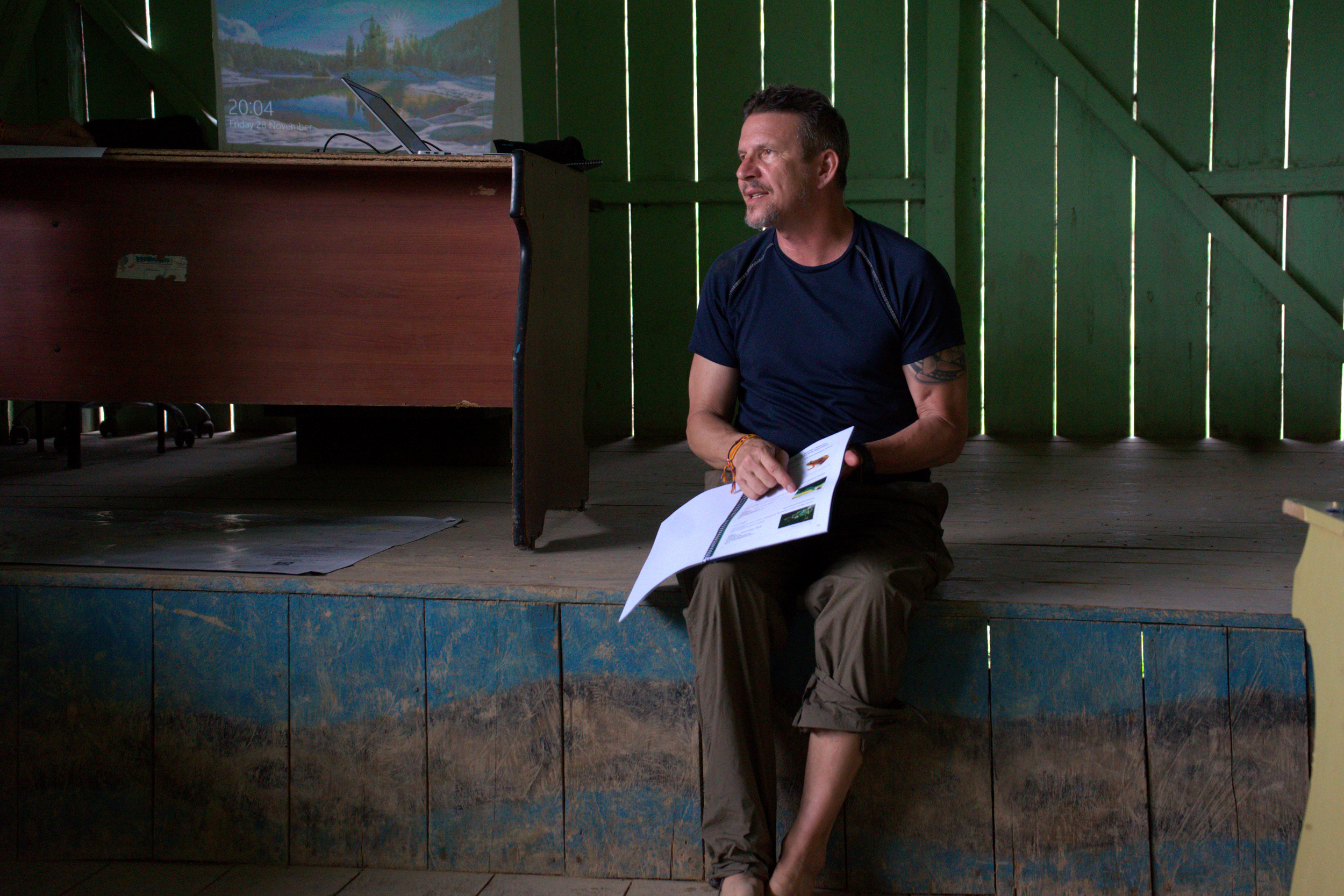
Now, a barefoot Peck, one pant leg slightly rolled up, stepped again to the front of the community center, where about 45 Shuar sat in a semi-circle. This time, the mood was light. Peck was no longer an outsider, but a trusted scientific ally.
The first order of business was brainstorming. What should the research station look like? Where should it be built? And what are residents concerned about?
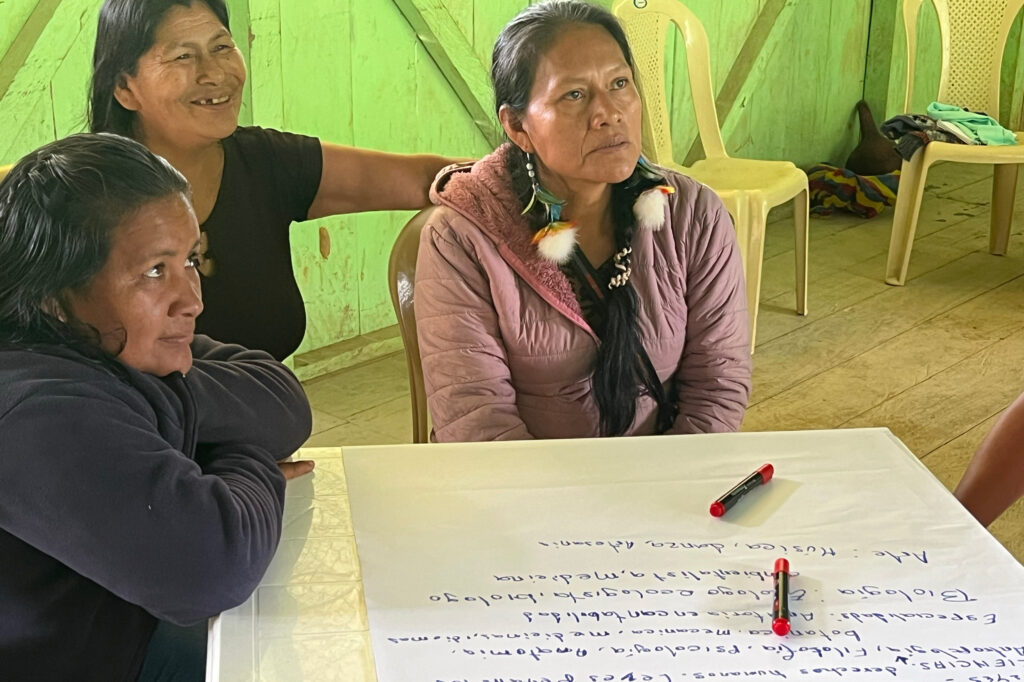
They broke into small groups, scrawling ideas with magic markers across long sheets of paper. Ángel Nantip, 63, a muscular community elder with a direct and unflinching gaze, spoke first. Nantip remembers when mining engineers and the Ecuadorian military first arrived in the 1990s to prospect for metals. They told him nothing bad would happen to the territory or the spiritual beings that live within it, he said. Only later did he learn how destructive the planned open-pit mine would be—and that it would sever the relationships among communities.
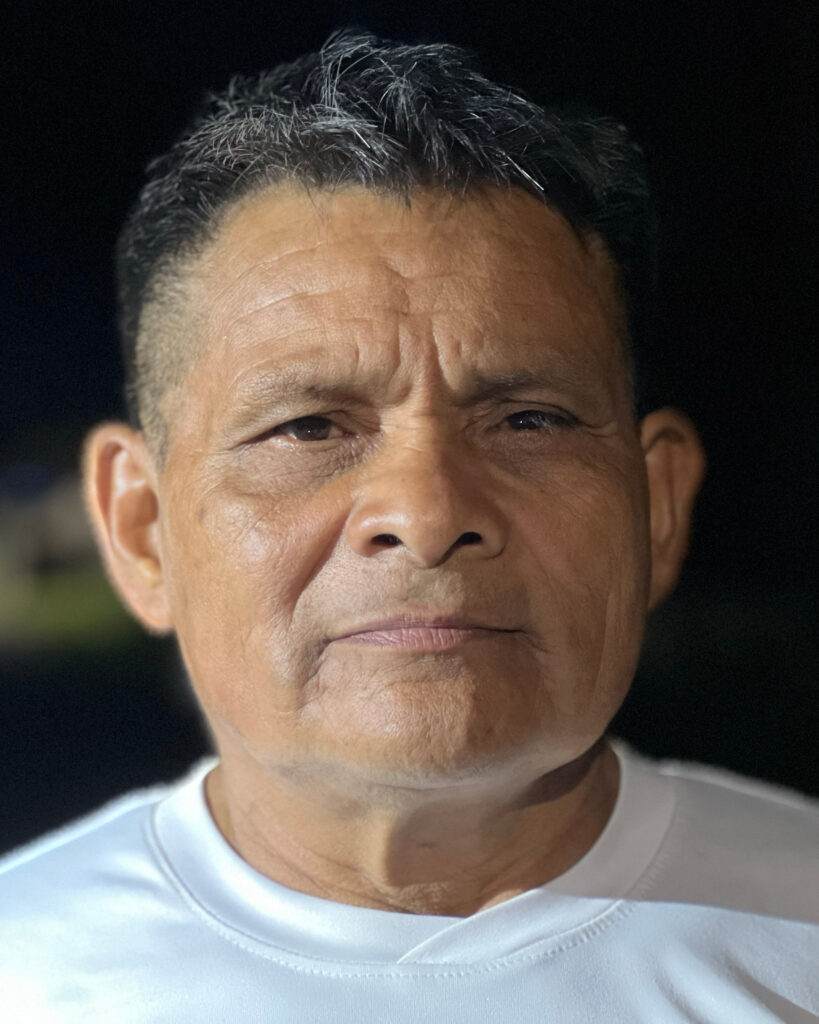
Before anything else, Nantip told the group, the community needed a way to protect its environmental defenders.
“We need an alert system when the threats come,” he said, his angular face tightening.
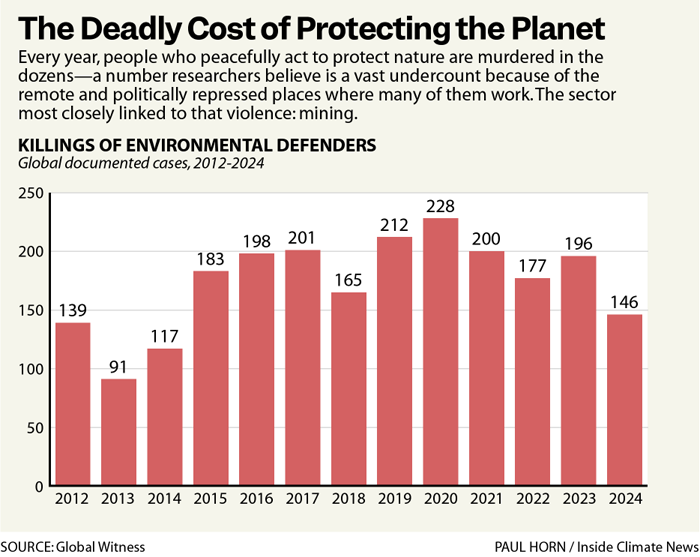
Peck wasn’t surprised when others raised the same concern. Each week, an average of three environmental defenders—people who peacefully protect ecosystems—are killed around the world, a number widely believed to be an undercount given the remote and politically repressed places where many of them work. The sector most closely linked to that violence: mining. Maikiuants was not immune.
Since Solaris arrived, the largely tranquil region had grown tense, driven by what leaders describe as a “divide and conquer” tactic. Mining companies secure the backing of certain communities or leaders with financial incentives, often filling gaps left by the state—access to schools, health clinics or basic infrastructure. Maikiuants’ school, for instance, has one teacher for about 45 students spanning all grade levels. Two nearby Shuar communities and an umbrella Shuar organization entered into various cooperation agreements with Solaris, the contents of which are confidential.
“As independent and legally recognized communities, we have the right to seek a better quality of life for the people of our community, where our children can study, our elderly can work, and we can have access to widespread healthcare that we have never had before,” the pro-mining communities said in a court filing about their relationship with Solaris. A spokesperson for those communities did not respond to a request for comment on this story.
Though the project has advanced without the consent of all impacted Indigenous groups, Solaris has likewise framed it as community-driven.
“At Solaris Resources, we believe that sustainable mining is not just an economic endeavour; it is a journey that must include the insights and values of every stakeholder involved, especially our indigenous populations,” said company president and CEO Matthew Rowlinson in a written statement on Solaris’ website. “Their lived experiences and deep connection to the land are vital to shaping responsible mining practices.”
Solaris did not respond to multiple requests for an interview, nor did it respond to a list of questions about the project, including its impact on local communities.
On the ground, the divisions sown by the company’s presence are stark. It’s turned neighboring villages into adversaries, with pro- and anti-mining communities’ disputes with one another spilling into court battles, military deployments and threats.
In 2022, members of the two pro-mining communities filed a criminal complaint against three Maikiuants residents, including Nancy Antún, a leader of the Maikiuants women, alleging they planned an attack on a mining camp in the region. All three fiercely denied the allegation. Antún said people from pro-mining communities have themselves made multiple threats against her, including that they will burn her house down while her children are inside.
Another prominent Shuar leader said she received a death threat from a Solaris executive—an allegation the company denies. Amidst the turmoil, the government deployed military forces to protect the concession, including on Maikiuants’ territory, which Ecuador’s Constitution recognizes as self-governing. In response, community guards detained several soldiers and now face criminal charges.
Similar disputes elsewhere in Ecuador have escalated into violence. In recent years, Indigenous leaders who opposed extractive projects—including A’i Cofán leader Eduardo Mendúa and Shuar leader José Isidro Tendetza Antún, a relative of multiple Maikiuants residents—have been killed, cases that rights groups say underscore the risks faced by environmental defenders in the region.
Back in the community center, as the morning meeting ended, the path forward was clear—and fraught. In Maikiuants, building the evidence needed to defend the forest carries risks. There would be no separating the science from the struggle.
The Monkey’s Axe
In many ways, Ecoforensic shouldered the work the Ecuadorian government was meant to do: protect its people, uphold the constitution and ensure companies followed the law. Instead, successive administrations deployed the military to suppress protests over pollution, shielded foreign firms from liability for massive toxic dumping and weakened civil society’s ability to resist.
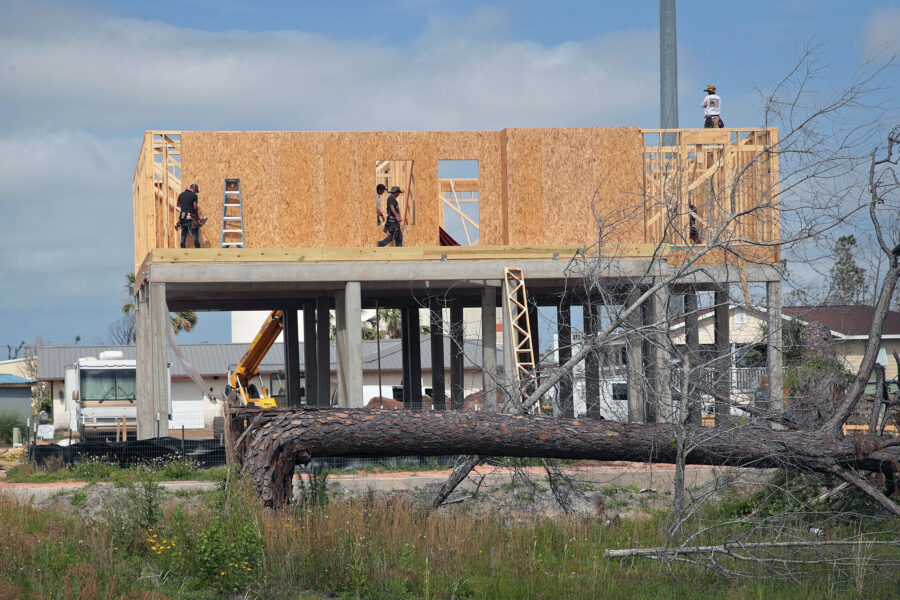
Under President Daniel Noboa, an ally of U.S. President Donald Trump, those pressures intensified. In recent months, his administration froze the bank accounts of prominent Indigenous leaders and environmentalists—including one belonging to a lawyer for Maikiuants —while dismantling the environment ministry and imposing sweeping restrictions on nongovernmental organizations.
The crackdown has made coalitions essential. Communities, lawyers and scientists are banding together as they push back against Noboa’s drive to accelerate mining and oil extraction.
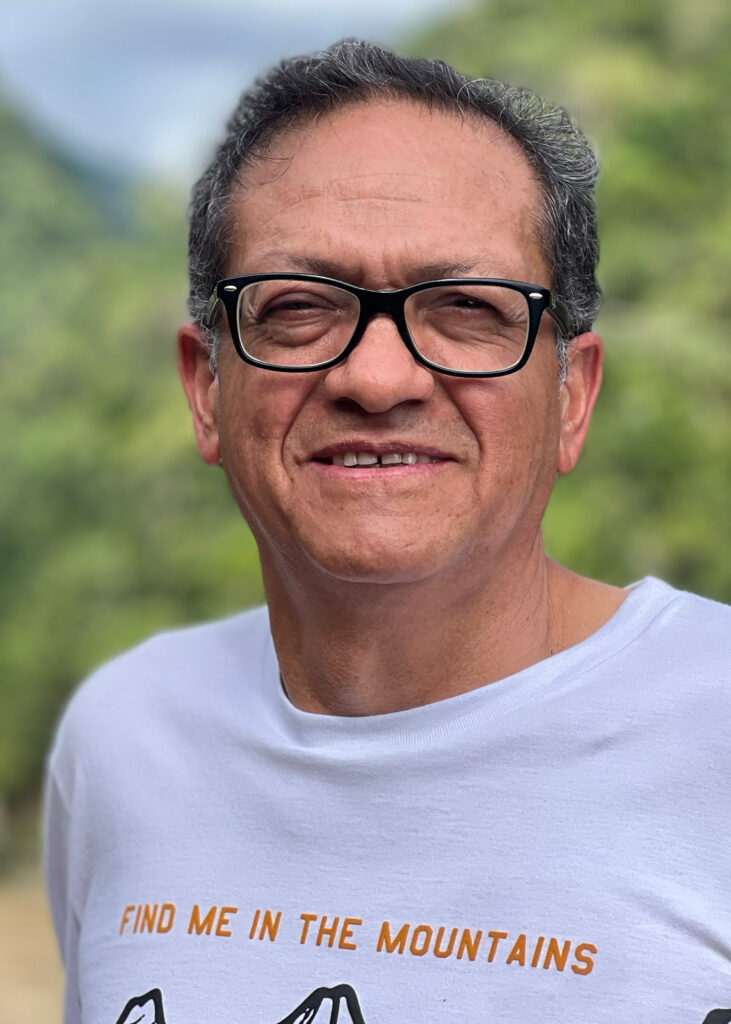
Now, as the afternoon meeting got underway, Peck invited an aquatic ecologist to the front of the room: Edwin Zárate, a lanky, soft-spoken biology professor at the University of Azuay in Cuenca. In Maikiuants, Zárate was quietly helping to build the scientific record of how the territory works as a living system—supporting paraecologists, establishing an agro-ecology program and setting up a meteorological station to track the climate in real time.
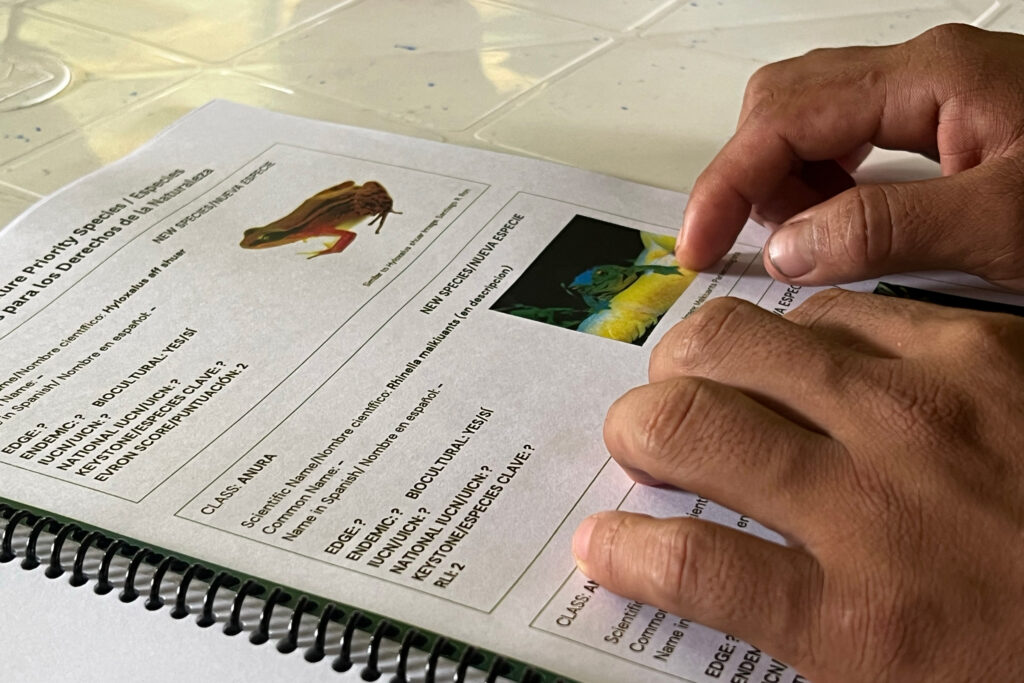
Peck moved through the room, handing out spiral-bound packets thick with color photographs—frogs no larger than a thumb, fish flecked with purple and green, each image paired with a short description.
“These are the species paraecologists have documented so far,” Peck said, as pages rustled open. “And they’re discovering more.”
“Every time we do new studies, we find new species,” Zárate added. Some, he said, were unknown to science—like the one paraecologists had recently found, a frog with skin as dark as night, speckled with iridescent blue dots, like a tiny galaxy.
Maikiuants, Zárate explained, sits in the rugged transition zone where the high Andes meets the tropical lowlands. It is a landscape defined by ancient upheaval: millions of years ago, colliding tectonic plates forced the Pacific seabed upwards. Each ridge and fold created its own microclimate, isolating species in narrow ecological niches. Here, extinction can come suddenly. Destroy a single slope, he said, and an entire evolutionary lineage can disappear with it.
That fragility has legal implications. Ecuador’s Constitution gives special protection to species with unique evolutionary paths—those that exist nowhere else on Earth, representing a “one-of-a-kind” branch on the tree of life.
“Some species are more important for rights of nature cases than others,” Peck said. “Those at risk of extinction are very important—and species that exist only here.”
He turned next to keystone species, animals whose influence ripples through entire ecosystems. Jaguars, for instance, regulate prey populations, shape plant growth and feed scavengers through their kills. When keystone species disappear, food webs unravel. “The future of other species depends on them,” Peck said.
“The condor is another,” Zárate added. With wingspans stretching up to 12 feet, Andean condors are among the largest flying birds in the world. They are critically endangered in Ecuador, with fewer than 150 remaining, largely due to poaching and agricultural expansion. As scavengers, they play a vital role in disease control. A rapidly emerging threat: habitat loss from mining.
“Every time we do new studies, we find new species.”
— Edwin Zárate, University of Azuay biology professor
The information in the packets, Peck and Zárate explained, could give the landscape a voice, grounding nature’s constitutional rights in ecological data.
Using a small projector powered by a cable threaded through a gap in the wall, Peck cast a diagram of Ecuador’s rights-of-nature framework onto a poster affixed backward to the wall as a makeshift screen. The government’s duty to prevent species extinction appeared on an infographic, circled in red, adjacent to other constitutional guarantees.
Peck pointed to the protections for biocultural heritage—the inseparable ties between communities and the plants and animals they live with. That was something science alone couldn’t document.
“We need your stories,” he told the room. “Which species matter most to you? Why?”
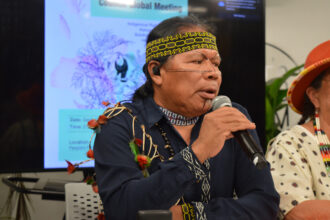
The room erupted into conversation. Lead paraecologist Claudio Ankuash Nantip, who goes by Pinchu, pointed to a photograph of a capuchin monkey.
“When people die, they don’t disappear,” he said. “They return as animals.”
Those who lived badly might come back as creatures of fear. Others return as protectors.
“Like the monkey,” he said.
Nearly a century ago, Pinchu said, a demon terrorized the community with an axe, killing people. It was the monkey who defeated it, burying the axe deep inside a mountain.
Elders once saw the species often. Now it is almost gone. Paraecologists have so far been unable to document it.
“Now,” Pinchu said, “the company wants to dig the axe up.”
Dreams of a Father
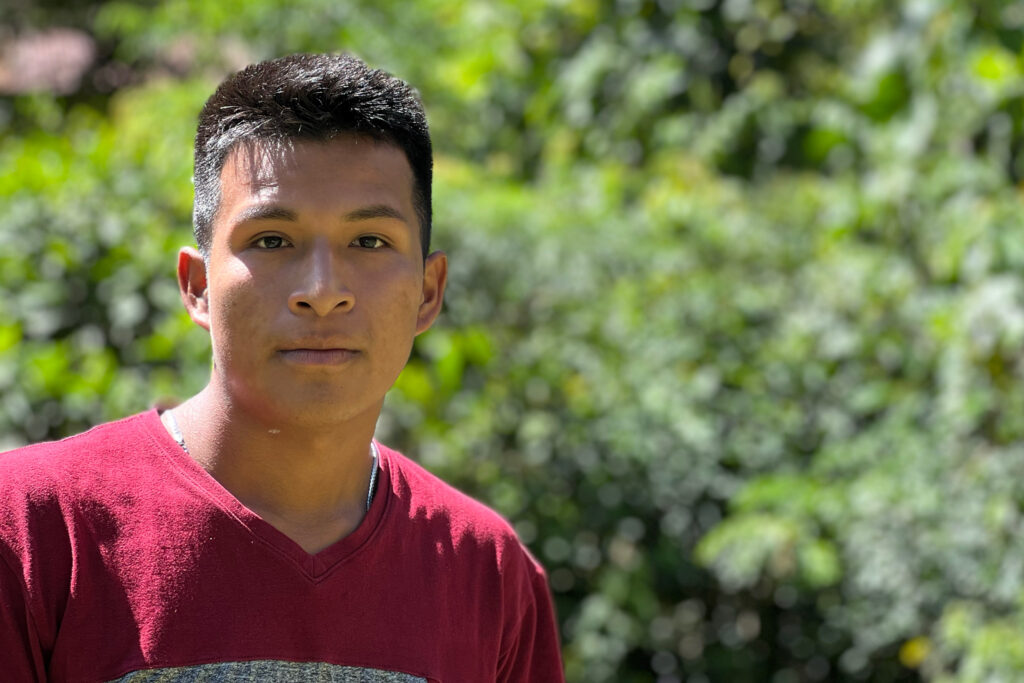
The next morning, Peck, Hundal and Zárate pulled on knee-high rubber boots and tried to keep pace with a group of Shuar heading into the forest to scout sites for the research station. The group was led by Jorge Antún, 60, a lifelong resident of Maikiuants and the father of paraecologist Jhostin Antún.
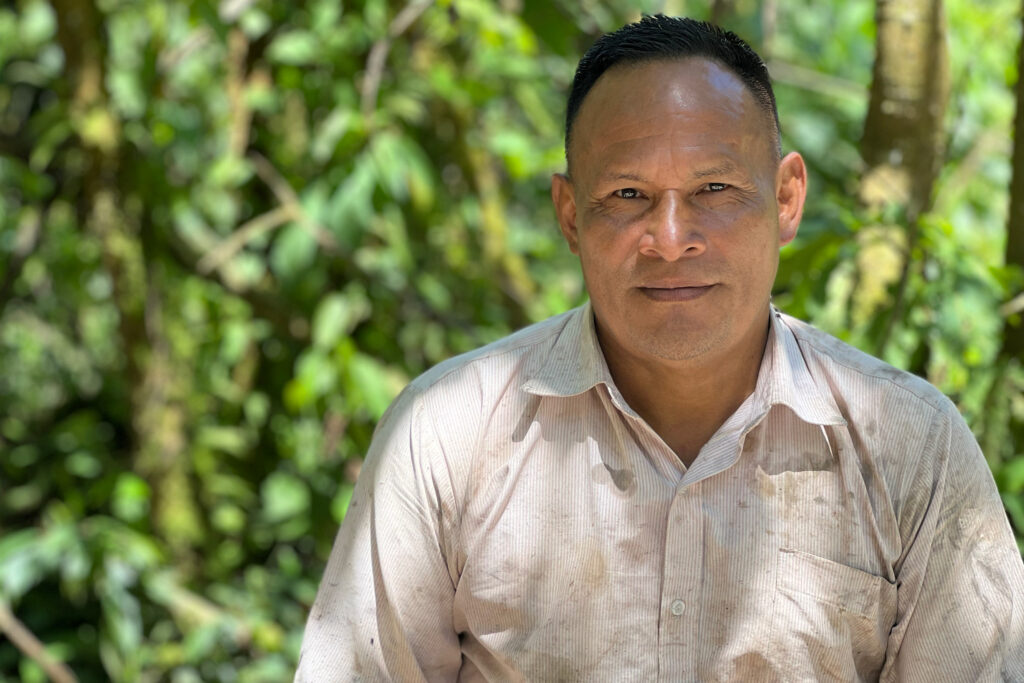
Compact and powerfully built from decades in the forest, Jorge moved easily along the trail. His long-sleeved beige shirt, visibly stained with mud and sweat in the warm, humid air, clung to his torso as he climbed.
Minutes in, he stepped off the path. Reaching into the vines, he plucked a leaf and held it up.
“This is good medicine for insects that burrow into your skin,” he said, explaining how the leaves are cooked into a paste and applied to the body.
Every few steps, the forest offered another lesson. Berries used as dish soap. Plants that calm sunburn. Ants whose bites burn like fire.
“The forest,” Jorge said, his eyes bright, “is our own storage unit for food and medicine.”
That is not how mining firms see it.
Companies’ environmental impact studies—required before permits are granted—are meant to assess a project’s social, cultural and ecological risks. In practice, lawyers say, Indigenous ecological knowledge is hardly ever included. Also absent are mentions of communities’ spiritual relationships to the land, like Maikiuants’ waterfalls, which residents view as sacred temples of spiritual renewal where their futures are revealed.
Companies’ science can also fall short. Ecoforensic’s review of Solaris Resources’ environmental impact assessment identified what it called “critical deficiencies,” including the omission of 91 at-risk or endangered species and scant attention to fish—an especially glaring oversight in an industry notorious for contaminating waterways. Mining has left a global legacy of heavy-metal pollution, acidic runoff and depleted aquifers.
The assessment also had mistakes, such as its failure to include the vulnerable-to-extinction giant anteater and bush dog. Paraecologists had already documented both species on Maikiuants’ lands.
More broadly, the document never analyzed whether the project could violate Ecuador’s rights-of-nature laws. That requires evaluating impacts on ecosystem functions (the work ecosystems do to keep themselves alive, like a tree converting sunlight into oxygen and wetlands filtering dirty water); on life cycles (think of a frog’s journey from egg to tadpole to adult); and on evolutionary processes (the long-term change of life over millions of years as it adapts for survival).
This story is funded by readers like you.
Our nonprofit newsroom provides award-winning climate coverage free of charge and advertising. We rely on donations from readers like you to keep going. Please donate now to support our work.
Donate NowNow, as Peck followed Jorge down the trail toward his home, it was hard for the ecologist to imagine company contractors producing the kind of patient, place-based knowledge needed to truly understand an ecosystem. The thought lingered as he ducked through the low doorway of the Antún family’s traditional hut.
Inside, the oval structure was meticulously kept: a swept dirt floor, a long wooden table with benches, a smoldering fire at its center. Pots, pans and a rifle hung from the walls. On a bench, two relatives, one in a dark T-shirt with her hair pulled into a loose bun and the other in a sage-green blouse, shelled peanuts into a large container while another lifted a squirming child from a colorful activity seat and brought the baby to her breast.
Jorge’s wife, Ilda Chias Nakaim Antún, handed out glasses of fresh pineapple juice and steaming plates of yucca and plantains, alongside hard-boiled eggs served with chili-flecked salt. But for the salt, everything came from the land around them.
Over the meal, Jorge spoke quietly about ideas for sustainable businesses: fish farming, fruit cultivation, even a local variety of vanilla.
“We want alternatives to mining,” he said. “We can be an example for others.”
His family is firmly opposed to the mine. His daughter Marcia Antún, the young mother, worried about air and water contamination.
“The company could force us to leave,” she said.
As the conversation turned back to economic possibilities, they discussed precedents. A cocoa project tied to paraecologists’ work on the brown-headed spider monkey helped farmers triple their incomes by pairing market access with forest protection. Other communities turned to ecotourism. In West Papua, Indonesia, where Peck helped develop paraecology initiatives, one of the first paraecologists went on to earn a Ph.D. and now leads the Binatang Research Center, Papua New Guinea’s leading conservation research institute.
In each case, the model produced something durable: livelihoods tied to ongoing scientific work, not extraction.
Reliable internet, now possible through satellite services, could open paths to e-commerce. The University of Azuay’s business school might help with planning. Jorge also imagined sharing the Shuar’s medicinal knowledge with the world, on their own terms.
“I have dreams for my family,” he said. “But I’m afraid I won’t be able to fulfill them because of the company.”
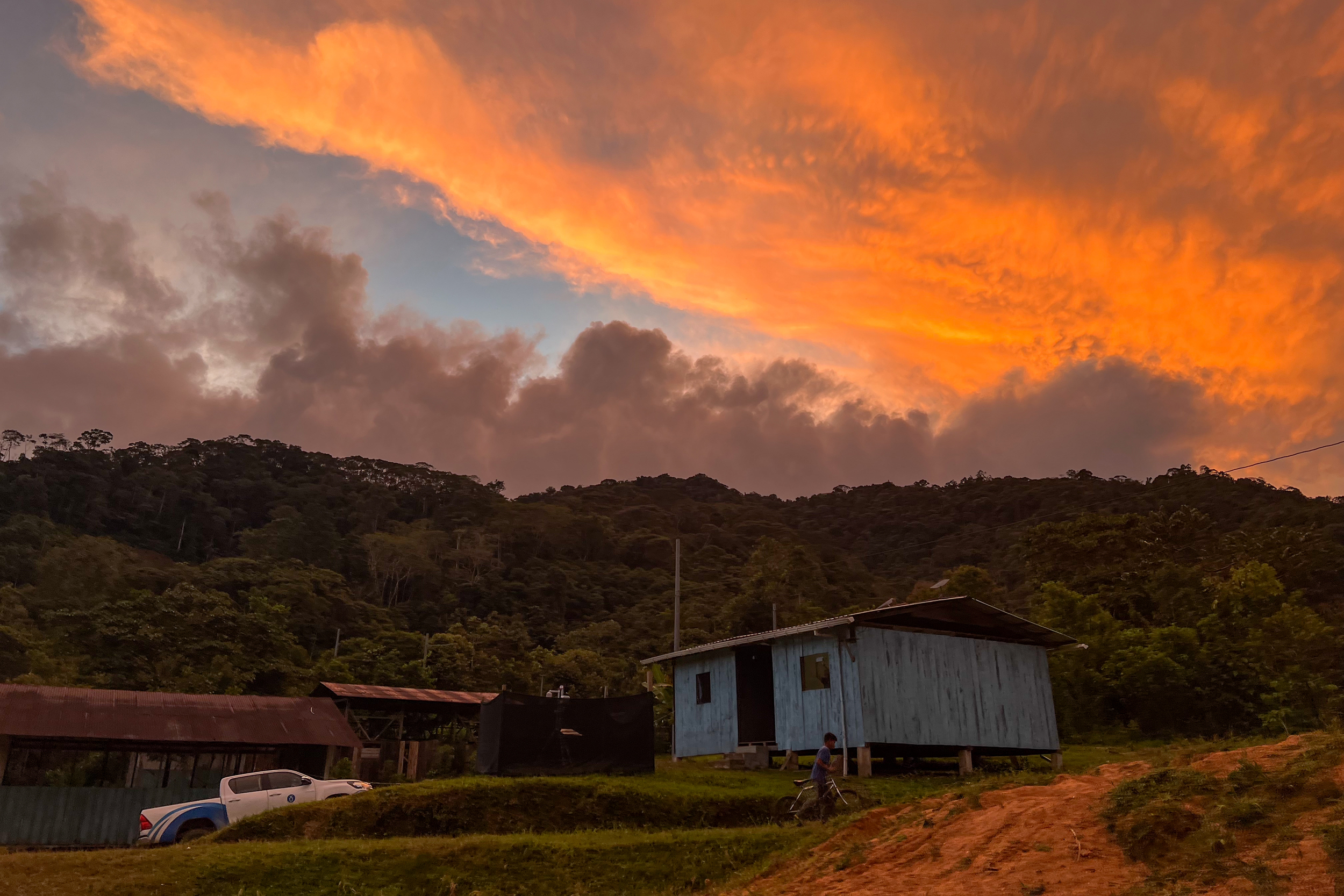
Time was not on their side. Solaris Resources’ final operational approval was expected within months.
Sustaining Life
Later that day, lead paraecologist Pinchu, who told the story of the monkey’s axe, set out on a narrow trail climbing out of Maikiuants, his 10-year-old son Kirup and Zárate following close behind. The forest tightened around them, the canopy draping over the path like a botanical cloak that choked out the midday sun, the air warm and faintly sweet with the scent of ripening fruit. They walked in silence until Pinchu signaled for everyone to stop.
A five-foot-long snake, no thicker than a golf ball, lay stretched across the path, its dark body blending into leaves like a shard of obsidian.
“It’s sleeping,” Pinchu whispered.
He picked up a fallen branch and shook it above the snake. Unhurried, the animal stirred, slid off the trail and vanished into the undergrowth.
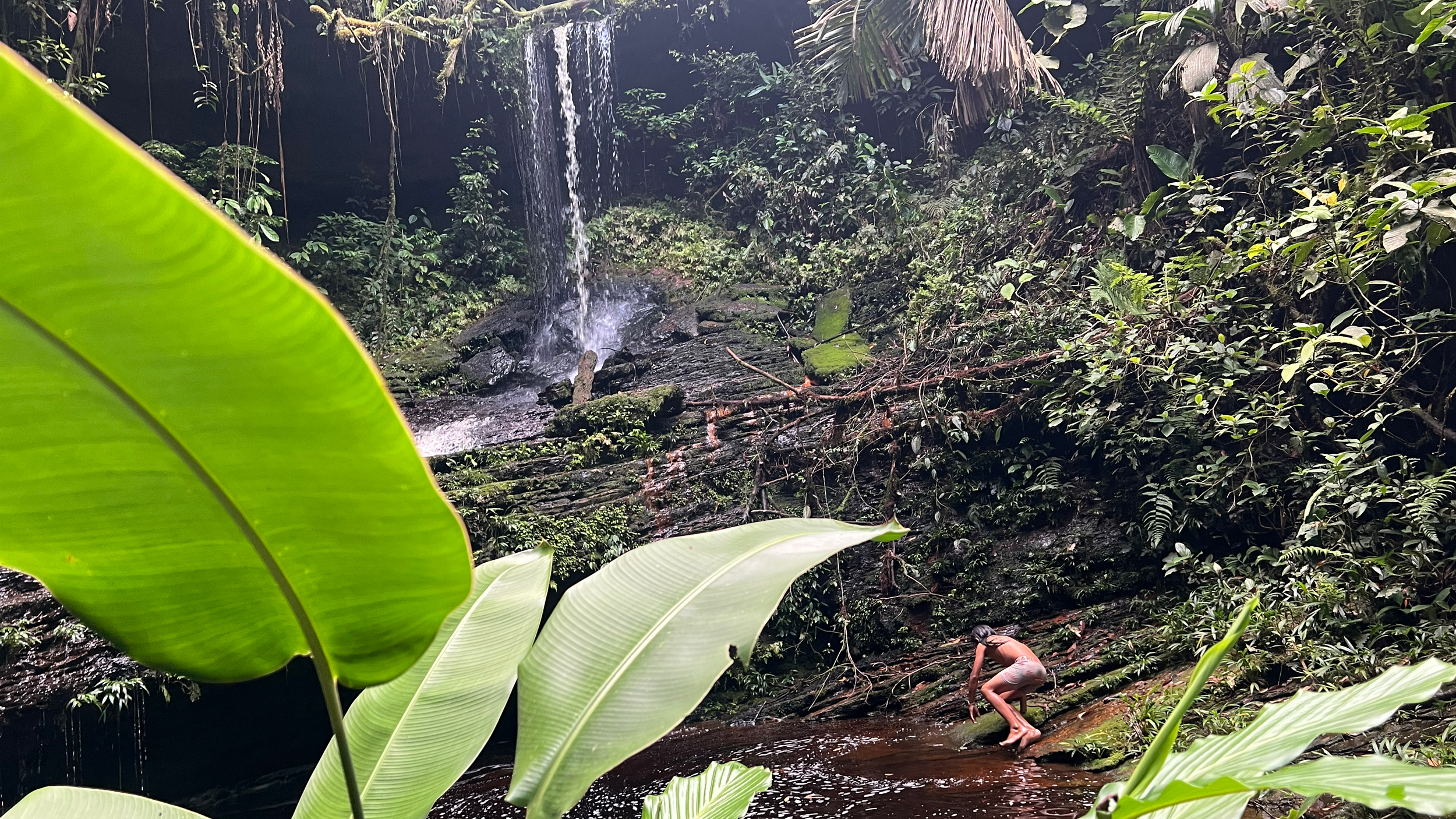
Farther on, the forest began to open. Sunlight pierced the canopy in narrow shafts, and then, suddenly, the trail opened into a hidden alcove. A waterfall spilled over a jagged ledge of dark rock, unraveling in thin silver strands into a lagoon below. Thick vines draped overhead like green tresses.
Kirup grasped one of the vines and slid smoothly down to the lagoon, diving in. Zárate and Pinchu followed, wading toward a small island carpeted in soft green moss. There, Pinchu pulled out a container of tobacco leaves steeped in water. Among the Shuar, the mixture isn’t smoked but inhaled as a tea—a practice Pinchu said brings calm and sharpens his connection to the forest, helping him listen and feel more deeply.
“We have ways of living that are also valuable. Our ancestral knowledge is valuable, and it’s not about money—it’s about sustaining life.”
— Claudio “Pinchu” Ankuash Nantip, lead paraecologist
Waterfalls hold deep spiritual significance for the Shuar. When life’s challenges arise, they follow protocols refined over generations, preparing carefully before visiting, communing with and leaving these places.
Only recently has Western science begun to affirm what many Indigenous communities have long understood. Time spent in nature has been shown to lower stress hormones, reduce inflammation, strengthen immune response and sharpen focus.
Yet the places where such scientific findings carry the greatest authority are often those most disconnected from the natural world—and whose consumption is driving the destruction of ecosystems like this one.
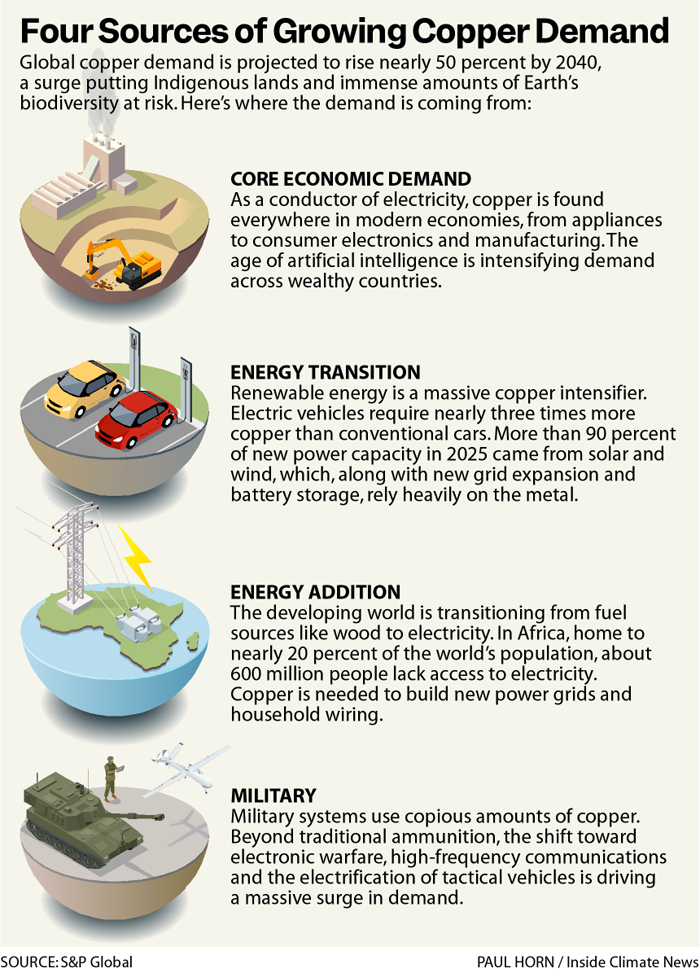
The copper beneath these mountains would likely be shipped to the United States and other wealthy countries, feeding the expansion of military hardware, energy transitions and infrastructure behind the artificial-intelligence boom, such as data centers.
A conventional data center can require up to 15,000 tons of copper. Facilities built to power AI systems can demand more than three times that amount, driving prices to record highs.
Those artificial worlds feel impossibly distant here, where now, a dripping wet Zárate emerged from the lagoon. This marked the 12th trip he’d made to Maikiuants, each one reinforcing for him the importance of scientists stepping out of walled offices and learning from other knowledge systems.
“We have to be more holistic,” he said.
The industrialized world, Pinchu added, has “a different way of viewing nature—only thinking about money.”
He dreams of a future in which his people can evolve and develop without losing the essence of who they are.
“We have ways of living that are also valuable,” he said. “Our ancestral knowledge is valuable, and it’s not about money—it’s about sustaining life.”
Love and Hope
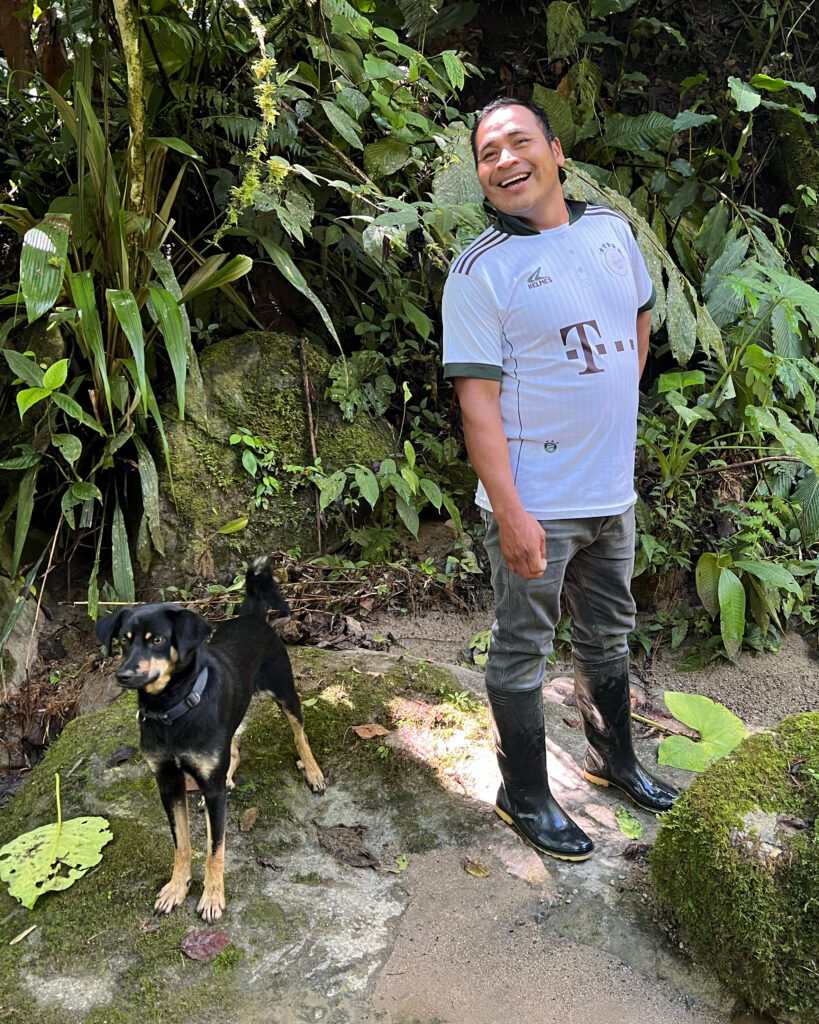
With the fresh jaguar tracks documented, Jhostin Antún and Olger Kitiar quickened their pace toward the camera trap, anticipation building with every step. They were high in the mountains now, far above the waterfall where Pinchu had taken Zárate.
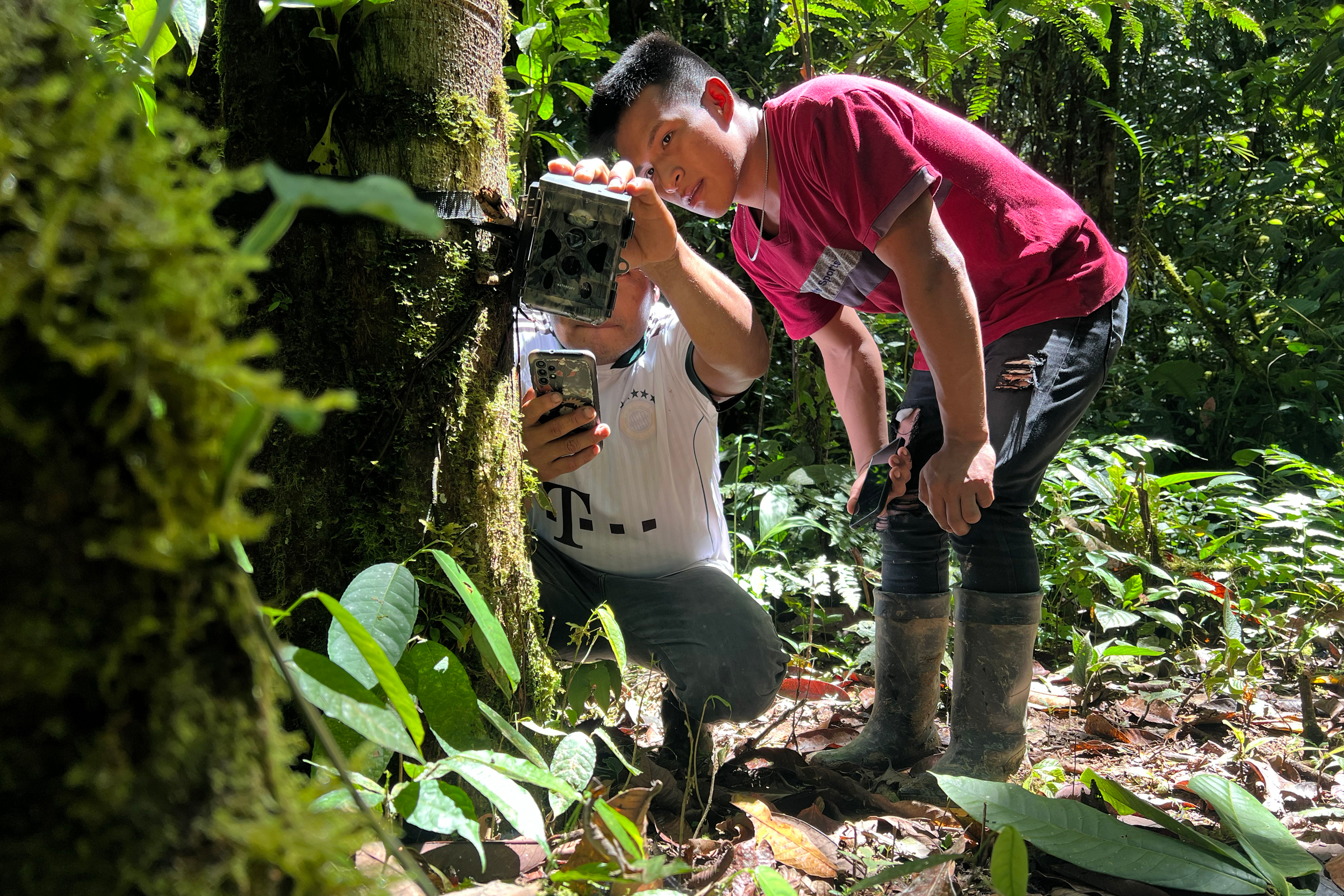
The camera was fastened to a tree washed in sunlight—a deliberate choice, since it ran on solar power. When Olger reached for it, pure delight sparked in his eyes.
“I love this,” he said. “I love seeing all the animals—sometimes there are things we haven’t seen in real life.”
He began transferring the data to his phone using Bluetooth, a 10-minute process that felt far longer. To pass the time, they scrolled through older recordings: pig-like peccaries rooting through the undergrowth, a spectacled bear lumbering past, turkeys, a species they call wild dogs, perdiz birds—and a jaguar, caught once, briefly, slipping through the frame.
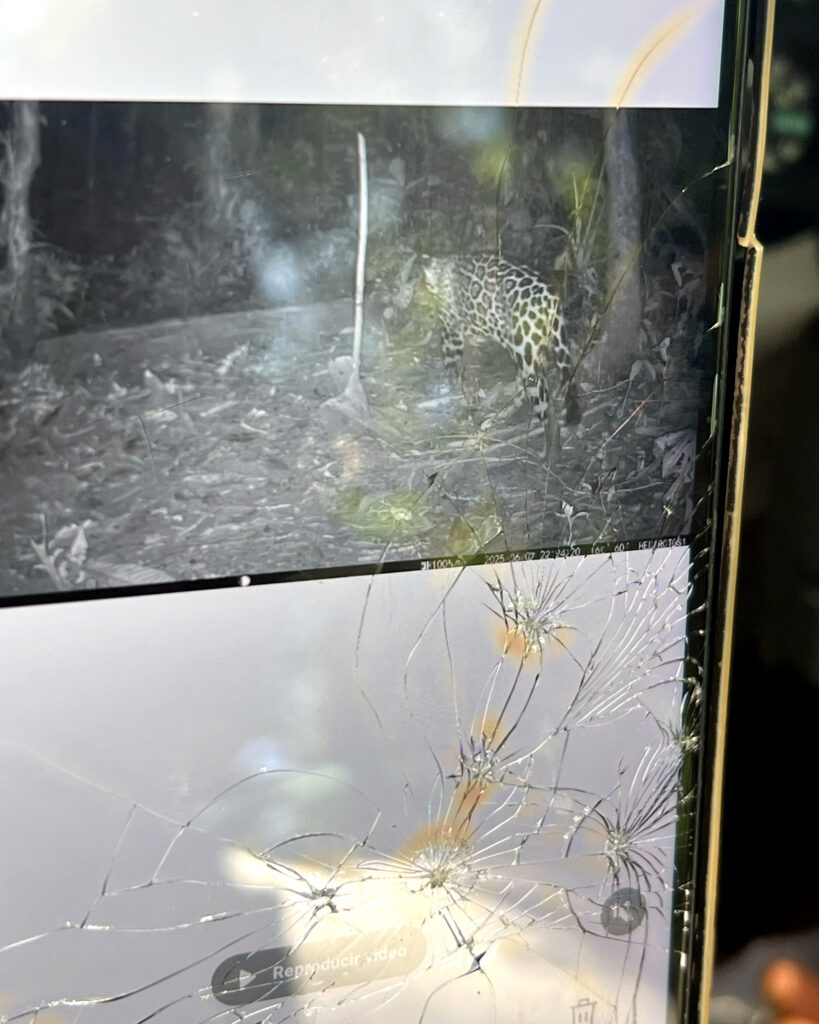
This camera was one of two they maintained on their territory. The other required an eight-hour hike each way and an overnight stay in the forest.
“It’s still as exciting as it was in the beginning,” Olger said. “We’re learning more and more and discovering new species.”
Jhostin had been part of the team that discovered an unknown frog, soon to be named the Maikiuants frog.
His work, he said, was both fun and deeply serious. Gesturing with his hands, he described the rhythms of daily life—planting, harvesting, eating what the forest provides. Agriculture, for his community, is not a commercial activity but a way of sustaining the body and spirit.
“Ecoforensic gives me hope that this way of life can still be protected,” Jhostin said.
He wants children someday, and he wants them to live in the forest without fear, free of contamination. Without territory, he said, you cannot teach children who they are. You cannot teach them the forest.
He wants a future of buen vivir—living well, living in balance. His father, Jorge, taught him the forest by walking through it, by explaining what each plant and river meant. His grandfather did the same, offering guidance not through lectures but through nature itself. That, Jhostin said, is where wisdom comes from.
And that is what he is trying to protect.
Olger signaled that the data had finished loading. The footage showed a lone tinamou, a chicken-like bird.
Their task finished, the two paraecologists walked back to the village—crossing a gushing, pristine river on the way, its banks alive with hundreds of iridescent blue butterflies rising and falling in slow waves.
On a narrow bank of stones and sediment in the middle of the river, where the water divided and came together again farther down, Jorge Antún sat quietly, taking in the sweep of forest and sky. Jhostin spotted his father and smiled. He and Olger crouched at the river’s edge, splashing the cool water over their faces before cupping their hands to drink, the current threading around them as it always had.
About This Story
Perhaps you noticed: This story, like all the news we publish, is free to read. That’s because Inside Climate News is a 501c3 nonprofit organization. We do not charge a subscription fee, lock our news behind a paywall, or clutter our website with ads. We make our news on climate and the environment freely available to you and anyone who wants it.
That’s not all. We also share our news for free with scores of other media organizations around the country. Many of them can’t afford to do environmental journalism of their own. We’ve built bureaus from coast to coast to report local stories, collaborate with local newsrooms and co-publish articles so that this vital work is shared as widely as possible.
Two of us launched ICN in 2007. Six years later we earned a Pulitzer Prize for National Reporting, and now we run the oldest and largest dedicated climate newsroom in the nation. We tell the story in all its complexity. We hold polluters accountable. We expose environmental injustice. We debunk misinformation. We scrutinize solutions and inspire action.
Donations from readers like you fund every aspect of what we do. If you don’t already, will you support our ongoing work, our reporting on the biggest crisis facing our planet, and help us reach even more readers in more places?
Please take a moment to make a tax-deductible donation. Every one of them makes a difference.
Thank you,