

The federal government’s pause on new loans for anaerobic digesters, the controversial method of converting animal manure from large-scale feeding operations into biogas, will now extend through the end of the year.
The U.S. Department of Agriculture explained the move in financial terms, saying digester projects had “significant delinquency rates and realized losses.”
Digesters are intended to cut greenhouse gas emissions. The Trump administration has targeted climate efforts across the federal government—but unlike many initiatives pitched as climate-friendly, digesters are popular with the agricultural industry and viewed with concern by environmentalists.
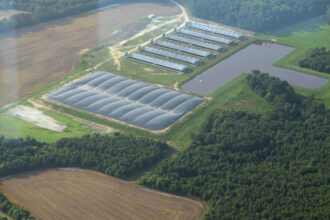
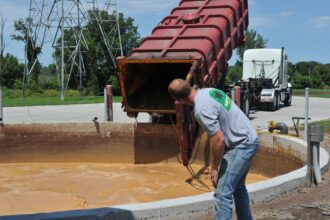
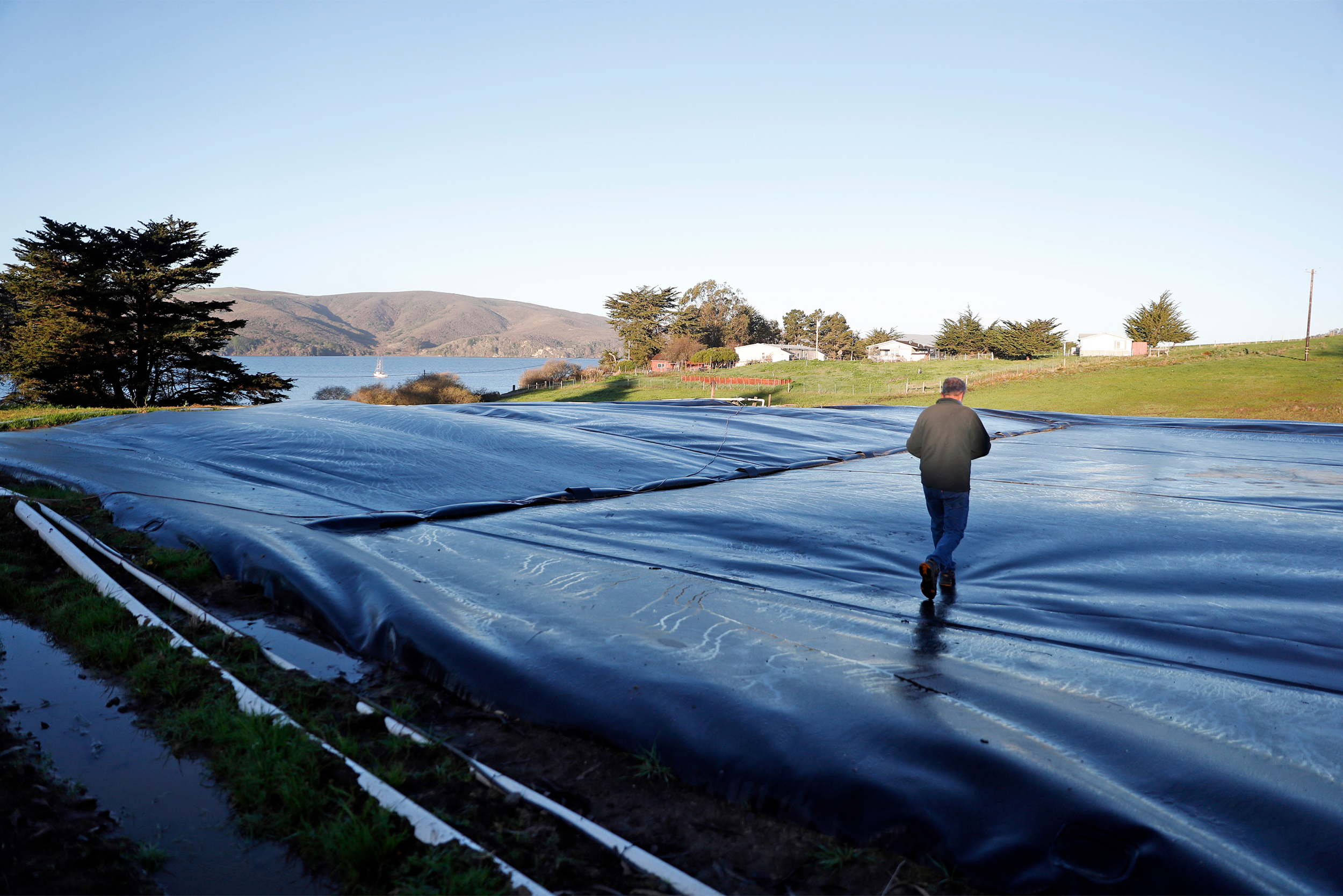
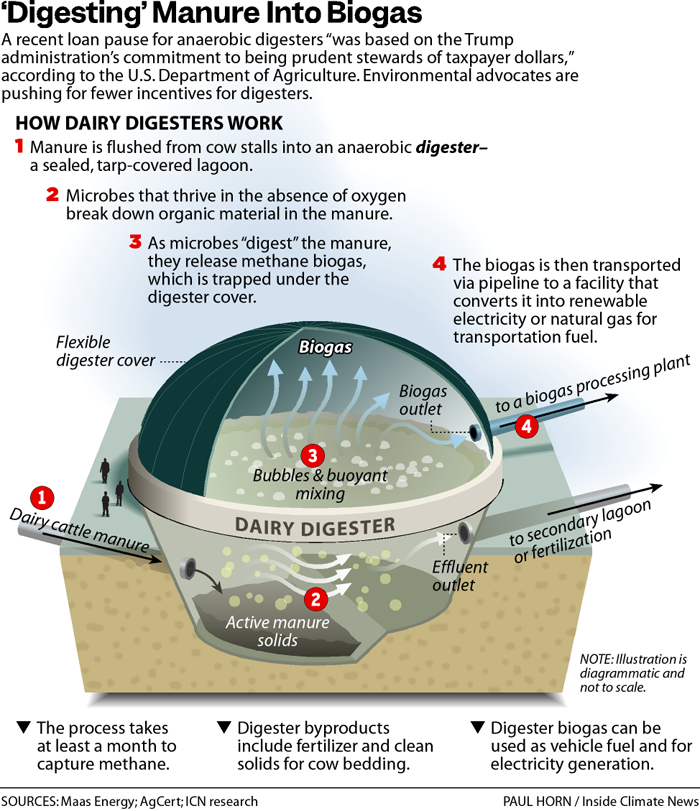
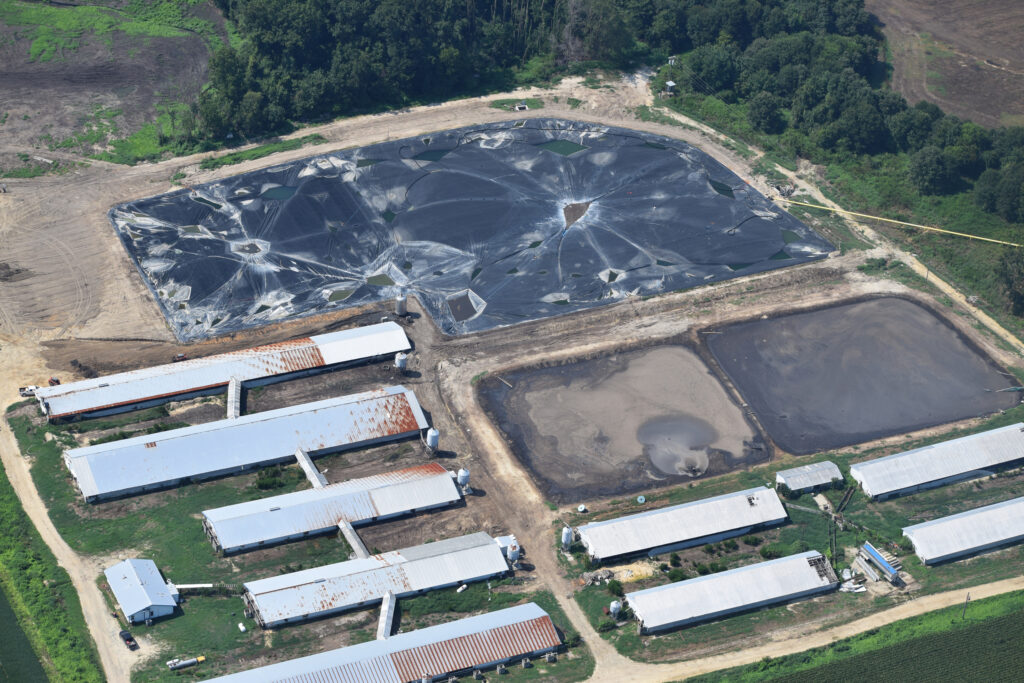
Digesters cover open-air manure pits with massive black tarps that expand as they trap gas—made up mostly of methane and carbon dioxide. The gas, intended to be burned for energy, can be captured via tanks too.
Hundreds of these projects operate on large-scale concentrated animal feeding operations, or CAFOs, in the United States, particularly in California, North Carolina, Idaho and Iowa.
Often located in communities of color, the digesters can both directly and indirectly fuel pollution.
“We see them as both an economic and environmental liability for Californians, especially Californians living near large dairy operations that have digesters,” said Phoebe Seaton, co-executive director for the Leadership Counsel for Justice and Accountability, noting hundreds of millions of dollars have been spent on them by the state.
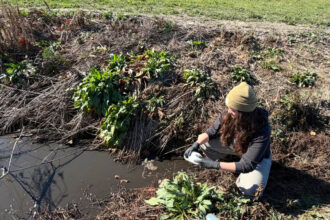
In North Carolina, one company, Legacy Biogas, received a federal loan in 2018 during the first Trump administration to supplement its $5 million digester investment at White Oaks Farm, but the operation subsequently had a series of environmental violations. Then the digester cover at the farm breached and discharged 10,000 gallons of waste into a nearby swamp in 2022. Legacy Biogas subsequently sold the farm at public auction in 2024 and went into foreclosure. The farm’s new owners haven’t restarted the digester.
The USDA’s decision to extend its pause on digester loans “was based on the Trump administration’s commitment to being prudent stewards of taxpayer dollars,” an agency spokesperson wrote in a statement to Inside Climate News.
Supporting “high risk” digester projects “threatens the long-term stability of the program and its capacity to fulfill its mission,” wrote J.R. Claeys, administrator of the USDA’s Rural Business-Cooperative Service, which manages the loan guarantees for digester projects.
Industry players are skeptical. The American Biogas Council, a group promoting digesters, thinks federal staffing cuts are at the heart of it, not delinquencies.
“The more we learn about what actually happened with these projects, the more surprised we are that there’s a pause in the first place, and the more surprised we are that it was even extended,” said Patrick Serfass, the council’s executive director.
Asked for details on delinquent digester loans, a USDA spokesperson pointed to public lender data available online.
An Inside Climate News review of the USDA lender data—last updated at the end of March—showed that of the 746 project lenders nationwide, 11 percent were considered over 90 days delinquent. The American Biogas Council says only a few digesters are seriously delinquent and argues that new projects should not be delayed.
“A Lot of Community Concerns”
The USDA directive from April extended a January pause. It came on the heels of rallies by several groups, including a half dozen from North Carolina, petitioning for loans under the Rural Energy for America Program to no longer go toward large-scale farms.
The loans have encouraged the continued use of digesters and the expansion of CAFOs, environmental groups say.
“These are touted as climate solutions,” Andrew deCoriolis, executive director of Farm Forward, a nonprofit dedicated to ending factory farming, told Inside Climate News. But “increasingly, the evidence is showing that this is driving expansion in factory farms,” driving more pollution, “and totally changes the economics of the farm. In most cases, the gas is not worth anything; it’s all the public subsidies and carbon credits associated with the gas.”
Nearly 400 manure-based digesters were operating nationwide as of the most recent federal estimate in June 2024, up from roughly 41 that the U.S. Environmental Protection Agency recorded two decades earlier. Another 73 were under construction across the country, the EPA reported.
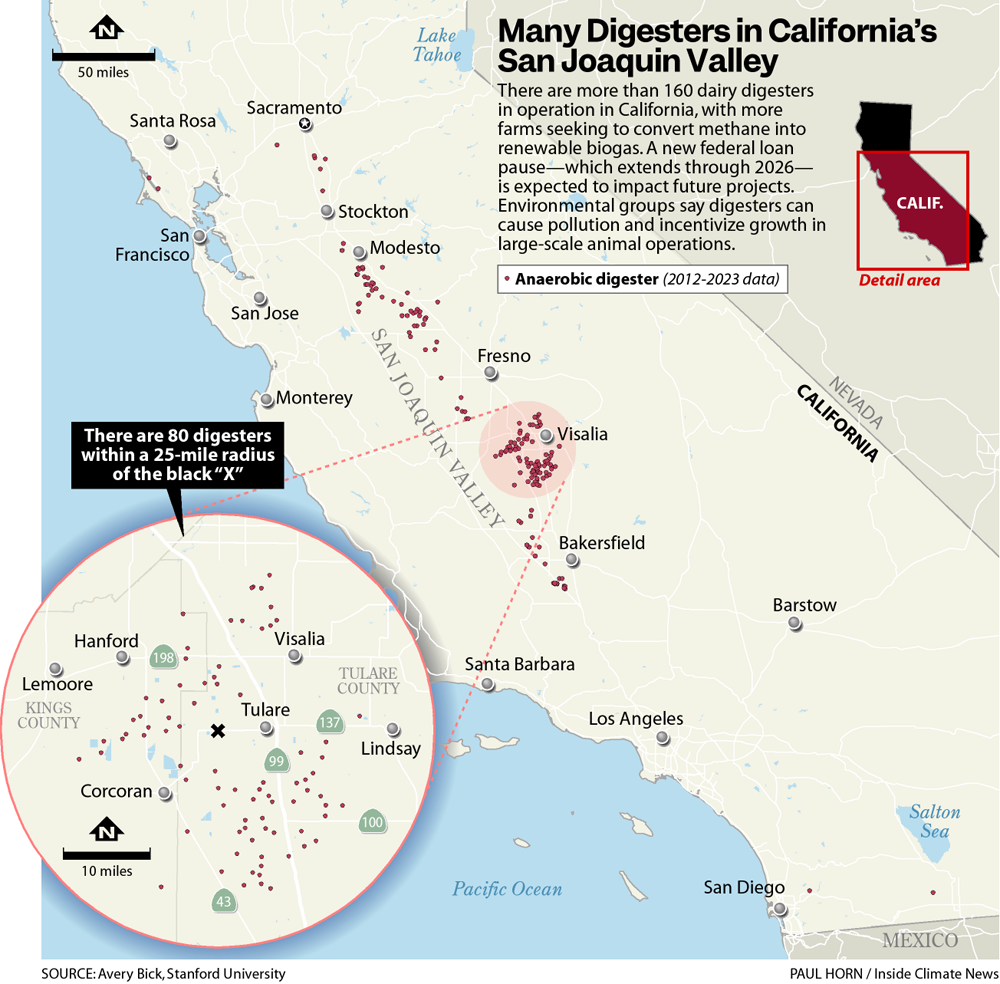
Many are in California, which has more than 160 digesters operating at dairy farms and dozens of others under construction, according to experts and industry groups.
California is the top producer of milk in the nation.
As dairies grow, communities in the state are concerned about digesters, said Tarah Heinzen, legal director at the nonprofit Food & Water Watch.
“Digesters leak and they also can increase emissions of other pollutants that are really harmful at the community level, like ammonia,” said Heinzen, who also pointed to worries about water pollution and the digestion process making nutrients in animal waste more soluble and thus prone to runoff. Her group is part of a coalition challenging the ways that California’s low carbon fuel standard can incentivize digesters.
Joan Casey, an environmental epidemiologist at Columbia University, published a review in 2015 of health harms CAFOs inflict on people living nearby. Families near CAFOs experience stress, cognitive problems, asthma and impaired lung function, among other health issues, she found.
This story is funded by readers like you.
Our nonprofit newsroom provides award-winning climate coverage free of charge and advertising. We rely on donations from readers like you to keep going. Please donate now to support our work.
Donate NowResearch shows the dairy industry in California creates about half of the state’s emissions of methane, a significant climate pollutant. The state has spent nearly $300 million in grants to cut down on dairy methane emissions and is also raising money to fund digesters with climate policies that make companies pay for their pollution.
The state views manure digesters as an effective greenhouse gas emission reduction tool, said Dave Clegern, a spokesman for the California Air Resources Board. Manure management reduced methane emissions from livestock to 9.9 million metric tons in 2023 from a peak of 12 million metric tons in 2012, the agency said.
“If you don’t build a biogas system, how much of that methane and carbon dioxide goes into the air?” asked Serfass, of the American Biogas Council. “100 percent, right?”
Nicole Ayache, the chief sustainability officer for the National Milk Producers Federation, pointed to a study in the journal Environmental Science and Technology that showed anaerobic digesters may reduce manure systems’ greenhouse gas emissions in a big way—58 percent to nearly 80 percent, depending on the region.
Ayache said the National Milk Producers Federation has been in touch with the USDA on the loan pause and the government’s ongoing review of delinquency rates.
“We hope that that’s done as efficiently and as soon as practical so that farmers who are depending on this program aren’t waiting,” Ayache said.
But Heinzen, of Food & Water Watch, pointed to a new study from researchers at Stanford University and other major institutions that found digester incentives are spurring CAFOs to get bigger because biogas sales are making manure profitable.
Farm Forward recently released a report on the effect of an Iowa law lifting the cap on the number of animals raised on farms with digesters. Animal numbers at permitted sites increased by 23 percent, the group found.
“We’re entrenching this really harmful model of livestock production,” Heinzen said.
About This Story
Perhaps you noticed: This story, like all the news we publish, is free to read. That’s because Inside Climate News is a 501c3 nonprofit organization. We do not charge a subscription fee, lock our news behind a paywall, or clutter our website with ads. We make our news on climate and the environment freely available to you and anyone who wants it.
That’s not all. We also share our news for free with scores of other media organizations around the country. Many of them can’t afford to do environmental journalism of their own. We’ve built bureaus from coast to coast to report local stories, collaborate with local newsrooms and co-publish articles so that this vital work is shared as widely as possible.
Two of us launched ICN in 2007. Six years later we earned a Pulitzer Prize for National Reporting, and now we run the oldest and largest dedicated climate newsroom in the nation. We tell the story in all its complexity. We hold polluters accountable. We expose environmental injustice. We debunk misinformation. We scrutinize solutions and inspire action.
Donations from readers like you fund every aspect of what we do. If you don’t already, will you support our ongoing work, our reporting on the biggest crisis facing our planet, and help us reach even more readers in more places?
Please take a moment to make a tax-deductible donation. Every one of them makes a difference.
Thank you,

Steven Rodas
Reporter, California
Steven Rodas covers water, wildfires and agriculture throughout California for Inside Climate News. Based in Los Angeles, he previously reported on the environment in New Jersey, covering energy, pollution, wildlife and development. Steven’s work has appeared in the San Francisco Chronicle, NJ.com/The Star Ledger and Grist. He worked as a copywriter at Google. Steven has a master’s degree from Syracuse University’s S.I. Newhouse School Of Public Communications. He is fluent in English and Spanish (and welcomes your tips).

Lisa Sorg
Reporter, North Carolina
Lisa Sorg is the North Carolina reporter for Inside Climate News. A journalist for 30 years, Sorg covers energy, climate environment and agriculture, as well as the social justice impacts of pollution and corporate malfeasance.
She has won dozens of awards for her news, public service and investigative reporting. In 2022, she received the Stokes Award from the National Press Foundation for her two-part story about the environmental damage from a former missile plant on a Black and Latinx neighborhood in Burlington. Sorg was previously an environmental investigative reporter at NC Newsline, a nonprofit media outlet based in Raleigh. She has also worked at alt-weeklies, dailies and magazines. Originally from rural Indiana, she lives in Durham, N.C.