

From our collaborating partner Living on Earth, public radio’s environmental news magazine, an interview by producer Aynsley O’Neill with Amy Warren, the scientific program officer at the New England Aquarium.
North Atlantic right whales were once so thoroughly hunted they nearly went extinct. In fact, they were called right whales because they were considered the “right” ones to hunt, as they lived close to shore and floated on the surface once killed.
When hunting these mammals was outlawed, they slowly started to bounce back, but today, right whales are dealing with new deadly threats from humans. So it’s a relief to have a successful calving season like this year, with 23 new calves, the most since 2009.
Amy Warren is the scientific program officer at the New England Aquarium. This interview has been edited for length and clarity.
AYNSLEY O’NEILL: Tell me about your role there at the New England Aquarium. How closely do you work with our subject, right whales?
AMY WARREN: One of the things that my team does is that we manage the North Atlantic Right Whale Identification Catalog, so any and all photographed sightings of right whales that happen anywhere in the North Atlantic come into our team, and we’re responsible for putting those into the catalog, incorporating photos and all the data that go with it. Now, we have this catalog that has over 800 individuals, which goes back to 1935. Any whale we’ve ever identified is in this catalog, living or dead. We get anywhere from 3,000 to 5,000 sightings a year with millions of photos, so it’s a lot of time and effort.
Zooming in a bit, I do also get to do fieldwork, so I’ll be on boats in different areas where right whales are feeding. For example, in April, I was on the water six days when we saw a bunch of whales every day. In the summertime, I get to go offshore on research cruises, and those are usually two weeks where we’re living on the boat, we’re out and we’re seeing whales every day.
O’NEILL: If somebody has never seen one of these right whales, not even a photo, how can we help visualize them? What makes these whales identifiable? What helps them stand out?
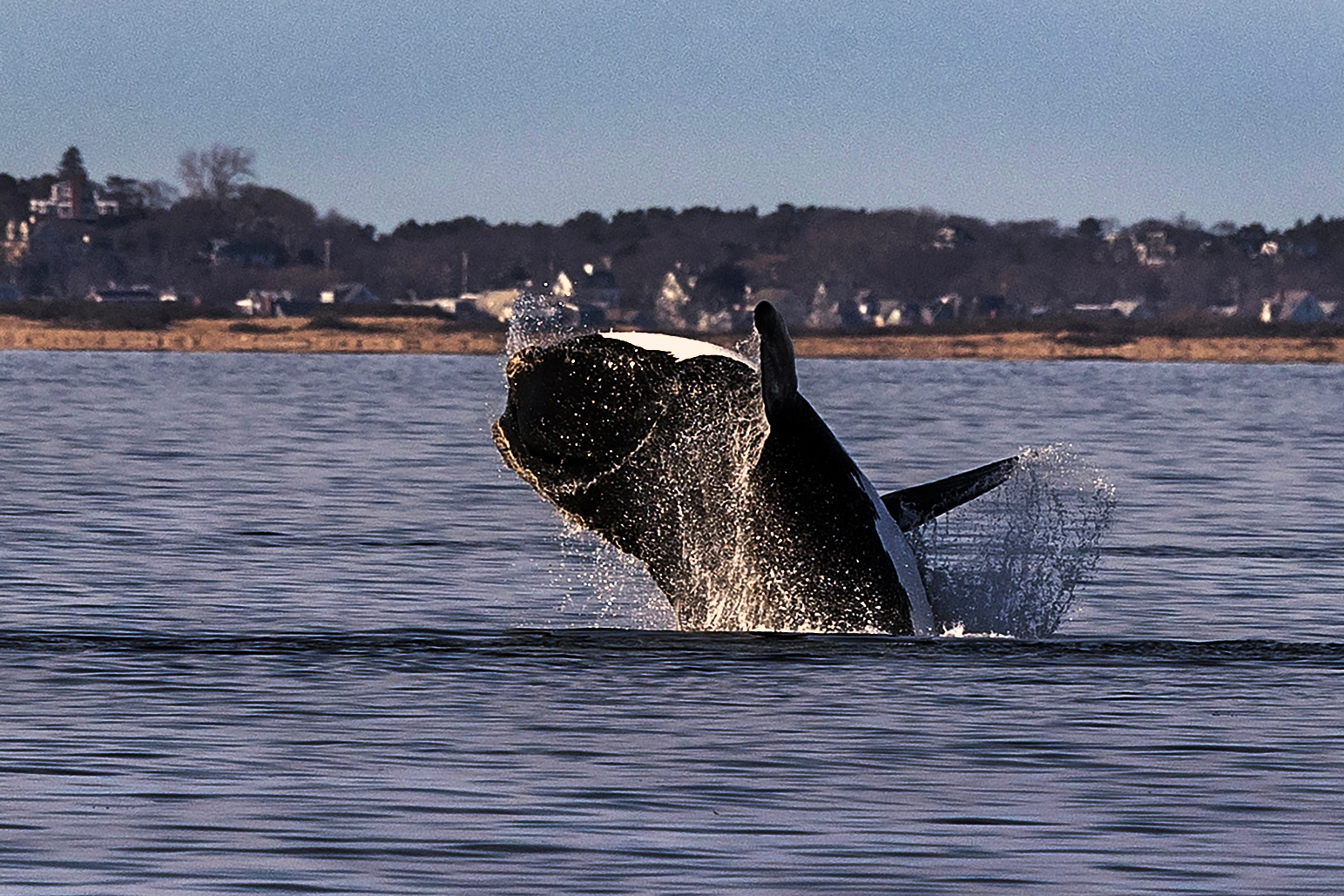
WARREN: A lot of people know humpback whales, so I think it’s sometimes easiest to start with them. Right whales are similar in some ways to people who don’t know them in size. They’re actually a little bit bigger, a little bit heavier—50 feet long, 50 tons—but what’s unique about right whales is they have white patches on their head. They’re called callosities, and they’re actually collections of whale lice, so they’re small …
O’NEILL: Lice?

WARREN: … Lice that congregate on these rough patches of skin on the whale’s head, yeah. It’s something that they’re born with, and they’re in different patterns for each whale. It sounds bad; I know we don’t have the best connotation with lice. But in this case, it’s perfectly fine. They’re just kind of feeding off of the dead skin. It’s more like a spa day—it works for the lice, and it doesn’t bother the whales. The reason why we actually appreciate the lice in this case is that the lice are white and the whale’s skin is black, so these rough patches without the lice would basically blend in with the skin. But with the contrast of the white versus the black, it basically makes these shapes and patterns. Each whale has really unique patterns on its head, and this is why we can identify them.
O’NEILL: North Atlantic right whales are critically endangered; estimates have their population at under 400 total. How much do we know about why these population numbers are so small, and how do they compare to populations in the past?
WARREN: We don’t know what the populations used to be, because they were decimated so long ago. Right whales were protected in 1932 from whaling internationally, but at the time no one can really say for sure … but the population of right whales was maybe between 20 and 50.
O’NEILL: Double digits is bad!
WARREN: Yes, exactly.
Their population actually did start to increase [from the 1930s to the 1980s] because they were no longer targeted. But then jumping to the 1980s to 2000s—technology has gotten better, fishing gear has gotten stronger, it’s gone further offshore, boats are bigger, boats are faster, and so all these new uses of the ocean by [humans] have made it more dangerous for whales.
Now add in climate change, so their food is moving. As their food has started shifting, it’s bringing right whales into new areas that they have not been before, and areas that are not ready for them.
There’s a lot of research that went on between the 1980s and the early 2000s in that they discovered where whales were feeding regularly. Researchers established these hot spots or these habitats for them, and were able to put in protections, either removing ships completely or slowing ships down, and removing some of the fishing gear from the water. In some areas, both up in the Bay of Fundy and in Boston, they moved shipping lanes to go around these whale-feeding areas. A lot of those things were helping, but as the food started shifting, the whales started shifting with them, and then whales started showing up into new places where those protections weren’t there, because they didn’t need to be there, and so that’s kind of where we’ve been in recent years.
O’NEILL: As I understand it, the problem isn’t only with the whales themselves dying, but there’s also an issue with the birth rates overall.
WARREN: It overall comes down to the health of the population, but also the health of each individual whale. If whales aren’t healthy, they’re not going to be able to give birth, and when we say a whale isn’t healthy, that could be for a number of reasons. It could be because they’re not finding enough food, it could be that a whale was hit by a boat and it survived, but it has this injury that now its body is fighting back from.
O’NEILL: What did this calving season mean for the North Atlantic right whale?
WARREN: This year, we saw 23 right whale calves born, and that is the fourth-highest calf count we’ve ever recorded, and the highest calf count since 2009. That is great. But one good year isn’t going to save a species. We need lots of good years, and we recently had a lot of bad years. We had a year with zero calves, a year of only five. One good year kind of just makes up for a few bad years. But it’s hopeful, it’s good. We love to see it.
We’re seeing that a lot of these females were giving birth more often, so a healthy right whale, we think, can give birth every three to four years. In the last decade or so, we were seeing females wait 10 years between subsequent calves, potentially because it was taking them that much longer to get back to a healthy weight, a healthy status before they were ready to get pregnant again. This year, we are seeing a lot of whales three, four, five, six years between calves. That’s very promising. That’s, to us, maybe a sign that they are a little bit healthier.
This story is funded by readers like you.
Our nonprofit newsroom provides award-winning climate coverage free of charge and advertising. We rely on donations from readers like you to keep going. Please donate now to support our work.
Donate NowO’NEILL: What would need to happen for these whales to reach healthier population numbers?
WARREN: We need years and years of these very high calf counts, and years and years with no whales dying from human-caused injuries, which is a very tall order. But also, we need all of these calves to survive into adulthood. Two years ago, five of the 20 calves born were not with us anymore by three months in. And this year, in January, we had two juveniles die from human causes. Of these 23 calves born, the chances of all of them making it into adulthood is pretty low.
O’NEILL: What do you think is important for people to keep in mind when they see this headline about, oh, great year for the North Atlantic right whale?
WARREN: We like to talk about numbers a lot. We like to talk about the population number, we like to talk about the calf numbers. But in general, I think it’s important to take a step back and look at the status of the population. There are things that we could do to help them more, and I think over the years, we have established a lot of management mitigation measures that do seem to be working. Given a year with some positive news, I hope that can be an incentive to keep going—like, don’t stop, don’t fall back thinking we fixed everything. It’s not that simple.
O’NEILL: What do these whales mean to you?
WARREN: I’ve loved whales since I was a kid. There was just this early love for the ocean and whales and dolphins, and I just thought those creatures were so interesting. I can’t tell you how many times I’ve been on the water, how many trips I’ve done over the years, but it never gets old. The excitement of seeing a whale does not change.
To go specifically into right whales, we know so much about a wild population that lives across the North Atlantic. We know these whales individually. A lot of them have names that we’ve given them; we know when they were born. We know who their siblings are. We know their parents and their grandparents. We know how many calves they’ve had. We have all these really unique stories.
I think, because we know each and every one of these whales, we do create these personal connections with them. Not to anthropomorphize them, but you do start to see a little bit of personality, like some whales do certain behaviors a lot, and some whales don’t do those behaviors at all. Some whales only show up in one area and are never seen anywhere else, or vice versa.
To see that individuality is really interesting, and it’s relatable. That’s another part of it too: Yes, they’re very different. They live in the ocean, but they are mammals. They give birth to young, they take care of them, they live long lives. It’s just … it’s relatable.
About This Story
Perhaps you noticed: This story, like all the news we publish, is free to read. That’s because Inside Climate News is a 501c3 nonprofit organization. We do not charge a subscription fee, lock our news behind a paywall, or clutter our website with ads. We make our news on climate and the environment freely available to you and anyone who wants it.
That’s not all. We also share our news for free with scores of other media organizations around the country. Many of them can’t afford to do environmental journalism of their own. We’ve built bureaus from coast to coast to report local stories, collaborate with local newsrooms and co-publish articles so that this vital work is shared as widely as possible.
Two of us launched ICN in 2007. Six years later we earned a Pulitzer Prize for National Reporting, and now we run the oldest and largest dedicated climate newsroom in the nation. We tell the story in all its complexity. We hold polluters accountable. We expose environmental injustice. We debunk misinformation. We scrutinize solutions and inspire action.
Donations from readers like you fund every aspect of what we do. If you don’t already, will you support our ongoing work, our reporting on the biggest crisis facing our planet, and help us reach even more readers in more places?
Please take a moment to make a tax-deductible donation. Every one of them makes a difference.
Thank you,