

Many of our impact case studies cover ongoing stories that Inside Climate News continues to actively cover. The impact reflected here is current as of publication and may be updated as the situation develops.
Ever since Europeans arrived on American shores, mountain lions have faced an existential threat. While Indigenous tribes long viewed the continent’s widest-ranging wild cat as a vital part of a healthy ecosystem, settlers regarded lions as unacceptable threats to life and livelihood.
I’ve reported on conflicts with mountain lions—also known as pumas, cougars, panthers, ghost cats and dozens of other common names, reflecting their broad distribution—for over 20 years.
In 2023 I heard that Washington state wildlife officials were killing a frightening number of young cougars in prime cougar habitat. Thirty-seven cats had been shot since the project had started five years earlier, and I wanted to understand what was going on.
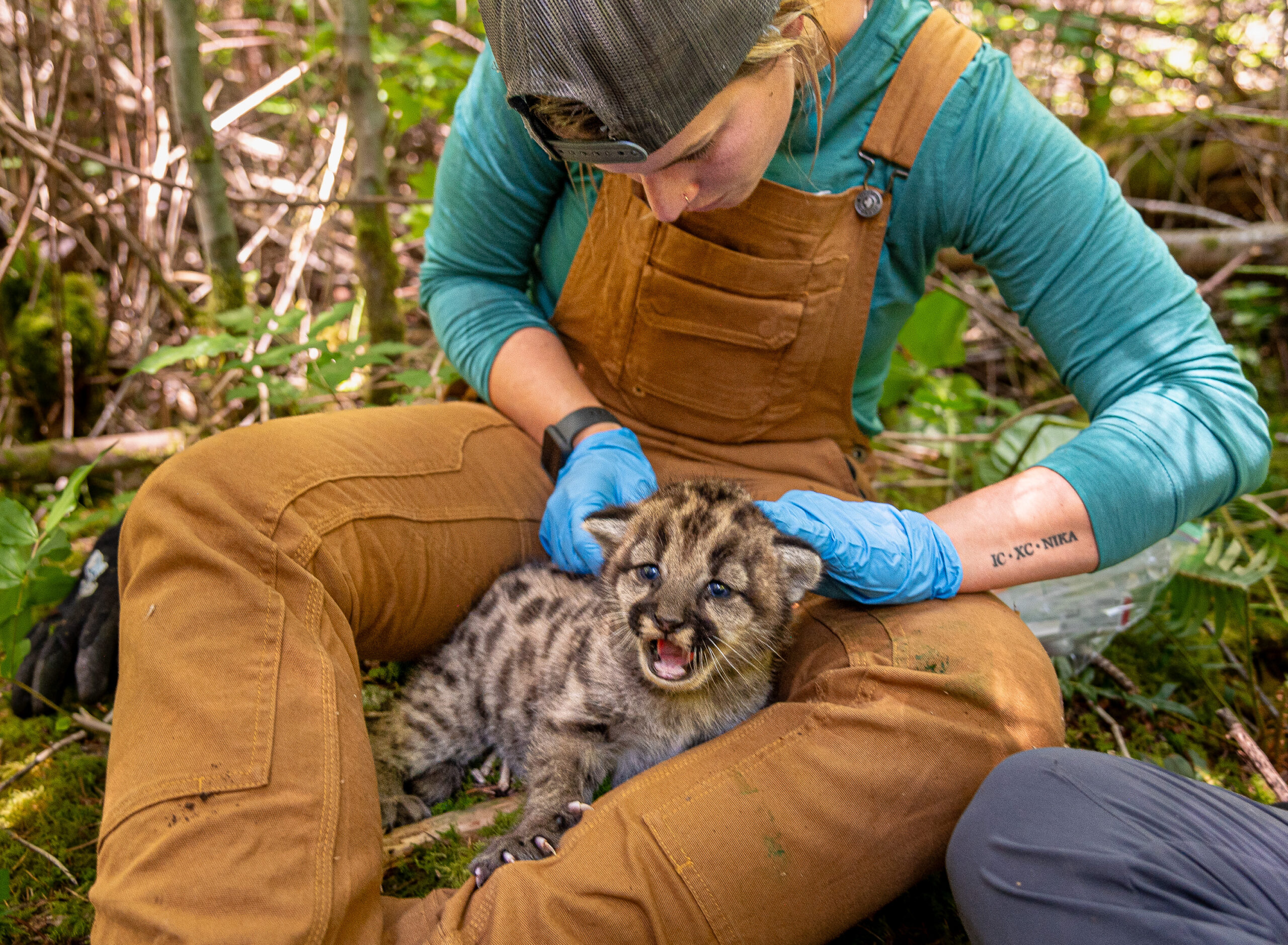
I learned about the slaughter from Mark Elbroch, who co-directs the Olympic Cougar Project as head of the Puma Program for Panthera, a global science-based wild cat conservation organization that collaborates with the Lower Elwha Klallam Tribe and five other tribes. The team is studying cougars in the Olympic Peninsula as an indicator of ecosystem health, building on previous research from Elbroch and others. The studies revealed how cougars boost biodiversity, increase plant diversity by controlling herbivore populations and nourish the soil with their kills, which also feed diverse species, from beetles to bears.
The Olympic Cougar Project has focused on young cats, which can travel hundreds of miles in search of new territory when they leave their mothers, to decide where to put a wildlife crossing corridor on Interstate 5. The highway, which separates the peninsula from the mainland, isolates the cougar population on the peninsula, reducing genetic diversity. But many of the monitored cats were being killed by wildlife authorities in response to residents who wanted the cats shot for preying on their goats, sheep and pets, which they left unattended at night—easy prey for young cougars still learning how to survive. Some residents were even killing the cats themselves.
State regulations did not consider cougar deaths resulting from these run-ins with humans when estimating population numbers. More importantly for the health of the wild population, the number of animals shot by authorities, and residents, were not included in the quotas that prompted the end of the annual hunting season.
The conflict offered an opportunity to explore potential solutions for coexistence through the perspective of the local tribes.
Though Indigenous peoples hold diverse views and traditions about the role of cougars, they all view the powerful predators as relatives that have as much right to inhabit the land as people. I wanted to help readers, and those who share the landscape with cougars, view the big cats as the tribes did.
Teaching fully grown humans how to live with cougars proved to be one of the project’s biggest challenges, I wrote in the story, which was supported by a Society of Environmental Journalists Fund for Environmental Reporting. It was reprinted in The Seattle Times, guaranteeing that the story would be read by those most affected and, critically, by policymakers who could find ways to protect the cats. It was also featured on Living on Earth, and honored by the Society of Environmental Journalists for Outstanding Feature Story.
“Balancing perspectives from residents, Indigenous people (Lower Elwha Klallam Tribe) and wildlife experts at the Washington Department of Fish and Wildlife, Gross writes a comprehensive review of the ecological value of majestic animals to the human population,” SEJ judges said. “(Michael) Kodas captures beautiful images that integrate moral obligation and compassion into the equation of human population expansion.”
Most importantly, the story led to notable science-based policy reforms.
People are the single largest cause of cougar mortality, killing 300 cats a year. After Washington wildlife commissioners saw that “conflict” deaths rivaled hunting as a leading cause of cougar mortality in the state, they passed new rules in 2024 that counted conflict deaths in the quotas that end hunting season.
The change reflects scientific evidence that excessive killing of cougars can actually lead to an influx of inexperienced juveniles that are more likely to attack livestock and pets. The new rules limit all sources of human-caused cougar mortality and promote nonlethal responses to conflict and help ensure the long-term survival of the population.
About This Story
Perhaps you noticed: This story, like all the news we publish, is free to read. That’s because Inside Climate News is a 501c3 nonprofit organization. We do not charge a subscription fee, lock our news behind a paywall, or clutter our website with ads. We make our news on climate and the environment freely available to you and anyone who wants it.
That’s not all. We also share our news for free with scores of other media organizations around the country. Many of them can’t afford to do environmental journalism of their own. We’ve built bureaus from coast to coast to report local stories, collaborate with local newsrooms and co-publish articles so that this vital work is shared as widely as possible.
Two of us launched ICN in 2007. Six years later we earned a Pulitzer Prize for National Reporting, and now we run the oldest and largest dedicated climate newsroom in the nation. We tell the story in all its complexity. We hold polluters accountable. We expose environmental injustice. We debunk misinformation. We scrutinize solutions and inspire action.
Donations from readers like you fund every aspect of what we do. If you don’t already, will you support our ongoing work, our reporting on the biggest crisis facing our planet, and help us reach even more readers in more places?
Please take a moment to make a tax-deductible donation. Every one of them makes a difference.
Thank you,