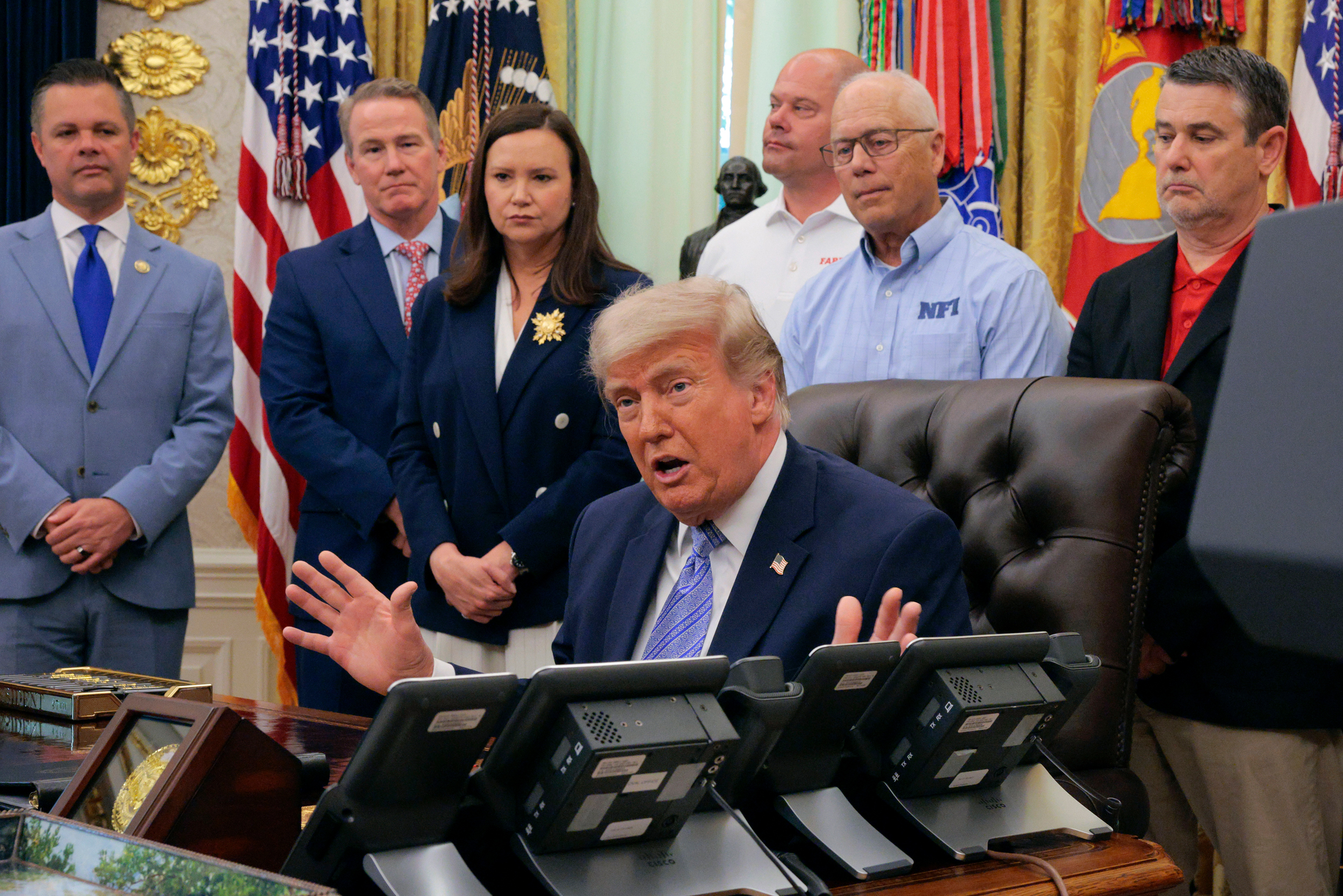


President Donald Trump said new regulatory rollbacks on chemical refrigerants will reduce the prices consumers pay for groceries and will not impact the environment. However, U.S. chemical, refrigeration and air-conditioning manufacturers said the changes will raise prices and his administration’s own projections show that greenhouse gas pollution will increase.
The primary rollback, announced by Trump and Environmental Protection Agency Administrator Lee Zeldin this month, extends the timeline for manufacturers of air conditioners and other equipment to scale back production of devices that use high-global-warming-potential hydrofluorocarbons as refrigerants. The change pushes back the timeline by several years for most equipment.
Hydrofluorocarbons, or HFCs, are synthetic chemical refrigerants that can be hundreds to thousands of times more effective at warming Earth’s atmosphere on a pound-for-pound basis than carbon dioxide. Current EPA regulations require equipment manufacturers to gradually make fewer devices like air conditioners and refrigeration equipment that use the most climate-damaging HFCs and instead use more climate-friendly refrigerants. The rules stem from the American Innovation and Manufacturing Act of 2020, which Trump signed during his first term as president.
An EPA assessment of the rule change concluded that cumulative HFC emissions will increase by 68 million metric tons of carbon dioxide equivalent by 2050 compared with what they would have been without the rule change.
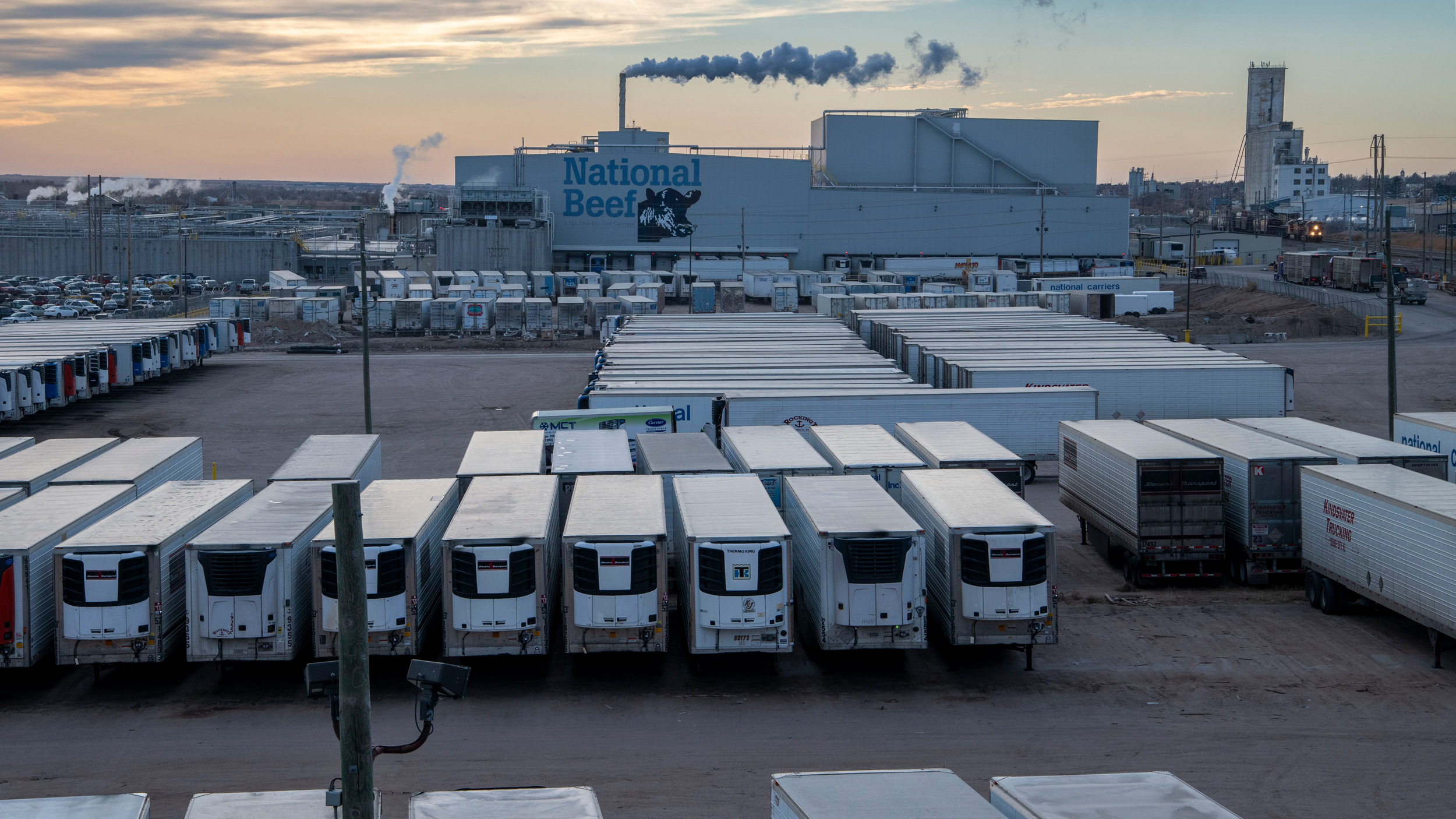
A second proposed change announced by Trump and Zeldin last week would exempt transport companies from repairing HFC leaks in refrigeration equipment used on trucks. The EPA estimated both changes would save Americans more than $2.4 billion over the next quarter-century.
“It’s ridiculous, unnecessary and costly,” Trump said of the existing regulations during a public announcement at the White House last week.
However, air conditioning and refrigeration manufacturers opposed the rollback.
“I don’t see how it saves any money,” said John Hurst, executive director of the Alliance for Responsible Atmospheric Policy, an industry group representing chemical refrigerant producers and cooling equipment manufacturers. “It’s not a cost reduction, it’s actually going to be a cost add.”
Hurst said the rule changes will disrupt what had been an orderly transition to newer, more climate-friendly technology under the AIM Act.
“American manufacturers did what Congress and the first Trump Administration asked them to do,” Hurst said in a written statement. “They invested in new equipment, new refrigerants, new production lines, and American workers. The Administration has now changed course in a way that weakens those investments.”
Costs will increase, industry experts said, because the AIM Act included additional measures to cut back production of high-global-warming-potential HFCs.
“This rule works against basic supply and demand,” Stephen Yurek, president and chief executive of the Air-Conditioning, Heating, and Refrigeration Institute (AHRI), said in a written statement.
Increased demand for the limited refrigerants could cost the refrigeration industry nearly $8 billion in refrigerant costs, Heating, Air-conditioning & Refrigeration Distributors International, an industry group, said in a written statement opposing the rule change.
When Trump signed the AIM Act in 2020, U.S. manufacturers supported the bill, which would enable the U.S. to ratify the Kigali Amendment to the Montreal Protocol, an international environmental agreement to reduce the production and use of HFCs.
U.S. ratification of the Kigali Amendment would create 33,000 U.S. manufacturing jobs and increase U.S. exports by $5 billion per year while reducing imports by nearly $7 billion annually, according to an economic analysis published in 2018 by AHRI and the Alliance for Responsible Atmospheric Policy.
This story is funded by readers like you.
Our nonprofit newsroom provides award-winning climate coverage free of charge and advertising. We rely on donations from readers like you to keep going. Please donate now to support our work.
Donate NowAn economic and environmental assessment of the rule change released by the EPA noted the potential for cost increases resulting from limiting the supply of high-global-warming-potential HFCs while simultaneously increasing demand for them. However, the agency did not quantify these costs or include them in its final analysis.
“We are not able to quantify all of these tradeoffs in this document,” the agency noted. “The estimates provided are not totally representative of the net effects of this rulemaking.”
Global HFC emission reductions under the Kigali Amendment were projected to prevent 0.5 degrees Celsius of additional warming by 2100. Such a difference would have real impact because every fraction of a degree of warming fuels more extreme weather, with consequences ranging from lost crops to destroyed homes.
The first rule change is “a reckless step backward for climate action,” Avipsa Mahapatra, climate campaign director for the Environmental Investigation Agency US, a nonprofit based in Washington, D.C., said in a written statement.
Mahapatra added that the still pending rule change that focuses on HFC leaks from refrigerated trucks would be a further blow to emission reduction efforts.
“Refrigerated trucks and trailers are among the leakiest users of HFC refrigerants,” Mahapatra said. “Exempting these systems from leak repair requirements weakens one of the most practical and cost-effective tools for implementation of the AIM Act.”
Without mentioning that he signed the AIM Act in 2020, Trump suggested he may now try to roll back the law entirely so that changes made by the current administration will endure.
We’ve “got to get rid of the law that was signed quite a while ago and we have to get rid of that because ultimately we want to make [the changes] permanent,” he said.
About This Story
Perhaps you noticed: This story, like all the news we publish, is free to read. That’s because Inside Climate News is a 501c3 nonprofit organization. We do not charge a subscription fee, lock our news behind a paywall, or clutter our website with ads. We make our news on climate and the environment freely available to you and anyone who wants it.
That’s not all. We also share our news for free with scores of other media organizations around the country. Many of them can’t afford to do environmental journalism of their own. We’ve built bureaus from coast to coast to report local stories, collaborate with local newsrooms and co-publish articles so that this vital work is shared as widely as possible.
Two of us launched ICN in 2007. Six years later we earned a Pulitzer Prize for National Reporting, and now we run the oldest and largest dedicated climate newsroom in the nation. We tell the story in all its complexity. We hold polluters accountable. We expose environmental injustice. We debunk misinformation. We scrutinize solutions and inspire action.
Donations from readers like you fund every aspect of what we do. If you don’t already, will you support our ongoing work, our reporting on the biggest crisis facing our planet, and help us reach even more readers in more places?
Please take a moment to make a tax-deductible donation. Every one of them makes a difference.
Thank you,

Phil McKenna
Reporter, Boston
Phil McKenna is a Boston-based reporter for Inside Climate News. Before joining ICN in 2016, he was a freelance writer covering energy and the environment for publications including The New York Times, Smithsonian, Audubon and WIRED. Uprising, a story he wrote about gas leaks under U.S. cities, won the AAAS Kavli Science Journalism Award and the 2014 NASW Science in Society Award. Phil has a master’s degree in science writing from the Massachusetts Institute of Technology and was an Environmental Journalism Fellow at Middlebury College.