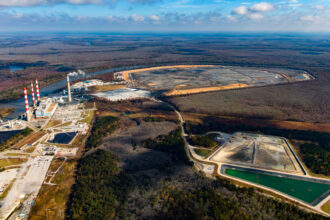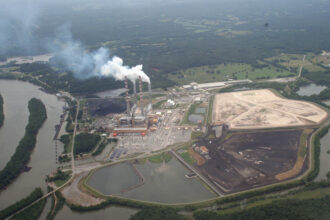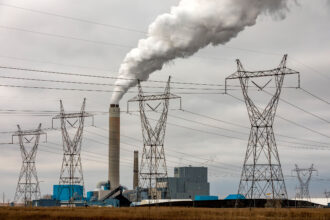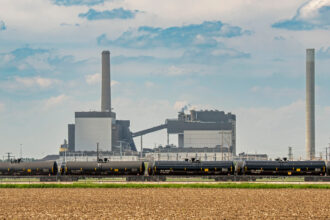


At a virtual public comment hearing hosted by the U.S. Environmental Protection Agency on Thursday, a long line of environmental advocates voiced strong opposition to proposed new regulations weakening requirements that utilities must follow in cleaning up toxic coal ash residue at hundreds of sites across the country at which coal was burned to produce electricity.
“The Trump administration has jeopardized the nation’s drinking water supplies as a favor to polluters,” Lisa Evans, senior counsel at Earthjustice and a former EPA attorney, said in a statement. “It’s just not right.”
The Trump administration announced in April that it would repeal a rule put in place in 2024 by the Biden administration’s EPA that required utilities to monitor coal ash sites at inactive coal plants. The Trump EPA also said it would loosen requirements for protecting groundwater near those sites. Now the Trump administration wants to rely on states for coal ash monitoring and enforcement, and enable them to bypass national standards in some cases.
In announcing the new proposed regulations in April, EPA Administrator Lee Zeldin called them “commonsense changes” and said they “reflect EPA’s commitment to restoring American energy dominance, strengthening cooperative federalism, and accommodating unique circumstances at certain [coal ash] facilities.” ‘
The proposed rule would exempt sites where coal ash is stored from regulation, and permit coal-fired power plant owners to minimize, delay or avoid dealing with the coal ash at their facilities.
Coal ash, or coal combustion residuals, is the mineral residue left after burning coal to generate electricity. It contains potentially toxic levels of substances like mercury, arsenic and lead, all of which are associated with human health problems, including cancer.
More than half of the fine, gray, powdery residue is used each year to create concrete, drywall or other industry applications. This is often called “beneficial use” by the coal industry.
A 2022 study by Earthjustice and other environmental groups found that more than 90 percent of coal power plants across America were contaminating groundwater via coal ash residues.
At Thursday’s virtual public comment session, required by law, a spokesman for the American Coal Ash Association lauded the Trump rollbacks as the right move forward.
John Ward, whose trade group focuses on advancing the management of materials made from coal ash, said the association is in support of the EPA’s move to eliminate criteria defining “beneficial use” for coal ash. He called coal ash an underutilized domestic mineral resource. Coal ash can be useful in the production of cement, wallboard, agriculture and potentially critical minerals, he said.
Coal ash can improve concrete strength and durability, while supporting the supply chain for critical construction materials, said Leah Pilconis, vice president of government affairs and general counsel at the American Cement Association.
That trade group also supports the EPA’s proposed provision changes. Among them: redefining coal ash for cement manufacturing not as an industrial waste but instead as a part of the cement production process. The proposed changes come as supply of coal ash declines, Pilconis said, and could improve access to legacy coal combustion residue.
But beyond the coal ash used to make cement and other materials, vast quantities of the toxic residue are kept on-site at both active and retired coal plants, where it’s often covered with water or soil to prevent it from contaminating the air or waterways. The EPA has long had concerns about these sites: In 2002, the agency reported that improper lining on these coal ash ponds and landfills allow toxins to leach into the groundwater.
That threatened nearby water supplies, the agency found, by contaminating groundwaters above federal safety standards.
In their comments on Thursday, environmental groups said the EPA’s proposed rule guts protections against the dangers of burning coal and puts the nation’s groundwater at risk. Existing rules were built upon years of science, litigation and documented harm, they said.
Jennifer Cassel, another attorney with Earthjustice, said water near coal ash becomes thick with pollution, like a tea that is steeped for too long.
Cassel has been working on protecting communities from coal ash pollution for 15 years and said rain and hurricanes amplified by climate change have exacerbated these threats. And those who live near coal ash dumps, she said, continue to discover cancer at a rate that makes them think, “This cannot be normal.”
“EPA, you know the record,” Cassel said. “You made the record.”
Kristina Zierold, a professor at the University of Mississippi, said she has found that children exposed to coal ash are more likely to suffer from depression and have poorer school performance than children who aren’t exposed.
Zierold said she has been researching the health impacts of coal ash on children since 2011 and was awarded a National Institutes of Health grant in 2015 to investigate coal ash and neurobiological health in children six to 14 years old.
She and her research team utilized air pollution and dust sampling in the homes of children to collect coal ash and tested children for neurobehavioral and mental health conditions in multiple ways.
This story is funded by readers like you.
Our nonprofit newsroom provides award-winning climate coverage free of charge and advertising. We rely on donations from readers like you to keep going. Please donate now to support our work.
Donate NowIf a child performs poorly in school, that can have cascading effects through adulthood, Zierold said. Depression in children can lead to poor social interaction, lack of learning and in some cases suicide, she said.
“Do you want your children playing on coal ash in parks and playgrounds?” Zierold asked. “Do you want them breathing it in and ingesting it? I don’t.”
Brianna Knisley, the director of public power campaigns at Appalachian Voices, said
the 2008 Kingston Fossil Plant coal ash spill was one of the worst industrial disasters in U.S. history. It’s an example of what happens when the EPA leaves coal ash management up to state regulators and utilities, she said.
The 900 workers who cleaned up the spill were denied protective gear and told the coal ash they were working to remove was clean enough to eat. Hundreds of workers became sick and dozens are dead, Knisley said.
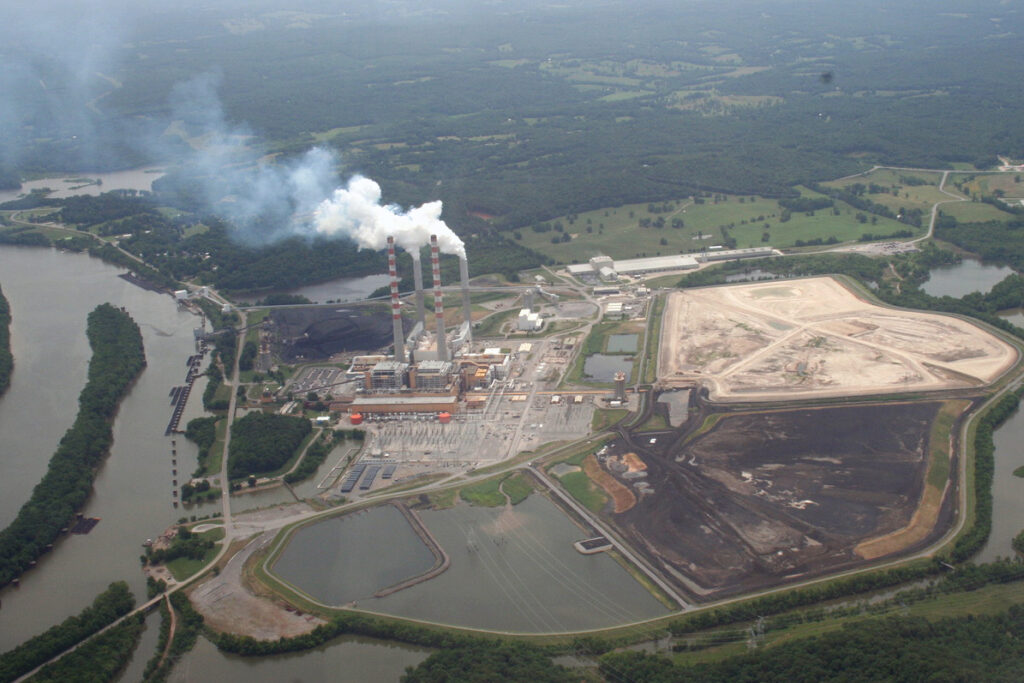
Angie Mummaw, an organizer with Appalachian Voices, who lives near the Cumberland Fossil Plant in Tennessee, said she’s tired of communities like hers being treated as sacrifice zones while the coal industry asks for permanent loopholes instead of cleaning up the messes they’ve created.
Knisley has worked with communities where coal ash was used to fill children’s ball fields and seen Tennessee Valley Authority waste piles of the toxic ash piled up behind a public playground, open to the wind. The Tennessee Valley Authority did not immediately respond to questions from Inside Climate News.
“This is coal ash management without strong federal regulation and enforcement,” Knisley said. “States and utilities are not going to keep communities safe.”
A spokesperson for the Tennessee Valley Authority (TVA) said in the aftermath of the 2008 dike failure that led to a massive coal ash spill at the Kingston Fossil Plant in Roane County, the authority committed to becoming an industry leader in safely managing coal ash. It pioneered technology to ensure TVA coal ash sites are safe, secure and protective of human health and the environment, the spokesperson said, while enabling future beneficial use of the coal ash.
About This Story
Perhaps you noticed: This story, like all the news we publish, is free to read. That’s because Inside Climate News is a 501c3 nonprofit organization. We do not charge a subscription fee, lock our news behind a paywall, or clutter our website with ads. We make our news on climate and the environment freely available to you and anyone who wants it.
That’s not all. We also share our news for free with scores of other media organizations around the country. Many of them can’t afford to do environmental journalism of their own. We’ve built bureaus from coast to coast to report local stories, collaborate with local newsrooms and co-publish articles so that this vital work is shared as widely as possible.
Two of us launched ICN in 2007. Six years later we earned a Pulitzer Prize for National Reporting, and now we run the oldest and largest dedicated climate newsroom in the nation. We tell the story in all its complexity. We hold polluters accountable. We expose environmental injustice. We debunk misinformation. We scrutinize solutions and inspire action.
Donations from readers like you fund every aspect of what we do. If you don’t already, will you support our ongoing work, our reporting on the biggest crisis facing our planet, and help us reach even more readers in more places?
Please take a moment to make a tax-deductible donation. Every one of them makes a difference.
Thank you,

Arcelia Martin
Reporter, Texas Renewables
Arcelia Martin is an award-winning journalist at Inside Climate News. She covers renewable energy in Texas from her base in Dallas. Before joining ICN in 2025, Arcelia was a staff writer at The Dallas Morning News and at The Tennessean. Originally from San Diego, California, she’s a graduate of Gonzaga University and Columbia University Graduate School of Journalism.