

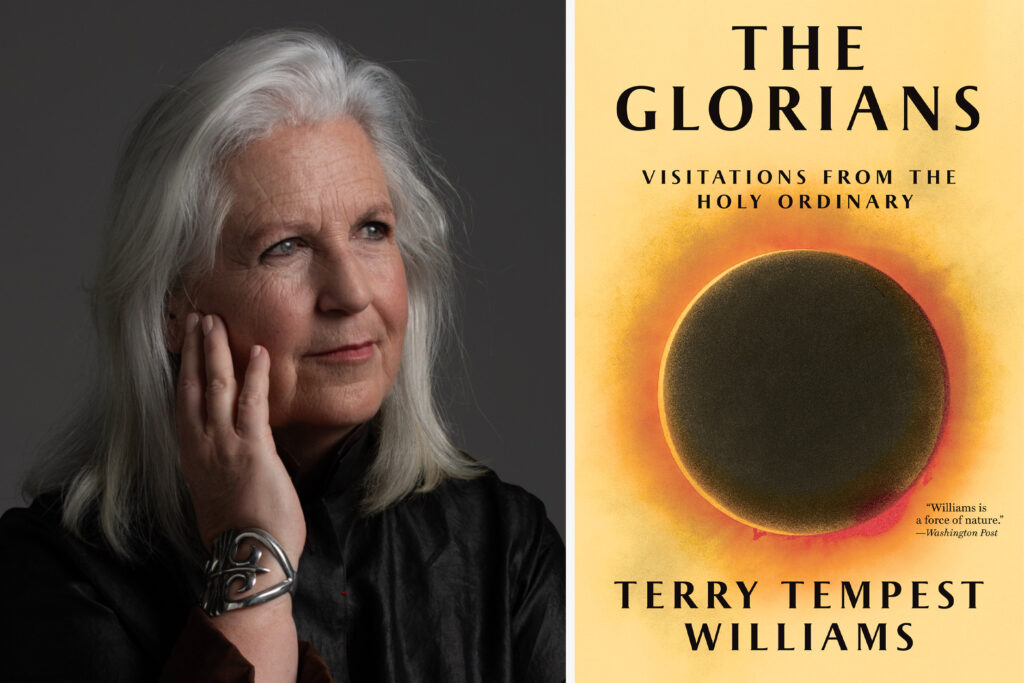
From our collaborating partner Living on Earth, public radio’s environmental news magazine, an interview by host Steve Curwood with author Terry Tempest Williams.
At first glance, a desert may appear barren. But it’s actually a place teeming with life. There are coyotes, wind in the cottonwood trees, a never-ending night sky, and once in a while, water that comes and goes with ferocity.
The Utah desert, with its raw beauty, has long been a muse for writer Terry Tempest Williams, who lives in Castle Valley. Her environmental classic “Refuge: An Unnatural History of Family and Place” interwove a story of environmental crisis with her mother’s battle with cancer.
In her 2026 book, “The Glorians: Visitations from the Holy Ordinary,” Williams explores miraculous moments of grace that call for our attention, even in spaces that may at first seem unremarkable. When Williams joined us for an online Living on Earth book club event, we asked her to start by reading from a passage near the beginning of her book, one of her first encounters with a “Glorian”:
In late spring, fierce winds converge in our valley in the Red Rock Desert, a reliable occurrence that has shaped this erosional landscape. The winds are particularly strong one morning in May. I am outside admiring the coyote willow draped in magenta flowers, each one resembling a snapdragon blossom, only larger than the length of my index finger.
Suddenly, in a swoop of wind, our stone patio is strewn with flowers. They are too lovely to let lie. So I decide to gather them and bring them inside. I get a basket from the kitchen. When I return to the patio, the wind has blown most of them away. I bend down to pick one up, only to see it move. Not only does it move—it has legs. I realize the blossom is being transported by an ant. This wee little being appears as a small black boat with a large pink sail above its six-legged body.
I follow it. For close to half an hour, I walk behind the ant as it carries a petal clutched in its mandibles and moves across the patio at a quick and steady pace. It continues down the stone path from our porch, then sets off across the red sand, where I can see in the distance a thriving ant colony emerging from the desert floor like a raised fist. Each time a breeze comes up, threatening to blow the tiny ant over, a pair of attending ants appear to hold the ant steady, then disappear. Each time the ant is about to cross a perilous path, facing cracks between stones, again a pair of ants appear to ferry the ant across the chasm, and again disappear.
The ant continues on its mission, projecting its strange shadow ahead as it approaches a wide patch of prickly pear. I think surely this will be its demise. The flower is impaled by a spine, and then miraculously three ants appear to help lift the blossom above, around and over the cacti, and once on open ground, vanish. When the ant finally arrives at the ant colony I watch it slowly climb up the hill with the magnificent blossom intact. The ant reaches its destination, pauses, then lays the flower down at the entrance of its home, where it is instantly met by dozens of workers, who, in a frenzy of purpose, cut the flower into tiny pieces, each one carrying a part of the pink blossom down into their chambers, where I imagine they are lining a pathway to the queen. This is a Glorian. The ant carrying the coyote blossom across the desert is a Glorian. A Glorian is an encounter. A Glorian is a meeting with élan vital. A Glorian is a moment of grace.
This conversation with Terry Tempest Williams has been edited for length and clarity. The full interview is available at the top of the page.
STEVE CURWOOD: The last time we talked to you, we discussed your book, “Erosion,” and it was our last big live event before the pandemic, at the Cambridge Public Library. What’s happened in your life since then?
TERRY TEMPEST WILLIAMS: You know, it’s really bookended by you. It’s so interesting how life holds itself. What’s happened to me? We weathered the pandemic. We now have a million citizens that we lost. All of us know someone that passed during this time.
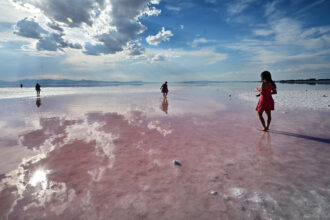
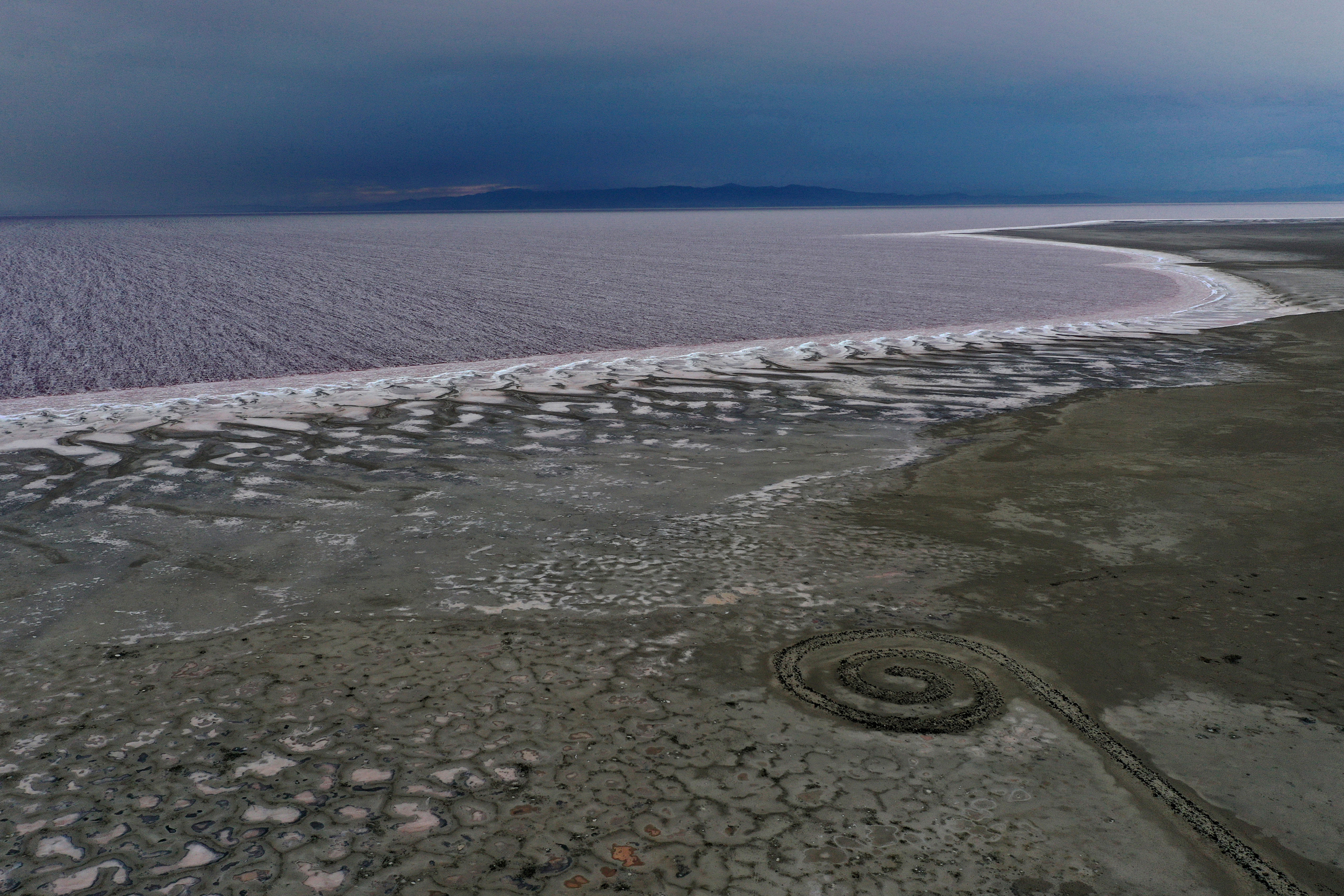
I’ve been teaching at the Harvard Divinity School, and we’ve been able to bring 20 students to Great Salt Lake as it’s retreating. It was so meaningful to see these students from Cambridge have 10 days in the wild where they could enter “Sun Tunnels” by Nancy Holt, or walk through Robert Smithson’s “Spiral Jetty,” but most importantly, into the waters to feel the power of Great Salt Lake as our sacred mother, which our brothers and sisters in the Ute Nation have admonished us to call her.
We’ve also been through a lot together. We have a president who is beyond politics, and alongside extraordinary cruelty we have seen extraordinary compassion. At this moment of uncertainty, where there’s so much beauty that remains, this is a place where we can stand steady.
CURWOOD: This is not an easy place, though, to stand steady, is it?
WILLIAMS: No, it isn’t, and change is all around us. Living in an erosional landscape where we are shaped by wind, water and time, there’s no expectation that things aren’t going to change, and that might make it a little bit easier.
DOERING: You write about these night walks that you take in the desert, and you have this wonderful passage: “Deserts are nocturnal landscapes alive with creatures aligned with darkness; I move among them.” What is it about this walking at night practice that really captivates you?
WILLIAMS: It really was out of necessity, because during the pandemic in the summer it was so hot. I think we had 52 days of blistering heat; it got as high as 116 F, and you can’t walk during the day when it’s that hot. So I thought, I can walk at night.
What I learned is that our eyes adapt to darkness, especially in the light of a full moon, and the red rocks become blue. You see the eye shine of deer. If you’re lucky enough, you see the eye shine of a coyote—red—and the eye shine of a jackrabbit that is red like flames. You become so familiar with the changing sky, depending on the time of night that you go, that you begin to feel very comfortable orienting around a rotating sky. Even the Milky Way rotates, and I had never experienced that before.
I think it was about my eyes adjusting to the dark, how the Milky Way becomes dimensional. It wasn’t just a smudge of stars, but actually you could almost pull it out into a third, fourth dimension. It was very wild.
I had a partner, Bianca, and she was in Vermont, I was in Utah. We ended up doing night walks together and writing letters to one another, audio letters, and I could hardly wait till the next morning to find out what my companion, my night walk companion saw. Where I was seeing deer, she was seeing cows. Where I was seeing the Milky Way, she was imagining it. So I think we found our people, whether they were the pods in proximity or our night walking companions.
This story is funded by readers like you.
Our nonprofit newsroom provides award-winning climate coverage free of charge and advertising. We rely on donations from readers like you to keep going. Please donate now to support our work.
Donate NowCURWOOD: How fair is it to say that you find Glorians everywhere, or that we can find them everywhere?
WILLIAMS: I think they are everywhere, if we are present, if we slow down enough to see, if we favor our senses and if we recognize the yearning that we have for other people, other species, moments of grief, moments of compassion—the full range, I think, is there for us.
Glorians is a book where I didn’t hold back, because I think we’re in a time where we cannot afford to. This is a book where I took risks that in other books I have not, because I think that’s what this moment warrants.
I talk about a global prayer that was offered; I remember calling Jonah Yellowman, who is a medicine person in Monument Valley—Dine, Navajo—and I said, “Jonah, do you want to join me? There is this global prayer that’s happening.” He said yes, and it happened at 11 o’clock on a Sunday.
As I was walking out where I say my prayers on our porch, I faced South Round Mountain, which is an igneous volcanic plug. For comfort and solidarity with my grandmother—whom I love, who taught me about dreams—I held this amethyst crystal in my hand as the prayer was internal; it was just that people would stand in prayer around the world at this moment for those in the pandemic, and those who had this virus.
My eyes were closed. I felt this fire burning inside Round Mountain, and in my mind’s eye, I could see a small flame coming toward me. And would you believe me if I told you it entered my heart, and all of a sudden my entire body felt like it was on fire, my hands were so hot that I opened my eyes and I opened my hand where my grandmother’s hand stone—that’s what she called it—I could see where that crystal had been burned.
Now, that is not a story I would normally tell, except to those closest to me. That is a story that normally I never would have written. But I trust that now, because I think we are evolving as a species, we realize these issues that are so confounding, and that we are confronting—be it climate, be it ICE in our neighborhoods, or be it pandemic, fire, or floods—we do have the capacity to create a new way of being, to create a new way of seeing.
To me this evolution is also a Glorian. It is a moment where our collective focus can change everything. And I’m not talking about hope. I think there’s something deeper than hope. For me, that is engagement—being present wherever we call home. Then we will know what to do.
About This Story
Perhaps you noticed: This story, like all the news we publish, is free to read. That’s because Inside Climate News is a 501c3 nonprofit organization. We do not charge a subscription fee, lock our news behind a paywall, or clutter our website with ads. We make our news on climate and the environment freely available to you and anyone who wants it.
That’s not all. We also share our news for free with scores of other media organizations around the country. Many of them can’t afford to do environmental journalism of their own. We’ve built bureaus from coast to coast to report local stories, collaborate with local newsrooms and co-publish articles so that this vital work is shared as widely as possible.
Two of us launched ICN in 2007. Six years later we earned a Pulitzer Prize for National Reporting, and now we run the oldest and largest dedicated climate newsroom in the nation. We tell the story in all its complexity. We hold polluters accountable. We expose environmental injustice. We debunk misinformation. We scrutinize solutions and inspire action.
Donations from readers like you fund every aspect of what we do. If you don’t already, will you support our ongoing work, our reporting on the biggest crisis facing our planet, and help us reach even more readers in more places?
Please take a moment to make a tax-deductible donation. Every one of them makes a difference.
Thank you,