

The first warning reached the Florida Fish and Wildlife Conservation Commission before a single sloth had arrived in Orlando.
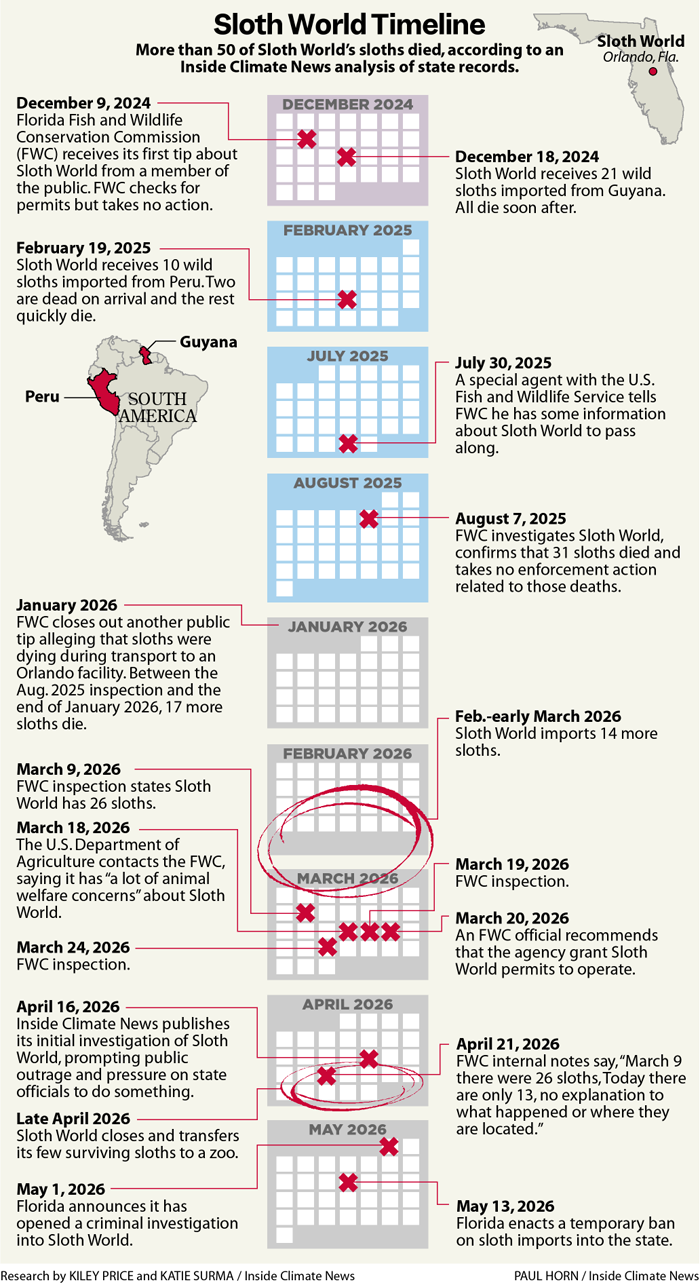
On Dec. 9, 2024, a member of the public called the agency after seeing advertisements for a new business called Sloth World. The caller said owner Benjamin Agresta was hiring employees and telling prospective workers that the facility’s first shipment of the tree-dwelling mammals would arrive within days.
An FWC employee found no active permits associated with Agresta, Sloth World or the Orlando address where the attraction was being developed.
“So just wanted to pass along to you,” the employee wrote in an internal email the same day to an agency investigator, who went out to take a look—eight months later, after at least 31 of the sloths had died.
Months of emails, released to Inside Climate News through a public records request, offer new insight into what the state agency regulating businesses with exotic animals did to try to avert deaths of dozens of sloths on their watch.
Virtually nothing.
After Inside Climate News broke the story in April, the business shuttered, transferring its few surviving sloths to a zoo. The state opened a criminal investigation into the company, halted sloth imports for two months and tightened its licensing requirements. But behind the mass deaths was an agency that saw no need to intervene.
FWC declined a request for an interview and did not respond to a lengthy list of questions, including what authority the agency has to act when there are potential animal-welfare concerns with exotic wildlife.
Read More

At ‘Sloth World’ in Florida, Wild Sloths Have Died by the Dozens
By Katie Surma, Kiley Price
In a prior email to Inside Climate News about Sloth World, an FWC spokesperson said the business’s actions “did not meet the legal standard for animal cruelty” under Florida law and that FWC referred possible zoonotic disease deaths to the federal government.
“There was no legal basis for enforcement action or closure, and while the deaths of these animals are tragic, subsequent inspections found the facility compliant with care and housing standards,” the spokesperson wrote in an April 30 email.
Florida Gov. Ron DeSantis’ office did not respond to questions from Inside Climate News about whether he would support greater authority for the agency to act in such cases or tighter controls on the sloth trade.
“I know FWC got involved and I think that they’re going to have to rectify whatever was the matter,” DeSantis said at an April press conference.
A Mounting Body Count
The first shipment of wild sloths arrived from Guyana at the business nine days after the initial tip in December 2024. Agresta’s employee Peter Bandre showed up at Sloth World’s Orlando facility several days before the animals were due to land and discovered the building—an empty warehouse—was unprepared, according to FWC emails and records, and videos of the interior obtained by Inside Climate News.
The building lacked adequate heating during an unusually cold period in central Florida, a serious problem for sloths. Deeply sensitive to environmental changes, the tropical mammals require high humidity and warm temperatures. Bandre would later tell investigators that it was too late to cancel the imports. The sloths arrived. The outcome was catastrophic. All 21 were soon dead.
The 10 in the next shipment died, too.
Internal FWC notes prepared in March 2026 say that the agency was not informed and that notification of the mass deaths was not required under state law. Instead, regulators learned about the deaths only after receiving a complaint.
It’s unclear who made that complaint or when it was filed. But in an email dated July 30, 2025, a special agent with the U.S. Fish and Wildlife Service’s Office of Law Enforcement told FWC investigator Rick Brown: “If you get a chance give me a call sometime this next week to discuss ‘Sloth World’ over off I-Drive. Have some info I’d like to pass along from a source.”
Brown conducted an inspection on Aug. 7, 2025. During questioning, Bandre blamed the December cold snap and a failed heating system for the deaths. Brown noted in his report that the facility had already lost two veterinarians in less than a year and that there were only six surviving sloths at the facility that day.
There were seven other sloths the inspection failed to account for. By the date of the inspection, Bandre and Agresta had imported 44, according to state import records in the FWC’s possession. The inspection report mentioned 37 and gave no indication that Brown ever asked about the seven other sloths. The FWC did not respond to a question about this discrepancy.
The August inspection did not result in enforcement action for the deaths. In a later email to a colleague about his inspection, Brown said he found no evidence of criminal intent and that the business had made improvements to prevent more deaths.
“Revocation of licenses usually involves a finding of some form of intentional mal-conduct or demonstration of an inability/unwillingness to comply with captive wildlife rules,” Brown wrote.
Within 10 days of that August inspection, at least two more sloths were dead, necropsy records prepared by the state’s agriculture agency show. Sloth World continued importing animals—and the body count mounted, according to import records and necropsy reports.
The necropsy reports from August and the rest of that year detail the grim ending to the sloths’ lives: diarrhea, hair loss, excessive thirst, disorientation, a suspected “back/neck injury,” and “suspected emaciation and weakness from stress of travel.” The records also reveal that multiple animals carried viral infections.
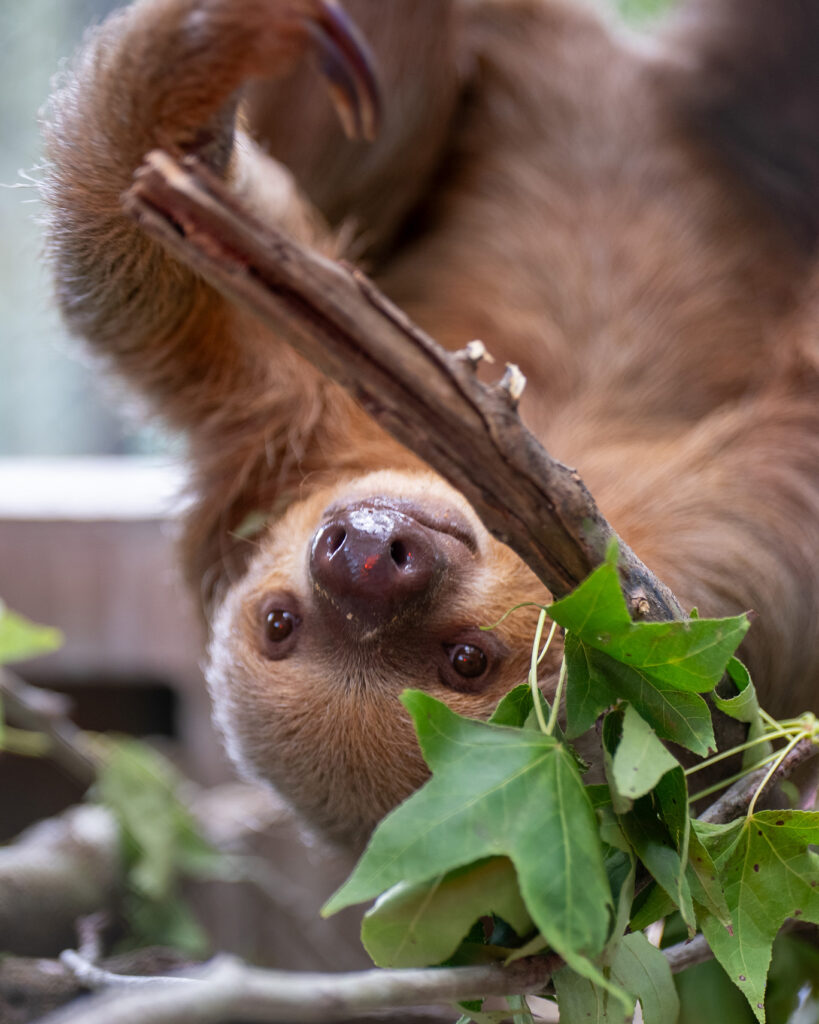
Despite mounting red flags, investigators closed out a tip in January 2026 alleging that an Orlando facility held roughly 80 sloths and that animals were dying during transport.
“Please close this complaint out. The agent recently learned of previous issues that have already been investigated and cleared,” Brown wrote to an FWC colleague.
In reality, the crisis was escalating. Necropsy reports show that between Brown’s August 2025 inspection and the end of January 2026, at least 17 sloths died.
“Severely sunken” eyes, a necropsy report from January 2026 said. “Spinal hemorrhage may reflect acute trauma,” read another, from December 2025.
In February and early March, Sloth World imported 14 more sloths.
On March 7, Bandre informed regulators he was no longer affiliated with Sloth World—Agresta had fired him. Days later, FWC investigators learned that Sloth World’s then-veterinarian had warned Bandre four-and-a-half months earlier that pathologists conducting necropsies on the sloths believed they might be dealing with a novel virus. FWC officials swapped emails discussing animal cruelty statutes and captive wildlife regulations, and federal officials began raising alarms, too.
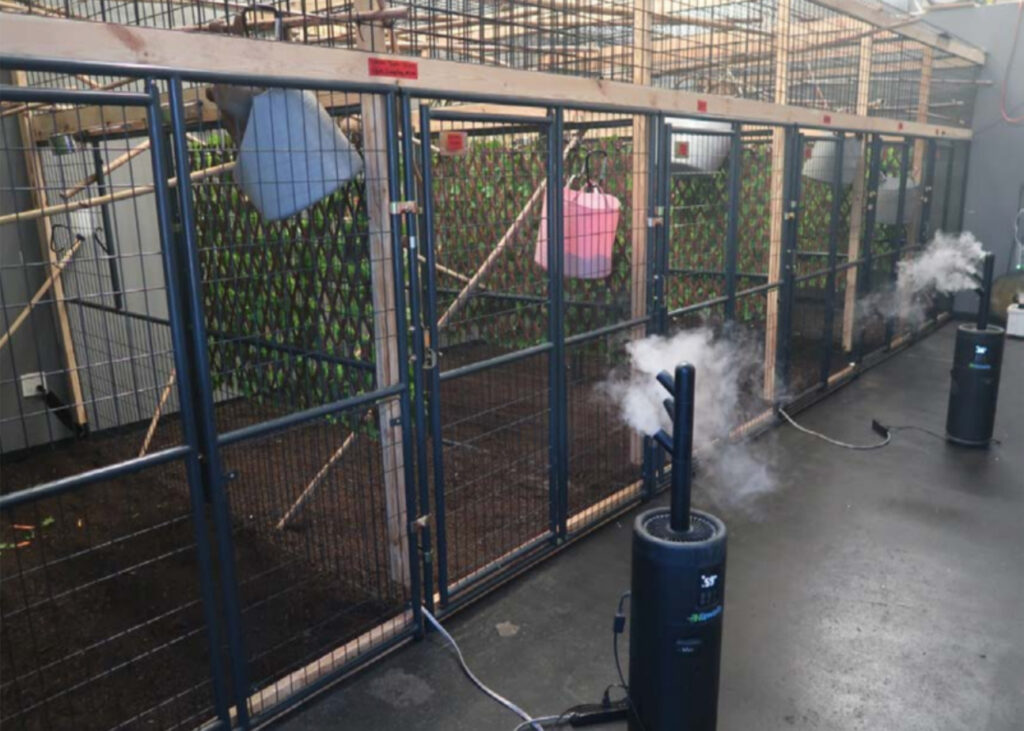
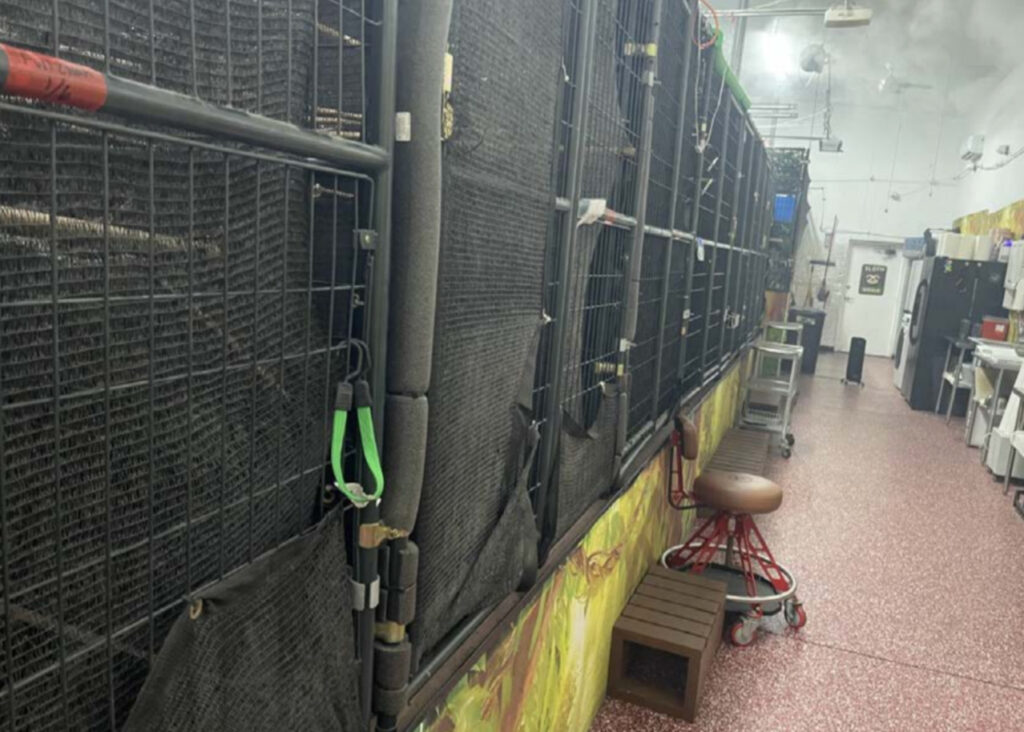
Photos from a Florida Fish and Wildlife Conservation Commission inspector show Sloth World’s warehouses in February and March. Credit: Courtesy of Florida Fish and Wildlife Conservation Commission
On March 18, officials with the U.S. Department of Agriculture’s Animal Care contacted the FWC, saying they had “a lot of animal welfare concerns” about the business and wanted to share information that could support a state investigation.
“USDA is somewhat at a standstill right now as they are not yet licensed with us yet,” the email said.
A USDA spokesperson told Inside Climate News that the agency had no authority to act at the time because Sloth World was not yet exhibiting animals to the public and did not hold an Animal Welfare Act license. The spokesperson said the USDA “cooperates with state partners when concerns arise about the welfare of exhibited animals” and shared information it received about Sloth World with FWC.
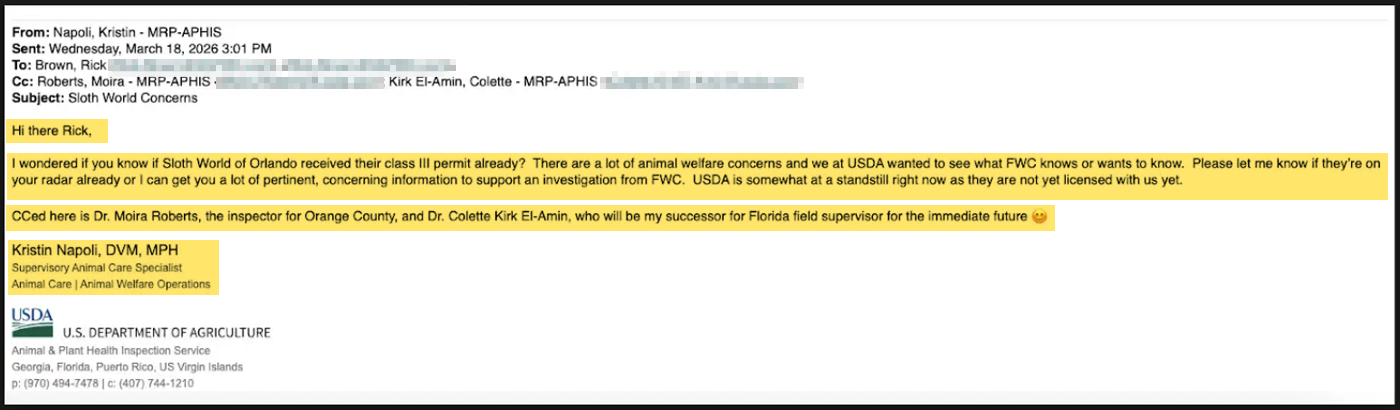
The USDA’s March 18 communication to FWC included an internal email from the agency’s veterinarian detailing allegations from Bandre. Among them: Though Sloth World never officially opened to the public, Agresta had already raked in roughly half a million dollars in advance ticket sales, according to Bandre.
“Mr. Agresta obviously puts profit over the [animals’] health and well-being,” the USDA vet said in the email. “He even suggested to Pete to burn a pregnant female that was not exhibiting health signs yet to get rid of the virus.”
Asked for comment, neither Agresta nor Bandre responded.
Throughout March, FWC carried out more inspections. Officials described enclosures decorated with “fake greenery” on wooden lattices and counted 28 sloths. Once again, they found no violations of Florida law.
This story is funded by readers like you.
Our nonprofit newsroom provides award-winning climate coverage free of charge and advertising. We rely on donations from readers like you to keep going. Please donate now to support our work.
Donate NowAlthough Bandre was no longer with Sloth World, he contacted Brown, the FWC inspector, on March 23 to tell him more sloths had died.
“I believe there are 6 additional animals deceased in the refrigerator at the moment with 4 others showing symptoms,” Bandre wrote.
Mary Hollingsworth, faculty director of the Animal Law & Policy Clinic at Harvard Law School and a former senior trial attorney with the U.S. Department of Justice’s Environment & Natural Resources Division, said it’s not uncommon for state authorities to abdicate “their responsibilities to protect animals that they have the authority to protect.” Common reasons: politics, an agency choosing other priorities or state officials deferring to the federal government, even when federal agencies can’t or don’t act.
“I cannot say which, if any, of these excuses are relevant here,” Hollingsworth told Inside Climate News in a written statement. “But it appears that Florida state officials had the authority, the knowledge, and the opportunity to take action to protect the many sloths who had the misfortune of ending up at Sloth World.”
After Bandre was fired, the state permits in his name allowing Sloth World to import and display wildlife left with him, according to March emails between Bandre and FWC officials. Agresta submitted an application that month for a new exhibition license.
“It is my recommendation that after consulting with Inv. Rick Brown and Lt. Urban that we issue Agresta the permits so he can apply for his USDA permits,” a FWC official wrote in a March 20 email.
Another sloth died the next day. It suffered from mouth ulcers and diarrhea, according to its necropsy report. Within a few days, two more animals were dead.
On April 16, Inside Climate News published its initial investigation, prompting public outrage and pressure on state officials to do something. Internally, FWC documented yet more reasons for concern.
“March 9 there were 26 sloths, Today there are only 13, no explanation to what happened or where they are located,” said FWC internal notes dated April 21. The notes also said that another Sloth World veterinarian had quit.
Still, the agency’s conclusion remained unchanged.
“Rick conducted his inspection,” the notes said. “No Captive Wildlife – FWC violations observed.”
“Rick,” the notes said, “will closely monitor the situation.”
About This Story
Perhaps you noticed: This story, like all the news we publish, is free to read. That’s because Inside Climate News is a 501c3 nonprofit organization. We do not charge a subscription fee, lock our news behind a paywall, or clutter our website with ads. We make our news on climate and the environment freely available to you and anyone who wants it.
That’s not all. We also share our news for free with scores of other media organizations around the country. Many of them can’t afford to do environmental journalism of their own. We’ve built bureaus from coast to coast to report local stories, collaborate with local newsrooms and co-publish articles so that this vital work is shared as widely as possible.
Two of us launched ICN in 2007. Six years later we earned a Pulitzer Prize for National Reporting, and now we run the oldest and largest dedicated climate newsroom in the nation. We tell the story in all its complexity. We hold polluters accountable. We expose environmental injustice. We debunk misinformation. We scrutinize solutions and inspire action.
Donations from readers like you fund every aspect of what we do. If you don’t already, will you support our ongoing work, our reporting on the biggest crisis facing our planet, and help us reach even more readers in more places?
Please take a moment to make a tax-deductible donation. Every one of them makes a difference.
Thank you,

Katie Surma
Reporter, Pittsburgh

Kiley Price
Reporter
Kiley Price is a reporter at Inside Climate News, with a particular interest in wildlife, ocean health, food systems and climate change. She writes ICN’s “Today’s Climate” newsletter, which covers the most pressing environmental news each week.
She earned her master’s degree in science journalism at New York University, and her bachelor’s degree in biology at Wake Forest University. Her work has appeared in National Geographic, Time, Scientific American and more. She is a former Pulitzer Reporting Fellow, during which she spent a month in Thailand covering the intersection between Buddhism and the country’s environmental movement.