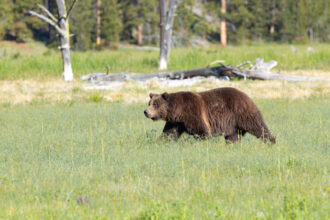
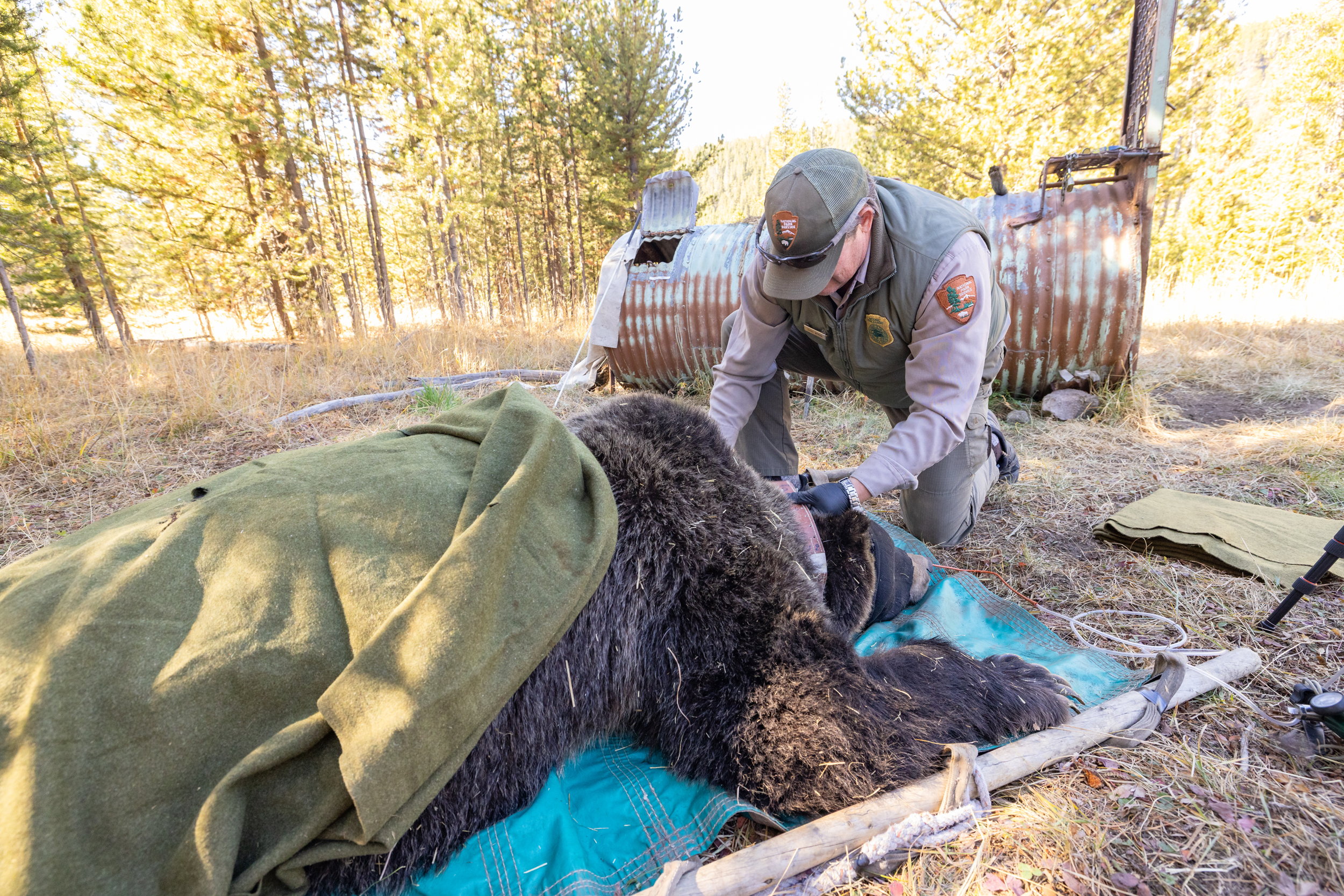


Standing just north of Yellowstone National Park in Montana, U.S. Secretary of the Interior Doug Burgum proposed Tuesday to return management of grizzly bears to the states.
At the Montana press conference, where he was joined by Idaho Gov. Brad Little, Montana Gov. Greg Gianforte and Wyoming Gov. Mark Gordon, Burgum pointed to recovering grizzly bear populations as justification for rethinking how the population is protected.
“Today is a day of gratitude and it’s a day of celebration,” Burgum said during the gathering. “We have to, as a nation, celebrate when species can come off the endangered species list.” Burgum acknowledged what was proposed Tuesday would not take away the bears’ Endangered Species Act (ESA) protections, but he viewed the move as a step toward delisting grizzlies.
More than 50,000 grizzly bears roamed the Western U.S. before 1800, but today, their numbers are closer to 2,200, after reaching a low of between 700 and 800 in the mid-1970s, according to federal wildlife regulators.
The announcement came on the heels of other species protection rollbacks by the Trump administration and on the same day the president tweaked language in the Endangered Species Act (ESA) to exclude protection of habitats that threatened species depend on, which has drawn litigation and outcry from environmental groups.
Even under the new proposed grizzly bear rule, the bruins would still be protected under the Endangered Species Act, which has safeguarded the animals since 1975.
Sport hunting of grizzly bears is, and would remain, illegal regardless of how the rule advances.
While environmental organizations breathed a sigh of relief this week when President Donald Trump did not announce a delisting of grizzly bears from ESA protections, they remain concerned over what the rule could mean going forward as efforts continue to help the bruins recover.
“Despite what Burgum claims, grizzly bear recovery is about more than population size,” Jenny Harbine, managing attorney with Earthjustice’s Northern Rockies office, told Inside Climate News on Wednesday. “Threats to grizzly bears are only mounting under the Trump administration and the species has faced back-to-back record-high mortality years.”
Yellowstone National Park—and its surrounding mountains and valleys—are home to one of the six “distinct population segments” of grizzlies in the lower 48 states.
Two years ago, preliminary data from the Interagency Grizzly Bear Study Team, a group of scientists from tribal, federal and state agencies, showed that 42 of 43 grizzly bear deaths in the Yellowstone area were “human caused.” That was also the case for all 27 of grizzly bear deaths in areas beyond where wildlife biologists typically monitor species activity.
Nonetheless, the Yellowstone and the North Continental Divide grizzly bears around Glacier National Park are considered by many to be thriving populations that have successfully recovered by the standards set for the bears under the ESA.
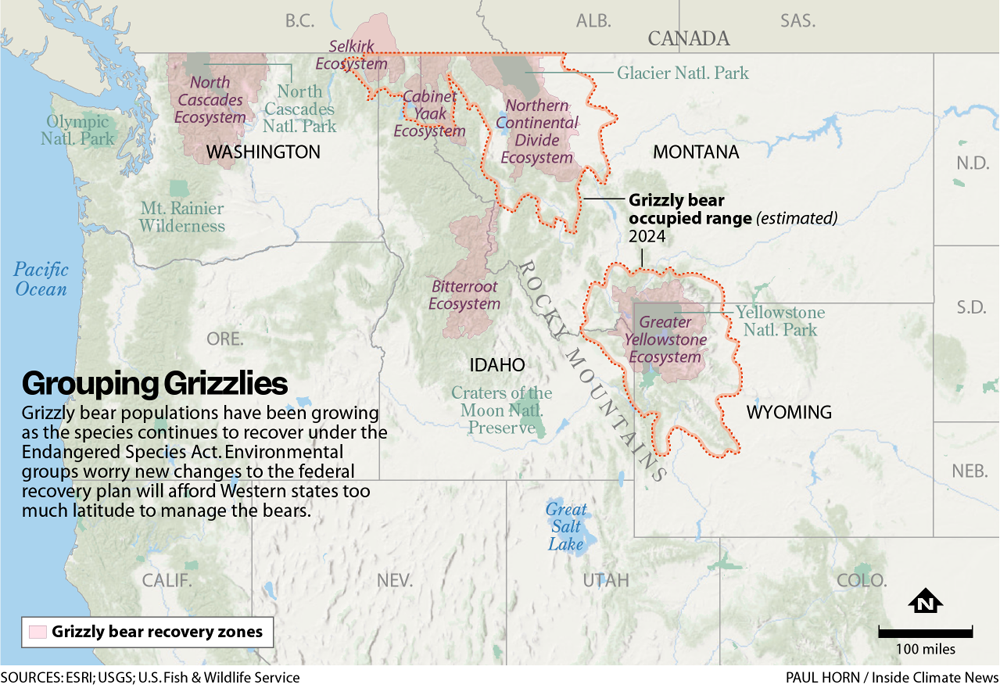
More bears has led to more pressure for the U.S. Fish and Wildlife Service (USFWS) to go a step further and delist grizzly bears from the ESA, which protects grizzlies from loss of habitat, disease or predation—including man-made threats—or insufficient regulations to ensure their long-term survival.
The Department of the Interior said Tuesday that the bear’s ongoing recovery requires a “revised proposal to increase management flexibility” of the species in all of Washington and parts of Idaho, Montana and Wyoming.
“This proposal recognizes these successes and right-sizes management where the greatest conservation success has taken place,” USFWS Director Brian Nesvik said in a statement. “This action would support the administration’s priority of easing regulatory burdens through common sense flexibilities in management.”
But putting control over how the species is managed in the hands of the states amounts to allowing for the incidental “take,” or killing, of grizzly bears when they encroach upon or impede human activity, advocacy groups warned.
“No question that this rule would definitely lead to more dead grizzly bears,” Andrea Zaccardi, the carnivore conservation program legal director at the Center for Biological Diversity, said on Wednesday.
This story is funded by readers like you.
Our nonprofit newsroom provides award-winning climate coverage free of charge and advertising. We rely on donations from readers like you to keep going. Please donate now to support our work.
Donate NowZaccardi is particularly worried about bears in the Greater Yellowstone Ecosystem and the Northern Continental Divide Ecosystem, where they could be killed by traps intended for other species. “One of my major concerns is the incidental take that’s incidental to trapping other species,” she said.
The exceptions under which a state or tribal agency would have the authority to kill a grizzly will depend on agreements between those parties and USFWS.
In a post on X on Wednesday, Secretary of the Interior Burgum wrote: “The science is more than clear: grizzly bears have recovered and far exceeded federal recovery benchmarks.”
Zaccardi said it is misleading to say the lower 48 states have healthy grizzly bear populations because there are no grizzly bears in two of the six recovery zones. Grizzly population objectives have only been met in two of the recovery areas, according to CBD staff.
“No question that this rule would definitely lead to more dead grizzly bears.”
— Andrea Zaccardi, Center for Biological Diversity
Federal officials are also “not looking at the lack of connectivity” between grizzly bear populations, which biologists have reported is critical for the species overall health, Zaccardi added.
Although attorneys with environmental groups continued to parse through the details of the 62-page rule on Wednesday, advocates have pointed to worrying ramifications baked into the changes.
“Courts in Montana and Idaho have limited wolf trapping seasons to avoid the likelihood that grizzly bears could be harmed by trapping during their non-denning period,” Earthjustice, an environmental nonprofit, highlighted in an analysis of the proposed rule. “If finalized, this incidental take exception would reverse those trapping limits.”
And while the proposed rule doesn’t delist grizzly bears, Senators Steve Daines and Tim Sheehy—both Republicans representing Montana—alluded to that potential step in the future in an Interior Department press release announcing the change.
“It’s long past time” to delist grizzly bears, Daines said, and Sheehy was quoted saying he looks forward to working with the Trump administration to delist the species in the future.
Daines and Sheehy did not immediately return phone and email requests for further comment Wednesday.
Before it can be approved, the revised rule will be published in the federal register Friday, July 17, and a public comment period on the proposal will be open through Aug. 17.
Jake Bolster contributed to this story.
About This Story
Perhaps you noticed: This story, like all the news we publish, is free to read. That’s because Inside Climate News is a 501c3 nonprofit organization. We do not charge a subscription fee, lock our news behind a paywall, or clutter our website with ads. We make our news on climate and the environment freely available to you and anyone who wants it.
That’s not all. We also share our news for free with scores of other media organizations around the country. Many of them can’t afford to do environmental journalism of their own. We’ve built bureaus from coast to coast to report local stories, collaborate with local newsrooms and co-publish articles so that this vital work is shared as widely as possible.
Two of us launched ICN in 2007. Six years later we earned a Pulitzer Prize for National Reporting, and now we run the oldest and largest dedicated climate newsroom in the nation. We tell the story in all its complexity. We hold polluters accountable. We expose environmental injustice. We debunk misinformation. We scrutinize solutions and inspire action.
Donations from readers like you fund every aspect of what we do. If you don’t already, will you support our ongoing work, our reporting on the biggest crisis facing our planet, and help us reach even more readers in more places?
Please take a moment to make a tax-deductible donation. Every one of them makes a difference.
Thank you,

Steven Rodas
Reporter, California
Steven Rodas covers water, wildfires and agriculture throughout California for Inside Climate News. Based in Los Angeles, he previously reported on the environment in New Jersey, covering energy, pollution, wildlife and development. Steven’s work has appeared in the San Francisco Chronicle, NJ.com/The Star Ledger and Grist. He worked as a copywriter at Google. Steven has a master’s degree from Syracuse University’s S.I. Newhouse School Of Public Communications. He is fluent in English and Spanish (and welcomes your tips).