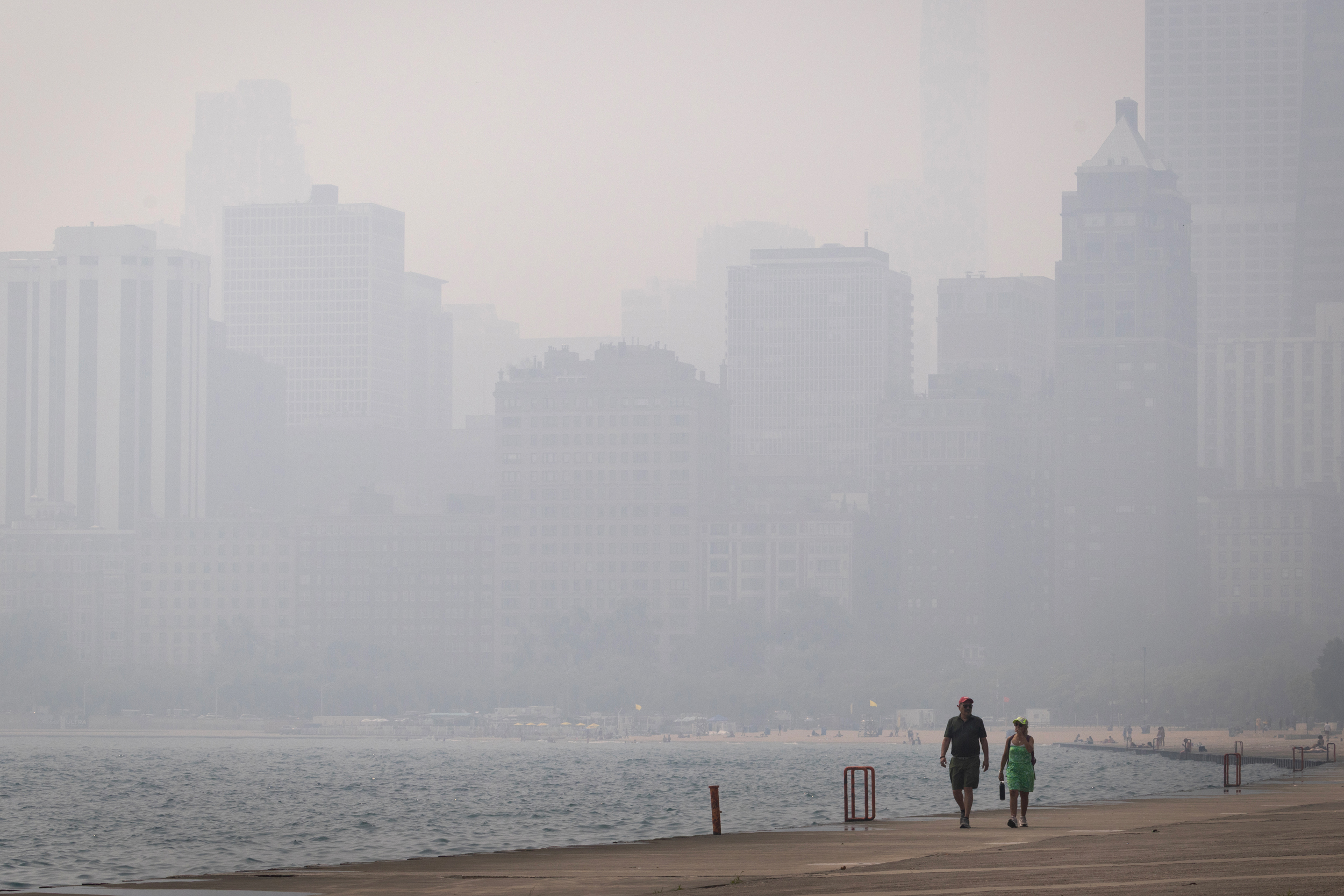


Smoke from climate change-fueled wildfires in Canada and northern Minnesota blanketed skies across much of the Midwest and East Coast, exposing millions of Americans to dangerous levels of air pollution. The National Weather Service warned residents in exposed areas to stay indoors as researchers began to assess the death toll.
One city particularly hard hit by the pollution was Chicago, where all outdoor beaches and pools closed and the Chicago Park District moved activities indoors.
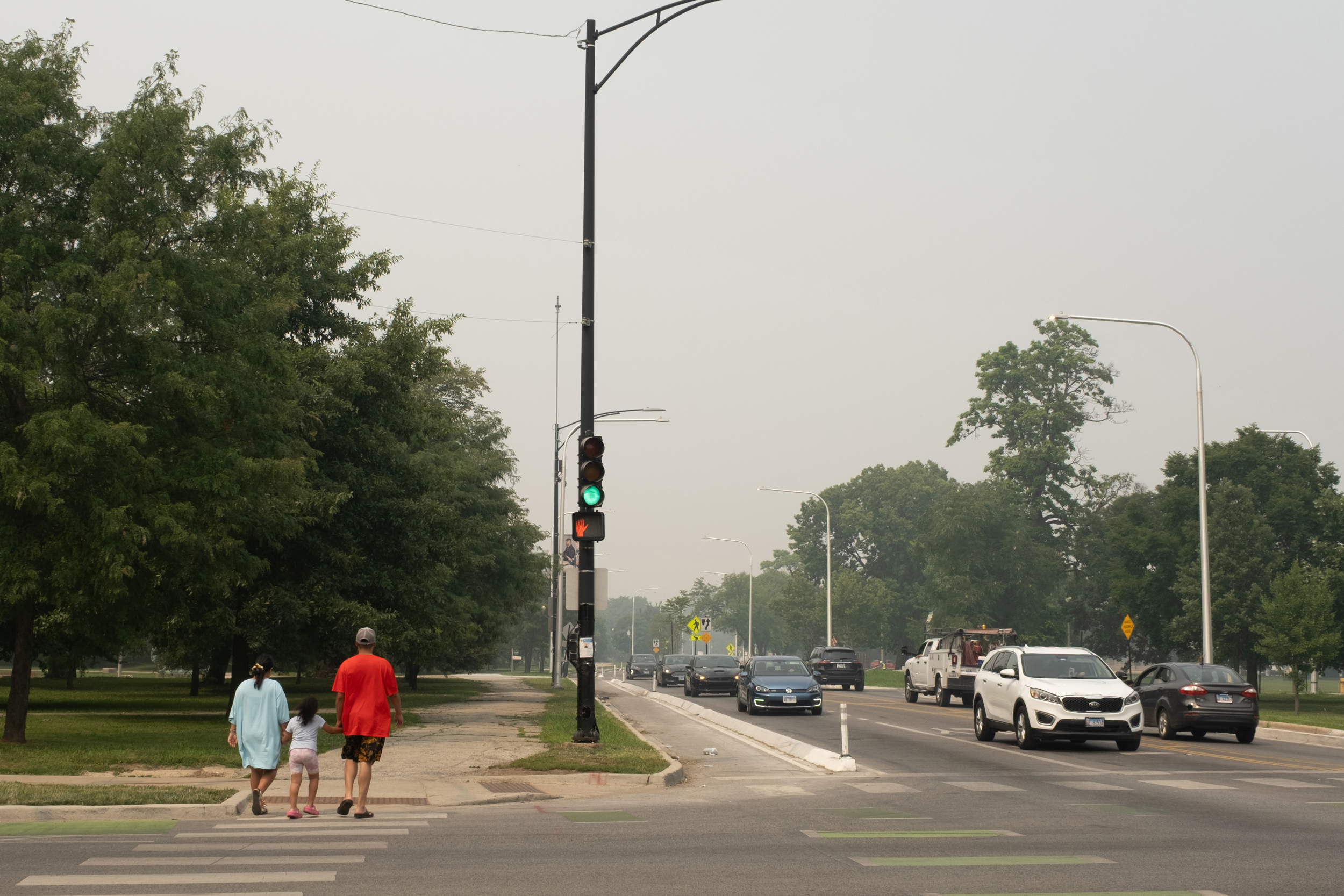
On Thursday afternoon, every sensor in the city’s 277-point air quality network registered “very unhealthy” or “hazardous” conditions, the two highest levels on the EPA’s air quality index. The thick, smoky haze was visible throughout the city, and residents could feel its effects.
In Humboldt Park, a neighborhood on the city’s West Side where the air quality index exceeded 300, Raymond Irwin got out of his truck and smoked a cigarette as he stood in line at a Puerto Rican food cart.
“It’s terrible,” Irwin said. “You can just look around and see the haze hanging in the air.”
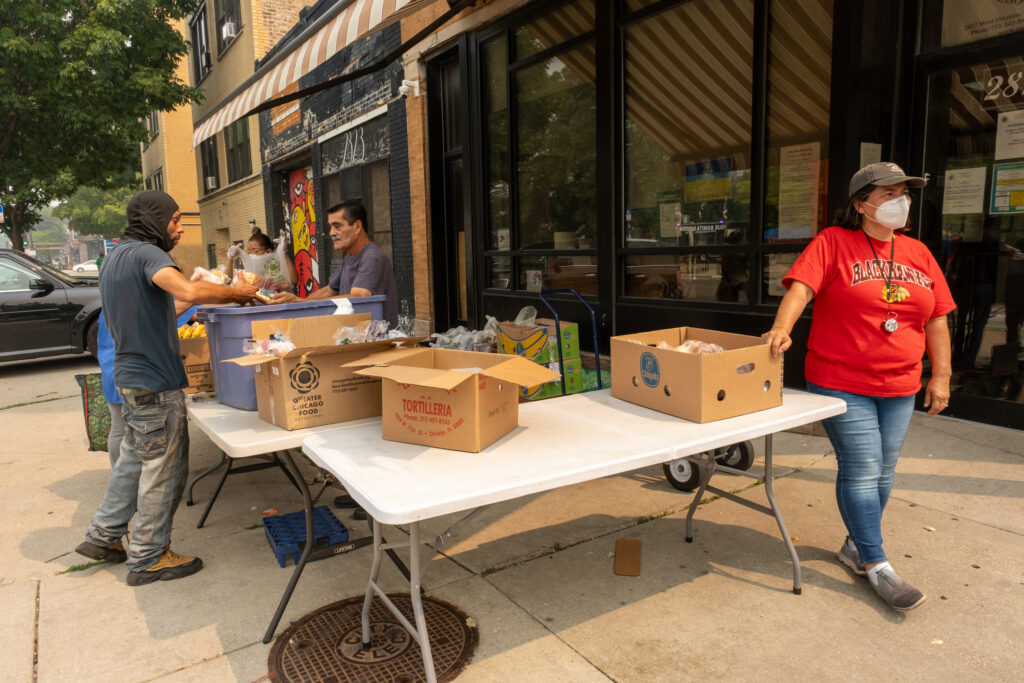
A few blocks south, Digna Abrego and Merce Lopez wore masks as they stood outside, handing out free groceries from the European American Association’s weekly food pantry. They had fewer takers than usual, Abrego said, and she thought it was because of the smog.
Lopez, who has asthma, said she felt “suffocated” that day. Abrego said she felt “terrible,” and noticed people in line coughing more than usual. Both noticed a strong, smoky smell.
“We stay here because we need to give out everything,” Abrego said, “but we know it’s not healthy for us.”
As of Thursday afternoon, Ontario’s Ministry of Natural Resources reported 177 active fires in the Canadian province following significant lightning storms over the past few weeks.
An additional 15 active wildfires were reported in northern Minnesota by Superior National Forest. This included four active fires inside the Boundary Waters Canoe Area Wilderness, the most frequently visited wilderness in the United States.
Fires moved back and forth across the U.S.—Canada border in a remote, heavily forested area known for its wet spongy soil. Former wildland firefighter and hotshot crew supervisor Tim Casperson dubbed the fires “an international quagmire.”
Superior National Forest reported the region had not experienced these “widespread, [unprecedented] extreme fire conditions in over 20 years.”
Casperson said fuel loads on the forest floor were primed for fire following recent storms that created massive blowdown events, leveling trees across 100s of thousands of acres.
“It’s dog hair thick,” Casperson said on his podcast, The Hotshot Wake Up. “Balsam fir that looks like a giant wall of Velcro that [firefighters] are trying to get through. East Coast, that is what is going to bring you all of your smoke.”
Smoke from wildfires turned skies into a yellow haze as far away as Boston and Washington, D.C. Such smoke can cause health impacts ranging from minor symptoms like watery eyes and shortness of breath to potentially fatal outcomes, including heart attacks and strokes, said Colleen Reid, an associate professor of geography at the University of Colorado, Boulder.
The main concern is increased concentrations of fine particulate matter (PM2.5), which can penetrate deep into the lungs and the bloodstream, negatively affecting both the respiratory and cardiovascular systems.
More than 300 million people in North America and Europe were exposed to daily PM2.5 pollution caused by Canadian wildfires in 2023, with 70,000 premature deaths linked to those fires, a study published in September in the journal Nature concluded.
“If you see a sunset that’s really pink or red, it is indicative that there is a lot of air pollution, and so you should take precautions,” said Reid, whose research focuses on health impacts of wildfire smoke. “Stay indoors as much as possible.”
In addition to the fine particulate matter, the smoke likely contains a range of hazardous air pollutants including acrolein, formaldehyde and benzene, said Emily Fischer, an atmospheric science professor at Colorado State University.
Fischer said concentrations of the pollutants will decrease over time and with increasing distance from the fires. However, at current levels, those reductions would make little difference.
“Right now, the big issue is just the sheer concentration of the smoke,” Fischer said. “From northern Minnesota all the way across to New York City [concentrations] right now are just extremely high.”
The Environmental Protection Agency’s Air Quality Index, a measure of PM2.5 and other pollutants, exceeded 600—more than twice the hazardous level—in Toledo, Ohio on Thursday.
“Very few communities would have experienced that level of particulate pollution before, it’s kind of at the end of the charts,” said Alistair Hayden, an assistant professor of practice at Cornell University’s Department of Public and Ecosystem Health and a former division chief at the California Governor’s Office of Emergency Services. “When it’s that high, we would really be expecting some pretty serious health impacts.”
Hayden recently helped create the Mortality Estimation Tool, a map that provides a real-time estimate of the number of deaths from wildfire smoke in every county across the U.S.
This story is funded by readers like you.
Our nonprofit newsroom provides award-winning climate coverage free of charge and advertising. We rely on donations from readers like you to keep going. Please donate now to support our work.
Donate NowThe site incorporates PM2.5 concentrations attributed to wildfire smoke and population densities into epidemiological models to estimate the likely increase in the number of wildfire smoke-related deaths over the last 30 days. A map from Thursday estimated there were four mortalities in Lucas County, Ohio, where Toledo is located. To the north in nearby Wayne County, Michigan, which includes Detroit, the estimated number of smoke-related deaths was 19. In Cook County, Illinois, including Chicago, the website estimated smoke over the last 30 days caused 30 deaths.
Hayden cautioned that the current high pollution concentrations are rarely seen and have not been well tested in existing epidemiological models. The mortality figures on the map should therefore be viewed as a preliminary estimate requiring further verification. Hayden added that he hoped their model would be proven wrong “because these numbers are looking bad,” he wrote in an email.
In addition to understanding the potential danger posed by wildfire smoke, it’s also important to know how to best reduce potential harms, Hayden said. Monitoring outdoor air quality on sites such as AirNow.gov is an important first step, he said. When pollution spikes, people should stay inside and make sure all doors and windows are closed. Air purifiers—even relatively inexpensive DIY cleaners made by taping an air filter to a box fan—improve indoor air quality during wildfire smoke events.
As the planet warms, wildfires like those currently burning in Canada and Minnesota will continue to increase. Nearly half of all acreage burned by wildfires in the western United States from 2001 to 2024 occurred during or immediately following heatwaves, according to a study published last month in the journal Science Advances.
The study’s lead author, Dmitri Kalashnikov, a climatologist at the University of California, Merced’s Sierra Nevada Research Institute, said the same is true of northern Minnesota and Ontario.
“There was a big heat wave that happened earlier this week, and that most definitely exacerbated the ongoing wildfires,” Kalashnikov said.
As the planet warms, heat waves are projected to grow more frequent, more intense and last longer. Laura Schifter, a senior fellow at the Aspen Institute, a Washington, D.C.-based think tank, said increasingly severe wildfires and the smoke they generate are now part of everyday reality.
“It is critically important to understand that we are living in a changing climate,” Schifter said. “We need to do things differently to adapt in addition to reducing our impact on the environment for the future.”
About This Story
Perhaps you noticed: This story, like all the news we publish, is free to read. That’s because Inside Climate News is a 501c3 nonprofit organization. We do not charge a subscription fee, lock our news behind a paywall, or clutter our website with ads. We make our news on climate and the environment freely available to you and anyone who wants it.
That’s not all. We also share our news for free with scores of other media organizations around the country. Many of them can’t afford to do environmental journalism of their own. We’ve built bureaus from coast to coast to report local stories, collaborate with local newsrooms and co-publish articles so that this vital work is shared as widely as possible.
Two of us launched ICN in 2007. Six years later we earned a Pulitzer Prize for National Reporting, and now we run the oldest and largest dedicated climate newsroom in the nation. We tell the story in all its complexity. We hold polluters accountable. We expose environmental injustice. We debunk misinformation. We scrutinize solutions and inspire action.
Donations from readers like you fund every aspect of what we do. If you don’t already, will you support our ongoing work, our reporting on the biggest crisis facing our planet, and help us reach even more readers in more places?
Please take a moment to make a tax-deductible donation. Every one of them makes a difference.
Thank you,

Phil McKenna
Reporter, Boston
Phil McKenna is a Boston-based reporter for Inside Climate News. Before joining ICN in 2016, he was a freelance writer covering energy and the environment for publications including The New York Times, Smithsonian, Audubon and WIRED. Uprising, a story he wrote about gas leaks under U.S. cities, won the AAAS Kavli Science Journalism Award and the 2014 NASW Science in Society Award. Phil has a master’s degree in science writing from the Massachusetts Institute of Technology and was an Environmental Journalism Fellow at Middlebury College.

Keerti Gopal
Reporter, Health and Justice
Keerti Gopal covers intersections between climate change, public health and environmental justice at Inside Climate News. Previously, she covered climate activism and movement repression. She is a National Geographic Explorer and has received fellowships from Fulbright, the Solutions Journalism Network, The Lever, and the National Press Foundation.