

In Renca, Chile, the Cerros de Renca Metropolitan Park reuses industrial wastewater to address a local water crisis.
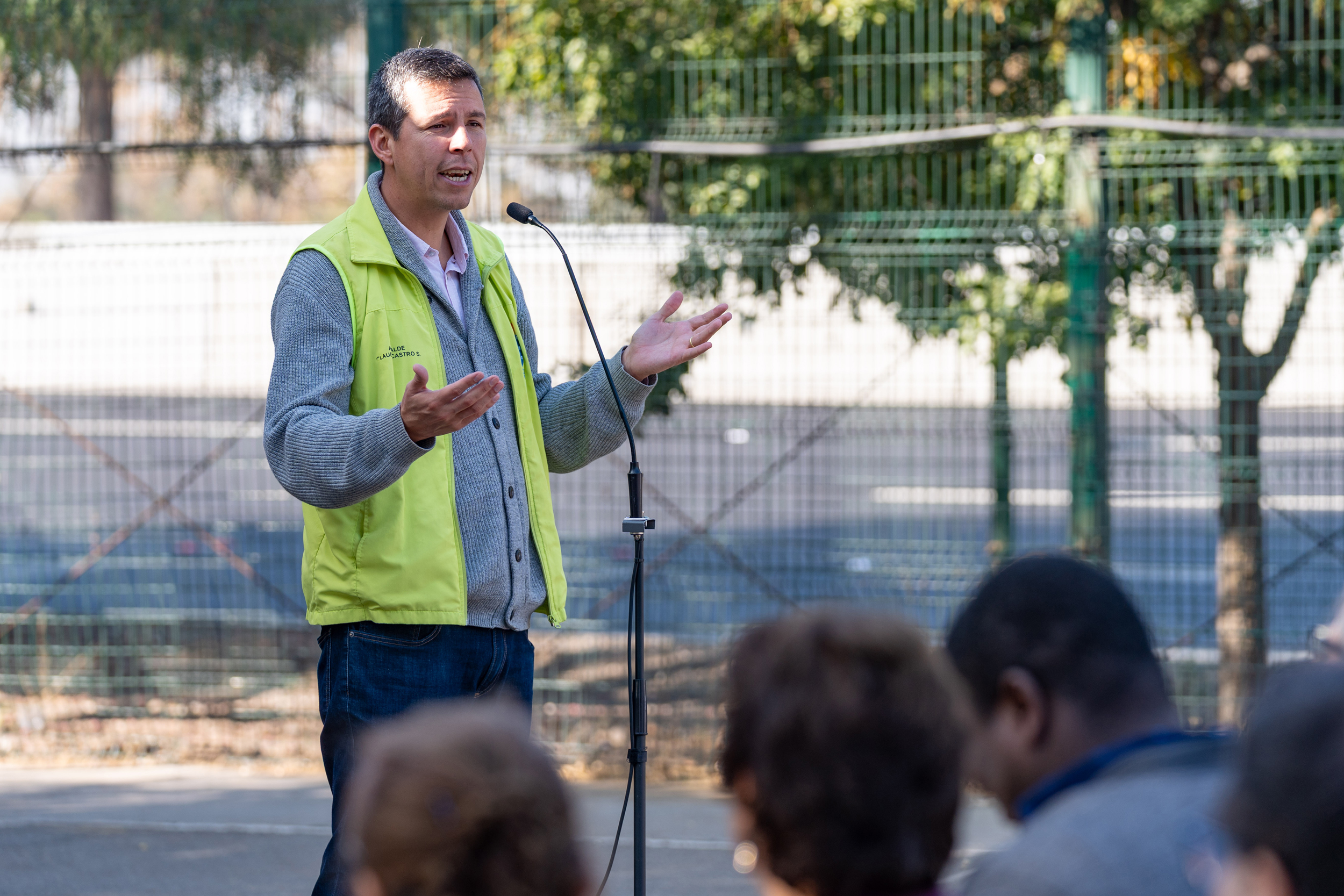
Renca’s mayor, Claudio Castro, has worked for a decade to attract international investors and philanthropists to fund that system and other environmental initiatives that the region could not afford on its own. The money flows directly to Renca, bypassing the Chilean national government and subverting the typical investment structure.
“For Renca, climate investment is not an environmental line item,” Castro wrote in an email. “It’s a social justice, public health, and urban development agenda.”
Most climate-focused capital is controlled by national governments, which can be bloated, slow and imprecise. As global attention turns to implementing climate action plans, some city, state and regional governments—known as subnationals—are trying to position themselves as attractive to investors.
These subnational governments are “at the front line” of climate change but do not receive the investment attention they deserve, said Chuks Okereke, director of the Centre for Climate and Development at Alex Ekwueme Federal University, Ndufu-Alike, in Nigeria.
“They’re closer to the people, they understand the issue more, but most climate finance has been designed to flow into the national level rather than the state level,” Okereke said.
Castro said that structure is a problem.
“The global financial architecture routes international capital and concessional loans almost exclusively through national governments,” Castro wrote. “These sovereign-only mandates create severe institutional barriers, locking ready and capable municipalities out of direct financing pipelines.”
Renca is part of the CHAMP Coalition, an emerging international group that aims, in part, to develop subnational governments’ financial capacity. Organized by the nonprofit World Resources Institute, CHAMP recently launched a steering committee led by Brazil and Germany to coordinate local efforts.
Michael Doust, an urban efficiency and climate director at the World Resources Institute, said local governments have to prove their viability to investors due to both real challenges and a bias against local leadership.
“We feel there’s enough funds in the market, but it’s not flowing to cities, both because of an inability to present investable propositions, but also because the market doesn’t see subnationals as very investable,” Doust said.
Antônio Francisco Da Costa e Silva Neto, CHAMP co-chair and ambassador for Brazil’s Ministry of Cities, said the coalition can help local governments demonstrate financial viability, making them more appealing to investors.
“If you aggregate cities that have similar problems or similar issues into a structured project, you might have the scale and aggregation to actually create the opportunities for investment,” Da Costa said.
Subnationals have already been involved in marshalling domestic funds. In a sample of 32 developed countries, subnational governments undertook 68 percent of public investment in climate projects across their respective countries in 2023, according to recent data from the Organisation for Economic Co-operation and Development (OECD).
But CHAMP and other advocates are looking to position these local governments to attract private and international investments—as much as five times the current amount, according to Doust—to help meet nations’ environmental pledges.
“There’s definitely been movement there, but we’re still seeing a huge shortage of finance flowing through cities,” Doust said.
This story is funded by readers like you.
Our nonprofit newsroom provides award-winning climate coverage free of charge and advertising. We rely on donations from readers like you to keep going. Please donate now to support our work.
Donate NowNina Hachigian, the founder of the nonprofit Alliance for Local Leaders International, said international financial institutions like the World Bank are made up of constituent countries that don’t want to give subnationals diplomatic autonomy.
“A lot of nation-states don’t want financing to go directly to their cities because they want to be able to control it for political reasons,” said Hachigian, who previously served as the U.S. State Department’s special representative for city and state diplomacy. “So it’s always a push.”
Sarah Bendahou, a research fellow on development finance at the Institute for Climate Economics, said there are two main ways for subnational climate finance to flow: multilateral financial institutions like the World Bank or International Monetary Fund operating through intermediaries to reach local actors, and dedicated subnational institutions complementing local government investments.
To attract that investment, Bendahou said, subnational governments need to show they can create a “pipeline of bankable projects,” or financially sound ventures with limited risk. That’s harder in developing countries or underserved cities that have historically received limited external investment.
In Renca, Castro created La Fábrica de Renca, an innovation hub that connects directly with private and public investors without going through the Chilean national government. Local officials take a “science-based and measurable” approach, Castro said, that is attractive to investors. The region has gained international recognition for its financing efforts.
Still, Okereke said, while subnational finance is attracting more attention, “there is still a lot to be done.” He pointed to Nigeria, where only one of 36 states has a climate bond to develop sustainable projects.
While many systems are stacked against local leaders, they have long engaged in diplomacy and can make progress on the issue despite the obstacles, Hachigian said.
“They just need to keep knocking on the doors and telling the story,” she said. “I don’t really think there’s a magic bullet, but they just need to make that diplomatic push as often and as loudly as they can.”
About This Story
Perhaps you noticed: This story, like all the news we publish, is free to read. That’s because Inside Climate News is a 501c3 nonprofit organization. We do not charge a subscription fee, lock our news behind a paywall, or clutter our website with ads. We make our news on climate and the environment freely available to you and anyone who wants it.
That’s not all. We also share our news for free with scores of other media organizations around the country. Many of them can’t afford to do environmental journalism of their own. We’ve built bureaus from coast to coast to report local stories, collaborate with local newsrooms and co-publish articles so that this vital work is shared as widely as possible.
Two of us launched ICN in 2007. Six years later we earned a Pulitzer Prize for National Reporting, and now we run the oldest and largest dedicated climate newsroom in the nation. We tell the story in all its complexity. We hold polluters accountable. We expose environmental injustice. We debunk misinformation. We scrutinize solutions and inspire action.
Donations from readers like you fund every aspect of what we do. If you don’t already, will you support our ongoing work, our reporting on the biggest crisis facing our planet, and help us reach even more readers in more places?
Please take a moment to make a tax-deductible donation. Every one of them makes a difference.
Thank you,

Ajani Stella
Fellow
Ajani Stella is a Dow Jones reporting fellow at Inside Climate News, based in New York City. Previously, he interned at amNewYork, covering politics, housing and crime. His reporting experience also includes immigration, labor and higher education policy issues. Ajani is currently a junior at Georgetown University, where he serves as executive editor of the student newspaper, The Hoya.