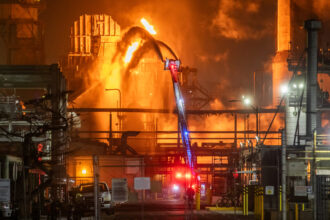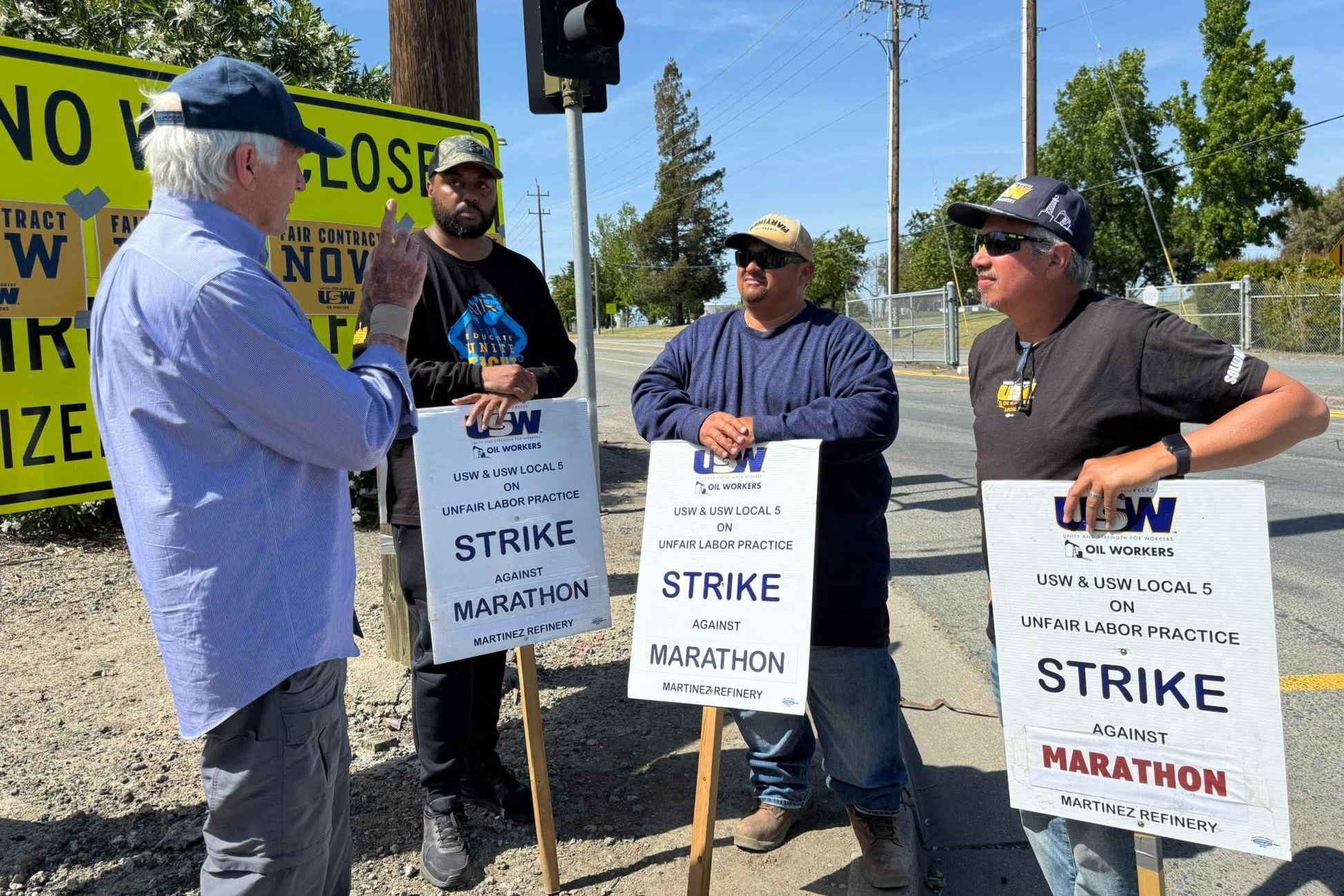


MARTINEZ, Calif.—Shortly after midnight on Nov. 19, 2023, while a processing unit at the Marathon Martinez Renewable Fuels refinery was starting up for the first time, hydrogen and diesel leaking from an overheated metal tube ignited into a massive blaze that engulfed Jerome Serrano, leaving the father of four in a months-long fight for his life.
Now Serrano’s co-workers have been locked out of their jobs at the refinery northeast of San Francisco after striking to improve what they describe as dangerous conditions caused by understaffing, relentless overtime shifts and a contract with fewer benefits than those offered to their union colleagues at other refineries.
Marathon Petroleum, the largest U.S. oil refiner, stopped operating processing units at its Martinez facility in 2020 while its plan to convert the facility from a petroleum refinery to one for renewable fuels underwent environmental review. Two years later, after county supervisors signed off on the project in a unanimous decision, Marathon started retrofitting machinery in the 113-year-old plant, and began processing vegetable oil and animal fats into renewable fuels the next year.
As operators tried to get a renewable diesel hydroprocessing unit up and running, no one knew that a startup valve was open when it should have been closed. That allowed fuel combustion to continue to generate heat, testing the limits of a metal tube in the furnace. Field operators were summoned to close fuel gas valves that fed the furnace, but the tube became “dangerously hot,” federal investigators determined, and failed. The breached tube released 200,000 pounds of highly flammable renewable diesel and 2,000 pounds of hydrogen, which quickly ignited and nearly burned Serrano to death.
Workers hoped a new contract would help prevent similar accidents in the future.
The National Oil Bargaining Program (NOBP) represents more than 200 United Steel Workers bargaining units in contract negotiations across the petroleum and renewables industry, and reached an agreement in February. Marathon was the lead company in national negotiations, so Martinez’s union representatives didn’t expect trouble bargaining terms for their refinery, said Jim Payne, secretary-treasurer for USW Local 5.
Instead, the Local 5 bargaining team found themselves sitting across the table from a “union-busting attorney” who wasn’t interested in compromise, Payne said. “I’ve been doing this for 40 years and I’ve never had an attorney sit at the table for bargaining.”
Workers came to the table with only two proposals to retain agreements they already had with the company, Payne said. They wanted to continue earning double-time pay for working the sixth or seventh 12-hour shift in a row, and time-and-a-half to be on standby before or after a shift in case another employee didn’t make it to work.
The NOBP negotiated a four-year contract with Marathon for workers employed by dozens of oil companies. But the $88 billion company offered the local union a three-year contract, arguing that they’re not part of the national program anymore since they process renewables—even though workers at another company’s renewables refinery are covered.
Plus, Payne told the company, the union gets to decide who’s covered by the contract, not them.
What’s more, both petroleum and renewable feedstocks are processed into highly flammable products like gasoline, jet fuel and diesel, USW Local 5 leadership argued when it petitioned California’s Occupational Safety and Health Standards Board to include renewable facilities under petroleum refinery safety regulations.
The board agreed and granted the request two years ago. The state Legislature followed suit a few months later with a law that required a similar change. But while Cal/OSHA agreed that the principal hazards of refining renewable and petroleum feedstocks “are nearly identical,” it still has not updated its rules.
Cal/OSHA is developing proposed amendments to expand the scope of state refinery regulations to include qualifying renewable fuel refineries, said Denisse Gómez, a spokesperson for the agency. “The proposed amendments are currently under review before they can proceed through the formal rulemaking process,” she said.
After months of negotiations, Marathon imposed the three-year agreement, which they called their “last, best and final offer,” Payne said.
That resulted in a strike, he said, because the offer didn’t comply with the national agreement. In June, workers made an unconditional return-to-work offer. The company rejected it, he said, “which turned a strike into a lockout.”
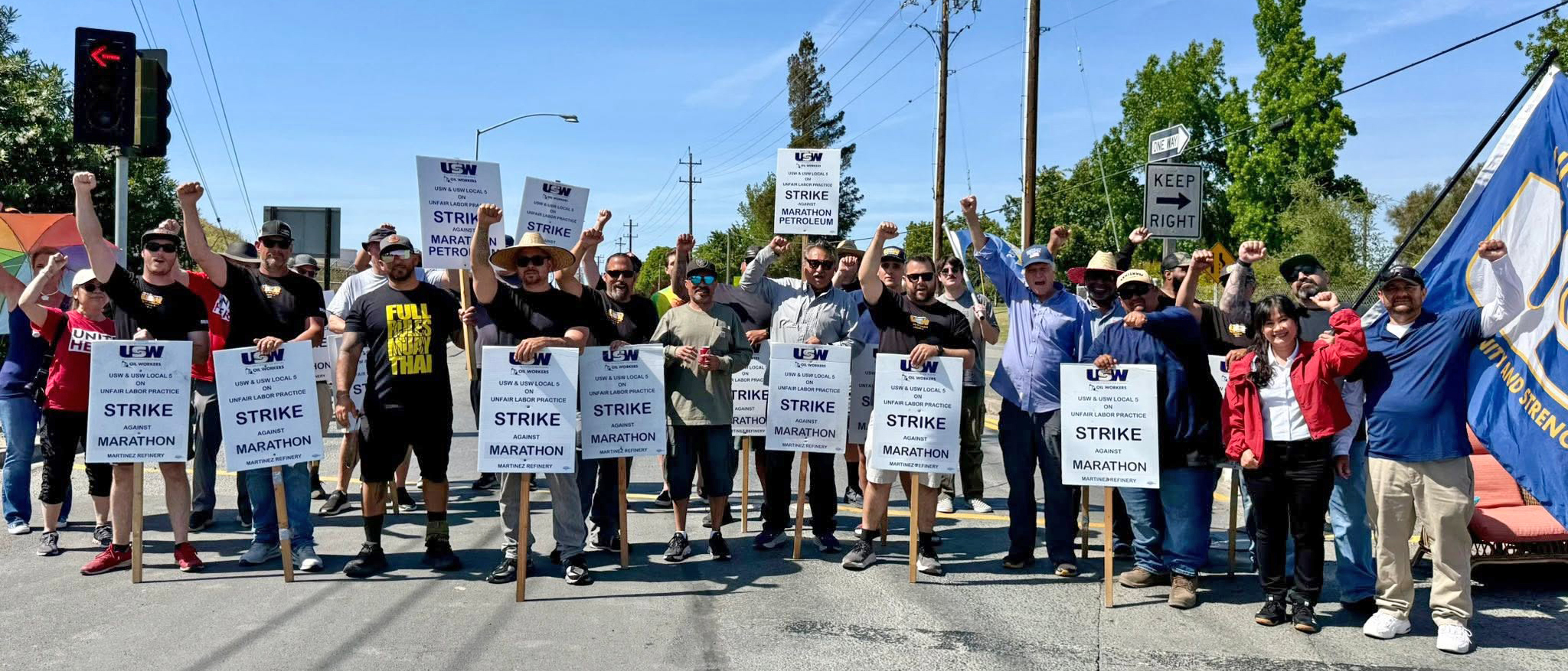
Marathon spokesperson Jamal Kheiry said the company is committed to reaching an agreement that is satisfactory to all parties.
“We decided to not accept their offer to return to work at this time, and instead continue negotiating in good faith toward an agreement that will support the long-term success of the facility, our employees, our customers and the communities we serve,” Kheiry said in an emailed statement.
The company continues to staff the Martinez Renewables facility with highly qualified Marathon personnel, Kheiry said. “Our team includes supervisors, engineers and technical experts with extensive experience and training in safe, reliable plant operations.”
Marathon did not answer questions about how many safety technicians are currently working in the plant who have the expertise to respond to an accidental release and prevent another potentially catastrophic incident.
Negotiations are scheduled to resume Friday.
Skeleton Crew
Employees at the Martinez refinery redoubled their long-time efforts to fight short-staffing and safety concerns after Marathon implemented massive layoffs when it shifted to renewables, said Nick Plurkowski, USW Local 5 president.
The company laid off 700 workers in 2020, including 350 with Local 5, and had only about 220 workers in 2023 when it resumed operations as a renewable fuel refinery.
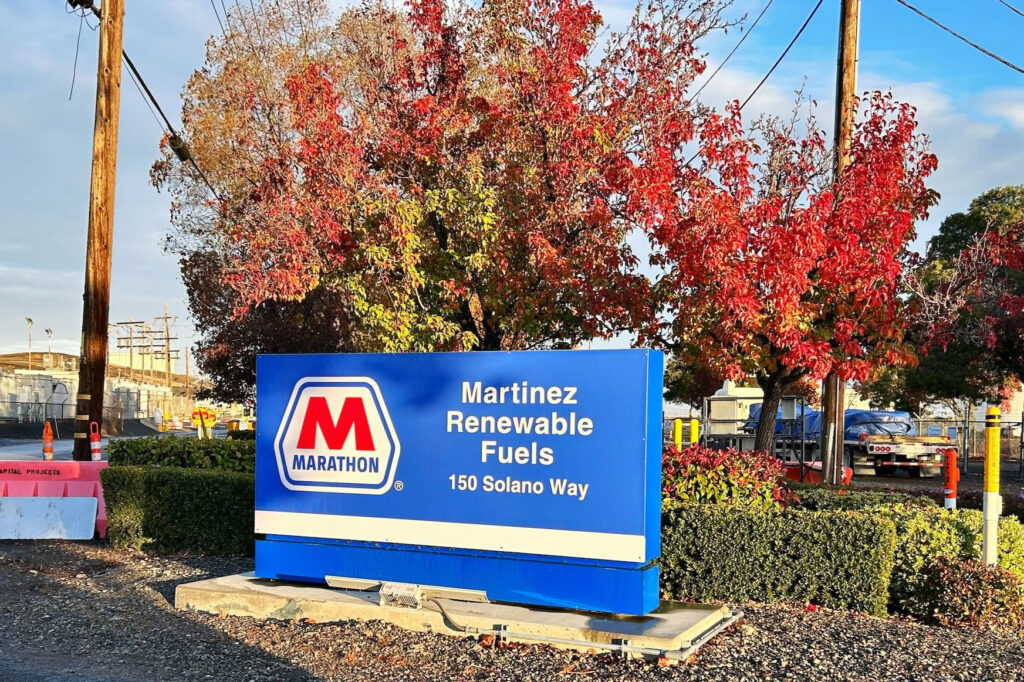
The skeleton crew lacked the safety technicians who used to roam around the plant monitoring conditions, and included a lot of new people working with flammable materials, Plurkowski said. “The safety aspect of that is huge.”
The company is doubling down on problems that are making the plant unsafe, Plurkowski said, like turning four days of mandatory 12-hour shifts into five, six or more days of 16- and 18-hour shifts to compensate for understaffing.
“It’s just not good for the workers and for the public to be having workers working these 18-hour days when you’re running a highly volatile chemical facility,” said Josh Sonnenfeld, senior policy researcher with the University of California, Berkeley Labor Center.
“At one point they did recognize that they were overworking us,” said striking refinery operator Bob Bulman, standing on the picket line on July 16, the 81st day of the strike.
That’s why management and the union crafted a letter of agreement that workers would receive double-time pay for the sixth and seventh day, said Bulman, who has worked at the plant since 2008, most recently monitoring tank levels for raw feed and finished products. But the company found that arrangement costly.
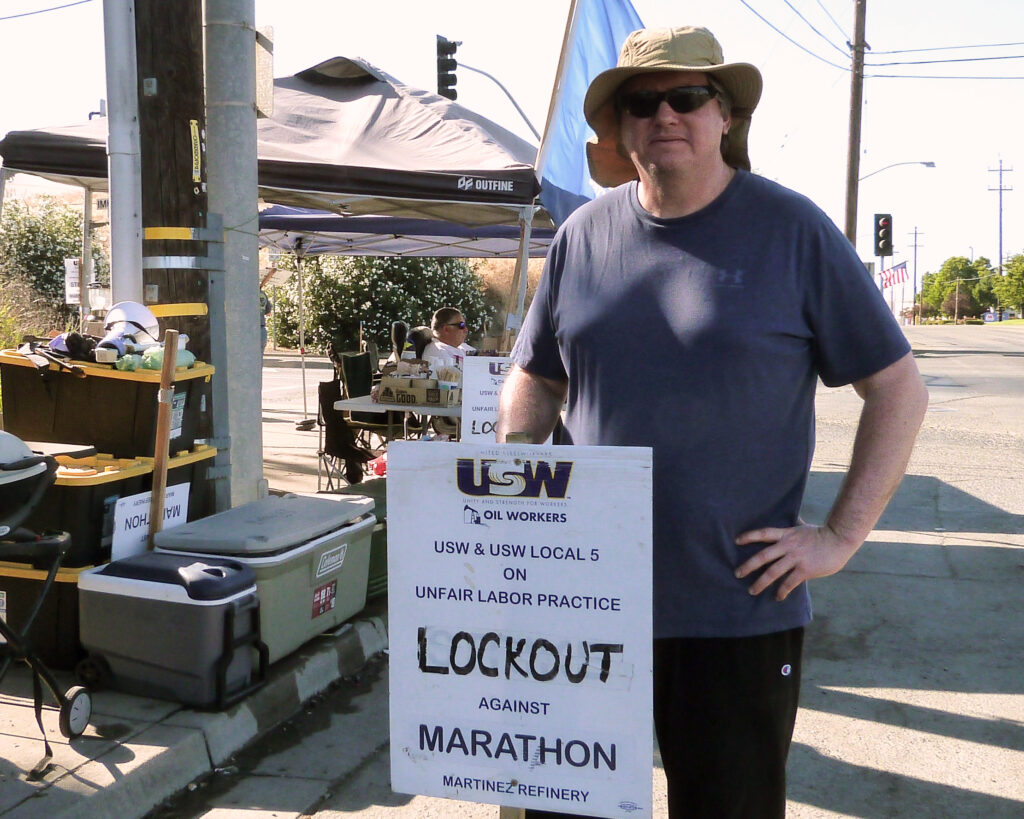
“They saw how much they were paying because we’re understaffed. Now they want to take that away. But that’s not the reason why we’re out here on strike,” he said. “Our main concerns were that we were overworked and understaffed.”
Workers are exhausted on the job, and many face an hour-plus commute, Bulman said. “You don’t want to put these guys not doing just 12, but now doing 16 and 18 hours working their butts off, driving on the road next to you and falling asleep, taking you out.”
If workers are walking around “basically intoxicated” because they’ve been sleep-deprived over many days while supervisors pressure them to go faster, Plurkowski said, it’s just a matter of time before another disaster strikes.
Inherent Risks
Plurkowski started out as a refinery worker years ago at the old Shell refinery (now Martinez Refining), a few miles west of the Marathon facility. As a newbie, he shadowed an experienced operator doing all the tasks he was hired to do, then did them himself while someone checked his work and answered the inevitable questions that arose.
But since Marathon laid off so many employees when it transitioned to producing renewable fuels, inexperienced workers have fewer opportunities for safety training or advice from senior colleagues, which is even more important during inherently risky operations like starting or shutting down a unit, Plurkowski said.
The fire that nearly killed Serrano happened when “they were just fighting the unit to get it started,” Plurkowski said. “They just kept at it, they didn’t back off to re-check what was happening. And that led to him being burned over more than 80 percent of his body through no fault of his own.”
The vast majority of the people who were starting up the new unit had been there less than six months, said Payne, the Local 5 financial officer.
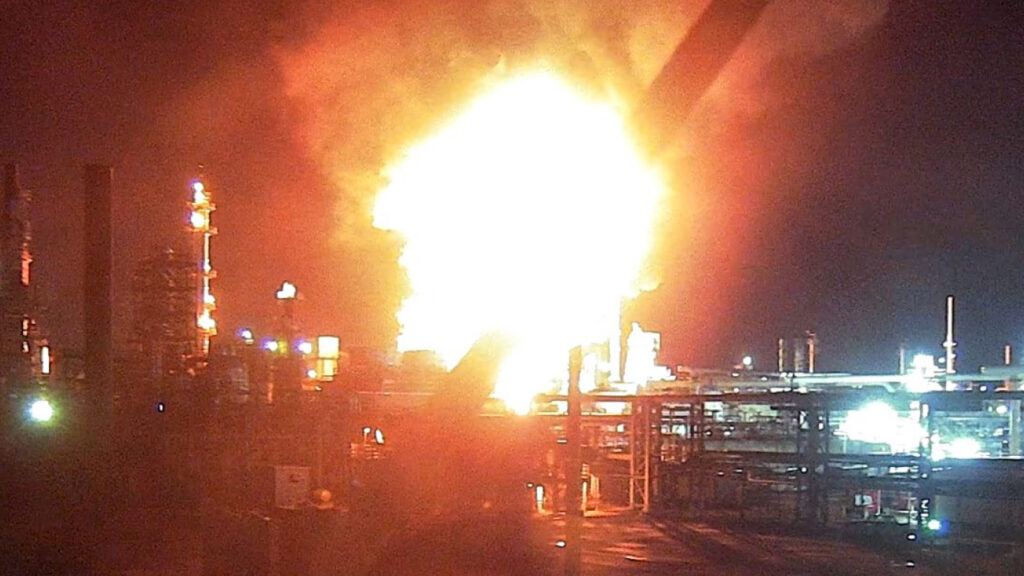
Serrano was helping someone who was too busy to deal with the overheated equipment. That worker, who found Serrano first, used to be a medic. Payne believes the only reason Serrano survived was because of that worker’s medical training.
The seriousness of the accident prompted the county’s Contra Costa Health staff to commission a third-party evaluation of the refinery’s management system and safety culture. The report, released last year, found “a potential polarizing disconnect” between operators and administrators in the refinery.
Operators consistently provided more negative ratings regarding both safety prioritization and resource allocation, the report found. It highlighted the need for a policy that not only allows workers to report safety concerns without fear of retaliation but also prioritizes safety over production demands and pressures to work quickly.
A report released 27 years ago found similar problems after a catastrophic accident at the same site, when it was a crude oil refinery run by Tosco, a company that no longer exists. The independent audit flagged “an adversarial relationship between managers and workers” as a contributor to a fire that killed four workers and seriously injured one.
The 1999 disaster was caused by an accidental release of naphtha, a highly volatile hydrocarbon mixture that Marathon now produces from biofuels at its Martinez plant.
Rescuing Stranded Assets
Renewable refineries leverage existing infrastructure from crude operations by using hydrogen to remove oxygen from biobased oils and fats. In petroleum refining, hydrogen is used to lower the sulfur content of diesel fuels.
The furnace that Serrano was trying to turn off had been used to remove sulfur to make diesel from petroleum before it was turned into a hydrodeoxygenation unit to remove oxygen from oils and fats.
Hydrodeoxygenation processors make diesel that’s functionally identical to petroleum diesel.
“Renewable facilities may be even more prone to explosions and fires because converting renewable feedstocks into fuels relies on hydrogen-intensive reactions that release substantially more heat in processors already prone to overheating,” according to an analysis by Greg Karras, an independent scientist who runs the clean-energy advisory firm Community Energy reSource.
“There’s definitely a relationship between the hydrogen intensity, the hydrogen flaring and the number of hydrogen-related fires and explosions in the refining industry,” Karras said. “Switching to processed vegetable oils and animal fats is going to increase those hazards.”
After Marathon started its biofuel project, it flared almost every day, said Karras, who has spent decades studying pollution and environmental justice issues. After seeing flaring at the facility for about six months, Karras reported the problem to the Interagency Refinery Task Force that was formed after a catastrophic accident at Chevron’s Richmond Refinery north of San Francisco released a massive toxic cloud over nearby cities and sent 15,000 people seeking medical care.
“People are going to be hurt or die, and you need to shut it down until this is fixed,” Karras told the task force at a public meeting.
“Then it blew up,” Karras told Inside Climate News. “And then their records disappeared.”
California officials did not answer questions about why the task force didn’t retain minutes of public meetings or what it did with the information Karras provided.
Marathon staff could have shut down the overheated furnace from the control room, reported experts with the U.S. Chemical Safety and Hazard Investigation Board (CSB), an independent federal agency. But the high temperature alarms didn’t initiate a shutdown in production, the report noted, because their activation initiated troubleshooting efforts instead, per Marathon policies.
“Marathon did not adequately ensure that the Martinez facility met the company’s minimum safety expectations before it started up as a renewable diesel facility,” the CSB concluded.
“Mad as Hell”
Plurkowski appeared before the Contra Costa Board of Supervisors July 14 to warn the board, which approved Marathon’s renewable conversion permit, that fatigue and understaffing was at an all-time high. His two minutes for comment were up before he was able to tell the supervisors his main point.
“Now we have Marathon basically locking us out until we agree to even more hours than we’re already doing there,” Plurkowski wanted to say.
The board should encourage Marathon to return to the bargaining table in good faith and negotiate a fair contract, he told Inside Climate News. He also wants the board to add specific, enforceable rules to the county’s industrial safety ordinance on fatigue and minimum staffing requirements.
People who live near these refineries know all too well that safety problems inside the plant threaten surrounding communities.
This story is funded by readers like you.
Our nonprofit newsroom provides award-winning climate coverage free of charge and advertising. We rely on donations from readers like you to keep going. Please donate now to support our work.
Donate NowThese accidents and issues keep getting repeated, said Heidi Taylor, who co-founded the watchdog group Healthy Martinez after another local refiner, the Martinez Refining Company, showered her community with 24 tons of heavy metals and other chemicals four years ago on Thanksgiving. Investigators cited poor fatigue management as a contributor to the accident.
The refinery apologized to the community “for dust releases” and other incidents and said it had implemented nearly a dozen corrective measures.
Regulators say they are learning from all the accidents, but they’re not, Taylor said.
“That is what is so scary about living in Martinez,” she said. “You never know when the next big event is going to happen.”
Multiple reports conclude that refineries need to be properly staffed to avoid fatigue, but no one’s holding them accountable and community members are “mad as hell,” Taylor said. “I want to see more aggressive enforcement and follow through from our regulatory agencies.”
Rep. Mark DeSaulnier, a Democrat whose district includes most of Contra Costa, told Inside Climate News he’s spent over 30 years dealing with the oil industry in an effort to protect the interests of consumers, workers and the environment.

There is a pervasive culture in the industry that prioritizes profits over safety, said DeSaulnier, who has visited workers on the picket line at Marathon’s Martinez Renewables refinery. “I’ve been to too many funerals of refinery workers due to corporate negligence.”
DeSaulnier fears he will have to go to more funerals if Marathon doesn’t change its practices.
Marathon’s Martinez refinery has received nearly 70 notices of violations from the air district for flaring and other infractions as a renewable fuels facility over the past three years.
“That’s a big red flag that plant operations are not smooth inside, that conditions are likely unsafe,” said USW’s Plurkowski.
“The thing that we hear all the time from steel workers on the picket line is that refinery safety saves lives,” said Marie Choi, strategy director for the Asian Pacific Environmental Network, a California environmental justice organization.
“When they say that, they’re not just talking about the lives of the workers in the plant,” Choi said. “They’re also talking about the lives of community members that live on the fencelines of these big, 100-year-old, polluting refineries.”
Having people managing dangerous processes on aging equipment on three or four hours of sleep, Choi said, “is really a recipe for disaster.”
Choi, who has visited workers on the picket line often since the strike started, thinks the company is trying to break the union.
Without a union in a refinery, who’s going to speak up when conditions are unsafe? she asked.
A lockout is “an extreme and harsh tactic,” said UC Berkeley’s Sonnenfeld.
If workers lose their union in a facility like this, they lose their voice and ability to speak out on safety issues, which affects the whole community, he said. “We’ve seen this over and over again.”
Where’s the Accountability?
California recognized the critical role workers play in preventing accidents when it approved “landmark” refinery safety rules in 2017. But the Western States Petroleum Association, a leading industry trade group, sued the state, arguing that the rules “grant unions new and unbargained-for authority over employers’ safety processes and safety-related expenditures.”
The state settled with the oil lobby group and proposed amending the law in January 2025, a month before the U.S. Environmental Protection Agency proposed rescinding key requirements for worker participation in safety plans in federal rules designed to prevent chemical accidents.
A coalition of union and public interest groups said the amendments would “significantly endanger” employees and communities near refineries by weakening the power of front-line workers to influence safety plans, among other provisions. The coalition called on California regulators to retain its landmark safety rules “as the current federal administration seeks to roll-back essential environmental, community and worker safety protections.”
“Marathon is really at the center of these issues,” said Sonnenfeld.
As a facility that receives public subsidies and taxpayer dollars through the Low Carbon Fuel Standard, he said, “policymakers and really everyone in this region of the state should be concerned about what’s the standard that we’re setting for refineries in California.”
California paid nearly $20 billion through Low Carbon Fuel Standard credits to biofuel suppliers, including Marathon, a February analysis from The Climate Center, a clean energy think tank, found. The subsidies allowed gasoline and diesel refiners to comply with the LCFS by producing biofuels or buying biofuel credits. Because biofuels use the same infrastructure as gas and diesel—which would otherwise lose market value—they outcompete zero-emission vehicles and “lock in a commitment to future carbon emissions,” the report noted.
Sonnenfeld believes California policymakers need to explain how they expect these publicly subsidized renewable facilities to treat their workers and ensure their facilities run safely.
Cal/OSHA did not respond to questions about how it will guarantee the safety of employees at renewable fuel refineries that receive billions in taxpayer subsidies if it does not ensure workers have a meaningful voice in safety plans.
If there had been a proper process-hazard analysis in place when Marathon restarted its operations in 2023 as required by the code regulating petroleum refineries, USW’s Plurkowski said, they would have checked every single part of every piece of equipment with a worker to map out all the potential scenarios that could cause problems.
But they didn’t do that, he said.
As workers approach nearly three months without a paycheck, Plurkowski wants to see them get back to work. But with negotiations set to resume Friday, safety has to be a priority, he said.
And with even fewer people keeping the refinery going since the strike, he said, “it just scares the hell out of me to think that these guys are going to go back in the plant once again after a prolonged period of time outside of the plant.”
Who knows how many valves could again be in the wrong position, just waiting for the right conditions to cause another fire like the one that injured Serrano, Plurkowski said.
“I’m really scared that it’s going to happen again.”
About This Story
Perhaps you noticed: This story, like all the news we publish, is free to read. That’s because Inside Climate News is a 501c3 nonprofit organization. We do not charge a subscription fee, lock our news behind a paywall, or clutter our website with ads. We make our news on climate and the environment freely available to you and anyone who wants it.
That’s not all. We also share our news for free with scores of other media organizations around the country. Many of them can’t afford to do environmental journalism of their own. We’ve built bureaus from coast to coast to report local stories, collaborate with local newsrooms and co-publish articles so that this vital work is shared as widely as possible.
Two of us launched ICN in 2007. Six years later we earned a Pulitzer Prize for National Reporting, and now we run the oldest and largest dedicated climate newsroom in the nation. We tell the story in all its complexity. We hold polluters accountable. We expose environmental injustice. We debunk misinformation. We scrutinize solutions and inspire action.
Donations from readers like you fund every aspect of what we do. If you don’t already, will you support our ongoing work, our reporting on the biggest crisis facing our planet, and help us reach even more readers in more places?
Please take a moment to make a tax-deductible donation. Every one of them makes a difference.
Thank you,

Liza Gross
Reporter, California
Liza Gross is a reporter for Inside Climate News based in Northern California. She is the author of The Science Writers’ Investigative Reporting Handbook and a contributor to The Science Writers’ Handbook, both funded by National Association of Science Writers’ Peggy Girshman Idea Grants. She has long covered science, conservation, agriculture, public and environmental health and justice with a focus on the misuse of science for private gain. Prior to joining ICN, she worked as a part-time magazine editor for the open-access journal PLOS Biology, a reporter for the Food & Environment Reporting Network and produced freelance stories for numerous national outlets, including The New York Times, The Washington Post, Discover and Mother Jones. Her work has won awards from the Association of Health Care Journalists, American Society of Journalists and Authors, Society of Professional Journalists NorCal and Association of Food Journalists.