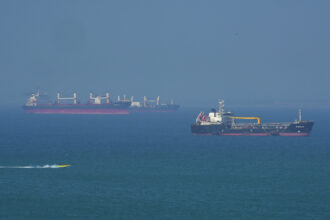
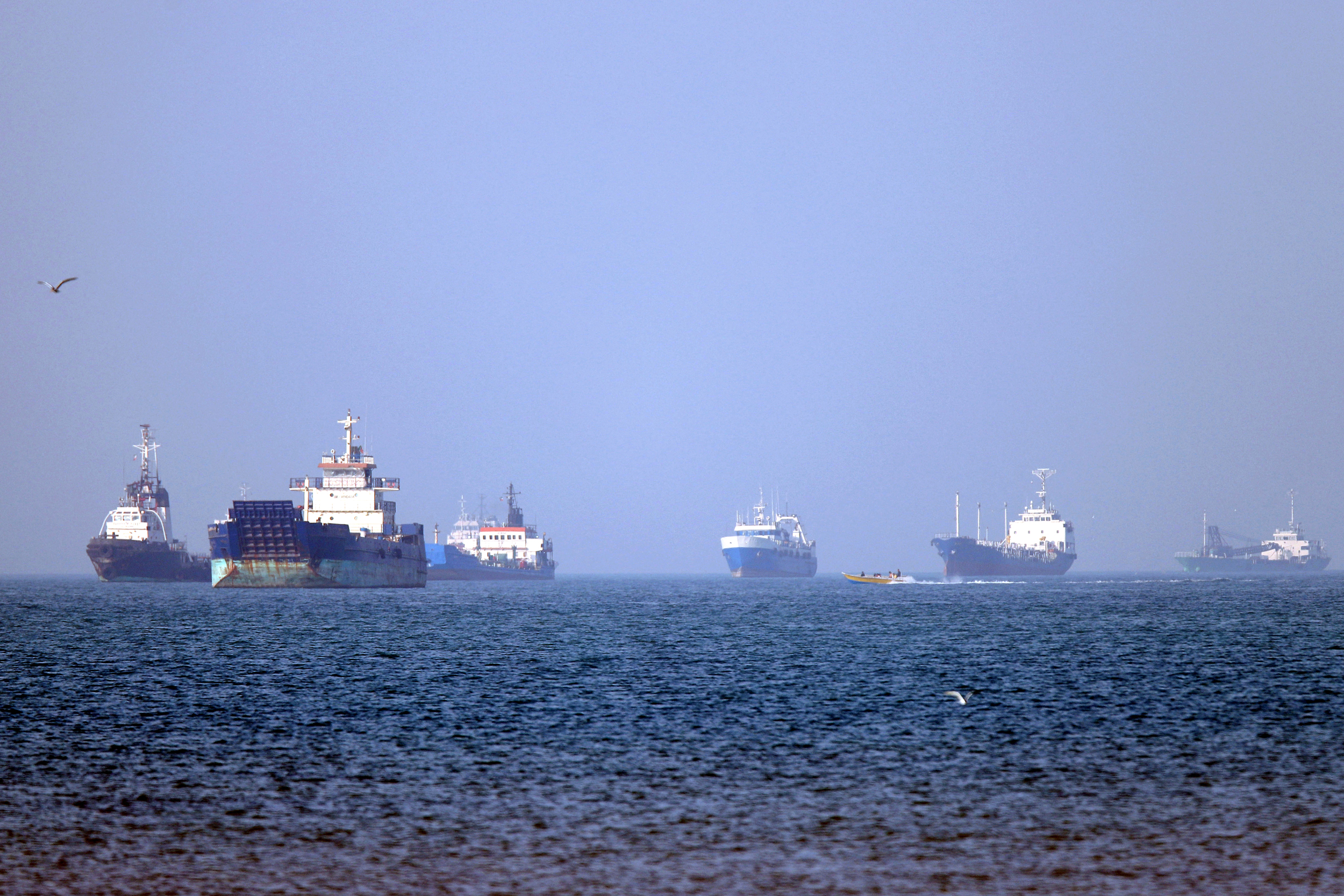


When the Strait of Hormuz closed five months ago, more than 1,500 commercial ships were stranded in the Persian Gulf and the Gulf of Oman—the largest unplanned concentration of idled vessels in the modern history of shipping. The human aspect of the Iran war layup drew the world’s attention: thousands of stuck seafarers and billions of dollars in disrupted trade.
Beneath the waterline, a quieter problem was accumulating.
A ship in motion is a hostile place for marine life. A ship sitting still is an invitation. Over months at anchor in warm water, hulls, sea chests and rudders become dense gardens of barnacles, mussels, algae and tube worms, a process marine biologists call biofouling. The salty Persian Gulf, where summer surface temperatures approach 38 degrees Celsius (about 100 degrees Fahrenheit), is an especially aggressive incubator. When those ships finally sail, they will carry their gardens with them.
New research from 25 marine scientists, published this week in the journal Biological Invasions, warns that the mass layover could seed a “super-spreader event” of invasive species as the fleet disperses to ports around the world. The warning has an unusual quality: Nearly everyone who studies this agrees the basic mechanism is sound—and almost no one can say how bad it will actually be.
“Species will certainly be departing the Persian Gulf on and in ships—that’s the inevitable part,” said study co-author James Carlton, a marine scientist at the Coastal & Ocean Program of Williams College and the Mystic Seaport Museum. “But we have a difficult time predicting when and where invasions will occur.”
He has a name for that combination of certainty and unpredictability, one he coined more than three decades ago in a landmark paper: “ecological roulette.”
The metaphor is precise in a way “super-spreader” is not. Most fouled hulls will deliver nothing. The organisms have to survive the voyage, arrive at a location with their preferred temperature and salinity and slip past whatever native species already occupy the niche. Any single ship is a long shot. But the Gulf layup is spinning the wheel more than a thousand times.
“A single vessel may deliver the winning species to the perfect host environment and bring about a major invasion,” said Bella Galil, a marine biologist at Tel Aviv University and one of the world’s authorities on marine invasions, who also co-authored the paper.
She was careful to distinguish this event from the slow, continuous flood of species that has entered the Mediterranean through the Suez Canal for 150 years. The Hormuz crisis is different: a sudden, one-off pulse, involving only a small set of organisms that are strong enough to cling to a hull.
But timing, she noted, is everything. Ships sailing now will reach Mediterranean and southern U.S. ports when the water is still warm enough to welcome Gulf-adapted stowaways.
The United Nations’ International Maritime Organization recently told UN News that “very few ships, if any” are actually sailing through.
Anthony Ricciardi, an invasion ecologist at McGill University who was not involved in the paper, independently reached the same framing. The prediction is “a pretty safe bet,” he said. “It’s not a matter of whether it’ll happen. It’s a matter of what magnitude.”
That word—magnitude—is where the science runs into a wall. There is no reliable baseline for how many marine invasions occur in an ordinary year, Carlton said, which means no one can accurately say how much this event raises the odds.
Consider the best-documented case in the field’s history. When a Japanese tsunami swept debris across the Pacific in 2011, it carried hundreds of living Japanese species to the shores of North America and Hawaii. Scientists knew the exact date, the precise origin and had a network of dozens of specialists tracking the arrivals. Fifteen years later, they’re still identifying what came ashore, and the question of whether any of it established new populations remains largely unresolved. If that is what a well-funded, fully mobilized detection effort looks like, the Gulf fleet will produce invasions that surface, if they surface at all, a decade or more after the fact.
This is the heart of what the scientists are actually warning about. The danger is real; the monitoring to catch it is not.
Galil’s recommendation is blunt and immediate: Collect and preserve fouling samples from the hulls of departing vessels now, for genetic analysis, so if an invasion does surface years from now, there is a record to trace it against.
The tools to do that already exist. Every vessel bound for a U.S. port must file a notice of arrival reporting its last five foreign ports and the dates it called at each—data that, a U.S. Coast Guard spokesperson confirmed, lets the agency identify which ships are arriving from an extended layup in the Gulf and precisely how long they sat.
Yet the Coast Guard has issued no bulletin, no port-inspection guidance and no advisory to its captains of the port about biofouling on vessels leaving the region. Arriving ships, the spokesperson said, are simply expected to meet existing standards. The agency can see the fleet coming. It has said nothing about what may be growing beneath the waterline.
Asked whether biofouling figured into the international effort to move the stranded ships out of the Gulf, the Coast Guard would say only that it is “monitoring the situation.”
The risk is not only new species arriving where they’ve never been. It can be subtler, and harder to see.
This story is funded by readers like you.
Our nonprofit newsroom provides award-winning climate coverage free of charge and advertising. We rely on donations from readers like you to keep going. Please donate now to support our work.
Donate NowCarolyn Tepolt, a marine population geneticist at the Woods Hole Oceanographic Institution and a co-author of the new paper, studies how species adapt to different conditions across their range. A ship arriving from the Gulf, she said, could carry individuals of a species already present at the destination—but carrying heat-tolerant genes their local cousins lack. Interbreeding could quietly infuse that adaptive potential into the resident population, or a new population could establish alongside it. Either way, “this would likely happen silently,” Tepolt said. Without deliberate genetic surveillance, no one would notice until something surprising forced a closer look.
The Asian green mussel, native to the Indo-Pacific from the Persian Gulf east to Indonesia, is established on Florida’s west coast—part of an invasion that genetic research traces to a single small introduction, one that spread stepping-stone fashion through the Caribbean and carries relatively little genetic diversity. Researchers have found no sign that arrivals from other regions have since mixed into it. That narrow genetic base is exactly what a hull from the Gulf could, in principle, disrupt: mussels adapted to some of the hottest, saltiest water on Earth, infusing new heat-tolerant variation into a population that has none to spare.
Where it takes hold, the mussel fouls Coast Guard navigation buoys and power-plant intakes—it was discovered in 1999 clogging cooling systems at Tampa Bay power stations. It also competes with native oysters, colonizing reefs where it has been linked to high oyster mortality.
Whether Gulf green mussels are genetically distinct from those already in Florida has not been studied. And because that kind of change would unfold invisibly—detectable only through the sort of genetic sampling that established the baseline in the first place—no one is positioned to catch it if it happens.
Prevention is cheap; cleaning ships is not. In-water cleaning of hulls before departure is possible but unlikely for most of a fleet whose owners are racing to resume trade and relieve stranded crews. The United States does require ships to keep their hulls free of fouling—under Coast Guard regulation, vessel operators must remove hull, piping and tank fouling on a regular basis—but a Coast Guard spokesperson said compliance is checked mainly through paperwork: Inspectors review a vessel’s ballast-water plan, logbooks and cleaning records, along with a visual look at the waterline, rather than an inspection of the submerged hull itself.
Over the past five years, the spokesperson said, the Coast Guard has directed six vessels to remedy excessive hull fouling. A stronger modern standard, published by the Environmental Protection Agency under the Vessel Incidental Discharge Act, cannot take effect until the Coast Guard finalizes its own implementing rules, which remain pending.
A handful of jurisdictions go further: New Zealand and California require biofouling management outright, and in February 2026 Brazil began enforcing penalties for ships that move between its coastal regions with dirty hulls. The International Maritime Organization’s 2023 biofouling guidelines remain voluntary worldwide, though the IMO agreed in April 2025 to begin developing binding rules. That work is years from taking effect.
For now, some ships have departed. What they carry beneath the waterline will disperse into the world’s ports on its own schedule, and by the time anyone knows what took hold, the vessels that brought it will have been cleaned, repainted and long since moved on.
About This Story
Perhaps you noticed: This story, like all the news we publish, is free to read. That’s because Inside Climate News is a 501c3 nonprofit organization. We do not charge a subscription fee, lock our news behind a paywall, or clutter our website with ads. We make our news on climate and the environment freely available to you and anyone who wants it.
That’s not all. We also share our news for free with scores of other media organizations around the country. Many of them can’t afford to do environmental journalism of their own. We’ve built bureaus from coast to coast to report local stories, collaborate with local newsrooms and co-publish articles so that this vital work is shared as widely as possible.
Two of us launched ICN in 2007. Six years later we earned a Pulitzer Prize for National Reporting, and now we run the oldest and largest dedicated climate newsroom in the nation. We tell the story in all its complexity. We hold polluters accountable. We expose environmental injustice. We debunk misinformation. We scrutinize solutions and inspire action.
Donations from readers like you fund every aspect of what we do. If you don’t already, will you support our ongoing work, our reporting on the biggest crisis facing our planet, and help us reach even more readers in more places?
Please take a moment to make a tax-deductible donation. Every one of them makes a difference.
Thank you,

Kate Waxman
Fellow
Kate Waxman is a Florida-based Outrider fellow at Inside Climate News, where she covers climate injustice across the state. She earned her M.S. in journalism from Columbia Journalism School and her B.A. in environmental science from Barnard, with reporting focused on coral reefs, climate science, and the communities closest to the water.