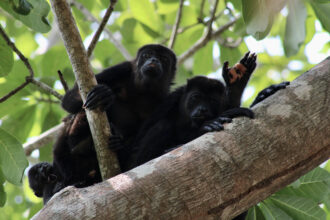
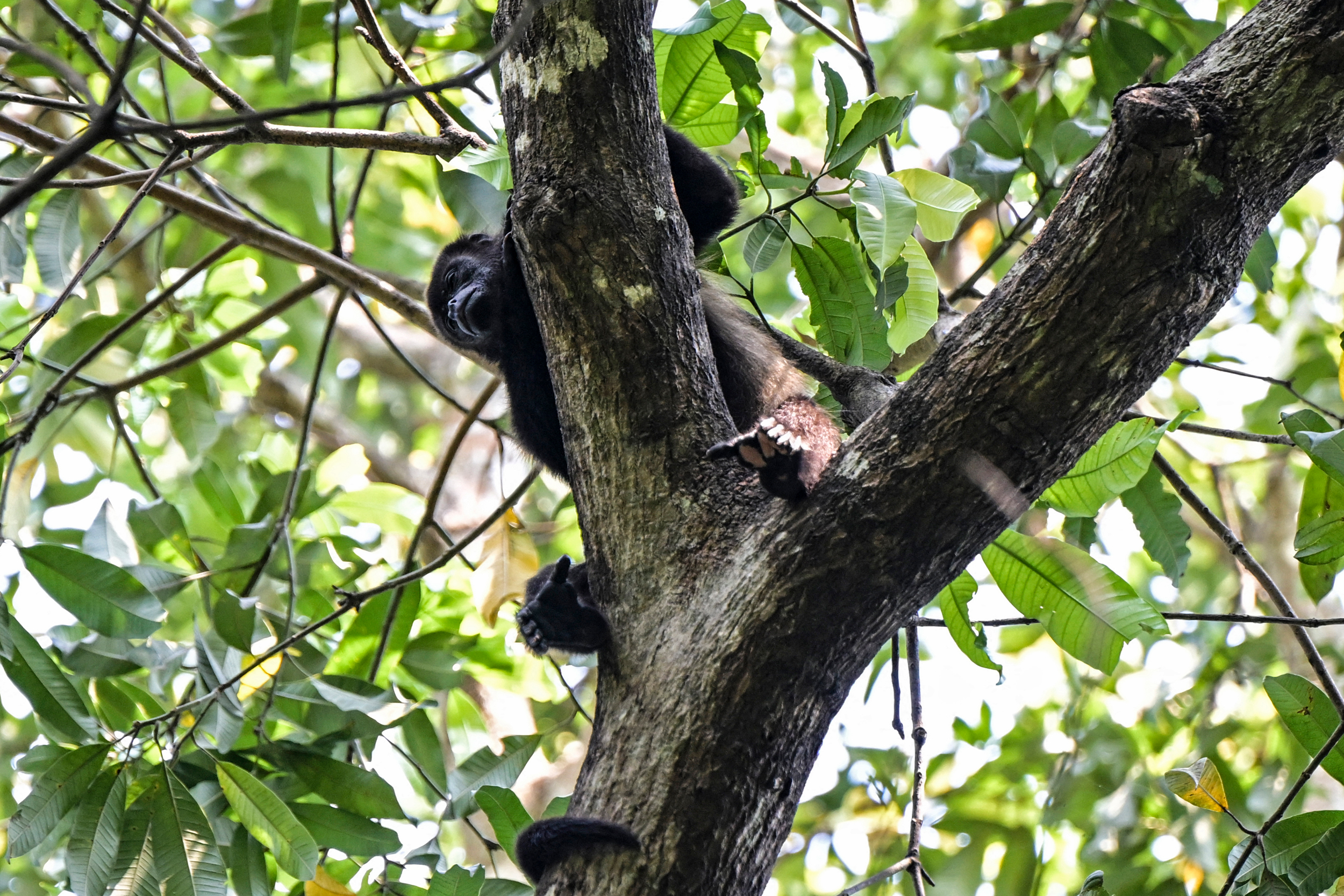


For thousands of years, Mexican howler monkeys have inhabited the lush rainforest canopy of what is now Los Tuxtlas—a 155,000-acre UNESCO biosphere reserve in the eastern state of Veracruz, 325 miles southeast of Mexico City. Every morning at around 4:30 a.m., these dark-haired primates wake up and begin their day the same way. First they howl. Then they poop.
A recent study published in the Journal of Hazardous Materials Advances analyzed the fecal matter of howler monkeys in Los Tuxtlas. The study found that more than 90 percent of collected samples were contaminated with microplastics, many of which originate from improper waste disposal in nearby human settlements.
Unlike state parks in the United States, UNESCO-designated reserves such as Los Tuxtlas are meant to be “sites that host human communities, who live from sustainable economic activities without jeopardizing the ecological value of the site.” However, the study’s findings show that human activities in Los Tuxtlas have contributed to increased plastic pollution in the reserve.
“Local communities in Los Tuxtlas handle their solid waste very poorly,” said María Fernanda Álvarez Velázquez, the study’s lead author. Individual households within and near the reserve frequently burn whatever plastic waste they produce, releasing various pollutants into the environment while turning the plastic more brittle. These smaller, more volatile plastic fragments subsequently travel by air onto the tree leaves the monkeys eat, thereby entering their bodies.
Yet local communities aren’t solely to blame: the problem is largely systemic, and large companies are at fault, too. Beginning in the 1990s, Mexican manufacturers began transitioning to plastic because other materials proved more expensive, thereby resulting in a higher amount of plastic waste. The shift in materials wasn’t properly accompanied by education campaigns teaching consumers in marginalized communities how to dispose of plastic properly, consequently enabling harmful disposal practices. “I would like to know what the Coca-Cola company has done to mitigate this situation,” said Rosamond Coates, a Veracruz-based scientist.
“Municipal leaders never paid much attention to the matter, either,” said Coates, who leads a research station in Los Tuxtlas owned by the National Autonomous University of Mexico, and who wasn’t involved in the study. Without any form of collective action, she explained, responsibility has fallen on the individuals who inhabit Los Tuxtlas, many of whom are unaware of the consequences plastic may have on the environment.
Such carelessness has affected local species such as the howler monkey, though the exact physiological consequences are not entirely clear. Álvarez Velázquez’s study is the first to investigate the presence of microplastics in Mexican howler monkeys, making it difficult to determine exactly how the health of these primates may be disrupted.
“The presence of microplastics doesn’t mean that the monkeys will die,” said Álvarez Velázquez, who is currently pursuing her doctoral studies at the Veracruz-based Ecology Institute (INECOL). But based on prior research linking microplastic ingestion with serious conditions—hormonal disruptions, chronic inflammation, and cancer, among others—howler monkeys are likely to face similar diseases. Furthermore, the presence of pollutants in monkeys suggests they must be present in other animals. “They must be inside other species that haven’t been studied as much,” said Coates.
The study’s findings are particularly serious because the Mexican howler monkey is already an endangered species. In 2024, the International Union for Conservation of Nature considered it one of the world’s 25 most endangered primates. The monkey’s dire situation is largely a result of expanding human settlements, unprecedented deforestation and rising temperatures. In the summer of 2024 alone, over 200 monkeys died from heat exhaustion, based on research by scientists at the Universidad Veracruzana.
According to Álvarez Velázquez, scientists are largely responsible for how little the inhabitants of Los Tuxtlas know about howler monkeys and their condition. “There is a big disconnect between the academy and society,” she said. “As scientists, we must dare to collaborate with illustrators, graphic designers and filmmakers. We can be of great help.”
Seeking to raise awareness, Álvarez Velázquez applied for a 2025 Rufford Foundation Grant to support the filming of a documentary about the howler monkeys she could screen at local schools. This culminated in “Aunque no vuelva a verte nunca” (“Even If I Never See You Again”), a 40-minute film co-written by Álvarez Velázquez, biologist Jorge Ramos Luna and scientist-turned-photographer Diana Rema. The documentary explains Álvarez Velázquez’s research for a general audience and recounts the recent history of Los Tuxtlas, narrating how decades-long extractivist practices by mining companies in Veracruz have decimated the reserve.
As Álvarez Velázquez has learned from screening the documentary, children and teenagers are very curious about the monkeys, but they are also very worried. When she screened the documentary at an elementary school, a student asked her where the monkeys would go once the rainforest was gone. “Sometimes you think that children are unable to think deeply about environmental issues,” she said of the experience. “But it’s quite the opposite. Among the children, there is a lot of interest, anxiety and sadness.”
The study concludes with a call to implement solid waste management programs in the area to reduce pollution and therefore protect the monkeys. “I wouldn’t like the findings of this study to be taken as something negative,” said Álvarez Velázquez, “but rather as a turning point that pushes us to enact change.”
The documentary, too, ends with a call to action by Álvarez Velázquez. “We mustn’t lose hope,” she reads from an unfolded piece of white paper. “We can and must imagine other futures. This entails building more responsible relationships that are more committed to the beings with whom we share the world. To the howler monkeys, to the forest, to the land that feeds us.”
About This Story
Perhaps you noticed: This story, like all the news we publish, is free to read. That’s because Inside Climate News is a 501c3 nonprofit organization. We do not charge a subscription fee, lock our news behind a paywall, or clutter our website with ads. We make our news on climate and the environment freely available to you and anyone who wants it.
That’s not all. We also share our news for free with scores of other media organizations around the country. Many of them can’t afford to do environmental journalism of their own. We’ve built bureaus from coast to coast to report local stories, collaborate with local newsrooms and co-publish articles so that this vital work is shared as widely as possible.
Two of us launched ICN in 2007. Six years later we earned a Pulitzer Prize for National Reporting, and now we run the oldest and largest dedicated climate newsroom in the nation. We tell the story in all its complexity. We hold polluters accountable. We expose environmental injustice. We debunk misinformation. We scrutinize solutions and inspire action.
Donations from readers like you fund every aspect of what we do. If you don’t already, will you support our ongoing work, our reporting on the biggest crisis facing our planet, and help us reach even more readers in more places?
Please take a moment to make a tax-deductible donation. Every one of them makes a difference.
Thank you,

Andrés Muedano
Outrider Fellow
Andrés Muedano is a fellow at Inside Climate News. He is originally from Mexico City and is currently a student at Harvard College. He is an organizer for the Writing for the Climate Initiative, an Editorial Board member for the Harvard Crimson, and an undergraduate fellow at the Edmond & Lily Safra Center for Ethics. Through his work, Muedano explores how science, philosophy, and literature can inform and inspire climate action.