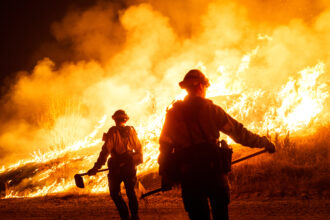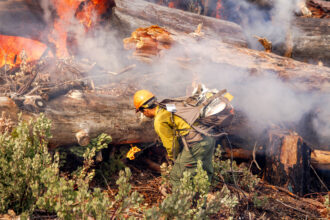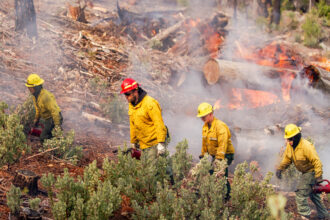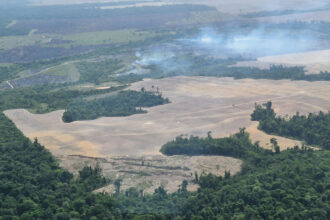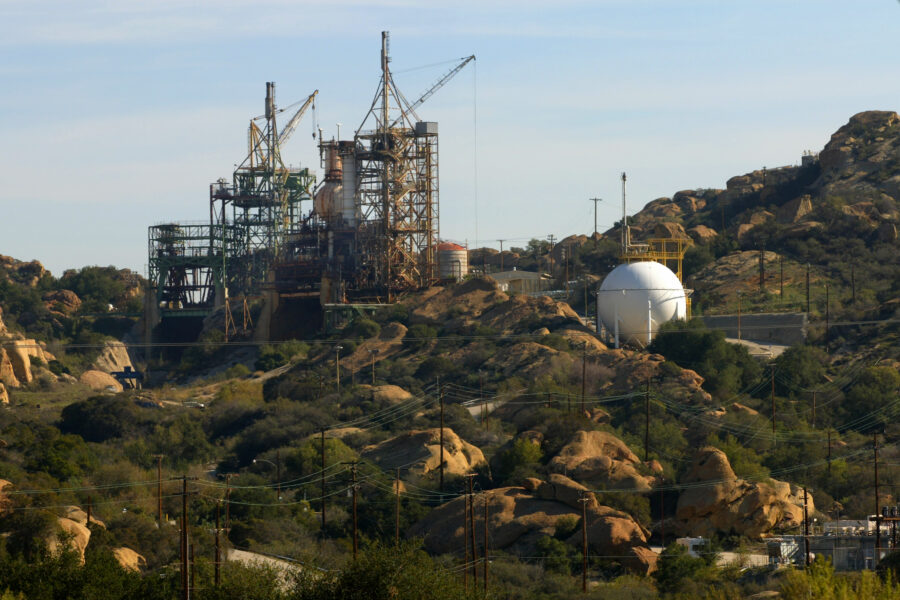
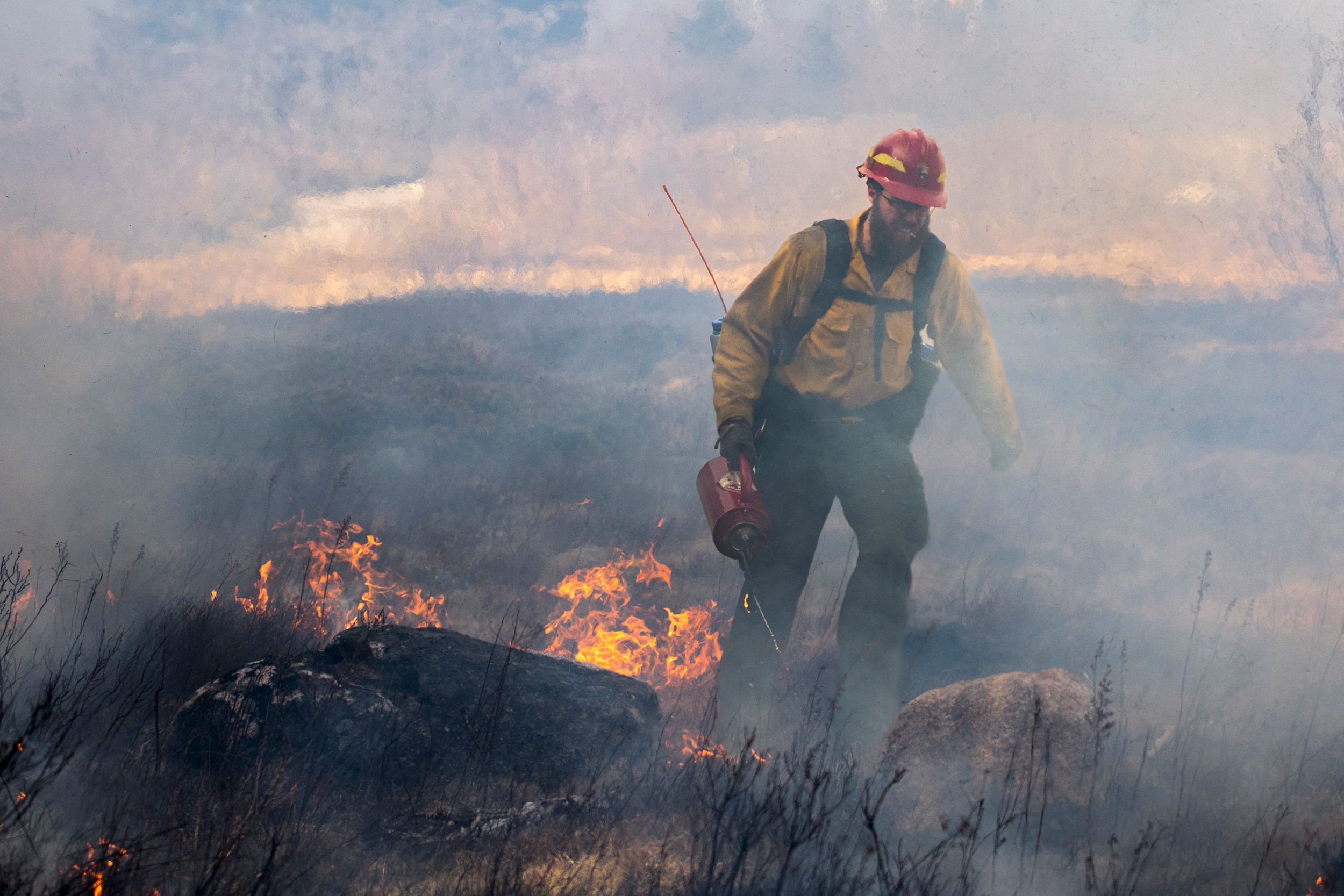


Wildfires in New England rarely make national news. The spotlight is more often on the catastrophic fires of Western states, but the Northeast’s fire season has been quietly heating up.
In 2025, severe drought quadrupled Maine’s late-summer fire activity. In 2024, another drought quintupled Connecticut’s fall wildfires, and one firefighter died while controlling a blaze. It was also Massachusetts’ most active fall fire season in 40 years.
Across the border, Nova Scotia saw its largest wildfires in recorded history in 2023, and more than 10 million acres burned in Quebec, creating a smoky haze that spread thousands of miles southward. Canadian wildfires created haze on the East Coast again this July.
“We think that the Northeast is an important place to have on the map when we’re talking about fire, and we often get ignored,” said Erin Lane, the director of the U.S. Department of Agriculture’s Northeast Climate Hub.
As forest managers and firefighters stretch their resources to respond to wildfires in a changing climate, they’re also dealing with new uncertainties from the Trump administration’s plans to radically alter the Forest Service and the new Wildland Fire Service.
New England’s Fire Landscape
Historically, New England states have been rainy enough to avoid massive, devastating wildfires. In Maine, for instance, most fires are extinguished before they surpass an acre, according to Terri Teller, a forest fire prevention specialist with the Maine Forest Service.
“We’re really fortunate here in the Northeast,” Teller said.
Regular rainfall means less dry, ready-to-spark fuel on the ground and plenty of water resources for firefighting, Teller said. Most New England wildfires are started by human activity—a campfire or burning debris, for instance—rather than lightning strikes.
“Where there are people is where we see the most fires,” Teller said, which means even small fires can put property or lives at risk.
The Northeastern Forest Fire Protection Compact, a cooperative body of five Canadian provinces, the six New England states and New York, has responded to hundreds of thousands of acres burned annually in the last few years, according to Steve Sherman, the compact’s executive director. Crews are deployed across state and national borders when local crews aren’t enough. It’s rare for the compact to need federal fire resources, he said.
“We’re constantly sharing ideas for training, fire weather forecasting or forecasting fire danger, as well as different equipment needs and uses,” Sherman said.
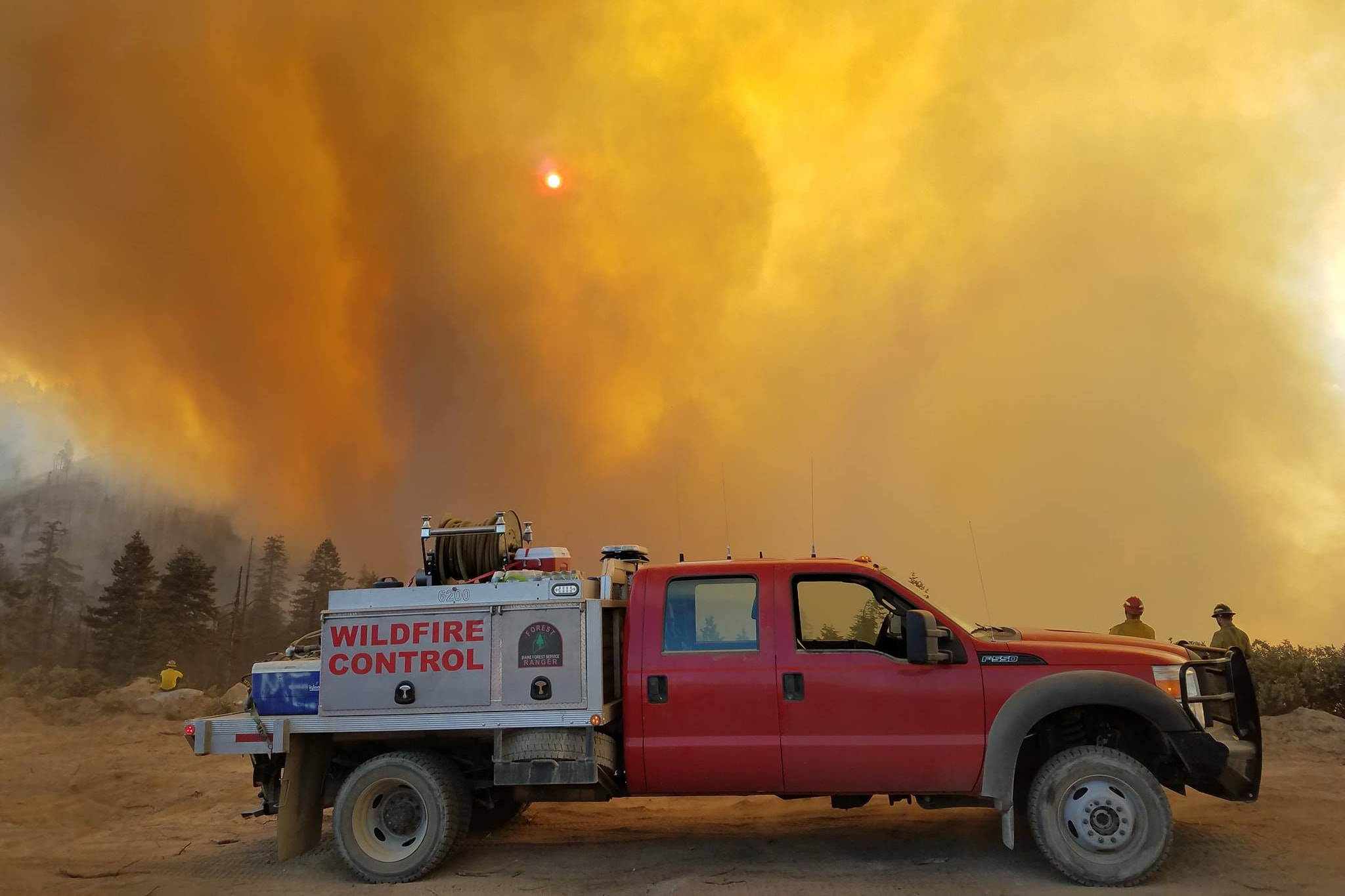
In addition to helping their immediate neighbors, firefighters from the Northeast also deploy to help crews on major fires out West, Teller said.
“Those are really great opportunities for us to learn how to manage or what goes on with some of the larger fires,” Teller said.
Taxed Resources
Temperatures in April and November, the peak fire seasons for the Northeast, are trending higher and becoming more erratic, said Lane, who has worked with the U.S. Forest Service for nearly 30 years. The warmer the temperatures, the dryer fuel sources become.
“We’re trying to adapt to these changes and this unpredictability we’re seeing,” she said.
Sherman said fire season in New England appears to be starting earlier and lasting longer. That means additional weeks of hiring seasonal and on-call firefighters and covering equipment costs.
“Any time you have a longer season, it just taxes fire resources,” Sherman said.
Though rain is abundant, Lane said the timing is critical. Short, intense storms that dump a lot of rain don’t do much to reduce fire risk if they’re followed by long dry stretches. When those dry periods turn into flash droughts, the risk of wildfire rapidly multiplies.
Last year, for instance, Teller said a rainy spring encouraged plant growth, but it was followed by an unusually dry summer that evaporated moisture reserves and left that new growth parched and ready to burn. Teller said 100-hour fuel sources—labeled by the amount of time it takes to lose all its moisture—became available, a rarity for Maine.
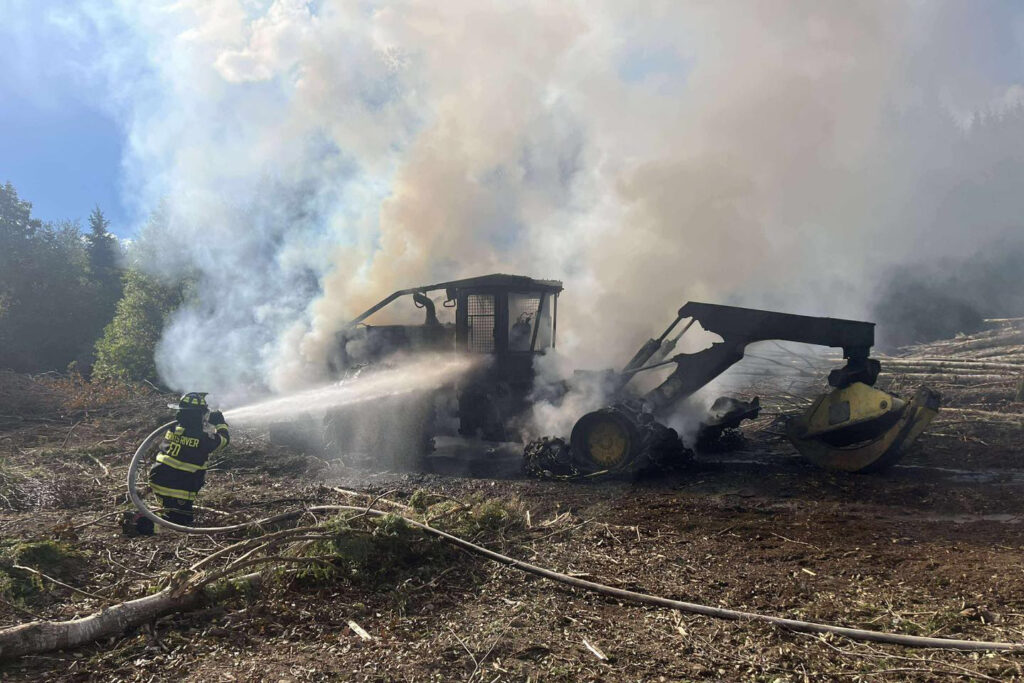
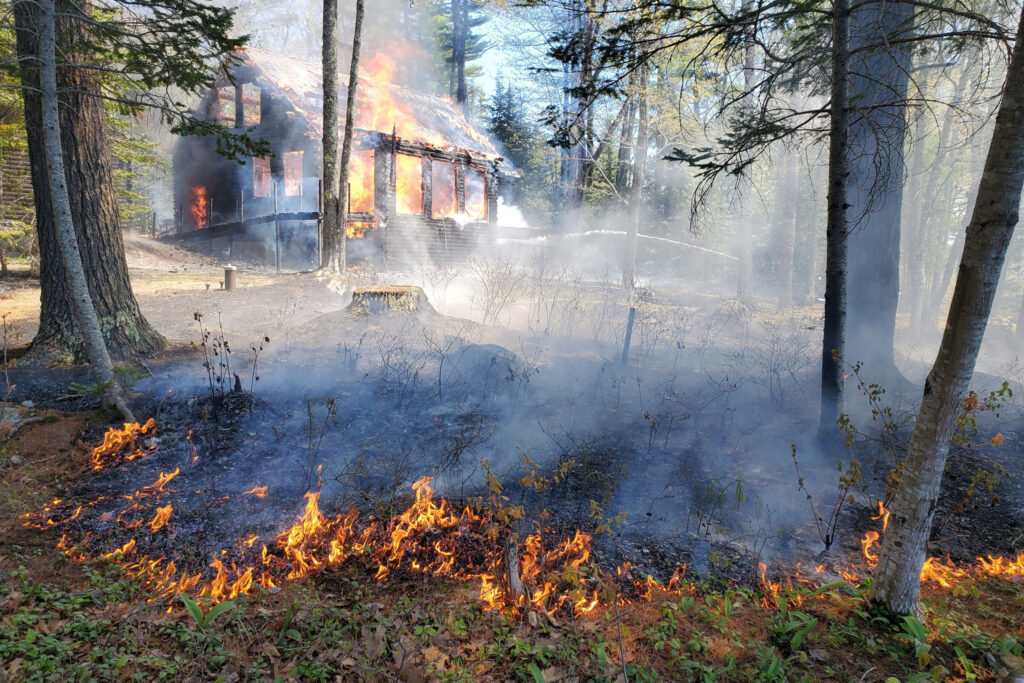
From August to October 2025, Maine’s Forest Service and local firefighters responded to 420 wildfires, Teller said, about four times higher than its 20-year average for those months.
“We were seeing fires burning deeper into the ground, which makes them a lot more difficult to fully extinguish, so it was taking more time, more water, more equipment,” she said.
The flash drought strained firefighting resources. On some of the busiest days of last summer, Teller said a couple extra wildfires in a single day might have surpassed the available manpower to respond.
“Last year, luckily, we didn’t get to that point,” Teller said.
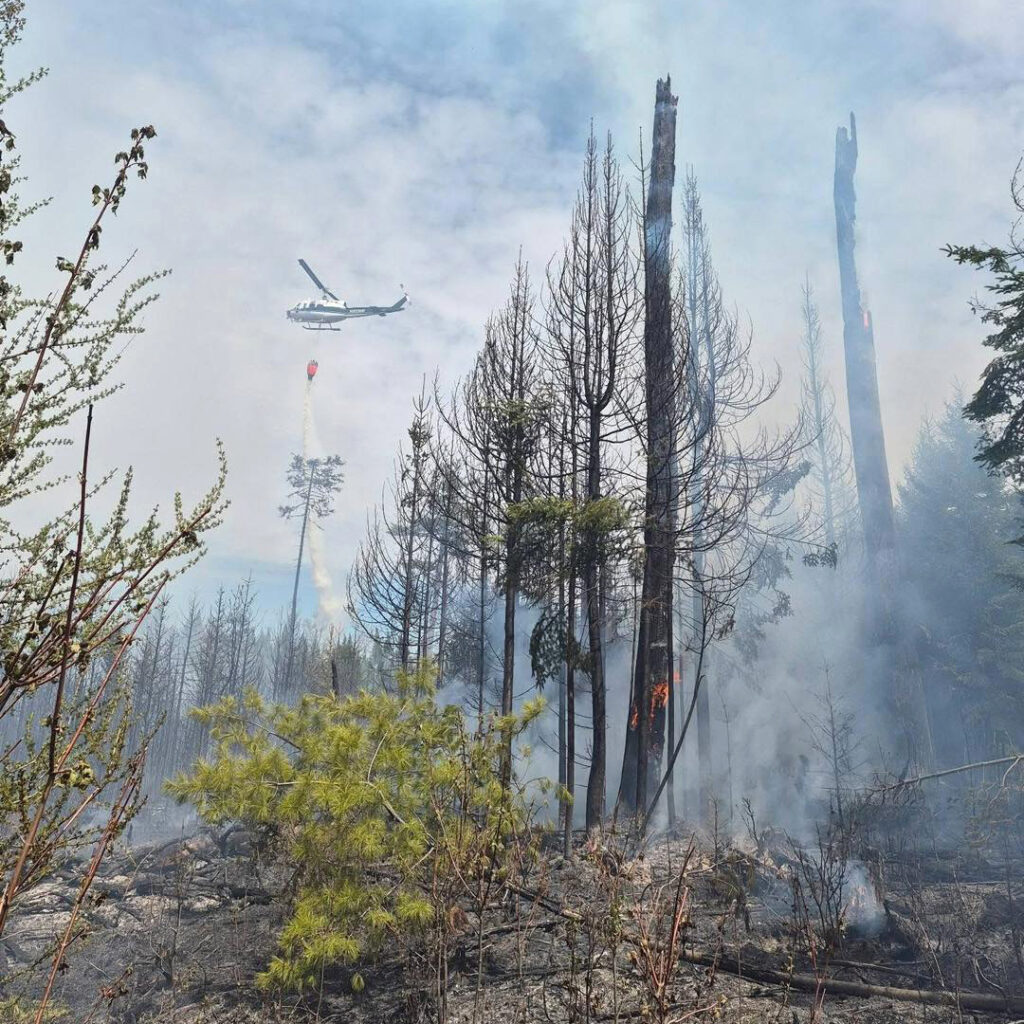
Sherman said the rest of New England and New Brunswick also saw more wildfires during the 2025 drought. Quebec set a new record in 2025 for deployments to assist other provinces and U.S. states, according to SOPFEU, the nonprofit that handles Quebec’s wildfire response. The federal Forest Service stationed one of its helicopters in New England due to fire conditions, Sherman said, which deployed once in Vermont.
“When you have fire conditions that last for month after month after month, then that just starts to cause fatigue in fire resources, as well as local fire departments, and increases the need for sharing resources,” Sherman said.
A New Federal Structure
Since the start of the second Trump administration, the federal agencies that research and respond to wildfires have been in a state of change.
In 2025, the U.S. Department of the Interior announced the creation of the Wildland Fire Service, which condenses firefighting services from multiple parts of the department into a single agency. The Wildland Fire Service officially launched at the start of 2026, despite Congress denying its $6.5 billion budget request for the year.
The Forest Service is the source of 70 percent of federal wildfire resources. But since it’s part of the U.S. Department of Agriculture, the service’s resources remain separate from the Wildland Fire Service. The Trump administration has expressed its intent to combine the two, but Congress has blocked that merger so far.
This April, the Forest Service announced plans to reorganize its regional offices and relocate its headquarters from Washington, D.C., to Utah. According to the Forest Service’s reorganization web page, its intent is to reduce bureaucracy and move leadership to Western states, which have more public land and more wildfire activity.
The Forest Service says around 500 employees will be asked to move, primarily from the current D.C. headquarters. The National Federation of Federal Employees (NFFE), however, projects that around 6,500 employees will be directly affected. About 40 percent of those people hold “red-card” qualifications to respond to wildfires when extra manpower is needed.
The reorganization will also close 57 out of 77 research stations around the country. According to the Forest Service, closing buildings would reduce maintenance costs but wouldn’t eliminate research projects or positions.
In New England, eight research stations are on the consideration list for closure. Additional closures could be announced over the next two years.
“It’s a mess. It’s sort of like throwing everything you can in a spaghetti bowl at the wall and see what sticks,” said Mariko Yamasaki, a biologist who was director of the Bartlett Experimental Forest, located in the White Mountains of New Hampshire, until she retired in 2023.
Bartlett is one of the stations on the closure list. Yamasaki added that the relative rarity of public lands in the Northeast makes the region a “blind spot” in the Forest Service’s decision-making.
Tom Schultz, the U.S. Forest Service chief, said in Congressional hearings in April that states, universities and nonprofits will be expected to take on more of the tasks that had previously been in the federal domain.
U.S. Reps. Chellie Pingree (D-Maine) and Maggie Goodlander (D-New Hampshire) are among the Congressional Democrats denouncing the plans for reorganization and the assumption that states can pick up the slack. Goodlander introduced a bill, HR 9464, at the end of June to block the closure of research facilities.
The Trump administration has also prioritized suppression of active fires over fuel removal, prescribed burns and other prevention methods. In 2025, hazardous-fuels reduction dropped by 35 percent, according to the Center for Western Priorities. Fire scientists say suppression is less effective than clearing out fuel sources before they burn.
This story is funded by readers like you.
Our nonprofit newsroom provides award-winning climate coverage free of charge and advertising. We rely on donations from readers like you to keep going. Please donate now to support our work.
Donate NowBefore the reorganization was announced, the Forest Service was already hit hard by the Department of Government Efficiency (DOGE) cuts in 2025. An estimated 11 percent of staff had left as of March 2026, including some in firefighting and emergency operations roles, according to an Inside Climate News analysis. Sherman said those changes didn’t strongly impact wildfire response in the Northeast, but other forestry programs, particularly in research and conservation, were more impacted.
“Research lost a lot of intellectual brainpower. It was no longer worth being there,” Yamasaki said.
The proposed Forest Service budget for 2027 includes a 44 percent reduction in funds for operations and total elimination of Forest and Rangeland Research’s $309 million budget. But the decline of research funding long precedes the Trump administration, said Robert Seymour, a professor emeritus of silviculture at the University of Maine.
Forestry research staffing and budgets have been dwindling for decades. According to a letter from Democratic senators to the Trump administration in February 2025, the service’s firefighting staff had declined by 45 percent in the previous four years.
“You could get sort of angry about the current administration and what they plan to do, but this starving of the Forest Service has been happening for decades. It’s nothing new,” Seymour said.
In the 1990s, Seymour said he worked with around seven staffers at Penobscot Experimental Forest’s research station, located in Orono, Maine. Today, there are two staff members listed on the experimental forest’s web page, and Seymour said other stations have no full-time employees at all.
“That’s true of most facilities around the country,” he said.
Budget and DOGE cuts have left some positions unfilled, plus a dearth of young employees to train into the next generation of agency leadership, he said.
“When you take ‘doing more with less’ over and over and over, you get to a point where there’s not a whole lot to do anything with,” Yamasaki said. “This has been coming for a while. This is not a—poof!— brand-new event.”
Despite the Forest Service’s assurances about improving efficiency and preserving research and staffing, the process has been opaque for researchers and state wildfire officials.
“The level of transparency in all of this has been really, really low, and it’s been disturbing,” Yamasaki said.
The “Workhorses” of Forestry
With the closure of research stations and the proposed deletion of the Forest Service’s research budget, the scientists who study wildfire and related forestry will be the first to feel the brunt of these changes.
Research stations on the closure list, like Bartlett, are the home of long-running studies on forest maintenance, harvesting and insect or disease management, including new invasive species. These studies help states and private land owners understand fire likelihood and how much fuel might be available to burn, Yamasaki said.
Other stations around the country share wildfire research with Northeastern firefighters through programs like the Forest Service’s North Atlantic Fire Science Exchange, so the region will feel those losses as well.
Experimental forests “have been the workhorse places to give forest practitioners the knowledge and the understanding to manage the forest conditions that they have,” Yamasaki said.
Even if a station closure doesn’t directly stop research, Yamasaki said it will become much harder. Without research facilities, she said, scientists won’t have on-site lab equipment or even basics like electricity, internet and running water, all of which will bog down their work and perhaps deter them from continuing research at the more remote sites.
“Experimental forests are not sitting next to a university campus. They’re two hours, four hours, eight hours away from the cooperators that use those locations,” Yamasaki said. “Bottom line: You’re hurting the cooperators and Forest Service people’s ability to do their job.”
Researchers who are relocated to new offices can’t readily duplicate their research in a new environment, Yamasaki said. Others may choose to leave the Forest Service or abandon their research instead.
“You can’t move studies that are 90-100 years old just anywhere else,” Yamasaki said.
Experimental forests are continuous records of forest activity and management. Some Northeastern tree species have a life cycle of more than 120 years, Yamasaki said, so we don’t yet have the complete picture of how these ecosystems change over time, especially in the face of climate change.
Seymour said it “would be a tragic end” to lose these ongoing experiments due to station closures or funding cuts.
“This is not a great situation for forestry, for forest science in the United States,” Seymour said. “A few more straws fall, the house of cards will come down.”
Widespread Uncertainty
While the research cuts concern Seymour, he said reorganizing the Forest Service for efficiency could be a positive, in theory.
“I always thought the Forest Service was a little too bureaucratic,” he said.
But how will the changes actually play out? Nobody seems to be sure.
“It’s hard to know right now what that [reorganization] would mean,” Teller said. “Not much information is out there.”
Teller agreed that more streamlined federal wildfire operations could be an improvement. She also pointed out that the Northeastern states already connect remotely with experts from other states for technical advice, so the headquarters and regional office relocations may not change much about their daily work. Time will tell, she said.
Sherman said from the information available so far, “we haven’t seen that there’s going to be a loss to the Northeast,” but future budget cuts, reduced support for state forestry, loss of institutional knowledge or the reduction of red-carded employees may create gaps in wildfire response that are hard to foresee.
“I’m not sure how that’s going to end up looking,” he said.
Yamasaki, on the other hand, believes the reorganization “has only amplified, for all to see, the lack of understanding” among leadership about what field-level employees and scientists are working on and their importance.
Teller said the Maine Forest Service will continue to turn to its fellow Northeastern Compact members as their primary resource during extreme wildfires. The Trump administration’s political tensions with Canada and tariffs haven’t impacted their cooperation across the border, in her opinion.
“We lean on our neighbors first for help within that compact,” she said.
As foresters and researchers wait to see what comes next, Sherman said the shared firefighting resources in the Northeast become even more critical.
“It actually makes the importance of the compact illustrated even more, because not any one agency can handle a prolonged wildfire season,” Sherman said. “The very nature of the compact is having that framework that allows us to operate even during a reorganization of the federal wildfire system.”
About This Story
Perhaps you noticed: This story, like all the news we publish, is free to read. That’s because Inside Climate News is a 501c3 nonprofit organization. We do not charge a subscription fee, lock our news behind a paywall, or clutter our website with ads. We make our news on climate and the environment freely available to you and anyone who wants it.
That’s not all. We also share our news for free with scores of other media organizations around the country. Many of them can’t afford to do environmental journalism of their own. We’ve built bureaus from coast to coast to report local stories, collaborate with local newsrooms and co-publish articles so that this vital work is shared as widely as possible.
Two of us launched ICN in 2007. Six years later we earned a Pulitzer Prize for National Reporting, and now we run the oldest and largest dedicated climate newsroom in the nation. We tell the story in all its complexity. We hold polluters accountable. We expose environmental injustice. We debunk misinformation. We scrutinize solutions and inspire action.
Donations from readers like you fund every aspect of what we do. If you don’t already, will you support our ongoing work, our reporting on the biggest crisis facing our planet, and help us reach even more readers in more places?
Please take a moment to make a tax-deductible donation. Every one of them makes a difference.
Thank you,

Sydney Cromwell
Contributor
Sydney Cromwell is a freelance journalist based in Maine. She has a bachelor’s in journalism and mass communication from Samford University. Sydney previously founded Southern Science, which covers environmental issues in Alabama. Her work has appeared in The New York Times and in local publications around Birmingham, Ala.