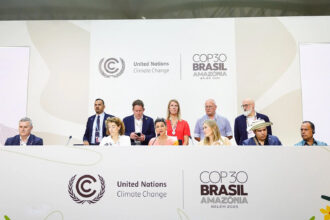


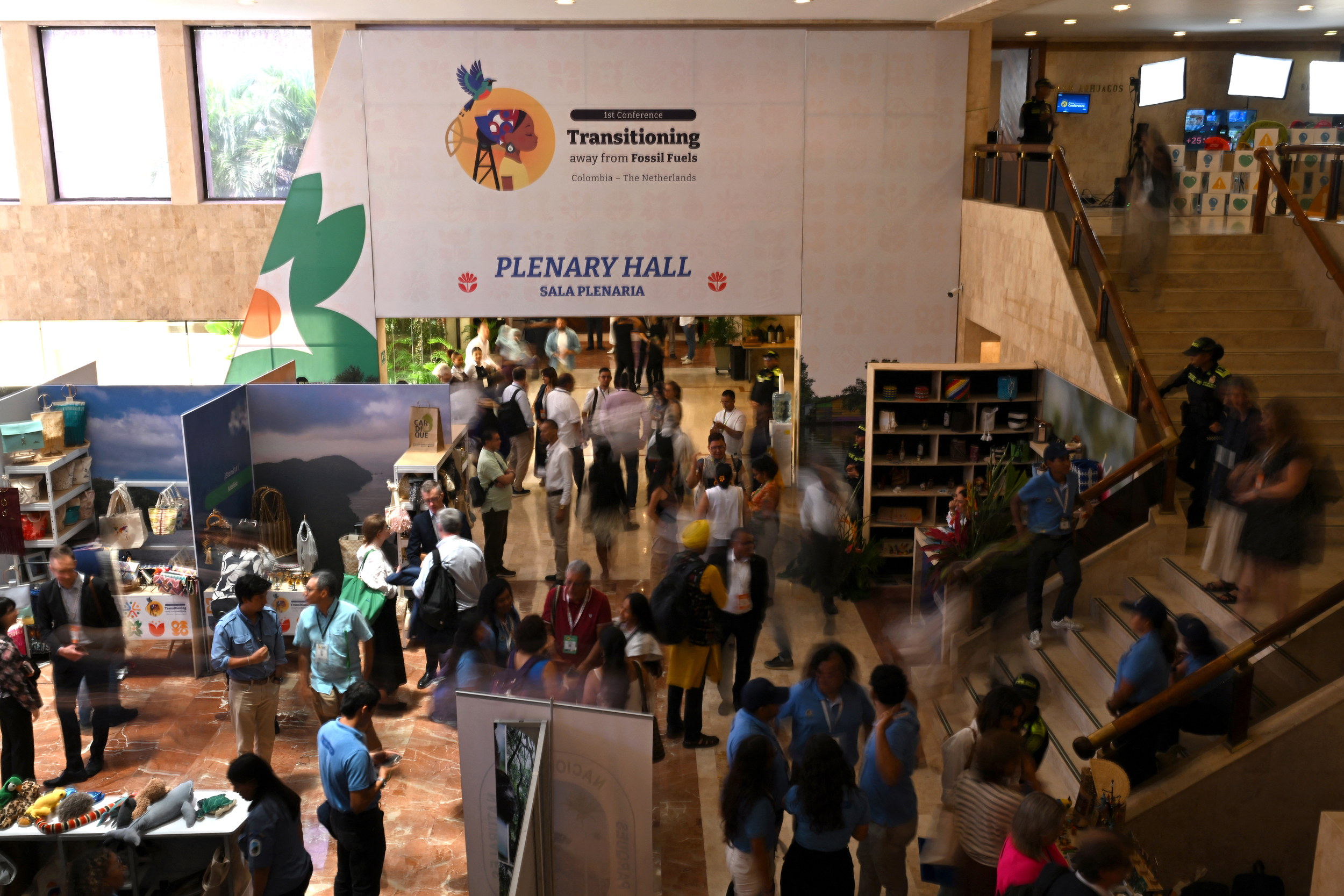
While some major fossil fuel producers keep pushing for expanded oil and gas use, which is linked to warfare, economic shocks and ecological damage, more than 50 countries at the first Conference on Transitioning Away From Fossil Fuels began developing plans to shift toward renewable energy systems designed for stability and abundance rather than scarcity and conflict.
At the end of the conference, France, where fossil fuels still power about 60 percent of the world’s seventh-largest economy, unveiled a pilot roadmap to phase out coal by 2030, oil by 2045 and gas by 2050, and to electrify sectors such as heating and transport. Colombia’s draft roadmap to largely ditch fossil fuels by 2050 emphasizes that transitioning to renewables could deliver $280 billion for the country in economic benefits.
The countries represented in Santa Marta, Colombia, generate about one-third of global economic activity. They broadly agreed to align their trade and finance policies with their transition plans, potentially creating significant economic momentum toward the faster decarbonization needed to avoid overcooking the planet with greenhouse gases.
The conference can be seen as a climate diplomacy track running parallel with the United Nations Framework Convention on Climate Change, but on a faster train with friendlier passengers, said Ralph Regenvanu, Vanuatu’s minister for climate change adaptation and a leader in efforts to accelerate climate action.
“It’s very heartening to have the Global North and the Global South in the same room, countries willing to talk about transitioning away from fossil fuels,” he said.
Participants and observers described the meeting as a space where fossil fuels themselves, and not just their emissions, were discussed as the root cause of overlapping crises, from conflict and displacement to economic instability. At past UNFCCC climate talks, those connections were often downplayed, especially in official documents.
The conference was convened by the Netherlands and Colombia during the closing days of COP30 in Belém, Brazil, late last year, as frustration grew over a small number of countries blocking any detailed discussions of phasing out fossil fuels. A follow-up meeting is set for early 2027 in Tuvalu, in the Pacific.
Organizers of the Santa Marta meeting also said the work of a special science panel associated with the conference is critical because media ecosystems are overloaded with climate and energy disinformation. Beyond policy details, discussions at the conference also revealed a shift in how energy is understood, shaped by lived experience and generational memory as much as by economics or technology.
Avoiding Past Mistakes
Until a few decades ago, coal miners were celebrated as heroes of prosperity, while kids grew up with “Put a Tiger in Your Tank” ads promising open-road freedom. Fossil fuels were synonymous with progress; many of the people now shaping energy policy came of age in that world, and the story wasn’t necessarily wrong for that time. But in a more crowded, connected world, that same system is now driving instability and climate degradation, and resisting the transition away from fossil fuels seems like longing for horse-and-buggy transport.
For the countries in Santa Marta, it’s not a question of whether to change, it’s how to change without repeating past mistakes. Veteran policy makers shared space with a younger cohort of advocates and negotiators for whom renewable energy systems are a baseline assumption, not an aspirational goal. Many are from developing countries and experience the risks of fossil fuels as immediate rather than as theoretical, and they challenge the fossil fuel industry’s misleading narrative that their products are needed to alleviate poverty.
“War right now is one of the largest contributors to the climate crisis,” said Faotu Jeng, founder of Clean Earth Gambia, a nonprofit group that has sparked environmental progress. Jeng noted that military emissions are not accurately accounted for under the Paris Agreement, which aims to limit global warming.
This story is funded by readers like you.
Our nonprofit newsroom provides award-winning climate coverage free of charge and advertising. We rely on donations from readers like you to keep going. Please donate now to support our work.
Donate NowIn the run-up to the 2015 global climate pact, highly militarized and economically powerful countries, including the United States, indicated they would veto language related to military emissions, but those numbers add up. Oil-gulping military deployments have long been intertwined with the fossil fuel economy. Outside active conflicts, researchers estimate that global militaries account for about 5 percent of global emissions, and project that rising weapons spending will threaten global climate targets.
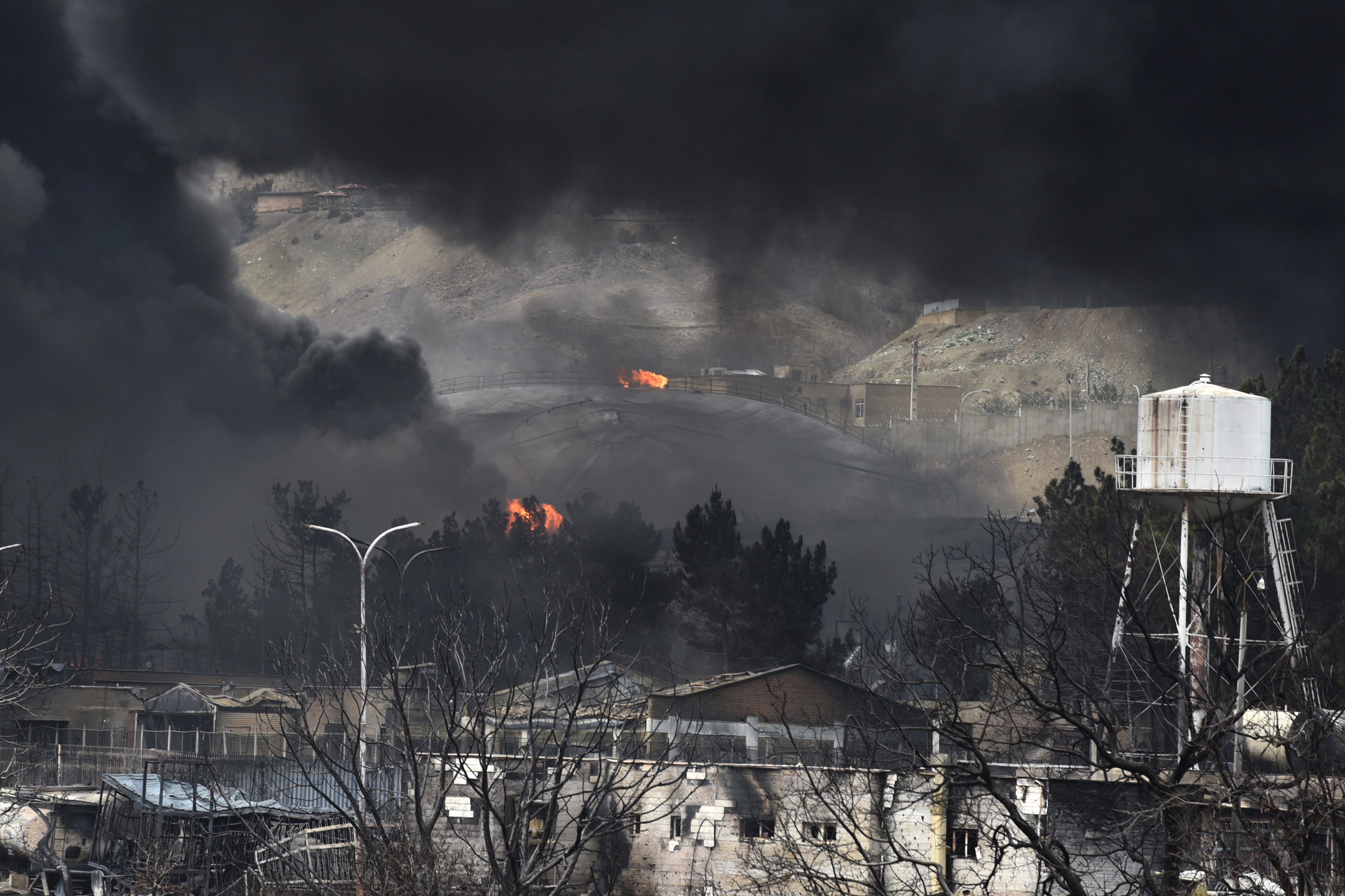
Recent conflicts have driven big emissions spikes from the mechanics of war: jet fuel, tanks, endless supply convoys, blazing oil and chemical fires, as well as homes, offices and factories, scorched forests and the carbon cost of rebuilding the shattered infrastructure if the wars ever end.
Russia’s invasion of Ukraine has generated more than 300 million tons of carbon dioxide emissions, about equal to the annual emissions of a mid-sized industrial country like Spain; the war in Gaza has resulted in about 30 million tons of emissions, equivalent to the annual emissions of smaller countries. And the U.S. and Israeli attack on Iran had a 5 million-ton carbon footprint in just the first few weeks, equal to the combined total of a dozen low-emission countries.
Participants at the Santa Marta conference focused directly on recognizing how the links between fossil fuels, conflict and instability work in the real world. Among those shaping the conversation was Somali peace and development leader Ilwad Elman, who has worked for years at the intersection of conflict, economic development and environmental stress.
During a webinar before the conference, Elman described how climate, war and economic disruption are not experienced as separate crises, but as overlapping pressures that reinforce one another in daily life. She said people live with that pressure every day, and that impacts like drought are not just environmental, but can determine whether families can stay on their farms, or are forced to move, which reshapes local economies and can intensify competition for resources.
That doesn’t allow the luxury of thinking about the impacts in an abstract way, she said.
“You don’t debate whether something is climate or conflict or economic instability,” she said. “You feel it all the same. You feel it as pressure, pressure on land, pressure on water, pressure on movements, pressure on people, and that pressure doesn’t stay contained.”
The Santa Marta discussions helped clarify that transitions are needed “out of fossil fuels, into renewable energy for all, and into a world that cares for nature,” former president of Ireland Mary Robinson said in a statement at the end of the conference.
“All must be grounded in justice,” added Robinson, a founding member of The Elders, a group of former world leaders that advocates for moral and ethical governance. Now is the time, she added, for a growing coalition of climate, justice and nature partnerships to “drive these transitions forward with the fierce urgency they demand.”
About This Story
Perhaps you noticed: This story, like all the news we publish, is free to read. That’s because Inside Climate News is a 501c3 nonprofit organization. We do not charge a subscription fee, lock our news behind a paywall, or clutter our website with ads. We make our news on climate and the environment freely available to you and anyone who wants it.
That’s not all. We also share our news for free with scores of other media organizations around the country. Many of them can’t afford to do environmental journalism of their own. We’ve built bureaus from coast to coast to report local stories, collaborate with local newsrooms and co-publish articles so that this vital work is shared as widely as possible.
Two of us launched ICN in 2007. Six years later we earned a Pulitzer Prize for National Reporting, and now we run the oldest and largest dedicated climate newsroom in the nation. We tell the story in all its complexity. We hold polluters accountable. We expose environmental injustice. We debunk misinformation. We scrutinize solutions and inspire action.
Donations from readers like you fund every aspect of what we do. If you don’t already, will you support our ongoing work, our reporting on the biggest crisis facing our planet, and help us reach even more readers in more places?
Please take a moment to make a tax-deductible donation. Every one of them makes a difference.
Thank you,

Bob Berwyn
Reporter, Austria
Bob Berwyn is an Austria-based reporter who has covered climate science and international climate policy for more than a decade. Previously, he reported on the environment, endangered species and public lands for several Colorado newspapers, and also worked as editor and assistant editor at community newspapers in the Colorado Rockies.