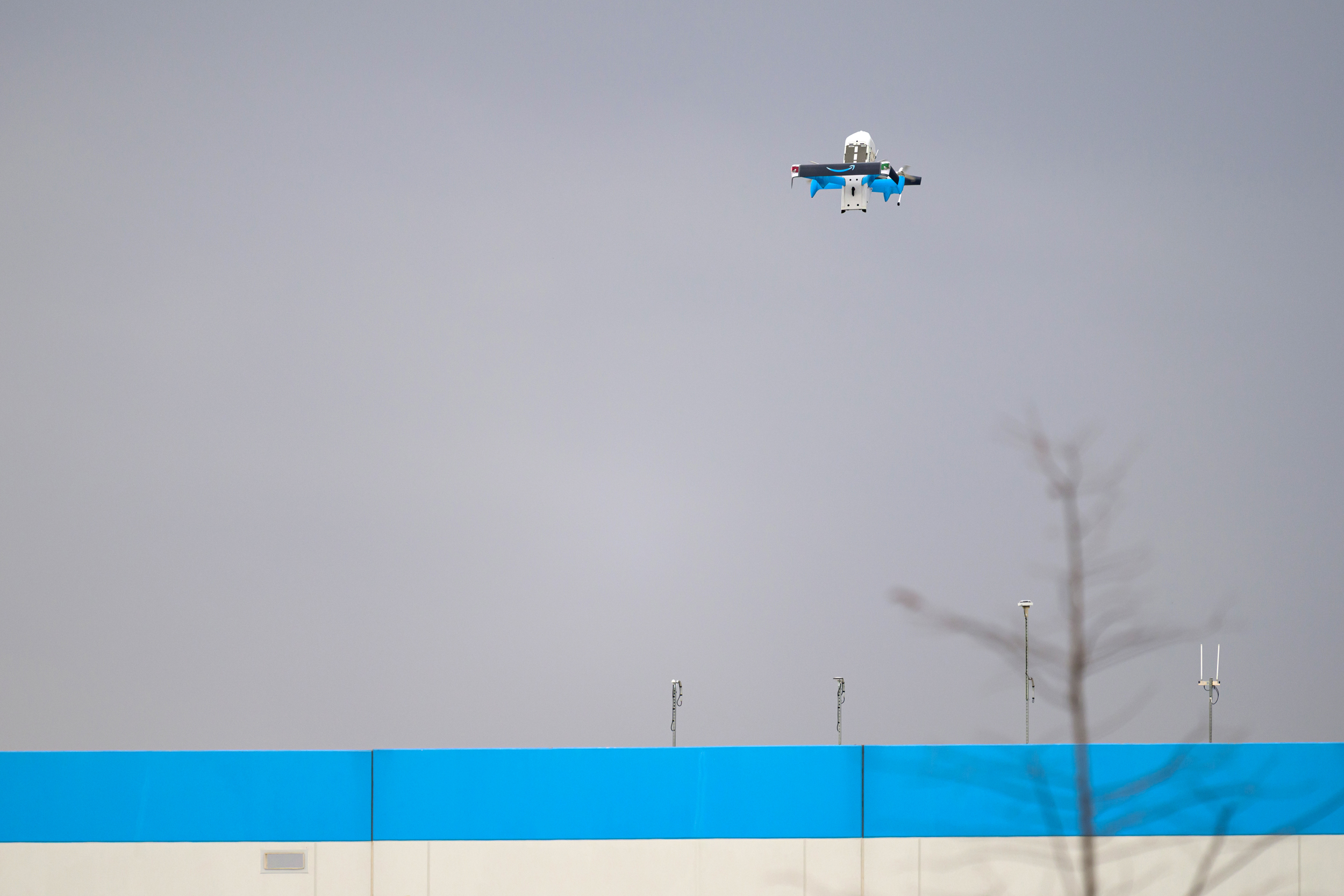


RICHARDSON, Texas—Jonathan Pace first noticed the noise. But it wasn’t until he bought a Bluetooth-based drone tracker that what seemed like a neighborhood nuisance became something he could measure: how often Amazon drones flew above his home—and how low they flew.
Pace, the chief operating officer of a software company, works from home in Richardson, a suburb north of Dallas. He chose the neighborhood for its quiet streets, single-family homes and peaceful backyards, where the loudest interruptions were lawn mowers and the occasional airplane flying overhead.
That changed when Amazon’s Prime Air delivery drones began to buzz near his home.
“There are always planes flying overhead, and they’re loud,” Pace said. “But the drone noise is higher-pitched. It’s like a mosquito buzzing near your ear. It’s frustrating.”
Companies and researchers say electric drones can make last-mile delivery cleaner, faster and safer by replacing gas- and diesel-powered vehicles that carry small packages through neighborhood streets. But the disruption in Richardson, part of the trial run for a delivery system that could spread across the United States, shows the growing tension of drone delivery and the realities of life beneath the flight path.
As the Federal Aviation Administration (FAA) prepares rules that could allow routine drone flights beyond a pilot’s visual line of sight, the question is no longer whether drones can deliver a box of coffee, medicine or toothpaste. It is whether they can do so often enough to meaningfully reduce pollution, and quietly enough that communities will accept them.
Curious about how often the drones were flying, Pace bought a drone tracker that detects signals broadcast under the FAA’s Remote ID rules. Screenshots he shared showed nearly nine drones per hour pass over his neighborhood between 10 a.m. and 4 p.m. on one January day. Some flights appeared to be as low as 135 feet, below the 150 feet Amazon told residents to expect at the time.
Amazon later said it changed flight routes and altitudes. The company first raised its minimum flight altitude in the area to 200 feet, then to 225 feet, while rerouting flights away from Pace’s neighborhood. Pace said the situation improved, though his tracker still occasionally recorded flights below the promised altitude.
Amazon said the apparent discrepancies were caused by downdraft.
“I don’t believe it,” Pace said.
For researchers, the conflict highlights a key trade-off in drone delivery: Design choices that improve efficiency can also make drones more noticeable to people on the ground.
In short, flying faster and lower can help maximize the environmental benefits of drone deliveries. But those choices can also make the aircraft louder and more disruptive, said Costa Samaras, director of the Wilton E. Scott Institute for Energy Innovation at Carnegie Mellon University.
“There are other challenges with drone delivery outside of energy and emissions,” Samaras said. “Noise, safety, interactions with other aircraft and other general quality of life issues are important factors.”
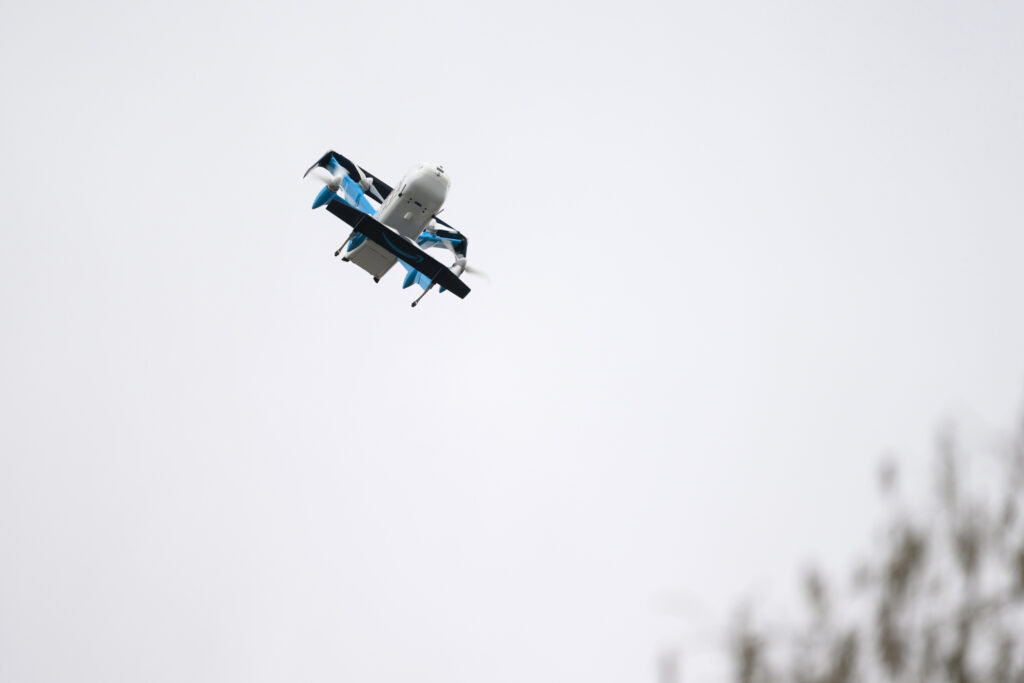
Amazon began its drone program in Richardson in December. The service quickly reached significant volume. Within three months, an Amazon representative said the site had completed more than 13,000 deliveries.
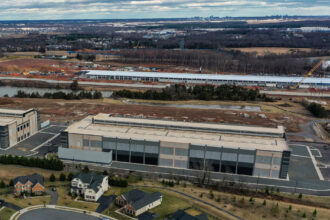
At its STX8 warehouse in January, Prime Air drones appeared to take off or land roughly every three to five minutes. That kind of frequency is exactly what worries residents. A drone every once in a while may be a novelty. A drone every five minutes can feel like infrastructure.
Pace is not alone in his concerns. Drone delivery has become a recurring topic at Richardson City Council meetings. At a March 9 meeting, Sam Bailey, a senior manager of economic development policy at Amazon, told residents that the company was already making adjustments in response to residents’ concerns.
After those meetings, Amazon raised its drones’ minimum flight altitude and rerouted them to reduce the impact on residential areas. Even at the higher altitude, the flights remain well below the 400-foot ceiling the FAA is expected to allow under the proposed regulations.
“We value the feedback of the communities where we operate and have engaged extensively with Richardson residents, city leaders, and neighborhood associations since well before launching drone delivery in this area,” said Lindsay Hamilton, an Amazon spokesperson, in a statement to Inside Climate News. “We will continue working with community members and city officials to address their questions and concerns.”
Noise is not the community’s only concern. In early February, an Amazon delivery drone crashed into an apartment building. Video showed the aircraft struggling before colliding with the building at low speed and falling onto a grassy area. Smoke rose from the roughly 80-pound drone, though no fire was visible and no injuries were reported.
Amazon resumed service the day after the accident. In an interview in March, Richardson City Manager Don Magner said Amazon did not provide the city with an incident report before resuming service. The National Transportation Safety Board did not investigate.
Magner also acknowledged that local authorities have little influence over the airspace above them.
“Because it is the FAA who controls the airspace, these drones are going to fly over our community anyway,” he said. “What we can control is whether or not to approve their building plan on our land.”
As the FAA moves toward finalizing regulations for commercial drone operations, companies including Amazon Prime Air, Wing and Zipline are racing to expand real-world testing and delivery services across the country. The market is projected to more than quadruple by 2034.
This story is funded by readers like you.
Our nonprofit newsroom provides award-winning climate coverage free of charge and advertising. We rely on donations from readers like you to keep going. Please donate now to support our work.
Donate NowThe environmental case for drone delivery is straightforward at first glance. Powered by electricity, delivery drones can reduce tailpipe emissions by replacing gas-fueled trips for small packages.
Juan Zhang of the University of Eau Claire estimated that drone delivery could reduce emissions by up to 90 percent and transportation costs by roughly 40 percent when compared to truck-only transportation.
But researchers say the full climate impact depends heavily on how the system is designed, what trips drones replace and how often they fly. Trucks and vans can deliver tens or even hundreds of parcels along a route, while most delivery drones carry one item at a time. If trucks are electric, the emissions advantage of drones can shrink further.
“For overnight, same-day or two-day delivery, you will see the truck half empty,” said Zhang, an assistant professor of operations and supply chain management. “If customers are willing to wait, like to accumulate their deliveries within a week, I would say trucks are probably better than drones.
“But that’s not always the case,” she added.
Carnegie Mellon’s Samaras made a similar point. Drone delivery may not make sense for every household order, but it could make sense when it replaces a separate car trip, like buying specific dinner ingredients, even if that car is electric. That is a common use for drone delivery in the Dallas area.
Location can also matter. While vans and trucks may make sense in high-density delivery areas, drones can provide good benefits for overall energy consumption in more spread-out areas. “Drones can go much faster because they can go in a straight line and not have to wait in the traffic lights,” said Thiago Rodrigues, a University of Toronto researcher whose doctoral work focused on assessing the energy consumption and greenhouse gas emissions of autonomous delivery robots.
Researchers, including Samaras’ team at Carnegie Mellon, are also studying ways to make drone delivery more efficient by pairing drones with other transportation systems. One possibility is to use trucks, vans or even public buses as mobile drone carriers and charging platforms.
The challenge now is how to balance the efficiency of delivery by air with the disruption felt on the ground.
About This Story
Perhaps you noticed: This story, like all the news we publish, is free to read. That’s because Inside Climate News is a 501c3 nonprofit organization. We do not charge a subscription fee, lock our news behind a paywall, or clutter our website with ads. We make our news on climate and the environment freely available to you and anyone who wants it.
That’s not all. We also share our news for free with scores of other media organizations around the country. Many of them can’t afford to do environmental journalism of their own. We’ve built bureaus from coast to coast to report local stories, collaborate with local newsrooms and co-publish articles so that this vital work is shared as widely as possible.
Two of us launched ICN in 2007. Six years later we earned a Pulitzer Prize for National Reporting, and now we run the oldest and largest dedicated climate newsroom in the nation. We tell the story in all its complexity. We hold polluters accountable. We expose environmental injustice. We debunk misinformation. We scrutinize solutions and inspire action.
Donations from readers like you fund every aspect of what we do. If you don’t already, will you support our ongoing work, our reporting on the biggest crisis facing our planet, and help us reach even more readers in more places?
Please take a moment to make a tax-deductible donation. Every one of them makes a difference.
Thank you,

Andrew Liu
Fellow
Andrew Liu is an Outrider fellow at Inside Climate News and a journalist covering climate, business and technology. Born and raised in China, he spent more than 20 years living and working in Singapore before moving to the United States. He holds degrees from Columbia Journalism School and Singapore Management University. Before focusing on climate and business reporting, Liu spent more than a decade as a sports reporter for Singapore’s Lianhe Zaobao, a leading Chinese-language daily newspaper. His reporting took him across Southeast Asia, China and Brazil.