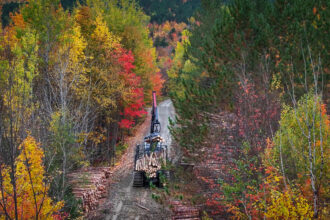


A new satellite tracking system finds that the United States has lost 350,000 acres of forest land per year—a rate of approximately one football field every two minutes—which is the equivalent of 2.3 billion metric tons of carbon dioxide emissions through the release of stored CO2 in the forests and lost potential carbon storage.
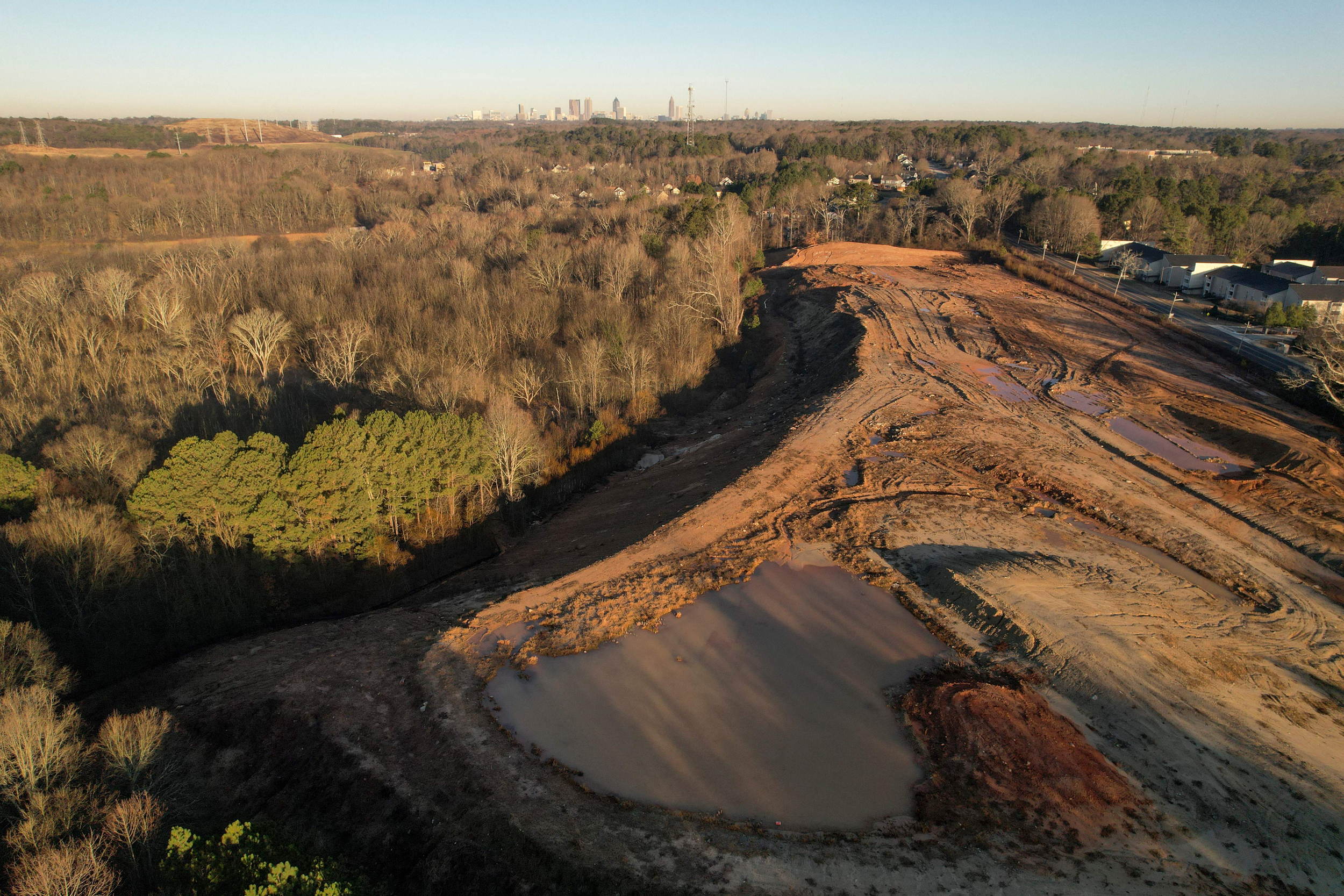
Researchers at Clark University in Massachusetts announced the initial findings of the U.S. Forest Monitor tool Thursday, tracking “persistent” forest loss in the lower 48 states and showing 9.8 million acres of forest land was lost to development or agriculture from 1990 to 2017.
Lead author Christopher Williams said the tool establishes an important historical baseline for tracking land use changes across the country and shows the need for more consistent monitoring of forest loss nationwide.
“When we think about forest loss and conversion, our minds often go to the Amazon or other tropical locations,” Williams said in an interview with Inside Climate News. “What this study shows is that forest loss is something that’s happening in the United States as well, and in our own backyards, and that it deserves our attention.”
The tool relies on land cover time-series imaging from the U.S. Geological Survey, identifying land that was previously forest but had been used for development or agriculture for at least five years. Williams said the researchers focused on those two segments because the resulting forest loss is often permanent and won’t revert back to forest for decades, if ever.
“It’s very rare, I would say, for us to see from the land cover dataset that a pixel goes from forest to development and then back to forest, or from forest to cropland and back to forest,” Williams said. “That’s unusual, but we just wanted to be really careful.”
Williams said the researchers are working to update the findings and hope to publish data through 2024 within the next year or so.
The monitor is funded and maintained by the Forest Carbon Data Partnership, a collaboration of conservation and academic organizations including the Open Space Institute, The Nature Conservancy, American Forests, the Trust for Public Land, the Land Trust Alliance and Clark University.
Williams said roughly half of the documented forest loss was for development and half was for cropland, a surprise to some of the researchers.
“I think at least some of our colleagues had expected most of it would be for development, you know, subdivisions and urban expansion and so forth,” Williams said. “But we actually still are converting a lot of our forest land to croplands.”
The report finds forest loss has been particularly dramatic in the Southeast.
The 11 states showing the most forest loss—Georgia, Texas, North Carolina, Florida, Arkansas, Alabama, Virginia, Mississippi, Missouri, South Carolina and Tennessee—accounted for approximately 70 percent of the total losses, but in different ways.
In Alabama, the sixth state in terms of forest loss, 79 percent of the forest lost was converted to cropland, while development accounted for 21 percent.
In Texas and South Carolina, nearly 60 percent of identified forest loss was for development.
Georgia was the most heavily deforested state, according to the report, both by total loss (almost 1.2 million acres) and percentage of total forest lost (4.4 percent) during the study period.
The 9.8 million acres lost nationwide represents about 2 percent of the total U.S. forestland over 28 years.
About This Story
Perhaps you noticed: This story, like all the news we publish, is free to read. That’s because Inside Climate News is a 501c3 nonprofit organization. We do not charge a subscription fee, lock our news behind a paywall, or clutter our website with ads. We make our news on climate and the environment freely available to you and anyone who wants it.
That’s not all. We also share our news for free with scores of other media organizations around the country. Many of them can’t afford to do environmental journalism of their own. We’ve built bureaus from coast to coast to report local stories, collaborate with local newsrooms and co-publish articles so that this vital work is shared as widely as possible.
Two of us launched ICN in 2007. Six years later we earned a Pulitzer Prize for National Reporting, and now we run the oldest and largest dedicated climate newsroom in the nation. We tell the story in all its complexity. We hold polluters accountable. We expose environmental injustice. We debunk misinformation. We scrutinize solutions and inspire action.
Donations from readers like you fund every aspect of what we do. If you don’t already, will you support our ongoing work, our reporting on the biggest crisis facing our planet, and help us reach even more readers in more places?
Please take a moment to make a tax-deductible donation. Every one of them makes a difference.
Thank you,

Dennis Pillion
Reporter, Alabama
Dennis Pillion is a reporter for Inside Climate News based in Alabama. He joined ICN in 2024 after 17 years working for Alabama Media Group, including nine as the statewide natural resources reporter. His work for AL.com and The Birmingham News, won numerous Green Eyeshade and Alabama Press Association awards for his coverage of environmental issues in Alabama. He was born and lives in Birmingham, Ala.