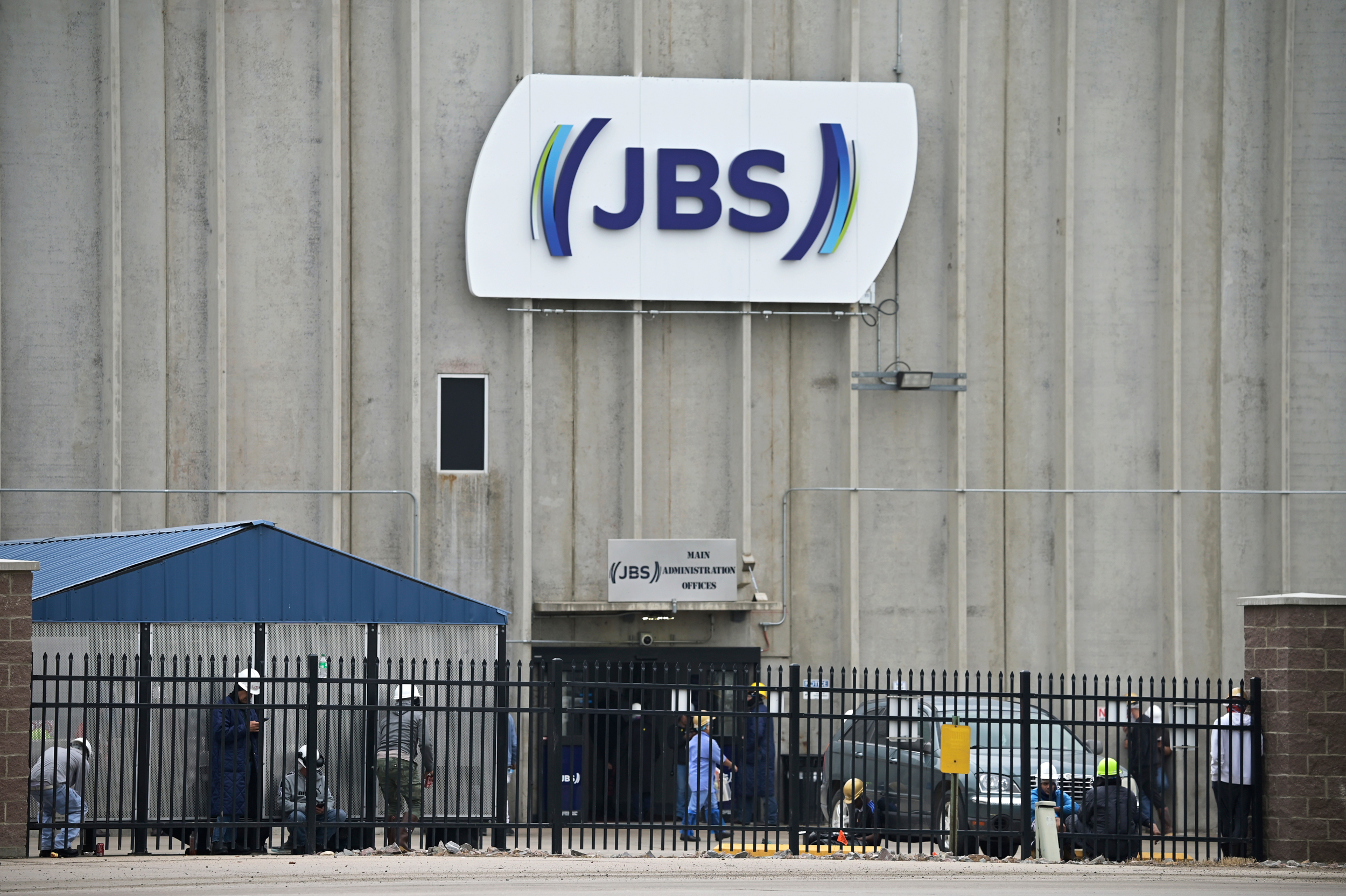


Five years ago, the world’s largest meat company took out a full-page ad in The New York Times, making a bold claim: “Bacon, chicken wings, and steak with net zero emissions. It’s possible.”
But according to new research, that assertion by JBS and hundreds of other promises made by meat industry giants amount to hollow attempts to woo consumers and investors with unsubstantiated claims.
A study, published in PLOS Climate on Wednesday, analyzed more than 1,200 claims in which the meat industry announced its intentions to reduce greenhouse gas emissions or reach carbon neutrality in its operations. The authors categorize 98 percent of those claims as greenwashing.
“We’re at this moment where we’re really trying to understand what is a real commitment to saving our planet and what is public relations,” said Jennifer Jacquet, one of the report’s authors. “And a lot of this is public relations.”
The livestock industry is aware it has a PR problem. Animal agriculture accounts for at least 16.5 percent total global greenhouse gas emissions, a figure that has prompted researchers and climate policy experts to recommend reducing meat consumption, especially in developed countries, where people eat disproportionately more meat and dairy products.
Research has found that it will be impossible to reach global emission reduction targets—even if radical cuts are made to fossil fuels—without major cuts to global livestock consumption.
Nutrition guidance in many countries has advised eating less meat for both dietary and environmental reasons, though attempts to issue such guidance in the United States—the world’s biggest beef consumer and, historically, its biggest producer—have failed.
Jacquet, a professor of environmental science and policy at the University of Miami, has for years studied the industry’s attempts to influence policy and public opinion. In a 2021 study, she and her colleagues found that the meat industry spent millions of dollars downplaying the role of livestock agriculture in heating the atmosphere. That study also found that only five of the world’s 35 largest animal agriculture companies had made commitments to reaching net-zero in their supply chains.
In the following years, more livestock agriculture companies began making a range of climate-related claims, saying they would reduce emissions and achieve net-zero. JBS, for one, made an abrupt reversal. The company said in 2019 that it bore no responsibility for greenhouse gas emissions in its supply chains. Two years later, it began making bold promises, saying it would achieve net-zero emissions by 2040.
That claim eventually drew legal attention. In 2024, New York Attorney General Letitia James filed a lawsuit accusing the U.S. division of JBS of misleading the public, saying the company’s plans to ramp up production were incompatible with its climate promises.
“When companies falsely advertise their commitment to sustainability, they are misleading consumers and endangering our planet,” James said in a press release at the time. “JBS USA’s greenwashing exploits the pocketbooks of everyday Americans and the promise of a healthy planet for future generations.”
The company reached a settlement in November of last year and agreed to pay $1.1 million that would be directed to New York farmers to implement agricultural practices that reduce emissions.
JBS did not respond to a request for comment from Inside Climate News.
This story is funded by readers like you.
Our nonprofit newsroom provides award-winning climate coverage free of charge and advertising. We rely on donations from readers like you to keep going. Please donate now to support our work.
Donate NowThe JBS lawsuit prompted Jacquet and her colleagues to analyze other livestock agriculture companies’ claims to see how they differ in both their ambition and planning. Looking at the same dataset as the 2021 study, they found that 17 of the companies have since made net-zero pledges. (The original study looked at 35 companies; this one considered only 33, because one, Dean Foods, was acquired by Dairy Farmers of America, and another, Wens Foodstuff Group, did not have a sustainability report available in English.)
“Like JBS, none of these companies provide a clear pathway on how they’re going to achieve those pledges,” Jacquet said. Only one company, Nestlé, made any financial commitment toward climate-related measures, investing roughly $4 billion, she noted. For the rest, she added, “that shows you that they’re not putting their money where their mouth is.”
The research team looked at the companies’ websites and annual sustainability reports, finding 1,233 environmental and climate-related claims. They found that the companies only provided supporting evidence for 356 of these claims and scholarly research to support only five of them.
Then, using an empirical greenwashing assessment framework, they determined that 98 percent could be deemed greenwashing.
The authors pointed out that some companies have net-zero targets but have only made relatively minor improvements, including reducing idling time for trucks and paper usage at single facilities in their operations, or improved animal breeding to develop animals that use resources more efficiently. Several said they intend to use methane-reducing feed.
“They make many promises and provide very little supporting evidence,” the study concludes. “Like the fossil fuel industry, which has used greenwashing over the last several decades to delay meaningful climate action, the meat and dairy industry may be misleading consumers and investors regarding whether and to what extent they are addressing environmental impacts, including climate change, with even less time to spare.”
The conclusion aligns with Jacquet’s recent research that found the animal agriculture industry, like the fossil fuel industry, knew of its climate impact long before acknowledging it publicly. And like the fossil fuel industry, it too strategized to discredit climate-related concerns over its product.
About This Story
Perhaps you noticed: This story, like all the news we publish, is free to read. That’s because Inside Climate News is a 501c3 nonprofit organization. We do not charge a subscription fee, lock our news behind a paywall, or clutter our website with ads. We make our news on climate and the environment freely available to you and anyone who wants it.
That’s not all. We also share our news for free with scores of other media organizations around the country. Many of them can’t afford to do environmental journalism of their own. We’ve built bureaus from coast to coast to report local stories, collaborate with local newsrooms and co-publish articles so that this vital work is shared as widely as possible.
Two of us launched ICN in 2007. Six years later we earned a Pulitzer Prize for National Reporting, and now we run the oldest and largest dedicated climate newsroom in the nation. We tell the story in all its complexity. We hold polluters accountable. We expose environmental injustice. We debunk misinformation. We scrutinize solutions and inspire action.
Donations from readers like you fund every aspect of what we do. If you don’t already, will you support our ongoing work, our reporting on the biggest crisis facing our planet, and help us reach even more readers in more places?
Please take a moment to make a tax-deductible donation. Every one of them makes a difference.
Thank you,